
A jury needs to see every link from the trucking company's choice to your family's losses, and one gap can sink the case.
What chain does the case have to prove?
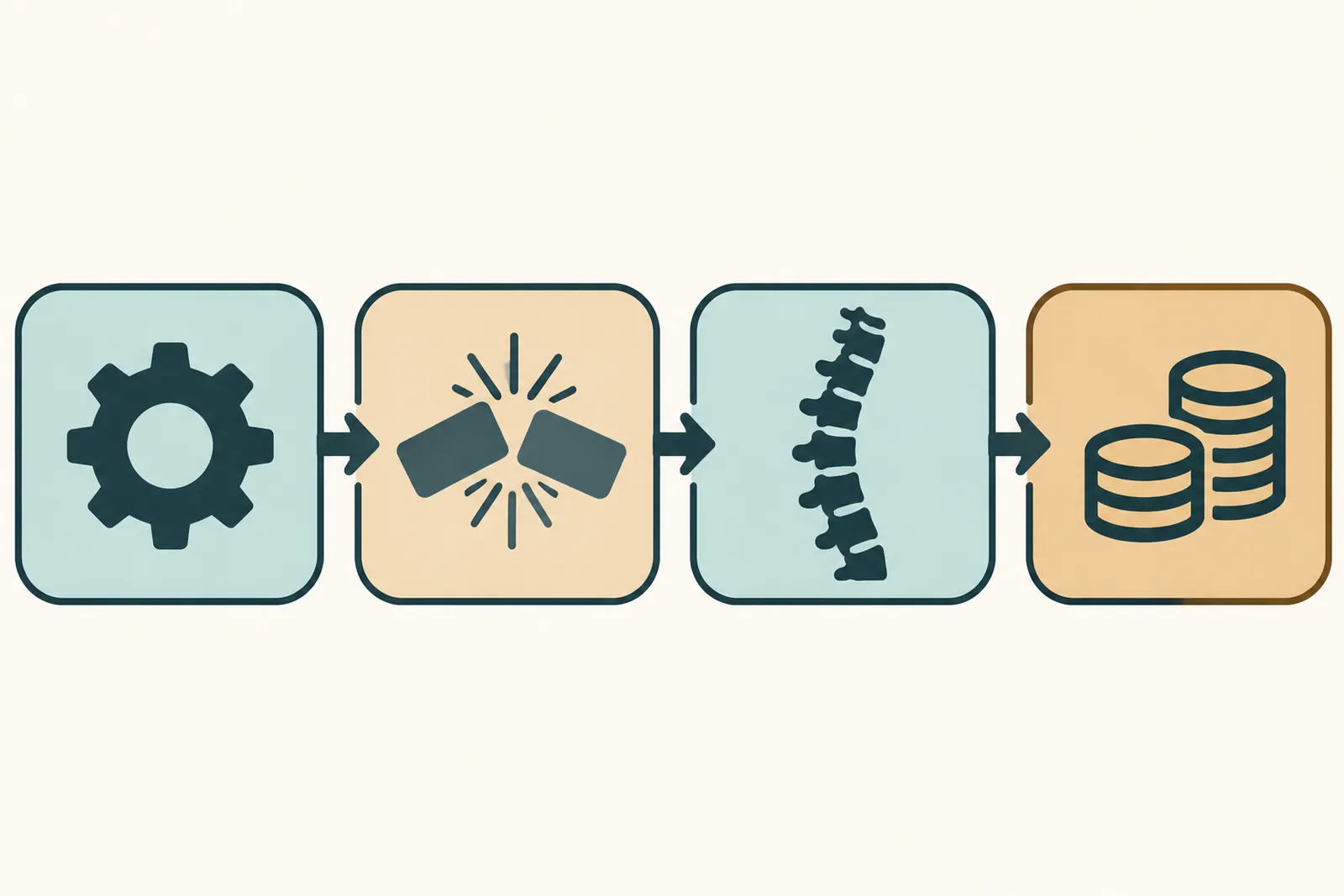
Hypothetical: Ray is a 38-year-old electrician. At 7:15 one morning a tractor-trailer runs a red light in Irving and hits his pickup broadside. He's left with an incomplete spinal cord injury. His case has four links, and a juror will ask one question about each.
| Link | The question a juror asks | Typical proof |
|---|---|---|
| Safety failure. | What did the driver or carrier do wrong? | Driver files, hours data, maintenance, and dispatch records. |
| Crash mechanics. | How did that failure produce this collision? | Scene measurements, vehicle data, and reconstruction. |
| Medical causation. | Did the crash cause this injury? | Treating physicians and imaging, before and after. |
| Damages. | What has it cost, and what will it cost? | Bills actually paid, a life-care plan, wage and vocational analysis. |
Short answer: Every link needs its own evidence. A trial theme like "the light was red and he knew it" helps a jury follow the proof, but it can't fill a link nobody proved.
The defense will look for gaps in Ray's story. He had a herniated disc treated two years before, so they'll say the crash only aggravated it. He went seven weeks without therapy after leaving the hospital, so they'll say he was getting better on his own. And the signal timing is disputed, so they'll say he pulled into the intersection late.
Do the experts work from the same facts?
In Ray's case, five experts could testify. Each one stays in a lane.
| Expert | Covers | Leaves to someone else |
|---|---|---|
| Reconstructionist. | Speed and position at impact. | Any diagnosis. |
| Biomechanical engineer. | Forces on Ray's body. | Whether this injury came from them. |
| Spine surgeon. | Diagnosis and medical causation. | Pricing future care. |
| Life-care planner. | Future services and their cost. | Present-value math. |
| Economist. | Lost wages in present value. | Which care is medically needed. |
Before anyone writes a report, they all get one master chronology, with a source for each entry and every estimate or disputed point marked. In Ray's file, that review caught two problems. The reconstruction put the truck at 44 mph at impact while the biomechanical report used 38, so both authors had to reconcile the number in writing. And home attendant care appeared in both the life-care plan and the economist's household-services loss, so it was counted once.
What makes an expert's opinion admissible in Texas?
Tex. R. Evid. 702 lets a witness qualified by knowledge, skill, experience, training, or education give an opinion if it helps the jury. Under Rules 703 and 705(c), experts can rely on data others in the field reasonably use, but the opinion is inadmissible if its underlying facts don't give it a sufficient basis.
Helena Chemical Co. v. Cox shows what a causation gap looks like. Cotton farmers in Mitchell County blamed an herbicide that two planes sprayed over the Spade Ranch in July 2015 for poor yields on more than 14,000 acres. Their fields sat between 1.8 and 25 miles from the spraying. A state inspector did only a visual check, and no lab ever tested for the herbicide's ingredients. On March 3, 2023, the Texas Supreme Court held that the evidence didn't raise a genuine fact issue on causation and reinstated summary judgment for Helena. The Court measured the expert proof against E.I. du Pont de Nemours & Co. v. Robinson, 923 S.W.2d 549 (Tex. 1995), which requires scientific opinions to rest on the methods of science, and Gammill v. Jack Williams Chevrolet, Inc., 972 S.W.2d 713 (Tex. 1998), which bars opinions with too great an analytical gap between the data and the conclusion.
Ray's experts can't leave a gap like that between the impact and his spine.
How do you prove medical bills and future care?
The leading paid-or-incurred case started in a grocery store parking lot. Aaron Haygood's car hit a minivan pulling out of the lot, and he needed neck and shoulder surgery. His providers billed $110,069.12, but because he was on Medicare they credited $82,329.69, leaving $27,739.43. The jury awarded the full $110,069.12 anyway. In Haygood v. De Escabedo, 356 S.W.3d 390 (Tex. 2011), the Texas Supreme Court held that § 41.0105 limits recovery to amounts actually paid or incurred, and that only evidence of recoverable medical expenses is admissible at trial. So Ray needs payment and adjustment records, not just the bills.
Future care works differently. Gunn v. McCoy, No. 16-0125 (Tex. June 15, 2018), treats future medical costs as a matter of reasonable probability, not certainty. So Ray needs evidence that each kind of care will likely be needed and what it reasonably costs.
His lawyer should test the life-care plan one service at a time, and keep every earlier version with the reason it changed. Take a single line, like six physical therapy visits a month for 20 years. Which doctor recommended it, and where's that in the chart? Is the price from a named local provider? Does it depend on a complication Ray doesn't have yet? If so, it should be labeled contingent. Our posts on Texas life care plans and proving lost earnings and earning capacity cover these pieces in depth.
How do you show what changed in daily life?
Ray's crew lead worked ladders with him for six years and can say what he can't do now. His wife coached Saturday baseball with him and can describe practice before and after.
How do fault rules and HB 19 shape the trial?
Five provisions decide how fault and the truck rules reach the jury.
| Provision | What it does |
|---|---|
| § 33.001 | A claimant more than 50 percent responsible recovers nothing. |
| § 33.003 | The jury assigns a percentage to each claimant, defendant, settling person, and designated responsible third party. |
| § 72.052 | On a timely motion, exemplary damages move to a second phase. |
| § 72.054 | If the carrier stipulates the driver was its employee acting in the scope of employment, claims like negligent entrustment generally wait for phase two, with listed exceptions. |
| § 72.055 | An authenticated photo or video of a vehicle in the crash is presumed admissible, with no expert needed except to authenticate it. |
If the jury believed Ray entered on a stale yellow, his share would come off the top.
Read more on Texas HB 19 and commercial truck lawsuits.
How should discovery feed the trial map?
Tex. R. Civ. P. 192.3 lets discovery reach unprivileged matters relevant to the subject of the suit. Rule 192.4 tells the court to limit discovery that's unreasonably cumulative or whose burden outweighs its likely benefit. A request for electronic data has to say so and name the form you want under Rule 196.4. A company deposition notice must describe its topics with reasonable particularity under Rule 199.2(b)(1).
What to do now: Ask for the dispatcher's texts from the 48 hours before the crash, from one custodian, tied to the red-light issue. If the carrier says they're gone, ask for its retention policy, the deletion date, and any vendor backup.
Frequently asked questions
The driver ran a red light. Doesn't that prove Ray's spinal injury? No. The red light is one link, and medical causation and damages need their own proof.
Can the reconstructionist testify that the crash caused the injury? Usually not. He explains forces and sequence, and Ray's spine surgeon ties them to the injury.
Is the hospital's full bill what Ray recovers? No. Haygood limits him to what was actually paid or incurred.
The Texas truck accident litigation hub covers the evidence that comes before trial.
Texas statutes and cases cited in this article
- Tex. R. Evid. 702–705 and Tex. R. Civ. P. 192–199
- Helena Chemical Co. v. Cox, Gunn v. McCoy, and Haygood v. De Escabedo
- Tex. Civ. Prac. & Rem. Code ch. 41, ch. 33, and ch. 72
This article is general information about Texas law, not legal advice about a particular case. Results depend on the facts, the evidence, the court and the law that applies. Reading it does not create an attorney-client relationship.

ABOUT THE ATTORNEY
Aaron A. Herbert
Founding Attorney
Board Certified in Personal Injury Trial Law
Aaron founded The Law Firm of Aaron A. Herbert in 2010 to focus on developing each client's case and seeking its maximum value. For over a decade, he has represented people seriously injured in major accidents and industrial catastrophes, pursuing trial verdicts and settlements while working to reduce the stress of litigation.
Education
- Texas A&M University · B.S., Criminal Justice, 1999
- University of Oklahoma College of Law · J.D., 2002; graduated in the top of his class
Trial experience & approach
Aaron earned numerous jury verdicts at boutique personal injury litigation firms. According to his biography, he spent a year as the top-earning litigation attorney at a firm that frequently appeared in verdict searches as having one of the highest numbers of trial wins in Texas. At another Dallas personal injury firm, he moved from managing pre-litigation attorney to managing litigation attorney over seven years as the firm grew into one of Dallas's largest personal injury firms.
His biography describes a reputation as one of America's most aggressive trial lawyers, with noteworthy recoveries from judges and juries and substantial pretrial settlements. Most of those settlements included confidentiality agreements requested by the defense. Aaron has said the recoveries were justified by the injuries and losses involved, which no amount of money could make someone choose to experience.
His approach combines passion, preparation, persistence and courtroom imagination. He believes a well-supported, engaged and motivated team working cooperatively helps deliver strong representation, with the goal of achieving the best possible result for every client.
Dallas roots, military service & publication
Born and raised in Dallas, Aaron enlisted in the United States Marine Corps after high school and later received an Honorable Discharge. He completed his university and law degrees after his military service and became a lifelong Sooners football fan in law school.
Publication: “Litigating Dog Bite Cases,” Texas Dog Law Seminar, Dallas, 2009.
Professional affiliations & recognition
Professional affiliations and recognition listed in Aaron’s biography:
- State Bar of Texas
- American Bar Association
- Association of Trial Lawyers of America (now American Association for Justice)
- Texas Trial Lawyers Association
- Dallas Trial Lawyers Association
- Dallas Bar Association
- Tarrant County Bar Association
- Million Dollar Advocates Forum
- The National Trial Lawyers – Top 100 Trial Lawyers