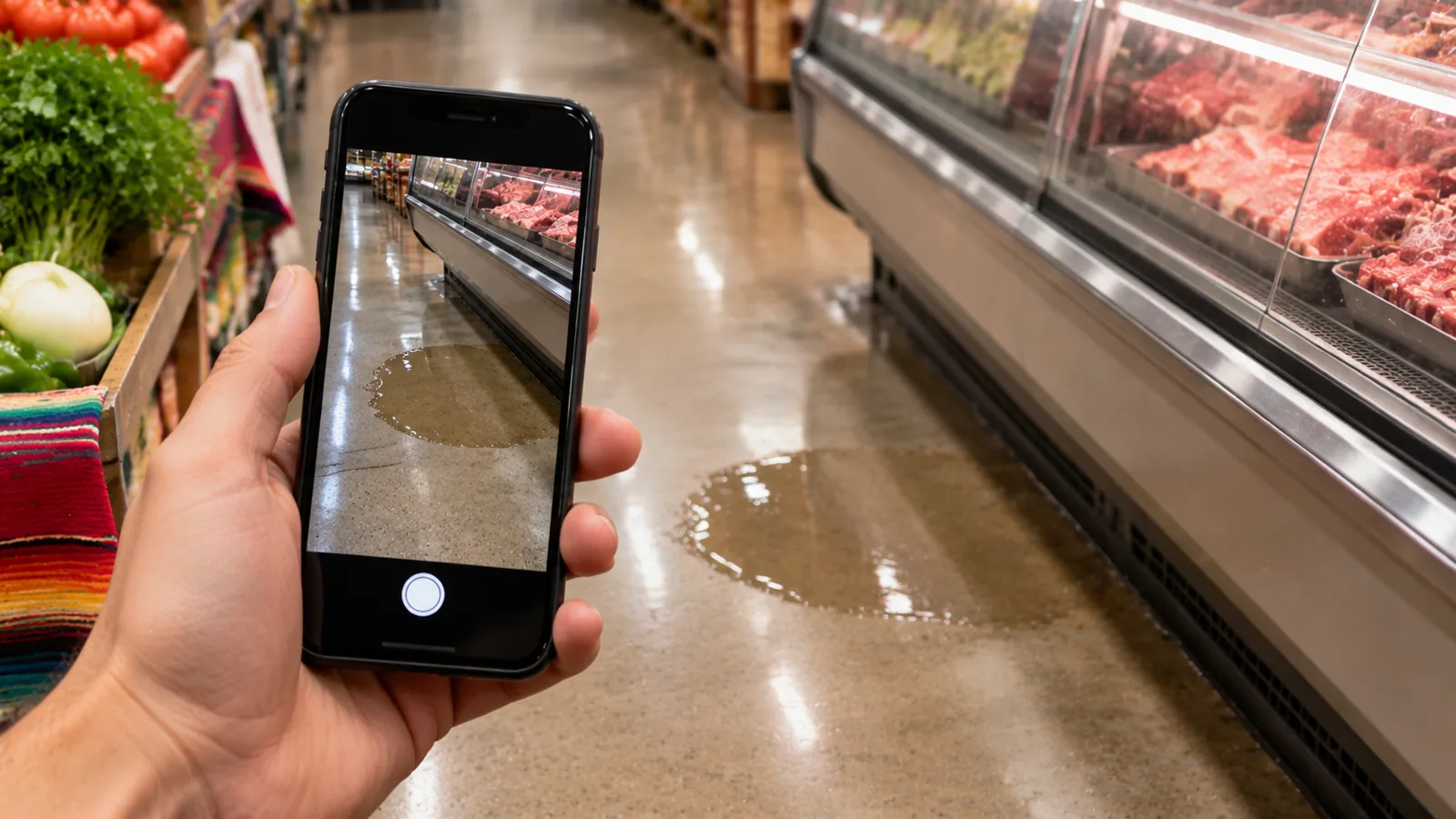
Slipped at a La Michoacana Meat Market? See a doctor. Tell the manager what happened. If someone with you can do it safely, photograph the floor before it gets mopped.
Say it was 6:10 on a Thursday, right by the refrigerated meat case, and you came down on your left wrist and hip while your daughter was two aisles over with the cart. We'll follow that fall all the way through. None of the next three days requires you to know what the liquid was or which company runs the store.
This article is about the La Michoacana Meat Market grocery chain. Paleterías and other independent businesses that use the "La Michoacana" name are different businesses. The company that operates a store may also carry a different legal name than the sign over the door, and a lawyer can help identify the right business once the basic facts are preserved.
Want someone to look at your fall? Tell us about your La Michoacana injury or call (214) 200-4878.
At the scene, protect your health before collecting evidence
Suppose an employee wants the aisle cleared, but your back hurts too much to stand. You stay seated by the produce bins until the paramedics check you. That's the right call, even if it means nobody photographs the floor.
If it seems serious, ask for an ambulance. The paramedic needs one sentence from you, something like "I slipped by the meat counter and landed on my left wrist and hip." Your son can write the time and the aisle number on his hand.
Before you leave, try to get the manager's name and an incident number. "Manager A. Lopez" written on the back of your receipt is plenty.
When you talk to the manager, stick to what you saw.
| Say this | Not this |
|---|---|
| "About 6:10, by the refrigerated meat case, clear liquid on the tile." | "The cooler's been leaking all day." |
| "I didn't see it before I fell." | "It must have been there an hour." |
| "My wrist and hip hurt." | "This is your fault, and you'll pay for it." |
A guess written into a report can later be treated as if you knew it.
Preserve the scene as it actually appeared
Suppose your daughter has her phone out before the mop arrives. Here's what she shoots.
- a wide shot from the end of the produce aisle, entrance mat in view, for the layout and lighting
- an approach shot from the tortilla display, facing the meat counter, for what a shopper walking up could see
- a close shot over the liquid, for size, color and cart tracks through it
- a warning shot from wherever the cone stood, for a cone tucked behind a shelf end, not in the aisle
She leaves the pictures on her own phone. If she texts them to you, the copy you get may not carry the original time stamp, so the phone that took them keeps the originals.
Those pictures are a start. A puddle beside a cooler won't prove the cooler leaked, and a stocker in a store shirt ten feet away may never have looked down. A floor drain or an entrance mat in the frame isn't proof the store broke a safety rule, either. Your lawyer uses the photos to decide what to ask for next.
Within the first day, write an accurate account
Suppose that night at the kitchen table, you write four lines.
| Entry type | Wording |
|---|---|
| Before the fall | "I didn't see anything on the floor as I turned toward the meat case." |
| After the fall | "My jeans were wet, and I saw a clear puddle about the size of a dinner plate." |
| What someone else said | "A woman with a red cart said she'd seen it a few minutes earlier." |
| What you don't remember | "I don't know if a cone was visible before I fell." |
Uncertainty written down today is more believable than certainty added next month.
Then put a few things somewhere safe. The paper receipt and the card confirmation go in an envelope with the store's address on it. Letters or emails from the store stay exactly as they came. Your shoes and the jeans go in a bag, unwashed, until you've talked with a lawyer. If a food item or product caused the problem, ask a lawyer how to keep it, and don't try to collect a hazardous substance yourself.
Witnesses can answer different questions about the fall
Suppose three people come over after you fall. Each one knows a different piece.
| Witness | Can tell you | Probably can't tell you |
|---|---|---|
| The shopper who saw you fall | How your feet slid and where you landed. | When the spill appeared. |
| A shopper who passed earlier | Whether the liquid was already there. | How you fell. |
| Someone who heard staff mention a leak | That a leak was discussed. | Whether it was this spot at this time. |
Put each name next to the one question they can answer.
- Get each person's phone number and a one-line description of what they saw.
- Don't tell anyone what you need them to say.
- Don't circulate a prepared statement for them to sign.
- Write down each witness's preferred language.
The woman with the red cart speaks Spanish, and your nephew translates for her while you wait for the ambulance. Write down what she said in Spanish as well as his English version, including her "creo que" and "como cinco minutos." If her statement is ever disputed, an independent interpreter may be needed, even though family helped that first evening.
Saturday: one folder
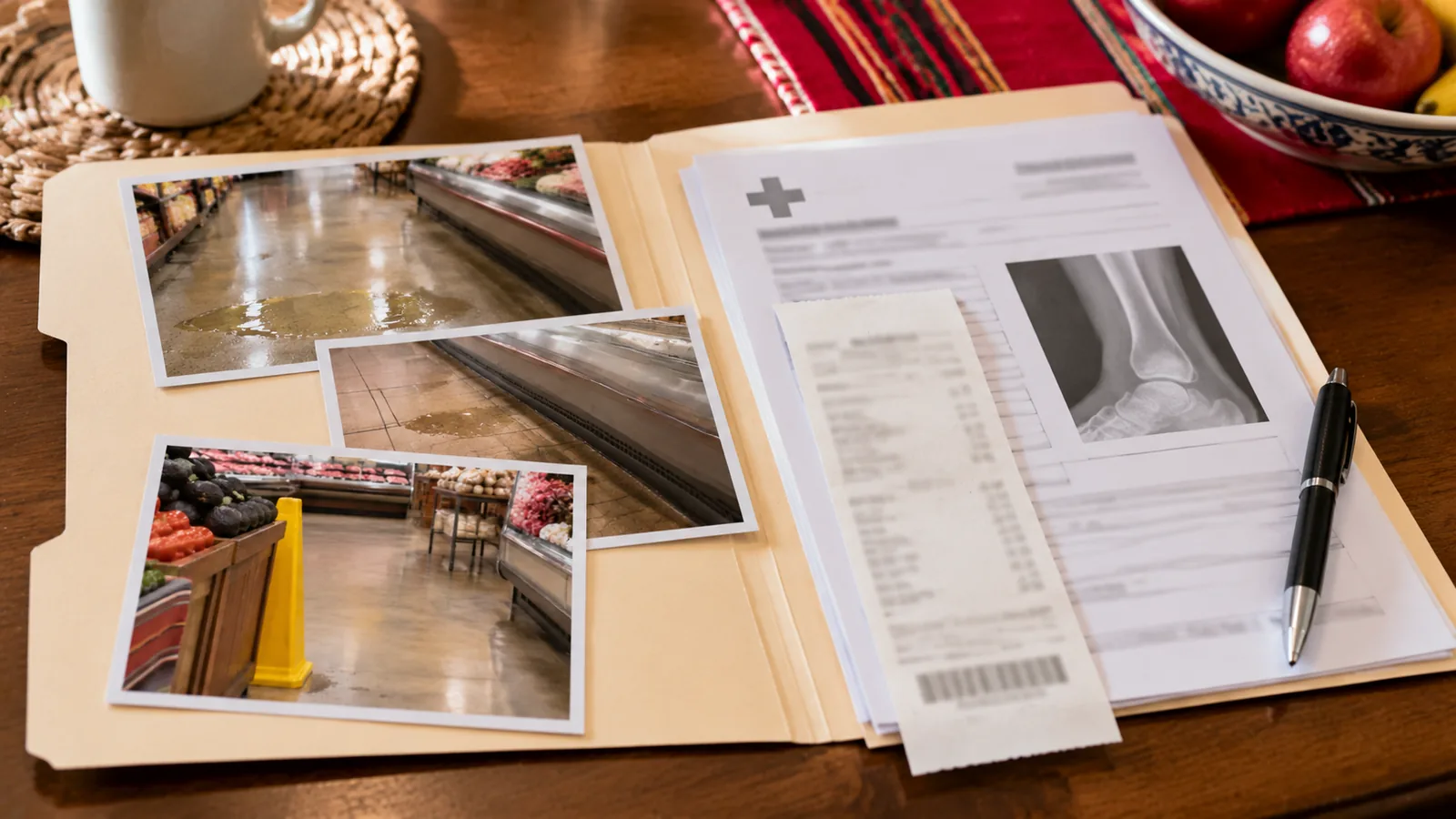
By Saturday morning your daughter has one folder going, oldest paper on the bottom:
- the urgent-care sheet: wrist sprain, follow-up in a week;
- the pharmacy receipt for the anti-inflammatory;
- Tuesday's orthopedic appointment card;
- a work note, no lifting over 10 pounds for two weeks;
- two rideshare receipts.
None of those four lines proves the store knew about the liquid. They do give a lawyer a list of things to request, starting with the footage (see preserving La Michoacana surveillance video).
Which camera sees that aisle?
Probably the dome over the produce entrance. Its footage could show when the liquid hit the tile and who walked past.
Is the camera clock right?
Check it against the register receipt. A camera clock five minutes fast moves 6:03 and 6:10 by the same five minutes.
What did the woman with the red cart actually see?
Only her own view of the floor counts as evidence of how it looked before the fall.
Where did the water come from?
A cooler, a mop bucket, and a dropped drink raise different questions.
Where was the cone before the fall?
A photo taken after employees responded may not show where it stood earlier.
What a lawyer does with the early information
Two things happen early: the lawyer checks the deadline, and the lawyer asks the store to keep its records.
| Deadline | Rule |
|---|---|
| Filing suit | Generally two years under Section 16.003, so a fall on March 3, 2026 points to March 3, 2028, subject to accrual rules and exceptions that need individual analysis. |
| Things that don't move it | An insurance claim, an incident report (which isn't a court filing), and talks with an adjuster. |
Filing and service need attention well before the last day.
Which business controlled this spot?
See identifying the correct La Michoacana defendant.
Was it a slip, a trip, or falling merchandise?
Each points to different proof.
What could show the store knew or should have known?
Usually a witness, a log, or the video. Most store cases turn on it.
Footage gets recorded over long before paper logs get thrown out. So the preservation letter goes out in the first week, and one sentence does the job:
It goes by certified mail, and the green card goes in the folder when it comes back. Nobody asks for every record from every store.
For the wider litigation path, see the La Michoacana injury case and trial preparation guide.
Bringing the incident information to a consultation
Suppose you walk in with a half-full folder. That's fine. Bring:
- the store address and the date;
- your medical providers;
- your photos;
- witness names;
- messages with the store or insurer;
- a list of what's missing.
You aren't expected to know which company runs the store or to prove anyone knew about the puddle. Finding the operating company is the lawyer's job, along with sorting out what notice evidence might exist and what can still be requested.
A practical family evidence plan for relatives
Suppose four relatives want to help. One organizer and one folder keep it accurate.
| Who | Does what |
|---|---|
| Your sister | Keeps every name and number in one notebook. |
| You | Keep all original records in one labeled folder in the kitchen drawer. |
| Maria | Logs her photos: "Photos 1-12 taken by Maria on her phone." |
| Whoever calls the store | Writes a line: "Tuesday, main line, assistant manager, told to wait for a claims call." |
One voice to the store keeps the record consistent.
- Ask someone who saw only the aftermath about the aftermath.
- Keep incomplete contact details as they are; don't invent a name.
The kitchen calendar
Skip the daily pain diary. It tends to make every day sound like the worst one. Jot a few words on the kitchen calendar each Sunday night instead. Three weeks after the fall, the calendar might read:
- "PT Mon/Thu"
- "still can't lift the laundry basket"
- "Ana drove me to work all week"
- "walked the block twice, no brace"
That last line matters as much as the others. Ask your lawyer whether a diary or calendar could be discoverable, and keep it consistent with what you tell your doctors. More on this in medical proof and damages after a La Michoacana injury.
Work proof is small and specific:
- your supervisor's text moving you to modified duty at the deli slicer, kept on the phone itself, not as a screenshot;
- pay stubs from the month before the fall and the month after;
- an email asking why, if your boss turned down a restriction.
The doctor's restriction and the employer's decision can rest on different reasons. Neither one turns a few weeks of light duty into permanent disability.
Review documents before making an irreversible decision
Suppose a week later, the claims office emails a one-page "medical assistance" form.
| The paper says | Ask |
|---|---|
| "Releases the store and its affiliates" | Which companies, exactly? It may reach more than the store. |
| "All claims arising from the incident" | Does it end claims you haven't thought of yet? |
| "Medical assistance payment" | Is it a release, and do you have to repay anyone? |
| "Acknowledgment" or indemnity language | Does it make you protect the business? |
Page two counts too, and so does any attachment.
If you already signed it, bring the signed copy to the consultation with the date, how it was handed to you, and any check that came with it. Whether it holds up depends on its exact words.
Say you call on Friday and the manager tells you there's no report under your name. Write that down word for word, with the date. Keep the claim number, and the name of the lane 3 cashier who called the manager over that Thursday. A missing entry doesn't prove nothing happened, and a report's existence doesn't prove negligence.
Two families, one fall
Two families, same fall, same aisle. Their folders look nothing alike.
| In the folder | The Garzas | The other family |
|---|---|---|
| First stop | Urgent care that night. | An argument with the manager; no doctor. |
| Photos | Eleven originals, with who took each one written on the envelope. | Forty cropped screenshots from a group chat. |
| What the store said | Nothing on record. | "Yeah, that cooler leaks." |
The Garza folder is thinner. A lawyer can still use every page of it, from the first call through trial.
What do I know for sure?
The store address, a medical visit, and the original photos.
What's disputed?
The liquid's source, where the cone was, and when the condition first existed.
What needs a professional?
Which company operates the store and whether video was kept.
If a letter comes from the store, it goes in the folder. If someone calls, write down who and when, and ask them to send the request by email. You can be friendly on the phone without agreeing to a release or guessing what your claim is worth.
For counsel: day four, first interview
The client is still on pain medication and tires after about 40 minutes. Break at the halfway point. Come back to the timeline at the end. Where she isn't sure, the notes say "not sure."
| Ask | Why it matters |
|---|---|
| When did you get to the store, and why? | It anchors the timeline to a receipt or video. |
| Which parts of the store did you walk through? | That sets the camera requests. |
| Where exactly did you fall? | Every later record has to match that spot. |
What was the client doing just before?
It bears on attention, footwear, and carts.
Did the client see the condition before falling?
It bears on awareness and the notice theory.
What hit the floor or an object, and was it a full fall or a partial slip?
The mechanism has to fit the injuries.
Who saw it?
Witnesses need to be found while memories are fresh.
Did an employee come over, and was a report made?
It shows the store's response.
Did the client leave for treatment?
That starts the medical timeline.
Separate observation, witness report, and inference
Suppose the client says three things in the first ten minutes.
| Type of statement | Example | Evidentiary significance |
|---|---|---|
| Personal observation | "I saw clear liquid on the floor after I fell." | The client can testify to it from personal knowledge. |
| Witness statement | "Another shopper told me the liquid had been there for several minutes." | A lead to a witness counsel must find and interview directly. |
| Inference | "The store must have known because an employee was nearby." | A conclusion; employee proximity without more doesn't establish notice. |
Only the first line is evidence from the client's own knowledge.
Where, exactly?
For example, from the interview notes: "Produce, 2nd bin row from entrance, by avocados. Dairy case 2 aisles over. Walking bakery → lane 3. Stocker end of aisle; cone far end. Dome camera over produce entrance. Floor dry going in, wet after."
Have the client mark a store diagram (fall spot, direction, displays, signs) without pushing for distances or walking speed she can't remember.
Liquid
- Color, and clear, cloudy, oily, or colored?
- How wide, and any debris?
- Any footprints or cart tracks running through it?
- Was it dripping from a display case or a machine?
- Was a sign out, or an employee already mopping?
Trip
- Was it a box, packaging, a pallet, or a floor mat?
- Could she see it, and was it in the normal path to the registers?
- Was someone stocking or cleaning nearby?
- Lighting adequate?
Falling merchandise
- What fell, and how was it stacked or displayed?
- Did the client or another person touch it?
- Was the shelf bent, or did it wobble?
Let her describe it. What did it look like, who was standing nearby, where was the sign? "Unreasonably dangerous" is your phrase, not hers.
Her medical history, before and after
An old injury doesn't end the claim; what changed after the fall is the claim, and the records have to show it. For example, answers from the same interview:
| Question | Her answer |
|---|---|
| That wrist, before? | Carpal tunnel surgery years ago. A knee sprain from soccer, too. |
| Back, neck, shoulder? | Arthritis in the lower back, chiropractic visits for her neck, a shoulder MRI two years back. |
| Medications? | A daily blood thinner. |
| Stairs before the fall? | Already slow. |
| Anything since? | Urgent care, an orthopedist, therapy. Then a minor rear-end crash a month later. |
Every line goes into the chronology, the crash included. The store's lawyers will find it anyway. Getting it down on day four keeps causation and the medical proof straight from the start.
Frequently asked questions
Do I have to fill out the store's incident form before going to the doctor?
No. Ask someone to let the manager know, and write down the manager's name.
A clerk said "I'm so sorry, we should have mopped that." Does that prove negligence?
Not necessarily. Write down who said it and the exact words.
Can a family member request the video?
They can ask that it be preserved, but that doesn't guarantee production. Nobody should pose as a lawyer or as an investigator for the business.
What if pain becomes noticeable the next day?
Get an evaluation and give an accurate history of when symptoms started. Delayed symptoms don't decide causation either way.
Should I post photographs on social media?
Leave your old posts up exactly as they are, and check with a lawyer before you post the fall photos. Deleting relevant content can create separate problems.
Will the store pay my urgent-care bill?
Not automatically. The store's liability insurance, medical payments coverage, and a voluntary "assistance" payment are three different things, so ask whether signing would release your rights or mean paying someone back later.
Tell us about your La Michoacana injury
Bring the store address, the date of the fall, and the folder, however thin it is. Tell us about your La Michoacana injury or call (214) 200-4878. Aaron Herbert is Board Certified in Personal Injury Trial Law by the Texas Board of Legal Specialization. His State Bar of Texas profile lists State Bar No. 24036761. The Law Firm of Aaron A. Herbert, P.C. is at 8330 Lyndon B. Johnson Freeway, Suite 700, Dallas, Texas 75243. No result is guaranteed, and contacting the firm doesn't create an attorney-client relationship.
Related pages on La Michoacana injuries
- Texas La Michoacana supermarket injury hub: every guide in one place.
- La Michoacana injury case and trial preparation guide: the full lawsuit.
- Preserving surveillance video and digital evidence: asking for footage.
- Identifying the correct La Michoacana business and property defendants: who controlled the store.
- Medical records, causation, and damages after a supermarket fall: treatment records.
Sources
- Texas Civil Practice and Remedies Code, Chapter 16, Section 16.003.
- Texas Judicial Branch, rules and standards.
- State Bar of Texas profile, Aaron Herbert, State Bar No. 24036761.
Legal sources checked November 2, 2026.

ABOUT THE ATTORNEY
Aaron A. Herbert
Founding Attorney
Board Certified in Personal Injury Trial Law
Aaron founded The Law Firm of Aaron A. Herbert in 2010 to focus on developing each client's case and seeking its maximum value. For over a decade, he has represented people seriously injured in major accidents and industrial catastrophes, pursuing trial verdicts and settlements while working to reduce the stress of litigation.
Education
- Texas A&M University · B.S., Criminal Justice, 1999
- University of Oklahoma College of Law · J.D., 2002; graduated in the top of his class
Trial experience & approach
Aaron earned numerous jury verdicts at boutique personal injury litigation firms. According to his biography, he spent a year as the top-earning litigation attorney at a firm that frequently appeared in verdict searches as having one of the highest numbers of trial wins in Texas. At another Dallas personal injury firm, he moved from managing pre-litigation attorney to managing litigation attorney over seven years as the firm grew into one of Dallas's largest personal injury firms.
His biography describes a reputation as one of America's most aggressive trial lawyers, with noteworthy recoveries from judges and juries and substantial pretrial settlements. Most of those settlements included confidentiality agreements requested by the defense. Aaron has said the recoveries were justified by the injuries and losses involved, which no amount of money could make someone choose to experience.
His approach combines passion, preparation, persistence and courtroom imagination. He believes a well-supported, engaged and motivated team working cooperatively helps deliver strong representation, with the goal of achieving the best possible result for every client.
Dallas roots, military service & publication
Born and raised in Dallas, Aaron enlisted in the United States Marine Corps after high school and later received an Honorable Discharge. He completed his university and law degrees after his military service and became a lifelong Sooners football fan in law school.
Publication: “Litigating Dog Bite Cases,” Texas Dog Law Seminar, Dallas, 2009.
Professional affiliations & recognition
Professional affiliations and recognition listed in Aaron’s biography:
- State Bar of Texas
- American Bar Association
- Association of Trial Lawyers of America (now American Association for Justice)
- Texas Trial Lawyers Association
- Dallas Trial Lawyers Association
- Dallas Bar Association
- Tarrant County Bar Association
- Million Dollar Advocates Forum
- The National Trial Lawyers – Top 100 Trial Lawyers