The name over the door is a starting point, nothing more. The company you sue after a fall comes out of other paper, and that paper doesn't always agree with the sign or with itself. The correct defendant is the legal person or entity whose duty and conduct support liability on the facts of your fall.
One store can involve several businesses at once.
- Store operation, such as a local operating company, which may carry a different legal name than the sign.
- Land ownership, such as a landlord or property owner.
- Maintenance, such as the operator, the landlord or an outside contractor.
- Employment, which sits with the company that actually employs the workers in the store.
- Insurance and claims, such as an insurer or claims administrator acting for one of the businesses above.
Any of those roles can sit with a different company, so each gets checked separately.
This guide covers the La Michoacana Meat Market grocery chain, not the ice cream shops (paleterías) or independent businesses that also use the "La Michoacana" name.
The gap between sign and entity is real. A 2018 Houston appeal named LMMM Houston #41, Ltd., d/b/a La Michoacana Meat Market #41 as the defendant, not a company simply called La Michoacana.
What follows is general. It doesn't describe how any particular La Michoacana location is actually organized.
Where and when, exactly
Store #12 on the receipt. Saturday, March 7, about 5:40 p.m. The tile in front of the second refrigerated case, east side of the shopping center. Paper receipt plus the matching card statement. That one line comes before any company name, and every record that comes in later gets checked against it.
The receipt is useful, and limited. It may identify a merchant. It won't say who possessed the premises, who employed the worker involved, who owned the equipment, or who kept up the parking lot. A lawyer backs it up with other records.
Then there's the name itself.
| What you find | What it does and doesn't show |
|---|---|
| "La Michoacana" on a supermarket, a meat market, an ice cream shop, or an independent store | Several businesses can share the name. They aren't one defendant. |
| A search result or the store sign | No corporate relationship, by itself. |
| The company's public website | Its history and store growth, not who owns, runs, or answers for a given Texas location. |
Each allegation needs evidence from this location and a good-faith basis.
Owner on paper, operator on the floor
The appraisal district can list one company as the landowner while a tenant runs the store. When it comes to duty, control usually matters more than title.
| Where the hazard came from | Where it may point |
|---|---|
| A cooler the tenant's employees were restocking | The tenant, if it created or handled the spill. The landlord in the appraisal records isn't automatically liable. |
| A structural roof leak over the same aisle | Possibly somewhere else, depending on who kept the roof. |
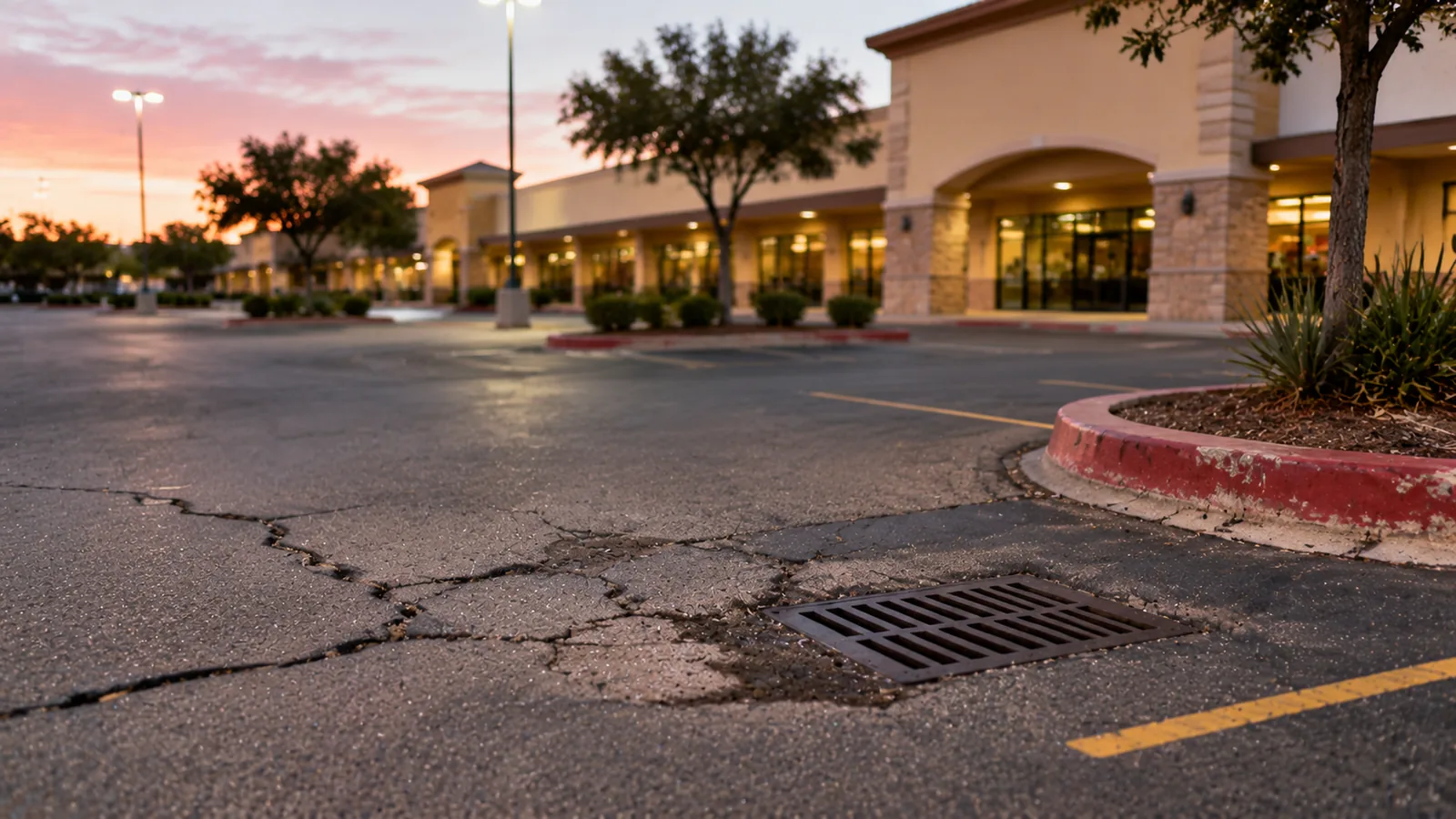
| Broken pavement in the lot | Whoever controls that exact spot: the store's own parcel, a shared common area, or someone else's property. |
Leases divide up repair jobs, but they don't answer every question. The question is who had possession and control of the area, which for a parking lot means checking the spot against legal descriptions and site plans. "The supermarket's lot" is a phrase people use. It isn't a finding about control.
More than one company inside
Operator, landlord, refrigeration contractor, overnight cleaners: inside one store, any of them might own a piece of the hazard. What the contracts say matters. By itself, though, contract language doesn't decide the duty owed to an injured invitee.
How much each relationship counts depends on the claim, the evidence, the duty, and Texas law. In one file, six control questions came out like this:
| Control question | Answer in one file |
|---|---|
| Who controlled the accident area? | The operating company; it ran the sales floor. |
| Who could inspect it? | The department managers. |
| Who had to fix the hazard? | The overnight cleaning contractor, for the floors. |
| Who controlled the equipment that created it? | The refrigeration vendor that serviced the leaking case. |
| Who had the contract duty to maintain it? | The landlord, for the parking lot drainage. |
| Who could close the area to customers? | The store manager on duty. |
When a contractor is involved
An invoice with a contractor's name on it doesn't prove that contractor caused your injury. And bringing in a contractor doesn't end every duty of the business that possessed the premises.
- The refrigeration company servicing the meat case, with records such as the contract scope, dispatch log and technician notes, for whether its repair failed or the case was never fixed.
- The cleaning company, with records such as its schedule, product sheets and area map, for whether the floor it covered was the floor you fell on.
- The property manager who arranged repairs, with records such as emails, work orders and sign-off sheets, for what it was told, what it ordered and who approved the job.
Photos from before and after the work help with all three, and so do employee reports of trouble afterward. On the day of a fall, a bad repair, unfinished maintenance, a fresh spill, and an unrelated condition can look the same.
Is the parent company in charge?
Sharing a logo, a website, or a mailing address doesn't make every affiliate responsible. Several kinds of company may be connected to one store. A parent may or may not direct store operations. The owner of the trade name may never have run a store. A management company may handle paperwork and never touch the floors. The local operating entity runs the place day to day.
Before alleging derivative or direct liability, a lawyer looks at actual control, agency, and the contracts.
Two names cause confusion. A registered agent accepts legal papers for an entity, and that job doesn't make the agent responsible for an accident. A registered office isn't necessarily the store, or the place where records are kept.
Where the operator's name turns up
In the Santibanez appeal, the name that mattered was LMMM Houston #41, Ltd., the limited partnership that did business as La Michoacana Meat Market #41. You find names like that in a handful of places, and each place tells only part of the story.
| Record | What it can show | What it can't |
|---|---|---|
| Texas Secretary of State filings | When the entity was formed, and its registered agent. | Who ran the floor on your date. |
| Assumed-name filings | The public name a business operates under. | A separate legal person behind the name. |
| The county appraisal district | The landowner on the tax rolls. | Who operated the store. |
| A deed | Who owned the property on a particular date. | Who controlled the spot that day. |
| Permits and licenses | Which entity holds them. | Every party with a duty. |
| Your receipt | The merchant for that one sale. | Who controlled the floor. |
| Payroll, through discovery | Who employed the workers. | Who kept the equipment. |
| Leases and service contracts | Who agreed to do what, including any landlord obligation. | What actually happened day to day. |
| The claims letter | A representative and the principal it names. | Every responsible party. |
Write down where each name came from. Checked facts go in one column and guesses in another, and no single paper gets to overrule the rest.
What does a defendant chart look like?
Each company under consideration gets a row, and the rows change as records arrive. The operator's row might read:
| Column | Entry |
|---|---|
| Legal name | The limited partnership printed on the receipt. |
| Public name | La Michoacana Meat Market. |
| Role | Operator of the store on the incident date. |
| Supporting record | The receipt and the lease. |
| Source type | Certified filing, receipt, deed, contract, sworn testimony, or unverified statement. |
| Date of the information | Retrieved November 2 (entity names and ownership change). |
| Open question | Did the operator or the landlord maintain the entrance mats? |
| Next step | Request the mat service agreement. |
A role column that only says "associated with the brand" means the work isn't finished.
For each proposed defendant, a lawyer should be able to complete one sentence: this company controlled the condition, did the work, employed the person, or owed some other duty. In one file the sentences were "it ran the sales floor where the spill sat," "it repaired the case that leaked," "it employed the stocker whose cart hit the shopper," and "it kept control of the parking lot lights." Only parties with a good-faith factual and legal basis get named.
The open rows get closed from the record table above: filings for the operator's legal name on the incident date, payroll for the employer, contracts and dates for the equipment, and the lease plus the control facts for the landlord.
Broken pavement between two stores
Someone trips on a broken edge of asphalt between the supermarket and the shop next door. The supermarket leases its space. Another company owns the shopping center. A contractor recently did drainage work nearby.
- Locate the defect exactly. A photo with the store in the background doesn't show who controlled that patch of asphalt.
- Compare the spot with the lease and the maintenance records.
- Check whether the defect was there before the drainage repair.
- Look for earlier complaints about the same area.
- Ask whether anyone inspected it or put up a barricade.
Each of the three may have its own defense. The investigation can end up supporting one party, several, or none of the ones first suspected.
When did each company come into the picture?
The registration you pull today may describe a company that took over the store last spring. Who ran it on the day you fell is a dated question.
- An acquisition, because the buyer may hold the incident records without being liable for an earlier fall.
- A lease start, because the tenant on your date may not be the tenant now.
- An assumed-name change or conversion, because the name on today’s filing may not match the one on your receipt.
- A record transfer, because whoever holds the video or logs now isn’t necessarily who answers for them.
- A new insurance policy, because coverage that began this year may not reach last year’s fall and the named insured may differ from an online listing.
Who insures the store and who gets sued are separate questions. An insurer's letter is never the only basis for a liability allegation.
Does a trade name tell you who to sue?
Take the sign over the door. It's an assumed name, the way a business presents itself to shoppers. It doesn't create a separate person, and it doesn't prove a parent company is liable. Texas procedure may allow a suit in an assumed name in the right circumstances, but that takes the actual rule and the facts. A familiar caption still leaves two questions open: who's responsible, and how service will be made.
The logo on the cart corral is the same story. Floor inspections may be a local job, not a headquarters one. And separate filings don't wipe out a related company's direct duty if it had its own role.
How much time is there?
Two years, generally. That's the personal injury limitations period in Section 16.003 of the Tex. Civ. Prac. & Rem. Code, subject to accrual rules and exceptions. A fall on March 3, 2025 points to March 3, 2027. Phone calls with an adjuster don't stop the clock.
The name in the petition matters as much as the date.
| Petition names | Records show | Usually called | What it can do to the deadline |
|---|---|---|---|
| "La Michoacana Meat Market" | The right business, under a slightly wrong name | Misnomer | Treated as the same defendant under the wrong name. |
| "La Michoacana Meat Market" | A different company altogether | Misidentification | The limitations analysis can change. |
Amendment and service need the same early attention. A claim filed under a trade name doesn't automatically preserve a suit against every affiliate. Limitations and diligence get checked at the start, not cleaned up at the end.
Who is the adjuster working for?
Ask. Claims representatives often write under the familiar brand, so get the answer in writing and keep it.
| What you're handed | What it doesn't tell you |
|---|---|
| A claim number | Who the responsible legal party is. |
| Insurer letterhead | Who the insured is. |
| A settlement discussion | Every party that may be responsible. |
A lawyer lines all of it up against the pleadings and the verified records.
What do disclosures and discovery add?
Before serving a single request, read the current text of Texas Rule of Civil Procedure 194.2, as amended, and the discovery-control order. That rule and the other discovery rules govern required disclosures and their deadlines.
Disclosures can identify the parties' legal theories, potential responsible persons, and discoverable insurance information. A store manager or corporate representative named there is a place to start. That person may not know everything, and the right company may still be missing.
Before serving discovery, a lawyer investigates the ownership and operating structure of that specific store and gathers correct legal names, assumed names, registered-agent information, ownership records, leases, and contracts. Targeted written discovery in a La Michoacana injury lawsuit can fill the gaps.
Other parties sometimes turn up. For example: the shopping center owner, a payroll or leasing firm, a staffing company that supplies overnight stockers, the vendor that waxed the floors that morning, a beverage distributor that built its own endcap, or a security company that runs the camera system. For the hazards these parties may be tied to, see wet floors, store hazards, and warning signs at La Michoacana. The La Michoacana injury case and trial preparation guide shows where this fits in the lawsuit.
Get it wrong one way and you face delay, motion practice, and limitations problems. Get it wrong the other way, by missing a company that controlled the hazard, and part of the case never gets looked at.
What should the file show about service?
Why each party was named. The legal names used, matching the companies actually served. Registered-agent information, every service attempt and return, and any fight over identity.
Keep duty and breach in separate folders:
- duty folder: the contract saying who handles a repair
- breach folder: the work order, and testimony about what happened
A contract missing from the first production doesn't prove there was no duty. A lease without its exhibits gets a list of what's missing. A contract covering several stores needs a check that it includes this location and this equipment.
What should you keep?
Paper, mostly. You don't need to research corporate structures yourself. Hold on to the receipt, photos of the exact spot, the names of any managers you spoke with, the incident card, and every letter. If you aren't sure about something, write "not sure" next to it. Tell your lawyer about each new letter or call.
Shortcuts to skip:
- a defendant picked from a map listing or an online review
- guesses filling the gaps
- whichever name shows up most
Don't substitute a party, accept a release, or promise a representative that a company won't be sued.
At a consultation, ask who will look into the entity question and what's still open. You want to hear about a documented look at this store and this spot. A confident claim that every location has one owner is a warning sign.
Each later update should cover:
- the operator the records support
- parties still under investigation
- how claims are being preserved
- what could change
Before any settlement releases affiliates or unnamed parties, check that language against the investigation. The La Michoacana attorney, fees, and claim data guide covers questions to ask about representation.
Frequently asked questions
Should I sue whatever company is on my receipt?
Start there, but don't stop. The receipt names a merchant for one sale. Someone else may control the floor condition or employ the person involved.
Can I sue the insurance company instead of the store?
Coverage and responsibility for the accident are different questions. An insurer doesn't become the proper negligence defendant because it handles the communications.
Is the landlord responsible for the parking lot?
The lease answers a lot of it. It shows what control the landlord kept and who repairs the asphalt. Ownership alone doesn't create every duty to a visitor, so notice and what actually happened day to day go into it too.
What if I used the wrong company name in the incident report?
Turn the report over as it is and explain what you knew then. An incident report isn't a lawsuit, and your lawyer should find the correct identities promptly.
How can I help if the paperwork names several companies?
Keep every document in its original form, note when and how you got it, and bring it all to your lawyer, including any release proposal.
Talk with Aaron Herbert's office
Bring the store address, the date, your receipt, and any letters or incident cards. Tell us about your La Michoacana injury or call (214) 200-4878. Aaron Herbert is Board Certified in Personal Injury Trial Law by the Texas Board of Legal Specialization. The Law Firm of Aaron A. Herbert, P.C. is at 8330 Lyndon B. Johnson Freeway, Suite 700, Dallas, Texas 75243. Contacting the firm doesn't create an attorney-client relationship, and no result is guaranteed.
Related pages on La Michoacana injuries
- Texas La Michoacana supermarket injury knowledge hub: every guide in this series.
- La Michoacana injury case and trial preparation guide: the complete lawsuit.
- Written discovery in a La Michoacana injury lawsuit: leases and contracts.
- Wet floors, store hazards, and warning signs at La Michoacana: spills and cones.
- Choosing a La Michoacana injury attorney and understanding claim data: picking a lawyer.
Sources
- La Michoacana Meat Market, our company, viewed November 2, 2026.
- LMMM Houston #41, Ltd. v. Santibanez, No. 01-16-00724-CV (Tex. App.—Houston [1st Dist.] Aug. 30, 2018) (mem. op.).
- Texas Civil Practice and Remedies Code Chapter 16, §16.003.
- Texas Judicial Branch, rules and standards, including Rule 194.2 as amended October 1, 2026.
Legal sources checked November 2, 2026.

ABOUT THE ATTORNEY
Aaron A. Herbert
Founding Attorney
Board Certified in Personal Injury Trial Law
Aaron founded The Law Firm of Aaron A. Herbert in 2010 to focus on developing each client's case and seeking its maximum value. For over a decade, he has represented people seriously injured in major accidents and industrial catastrophes, pursuing trial verdicts and settlements while working to reduce the stress of litigation.
Education
- Texas A&M University · B.S., Criminal Justice, 1999
- University of Oklahoma College of Law · J.D., 2002; graduated in the top of his class
Trial experience & approach
Aaron earned numerous jury verdicts at boutique personal injury litigation firms. According to his biography, he spent a year as the top-earning litigation attorney at a firm that frequently appeared in verdict searches as having one of the highest numbers of trial wins in Texas. At another Dallas personal injury firm, he moved from managing pre-litigation attorney to managing litigation attorney over seven years as the firm grew into one of Dallas's largest personal injury firms.
His biography describes a reputation as one of America's most aggressive trial lawyers, with noteworthy recoveries from judges and juries and substantial pretrial settlements. Most of those settlements included confidentiality agreements requested by the defense. Aaron has said the recoveries were justified by the injuries and losses involved, which no amount of money could make someone choose to experience.
His approach combines passion, preparation, persistence and courtroom imagination. He believes a well-supported, engaged and motivated team working cooperatively helps deliver strong representation, with the goal of achieving the best possible result for every client.
Dallas roots, military service & publication
Born and raised in Dallas, Aaron enlisted in the United States Marine Corps after high school and later received an Honorable Discharge. He completed his university and law degrees after his military service and became a lifelong Sooners football fan in law school.
Publication: “Litigating Dog Bite Cases,” Texas Dog Law Seminar, Dallas, 2009.
Professional affiliations & recognition
Professional affiliations and recognition listed in Aaron’s biography:
- State Bar of Texas
- American Bar Association
- Association of Trial Lawyers of America (now American Association for Justice)
- Texas Trial Lawyers Association
- Dallas Trial Lawyers Association
- Dallas Bar Association
- Tarrant County Bar Association
- Million Dollar Advocates Forum
- The National Trial Lawyers – Top 100 Trial Lawyers