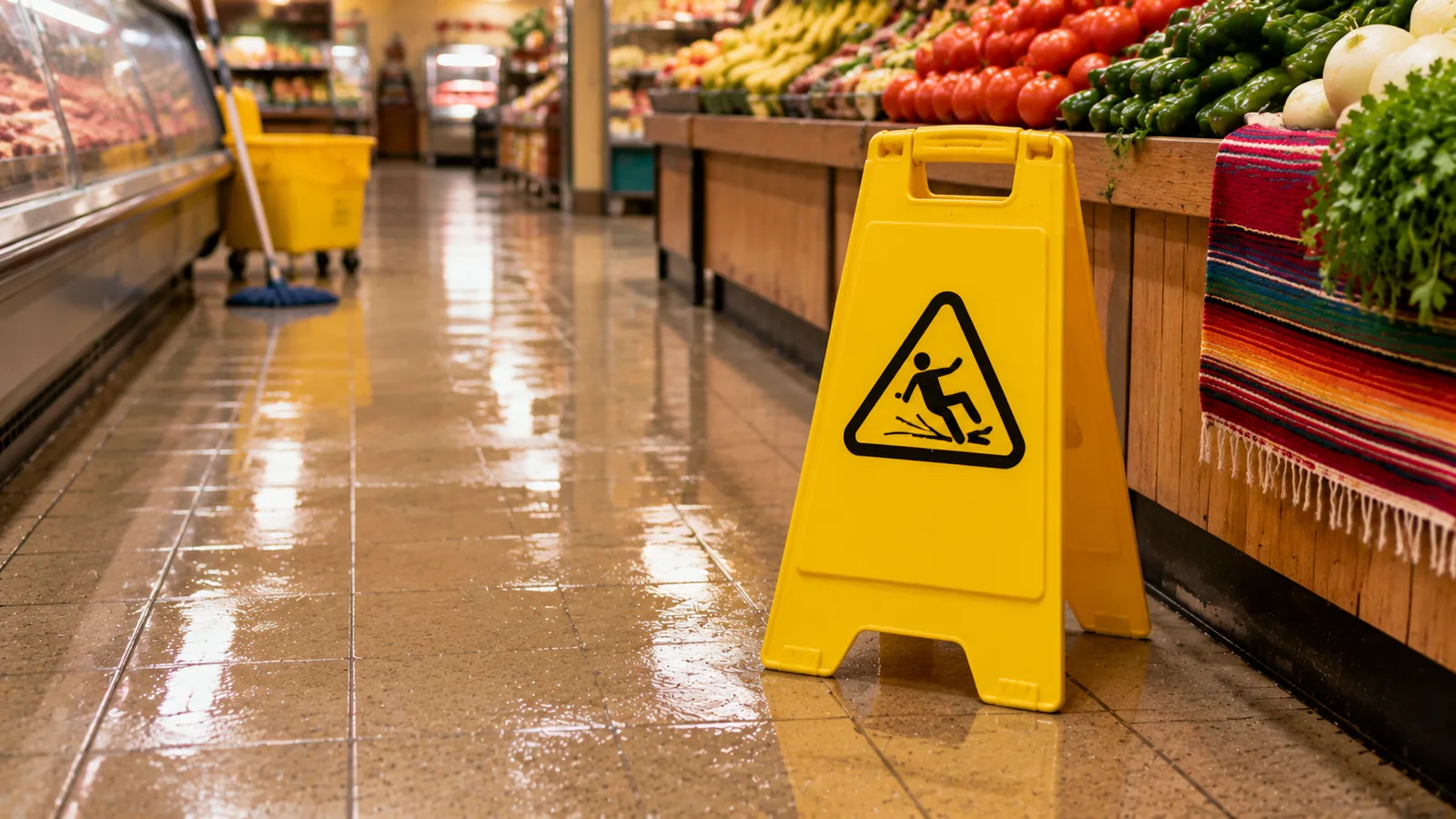
In a 2018 Houston appeal involving a La Michoacana Meat Market, a shopper slipped on pork lard near the produce area. Signs had been put out, but by his account they were hidden behind a produce shelf (LMMM Houston #41, Ltd. v. Santibanez).
A cone can show the store tried to warn. It can't show you were able to see it from where you walked. So the question after a wet-floor fall is where the sign stood, when it went down, and what it warned about.
| What a cone near the spill can show | What it doesn't settle |
|---|---|
| Someone on staff knew the floor was wet. | Whether you could see it from your cart. |
| The store took some step to warn. | Whether the step was enough for this spill. |
| Where the warning was at the moment of the photo. | Where it was a minute before you fell. |
| A shopper who saw the cone at 2:15 can place it before the fall. | Nothing, unless she can say where it stood and how she knows the time. |
| Video of the aisle from 2:00 on shows when the cone arrived, and where. | Whether you could see it from where you walked. |
A wet floor sign at La Michoacana Meat Market doesn't automatically defeat a Texas injury claim, and a missing sign doesn't automatically prove one. Save these the same day:
- A photo from the end of the aisle, at eye level, showing what you could see walking in.
- Close photos of the spot where your foot slid, and of any cone or sign.
- The names and numbers of anyone who saw where the cone stood before the fall.
- Your receipt, which fixes the time and the store.
In the Santibanez fall, signs were out, but the shopper said they were hidden behind a produce shelf. Your case gets the same treatment: the wet tile, curled mat, or leaning display has to be dangerous in the legal sense, the store has to have failed to use reasonable care about it, and it has to be what actually made you fall.
This guide covers the La Michoacana Meat Market grocery chain, not the ice cream shops (paleterías) or independent businesses that also use the "La Michoacana" name.
The sign over the door may not name the defendant, either. The company operating a store can differ from that name: the defendant in that 2018 Houston appeal was LMMM Houston #41, Ltd., d/b/a La Michoacana Meat Market #41.
These are general legal points. They don't describe documented conditions at any particular La Michoacana store, and they don't establish that any location violated a duty.
Hurt at a La Michoacana store? Call (214) 200-4878 or tell us about your La Michoacana injury. A call or a message doesn't make the firm your lawyers.
Grease, grapes, or a curled mat?
What made you fall decides what has to be proved. None of these rows is a finding about any store:
| Hazard | What the proof has to show |
|---|---|
| A crushed bottle of Jarritos in the beverage aisle | Where the liquid came from, how far it spread, and whether it crossed your path. |
| Grease by the meat counter | What the substance was, and that your shoe went through it. |
| Grapes or onion skins by the produce bins | That your foot hit that item, not something a foot away. |
| A curled entrance mat | The mat's shape at the moment you fell. |
| A leaning endcap of canned chiles | How it was stacked and who last touched it. |
| A pallet left in an aisle | Who put it there and how long it sat. |
| Broken pavement outside the doors | Who controlled that strip of the lot. |
Debris a few feet away proves little unless it ties to your fall. And name a substance by how it looked, not where you think it came from:
| You saw | Write down | Hold off on |
|---|---|---|
| Clear liquid on the tile | "Clear liquid, about a foot across, by the second freezer door." | "Mop water" or "cleaning solution." |
| A greasy sheen near the meat counter | "Shiny patch, my heel slid through it." | "Lard from the case." |
| Wet mat at the door | "Mat soaked, edge turned up near the carts." | "The mat was never changed." |
A guess written down on day one can be read later as something you knew. A photo shows color and location. Friction is another matter; footwear, movement, lighting, and the surface all go into that, and it takes a qualified person to assess it.
Meat counters and refrigeration
A refrigerated case standing next to the spot where you fell doesn't prove the case leaked. Suppose you slip in front of the meat display on a Sunday afternoon. Here's what a lawyer would look at.
- The display case and the floor drains nearby (either could be the source, or neither).
- Packaging in the area, since a torn tray of chicken can leak with no equipment problem at all.
- What employees were doing: restocking, cleaning, or icing the seafood display.
- The unit's service history, showing what was reported, what was repaired, and when.
- Witnesses who may have seen liquid on the floor before you fell.
What about a repair made after the fall? That needs careful evidentiary analysis. It isn't automatically admissible proof that the store was negligent before the event.
Someone says the case "always leaks"? Pin that down:
- Which unit, and which aisle. A bakery leak last spring says little about the dairy aisle today.
- Did anyone see liquid on this walking surface before your fall?
- The original service report, not a summary that the unit "had issues."
- What the contractor actually inspected. The technician may have worked on a different part.
Whether a leak can supply notice of a particular puddle is covered in proving store notice in a La Michoacana slip and fall.
Rain, entrances, and mats
A wet entrance on a rainy day doesn't make the store liable by itself. Outdoor weather gets its own duty analysis.
A storm clears at 3:40 on a Tuesday. You come through the left doors at 4:00, and your foot goes out where the vestibule runner ends and the tile begins.
| Save | From that Tuesday |
|---|---|
| Your route | Parking space, left doors, toward the carts. |
| Weather | Rain stopped about twenty minutes before. |
| Mats | A runner in the vestibule, a second mat at produce, and where the last one ended. |
| Light | Bright sun behind you, dimmer inside. |
| Warnings | Any umbrella station or wet-floor sign. |
The manager says the mat was flat when he got there. Does that end it?
He may be right about ten minutes after. Mats curl at the edge, bunch up, slide, and lift. Your fall can rumple a flat one, and the next cart can flatten a curled one. If it's safe and lawful, note the mat's size and where it lay. The video and the cashier who saw you go down can sort out the order.
Judge a warning from where the shopper walked
A warning gets judged by what a customer could see walking toward the area, not by what someone standing over the spill sees afterward. For example, details worth recording:
- What you saw before entering: a photo from the end of the aisle at eye level.
- What stood in between: a tall pyramid of canned goods between you and the cone.
- Glare: overhead lights bouncing off freshly mopped tile.
- Saturday at noon, six carts backed up at the meat counter.
- The cone sat by the restroom hallway. The puddle was two aisles over.
The minute counts too. A cone set down at 2:16 does nothing for a fall at 2:14. The table at the top of this article shows how a shopper's account or the aisle video pins that minute.
What happened in Santibanez?
At a Houston La Michoacana, a shopper stepped in pork lard near produce and fell. The appeal came down in August 2018 as LMMM Houston #41, Ltd. v. Santibanez, No. 01-16-00724-CV (Tex. App.—Houston [1st Dist.] Aug. 30, 2018) (mem. op.). Two fights: where the warnings stood, and what the future medical proof showed.
Signs had been placed, but he said they were hidden behind a produce shelf. The jury found the store's negligence caused the fall (100 percent) and awarded $120,000 for future medical care, among other items.
Then the trial court granted judgment notwithstanding the verdict on future medical and cut that award to $20,000, for a judgment of $100,000 plus interest. The court of appeals affirmed.
Two takeaways. Warning placement can be a genuine fact dispute, and a jury award can change after trial. The case isn't a prediction for any other fall, a settlement average, or a firm result. It's another lawyer's case, not an Aaron Herbert result.
A box lands on you. What changes?
Wednesday, 11:30 a.m. A box of canned tomatoes slides off the top shelf onto your shoulder. Nobody slipped on anything, so this isn't a floor case. The questions are about the box: how it was stacked, who touched it last, and whether anyone was moving it when it came down.
Get clipped by a stocking cart and it's different again. Now the claim may turn on what the employee was doing at that moment rather than on a condition. Texas courts look at what actually happened, whatever the petition calls it.
Ask in writing for these to be kept:
- the item itself, and its packaging information;
- the display, as it was set up;
- the names of the employees who stocked it.
Any inspection gets coordinated with the other side. Rebuilding the display for a demonstration, or testing the box yourself, can change the evidence. You want it the way it was when you got hurt.
Parking lots and shared areas
The store may not control the asphalt outside its own door.
| Problem | Who may answer for it |
|---|---|
| Pothole or broken curb | The landlord, a tenant, a maintenance contractor, or several. |
| Drain that pools water | Whoever designed, maintains, or controls that part of the center. |
| Dark walkway | Whoever is responsible for the lights. |
Photograph the exact spot. The leases, site plans, maintenance agreements, and actual practice that turn up later get compared with it.
A collision in the lot also needs a driver negligence analysis, because owning the lot doesn't make the business responsible for every driver's mistake. Three questions decide a lot. Did an independently actionable property condition contribute? Without one, the case may be only about the driver. Does a duty exist on these facts? And who are the right parties? See identifying the correct La Michoacana defendant.
A warning visibility exercise
Suppose you walk from produce into a wet aisle, and the cone stands on the far side of a tall display. Here's how a lawyer works through that.
- Compare your route with the camera's view. A camera looking down from the ceiling may see a cone that someone walking up couldn't.
- Measure the geometry, if it's appropriate. Distances and heights show what was blocked.
- Find out whether the display changed. A display rebuilt after the fall changes the sight line.
The same exercise has to take in the bad facts too. If a recording shows a shopper walking past a prominent warning into a clearly taped-off area, that deserves a candid look. Don't crop a warning out of a photo, and don't exaggerate how visible a faint smear was.
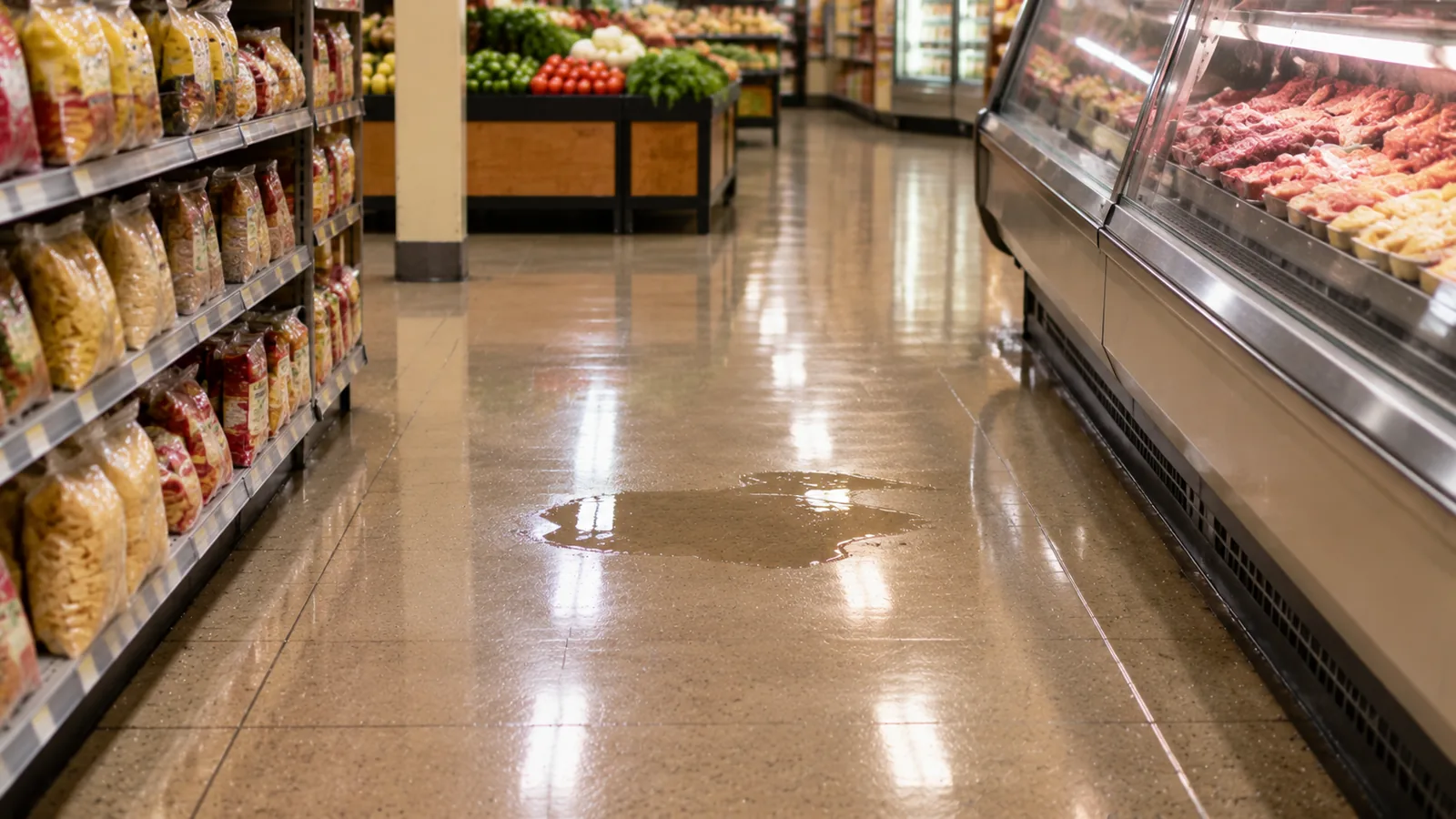
Does the hazard fit the injury?
| What you say | What it gets checked against |
|---|---|
| "My foot slid forward." | The footage, the contact points, your medical history. |
| "A case of oil fell on my shoulder." | The object and the impact. Not a floor case. |
| "I fell by the cracked tile." | Whether the wet patch beside it, or the tile, was under your foot. |
| "There was a cone right there." | Whether that cone warned of this spill or another one. |
Nobody remembers every movement of a sudden fall. Your doctors weigh the history you gave them, within their own fields, and the lawyer looks for corroboration. Where you aren't sure, the file says "not sure." A fall that could cause an injury doesn't prove it caused every condition you have.
What to bring when you talk to a lawyer
- Photos, especially ones showing your approach to the spot.
- The receipt, for the time and the store.
- A report number or the manager's name, to match the store's own records.
- The shoes you wore, in case footwear comes up.
- Witness phone numbers. Memories fade fast.
Then think about two questions you'll be asked. Did you see the danger before you fell? Did anything block your view?
A lawyer can evaluate what those facts mean legally. No lawyer can promise that a hazard was actionable or that you'll recover.
For lawyers: was the condition unreasonably dangerous?
Notice is one element. Another asks whether the condition posed an unreasonable risk of harm. Usually that's for the jury. Some conditions, though, are not unreasonably dangerous as a matter of law.
McIntire is the parking-lot case. The divot was three-quarters of an inch. The customer was seriously hurt. The Supreme Court of Texas still held, per curiam, that the divot wasn't unreasonably dangerous as a matter of law (United Supermarkets, LLC v. McIntire, No. 21-0208 (Tex. June 17, 2022)). How badly someone gets hurt, the court warned, doesn't make the condition dangerous.
Suppose the client tripped on a raised threshold at the door to the meat department.
| Look at | In the threshold case |
|---|---|
| The thing itself | Height, depth, texture, material, location. |
| Visibility | Did it blend into the floor? Lighting, shadows, reflections, floor pattern from the approach. |
| Path | A normal customer path, or a squeeze between displays and carts? |
| History | Recurring trouble, or a known maintenance problem? |
| Precautions | Warnings, barriers, mats. |
| Standards | A safety requirement or industry practice, if supported and admissible. |
| Fit | A foreseeable risk of this kind of injury. |
Shoot photos and video from the customer's angle. Close-ups taken after the fall don't show what she saw.
Experts can speak to slip resistance, shelving stability, refrigeration and drainage, lighting, human factors, and safety standards. They can't supply missing notice. "The store should have kept safer premises" isn't an opinion a court will credit. The opinion needs reliable facts, a defined question, and a fit with this fall. The La Michoacana expert witness guide covers reliability and testing.
Proving the store failed to use reasonable care
Under McIntire and United Scaffolding, Inc. v. Levine, 537 S.W.3d 463 (Tex. 2017) (a scaffold case that states general premises-liability law), a premises owner or occupier generally meets its duty by making the premises reasonably safe or adequately warning invitees about concealed, unreasonably dangerous conditions it knows or should know about. A store is not an insurer of every visitor's safety.
What counts as reasonable depends on the hazard, so the precaution has to match the condition. For example:
- cleaning a spill, for spilled milk in the dairy aisle
- repairing a leaking case, for a drip from the base of the seafood case
- removing an unstable display, for a leaning stack of watermelon crates
- securing equipment, for a pallet jack parked at an aisle end
- blocking access, for tape across a freshly mopped aisle
- a conspicuous warning, for a cone at each end of the wet section
- a safe alternate route, for opening the next aisle while one is closed
- inspecting equipment, for checking an ice machine drain line
Pleading "the store should have inspected more often" gets you nowhere by itself. Say which step, the minute it became possible, and how much risk it would have taken away.
Does the sweep policy set the bar?
In H-E-B, LP v. Peterson, No. 24-0310 (Tex. Apr. 10, 2026), the shopper pointed to the store's inspection practices. They didn't show how long the toy-aisle puddle had been there. A store's own policy also doesn't raise its duty above ordinary reasonable care.
Get the sweep logs anyway. From them you can pull:
- the minute someone initialed aisle 4;
- whatever that porter noted, or didn't;
- whose job the meat-case floor was on that shift.
What the logs can't give you is the puddle's age. By themselves they don't make out constructive notice.
Was there a cone, and did it do anything?
A sign bears on reasonable care. It doesn't decide liability. Here is one cone, start to finish, in a single file.
The fall is at 2:14 p.m. At 2:16 the video shows a clerk carrying the cone out and setting it down, so it wasn't there before. Even if it had been, the spot the store says it uses is behind the chile display, where nobody walking from the registers would see it. The cone itself just says "Caution," the same word as the sign that sat by the restroom hallway all week.
Could she have gone around? Every path to checkout crossed that tile. Tape covered half the aisle and stopped.
Around 2:40 a cart knocked the cone into the walkway. Now it was a trip hazard of its own.
Did the customer already know about the water? If she did, that can change the duty analysis and her share under comparative responsibility.
Is a puddle "open and obvious"?
Austin v. Kroger Texas, L.P., 465 S.W.3d 193 (Tex. 2015), answered a certified question about an employer's duty to its own employee. Along the way it discussed the general rule: an owner usually owes no duty to warn an invitee about a danger that's open and obvious or already known, with recognized exceptions. It isn't a shopper case. Applying it mechanically to a customer's claim is a mistake.
For a customer who slipped on clear liquid, the analysis rests on the evidence, not on a photo taken after the accident.
| Question | Answer in this file |
|---|---|
| Was the liquid visible from the approach? | Seen from the cart corral, it blended into white tile. |
| Did the floor reflect overhead lighting? | Glare covered the wet patch. |
| Did a display block the view? | A tortilla display at the aisle end. |
| Did the customer have to look elsewhere? | She was watching a stocker's cart coming the other way. |
| Did the customer actually know? | No one had pointed it out. |
Each answer that shows concealment cuts against an open-and-obvious argument.
No unreasonable risk, other causes
The defense may argue the condition was too minor or ordinary to pose an unreasonable risk as a matter of law. McIntire matters most for parking lots and walking surfaces, and a serious injury alone doesn't answer it. The store may also say you fell for an unrelated reason, or that some injuries came from an earlier or later event. Nobody should walk into mediation or trial with unexplained gaps between the client's account, the video, the incident report, and the medical chronology.
No notice
In a spill case, lack of notice is often the defense that matters most. After Peterson, the answer has to be tied to the specific condition at the time and place of the accident.
| The store may argue | What the response needs |
|---|---|
| No employee knew of the hazard | Actual proof of knowledge, if it exists. |
| The condition appeared moments before the fall | Evidence of duration. |
| There's no evidence of duration | A witness, recording, or record showing how long it was there. |
| The source is speculative | A connection between the source and this floor condition. |
| The plaintiff relies on general inspection practices | Evidence about the particular hazard. |
| No employee was near it before the accident | Evidence placing an employee there, with more than proximity. |
Every answer on the right is evidence about this hazard, not about the store in general.
Frequently asked questions
The cone is in my photo, but it showed up after I fell. Does that prove there wasn't one before?
That photo was taken at 2:31. It shows where the cone stood at 2:31 and nothing earlier. For 2:10 or 2:13 you need the video, the original image files with their timestamps, and anyone who saw an employee walk it over. Mark the real time on each photo you took.
Should I scoop some of the liquid into a cup?
No. Leave it where it is. Take one photo from the spot where you went down and one up close, and jot down the color and how wide the puddle was. If anyone ever needs it tested, your lawyer can ask for it to be preserved and inspected properly, with a safe method and a chain of custody, so the result can be trusted.
The whole floor looked dirty. Does that show the store knew about my spill?
A grimy floor in general and notice of the spill that hurt you are separate issues. It has to be the same condition, it has to have been there before you fell, and the question is what the store knew or reasonably could have found.
I was reading a price on dried chiles when I slipped. Is my claim over?
Reading a label counts as one fact. So does the glare on the tile, where the cone stood (if it stood anywhere), the route you took, and whatever else caught your eye. The duty question comes in too. Shoppers who read labels don't automatically lose.
Do I need a drawing of the aisle?
It's worth ten minutes. Sketch the tile where you fell, which way you were headed, the displays, any cone, and any camera you noticed. Sign and date it. Next to each item, write how you know it, and circle any distance that's a guess. If the store has moved things around since then, write that on the page too.
Talk with Aaron Herbert's office
Bring the store address, the date, and whatever photos, receipts, or witness names you have. Tell us about your La Michoacana injury or call (214) 200-4878. Aaron Herbert is Board Certified in Personal Injury Trial Law by the Texas Board of Legal Specialization. The Law Firm of Aaron A. Herbert, P.C. is at 8330 Lyndon B. Johnson Freeway, Suite 700, Dallas, Texas 75243. No result is guaranteed, and contacting the firm doesn't create an attorney-client relationship.
Related pages on La Michoacana injuries
- Texas La Michoacana supermarket injury knowledge hub: every guide in this series.
- La Michoacana injury case and trial preparation guide: the complete lawsuit.
- Proving store notice in a La Michoacana slip and fall: actual and constructive knowledge.
- Identifying the correct La Michoacana defendant: who controlled the area.
- Experts and reliable testing in La Michoacana injury cases: floor testing and visibility.
Sources
- Austin v. Kroger Texas, L.P., 465 S.W.3d 193 (Tex. 2015).
- United Scaffolding, Inc. v. Levine, 537 S.W.3d 463 (Tex. 2017).
- LMMM Houston #41, Ltd. v. Santibanez, No. 01-16-00724-CV (Tex. App.—Houston [1st Dist.] Aug. 30, 2018) (mem. op.).
- United Supermarkets, LLC v. McIntire, No. 21-0208 (Tex. June 17, 2022) (per curiam).
- H-E-B, LP v. Peterson, No. 24-0310 (Tex. Apr. 10, 2026).
- Texas Civil Practice and Remedies Code Chapter 33, §§33.001 and 33.012.
- Texas Judicial Branch, rules and standards, viewed November 2, 2026.
Legal sources checked November 2, 2026.

ABOUT THE ATTORNEY
Aaron A. Herbert
Founding Attorney
Board Certified in Personal Injury Trial Law
Aaron founded The Law Firm of Aaron A. Herbert in 2010 to focus on developing each client's case and seeking its maximum value. For over a decade, he has represented people seriously injured in major accidents and industrial catastrophes, pursuing trial verdicts and settlements while working to reduce the stress of litigation.
Education
- Texas A&M University · B.S., Criminal Justice, 1999
- University of Oklahoma College of Law · J.D., 2002; graduated in the top of his class
Trial experience & approach
Aaron earned numerous jury verdicts at boutique personal injury litigation firms. According to his biography, he spent a year as the top-earning litigation attorney at a firm that frequently appeared in verdict searches as having one of the highest numbers of trial wins in Texas. At another Dallas personal injury firm, he moved from managing pre-litigation attorney to managing litigation attorney over seven years as the firm grew into one of Dallas's largest personal injury firms.
His biography describes a reputation as one of America's most aggressive trial lawyers, with noteworthy recoveries from judges and juries and substantial pretrial settlements. Most of those settlements included confidentiality agreements requested by the defense. Aaron has said the recoveries were justified by the injuries and losses involved, which no amount of money could make someone choose to experience.
His approach combines passion, preparation, persistence and courtroom imagination. He believes a well-supported, engaged and motivated team working cooperatively helps deliver strong representation, with the goal of achieving the best possible result for every client.
Dallas roots, military service & publication
Born and raised in Dallas, Aaron enlisted in the United States Marine Corps after high school and later received an Honorable Discharge. He completed his university and law degrees after his military service and became a lifelong Sooners football fan in law school.
Publication: “Litigating Dog Bite Cases,” Texas Dog Law Seminar, Dallas, 2009.
Professional affiliations & recognition
Professional affiliations and recognition listed in Aaron’s biography:
- State Bar of Texas
- American Bar Association
- Association of Trial Lawyers of America (now American Association for Justice)
- Texas Trial Lawyers Association
- Dallas Trial Lawyers Association
- Dallas Bar Association
- Tarrant County Bar Association
- Million Dollar Advocates Forum
- The National Trial Lawyers – Top 100 Trial Lawyers