
The fall is on the 3:14 clip. The proof is often on the 2:50 one. In a La Michoacana Meat Market produce aisle, that earlier clip might show a jar of salsa breaking on the tile and a stocker walking past it.
Video can show what happened before a fall. It can't show anything nobody asked the store to keep. So the request has to go out early and name the right store, time, aisle, and cameras.
| A good request can | No request can promise |
|---|---|
| Point the store to the date, time, aisle, and cameras. | That video exists. |
| Ask for footage before and after the fall. | That a camera captured the hazard. |
| Ask for the records that go with it. | That the business hands it over before suit. |
This article is about the La Michoacana Meat Market grocery chain, not the ice cream shops (paleterías) or independent businesses that also use the "La Michoacana" name.
The sign over the door may not name the defendant. In a 2018 Houston appeal, the defendant was LMMM Houston #41, Ltd., d/b/a La Michoacana Meat Market #41.
Nothing here says any La Michoacana location lost, kept, or withheld a recording. Witnesses, photos, inspection sheets, and repair tickets can matter as much as video.
What else is on the drive besides the fall?
Ten seconds of footage may show exactly how you fell and still miss the question that usually decides the case: how long the hazard was on the floor.
Take the 3:14 fall again. Four stretches of footage might hold this:
| Clip | What it might hold |
|---|---|
| 2:50 p.m., produce camera | A jar breaking, a stocker glancing over, a cone |
| 3:05 p.m., dairy-case camera | Your route in, or someone mopping near a leak |
| 3:14:05 to 3:14:15 | Your feet going out from under you |
| 3:15 onward | The cleanup, where the signs went, and who watched |
The 2:50 clip is often worth more than the fall itself. Your lawyer picks the window from the facts, not from one standard interval.
Peterson is the warning. Toy aisle, a puddle, and nobody able to say how long it had been there. The Supreme Court of Texas reinstated summary judgment for H-E-B. To answer a no-evidence motion you need some evidence of how long the condition existed, and the 2:50 clip can be it (H-E-B, LP v. Peterson, No. 24-0310 (Tex. Apr. 10, 2026)).
Which store records can disappear first?
Some records are kept only for limited periods under ordinary business practice. At a supermarket, the list can include these:
- Camera footage, for the aisle, the employees and the fall; the letter asks for native files and data from the cameras on that spot.
- The incident report, for what staff wrote and when; the letter asks for the report, attachments and staff statements.
- Inspection entries, for who checked the area and when; the letter asks for sweep sheets or app entries for that department and day.
- Maintenance logs, for a leak tied to a spot on the floor; the letter asks for service tickets for the refrigerated case.
- The work schedule, for who worked produce or meat that day; the letter asks for the schedule and staff texts and messages about the incident.
You'll remember falling. You won't know how long the spill sat there or whether a clerk had a chance to see it. Video, logs, and testimony might. The first 72 hours guide covers what you can do yourself in those first days.
What goes in a preservation letter?
The person who opens the letter has to be able to find your event. For example, a letter for a March fall at the meat counter would list:
- Customer: Maria G.
- Date and time: March 3, around 2:30 p.m. (range 2:15 to 2:45, from the register receipt and a 911 call log)
- Store: the street address on the register receipt.
- Spot: the meat counter, beside the second refrigerated case.
- Condition: clear liquid on the tile in front of the case.
- Injury: a fall onto the left hip and wrist.
- Records: footage, the incident report, sweep entries, case service tickets, the counter schedule for March 3
Months from now, defense counsel may hand that letter to a judge.
| Do | Don't |
|---|---|
| Say why each category connects to the fall. | Claim the store has a retention policy you can't support. |
| Call an estimated time an estimate. | Present a guess as the exact minute. |
| Keep a copy and proof of delivery; follow up. | Demand records unrelated to the incident. |
| Ask for what connects to the fall. | Expect the letter alone to make the store keep everything forever. |
Maria keeps her own box too. Hers would hold the photos and videos on her phone, her texts about the fall, the register receipt, step-counter data if it matters, and the shoes and clothes she had on.
What can the produce camera prove?
More than any witness can, if the produce camera covered the right spot.
- The minute the liquid first appeared, for duration and constructive notice.
- A stocker creating the spill, seeing it or walking near it, for notice (nearby alone isn't enough, but it's a start).
- Another customer reporting it, for notice to the store.
- An aisle check or a sign going down, for what staff did before the fall.
- The fall and the minutes after, for how it happened and staff's response.
Proving store notice in a La Michoacana slip and fall claim covers how footage ties into notice. Ask for a wider window than the fall. How much wider depends on the facts, the camera coverage, and the rest of the evidence.
Is the clip on your phone the original?
Almost never. A clip sent by text usually arrives squeezed, trimmed, and missing its data.
- Save the text thread that carried it.
- Ask for the original export and the store's player software or export notes.
- Make a second copy to watch and mark up.
- Write down who sent each file, how, and when.
An evidence log gives every file one line. For example: produced by the store with its second set of responses, received June 12, file CAM07_1400-1500, native format with the store's own player, MP4 working copy made June 13 for review only. Anyone can trace that exhibit back to the original.
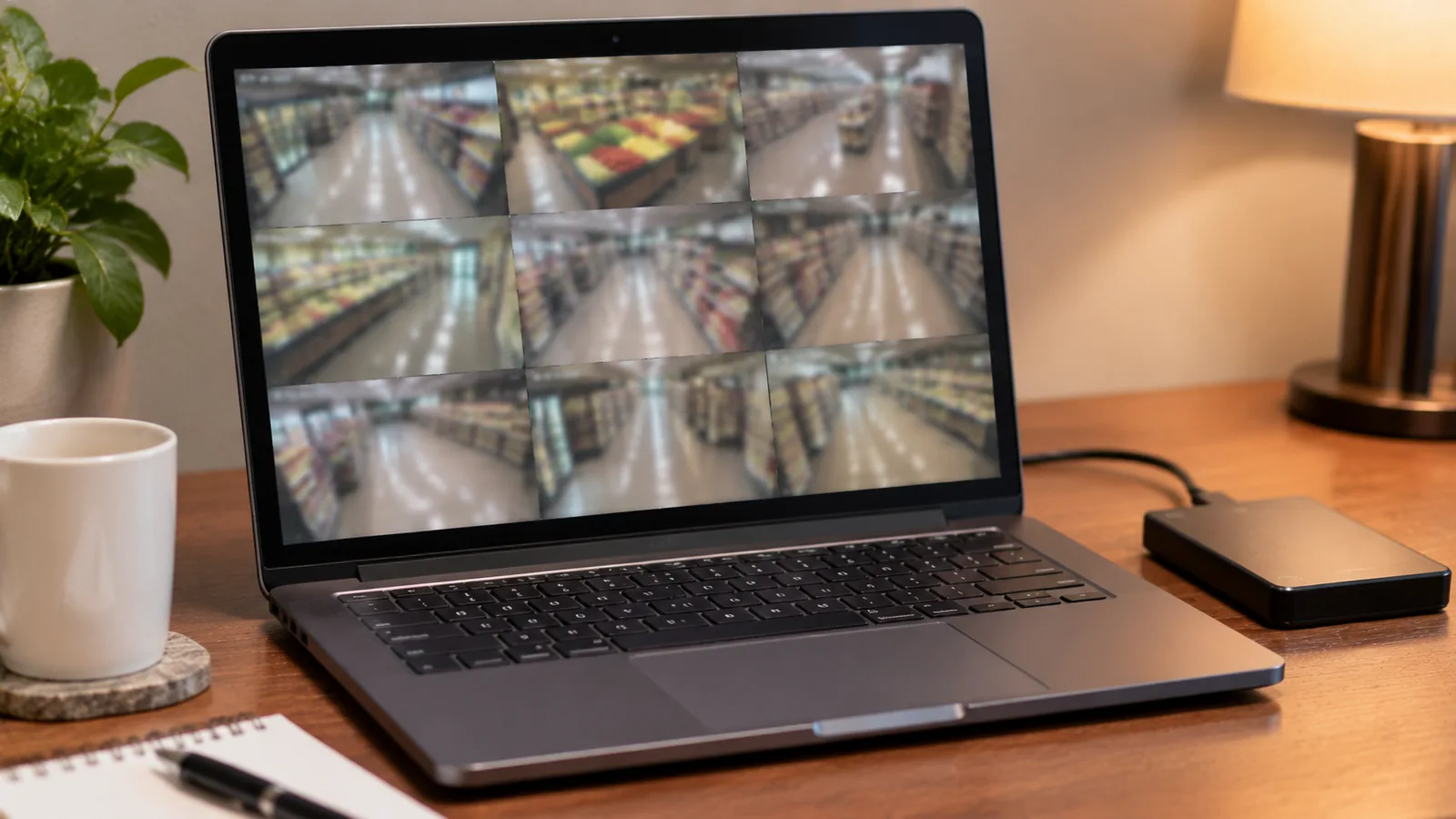
What should be checked when the store produces video?
Start with whether you got the native file and its data. Then work through five checks.
- The system clock, for how it was set and when it was last checked.
- The export, for whether timestamps changed or the footage was converted.
- The frames, for gaps or dropped frames.
- Each camera's field of view, for what it covers and any overlaps.
- The angles, for cameras the store didn't produce.
An on-screen time isn't proof by itself. Outside clocks help, each with its own limit, and the clock table in the next section lists them. Note every gap. Don't quietly fix the timeline.
Three clocks, three different times
The incident report says 2:30 p.m. The camera clip says 2:19. The receipt says 2:25. Each explanation needs its own check.
| Possible explanation | What to check |
|---|---|
| A camera clock difference | Whether anyone checked the camera clock. |
| An estimated report time | How the time was entered, and whether a later report estimates it. |
| Different events | Which sale is the shopper's; only your own receipt helps. |
| A 911 log | When the call went out, which isn't when you fell. |
| A second camera | Its own clock, which can be off by its own amount. |
| A clock that's simply wrong | Relative timing: 40 seconds before the fall stays 40 seconds. |
None of those numbers is the right one until the checks are done. An expert who corrects for a clock says which measurement the opinion uses and how much doubt is left, and nobody relabels the footage or calls the corrected time the system's own.
One 30-second clip, and that's all
Fall at 3:14. Clip runs 3:13:50 to 3:14:20. Nothing else produced. Is that a cover-up? Not yet. Ask about the system first:
- a camera at that spot, and whether it worked (an empty housing happens; so does a running system that didn't record)
- its view, and whether the floor was in it
- the normal retention period
- the date the fall was reported, and the date the letter arrived
- other cameras, and whether anyone saved them
- anyone who watched or copied footage that's now gone
Then the three-part spoliation test Texas courts use. In Brookshire Bros., Ltd. v. Aldridge, 438 S.W.3d 9 (Tex. 2014), the store had kept the fall and a short stretch before it, and the rest was recorded over. The Supreme Court of Texas left two questions to the trial judge: whether spoliation happened, and what remedy fits. A spoliation instruction is reserved for intentional destruction, or a negligent loss that irreparably took away the other side's meaningful ability to present its case.
| Part | Pin down with your lawyer | If it's missing |
|---|---|---|
| Duty to preserve | Who controlled the footage, and when a duty to keep it arose | No duty, no breach. |
| Breach | What was lost, and when | Lost footage alone doesn't prove liability. |
| Remedy | What the loss took from your case | No prejudice may mean no remedy. |
How should someone go through the footage?
With a log open beside the player, and no conclusions yet.
- Give each clip one log line: camera, time range, source, event.
- Put native originals in one folder and demonstrative clips in another.
- Keep a log of every crop, enlargement, slow-motion pass, stabilization, and annotation.
Notes describe frames, not conclusions. Resolution, lighting, compression, and reflections all blur what a shiny patch really is.
| Note that embeds an inference | More precise note |
|---|---|
| "Employee sees spill." | "At 00:41 relative time, the employee turns toward the area; whether he saw the liquid is disputed." |
| "Floor is wet." | "A lighter, shiny area near the case; the recording doesn't show what it is." |
| "Floor by the freezer: dry." | Blind spot behind the endcap; a witness or a photo taken minutes later fills it. |
| "Dairy camera at 2:52 = produce camera at 2:50." | Matched on one shared event, a cart passing the endcap; basis and margin noted |
No puddle in a wide shot? That still doesn't mean a dry floor. And if a second reviewer reads a clip differently ("stocker never looked down"), the reason goes in the log and both reviewers go back to the source.
In front of a mediator or a jury, each clip carries its source, start and end points, playback speed, and annotations. Enlarged stills are marked "enlarged." Estimated times are marked "estimated."
Who else might have filmed it?
Ask fast, and ask lawfully: no trespassing, no posing as an official, no getting into private systems. A delivery record can put an employee in the store, though it says nothing about a spill.
- The tire shop's camera next door, for you arriving and leaving, though not the spot where you fell.
- A witness's phone, for the original if the witness keeps it, though not the edited version on social media.
- Photos taken minutes later, for the scene if you know who took each and whether cleanup had started, though not what the floor looked like before the fall.
- A camera installed or removed since, for what changed at a later site visit, though not that the earlier event was recorded or a recording destroyed.
- Sweep sheets, checklists, spill reports and work orders, for what employees actually did, read with testimony, though not what policy said they should do.
That last item is where written discovery in a La Michoacana injury lawsuit goes digging.
What about the photos on your own phone?
- Keep every original, the blurry and unflattering ones too.
- Ask anyone else who took pictures in the store to do the same.
- Leave timestamps alone, and skip the cleaned-up copies.
- Be ready to say who held each phone and which apps the pictures passed through.
No recording at all? Witnesses, photos, inspection sheets, texts, and repair records can still carry a case, though none guarantees a viable claim. The La Michoacana injury case and trial preparation guide has the bigger plan.
Frequently asked questions
How long does La Michoacana keep video?
No one outside the company can give a number that fits every store and camera system, and this page won't guess one. Treat each day as one the footage could be recorded over, and get the preservation request out.
Will the store give me all the footage right away?
Before a lawsuit, it doesn't have to hand you anything, and it can say no. After suit is filed, discovery gives your lawyer a formal way to ask. A no in the first week doesn't mean the footage is gone.
Can my lawyer slow down the footage?
With the court's permission, a slow-motion clip or a still can be shown once it's identified. The original is kept and every change disclosed.
Is an annotated clip still "the video"?
It's a presentation version made from the video. Call it that, never "unaltered," and keep the original next to it.
Talk with Aaron Herbert's office
Bring the store address, the incident date, and whatever photos, receipts, or witness names you have. Tell us about your La Michoacana injury or call (214) 200-4878. Aaron Herbert is Board Certified in Personal Injury Trial Law by the Texas Board of Legal Specialization. The Law Firm of Aaron A. Herbert, P.C. is at 8330 Lyndon B. Johnson Freeway, Suite 700, Dallas, Texas 75243. Contacting the firm doesn't create an attorney-client relationship, and no result is guaranteed.
Related pages on La Michoacana injuries
- Texas La Michoacana supermarket injury knowledge hub: every guide in one place.
- La Michoacana injury case and trial preparation guide: the full lawsuit.
- The first 72 hours after a La Michoacana injury: early steps.
- Proving store notice in a La Michoacana slip and fall: duration evidence.
- Written discovery in a La Michoacana injury lawsuit: records requests.
Sources
- Brookshire Bros., Ltd. v. Aldridge, 438 S.W.3d 9 (Tex. 2014).
- H-E-B, LP v. Peterson, No. 24-0310 (Tex. Apr. 10, 2026).
- Texas Judicial Branch, rules and standards, Texas Rules of Civil Procedure as amended October 1, 2026.
Legal sources checked November 2, 2026.

ABOUT THE ATTORNEY
Aaron A. Herbert
Founding Attorney
Board Certified in Personal Injury Trial Law
Aaron founded The Law Firm of Aaron A. Herbert in 2010 to focus on developing each client's case and seeking its maximum value. For over a decade, he has represented people seriously injured in major accidents and industrial catastrophes, pursuing trial verdicts and settlements while working to reduce the stress of litigation.
Education
- Texas A&M University · B.S., Criminal Justice, 1999
- University of Oklahoma College of Law · J.D., 2002; graduated in the top of his class
Trial experience & approach
Aaron earned numerous jury verdicts at boutique personal injury litigation firms. According to his biography, he spent a year as the top-earning litigation attorney at a firm that frequently appeared in verdict searches as having one of the highest numbers of trial wins in Texas. At another Dallas personal injury firm, he moved from managing pre-litigation attorney to managing litigation attorney over seven years as the firm grew into one of Dallas's largest personal injury firms.
His biography describes a reputation as one of America's most aggressive trial lawyers, with noteworthy recoveries from judges and juries and substantial pretrial settlements. Most of those settlements included confidentiality agreements requested by the defense. Aaron has said the recoveries were justified by the injuries and losses involved, which no amount of money could make someone choose to experience.
His approach combines passion, preparation, persistence and courtroom imagination. He believes a well-supported, engaged and motivated team working cooperatively helps deliver strong representation, with the goal of achieving the best possible result for every client.
Dallas roots, military service & publication
Born and raised in Dallas, Aaron enlisted in the United States Marine Corps after high school and later received an Honorable Discharge. He completed his university and law degrees after his military service and became a lifelong Sooners football fan in law school.
Publication: “Litigating Dog Bite Cases,” Texas Dog Law Seminar, Dallas, 2009.
Professional affiliations & recognition
Professional affiliations and recognition listed in Aaron’s biography:
- State Bar of Texas
- American Bar Association
- Association of Trial Lawyers of America (now American Association for Justice)
- Texas Trial Lawyers Association
- Dallas Trial Lawyers Association
- Dallas Bar Association
- Tarrant County Bar Association
- Million Dollar Advocates Forum
- The National Trial Lawyers – Top 100 Trial Lawyers