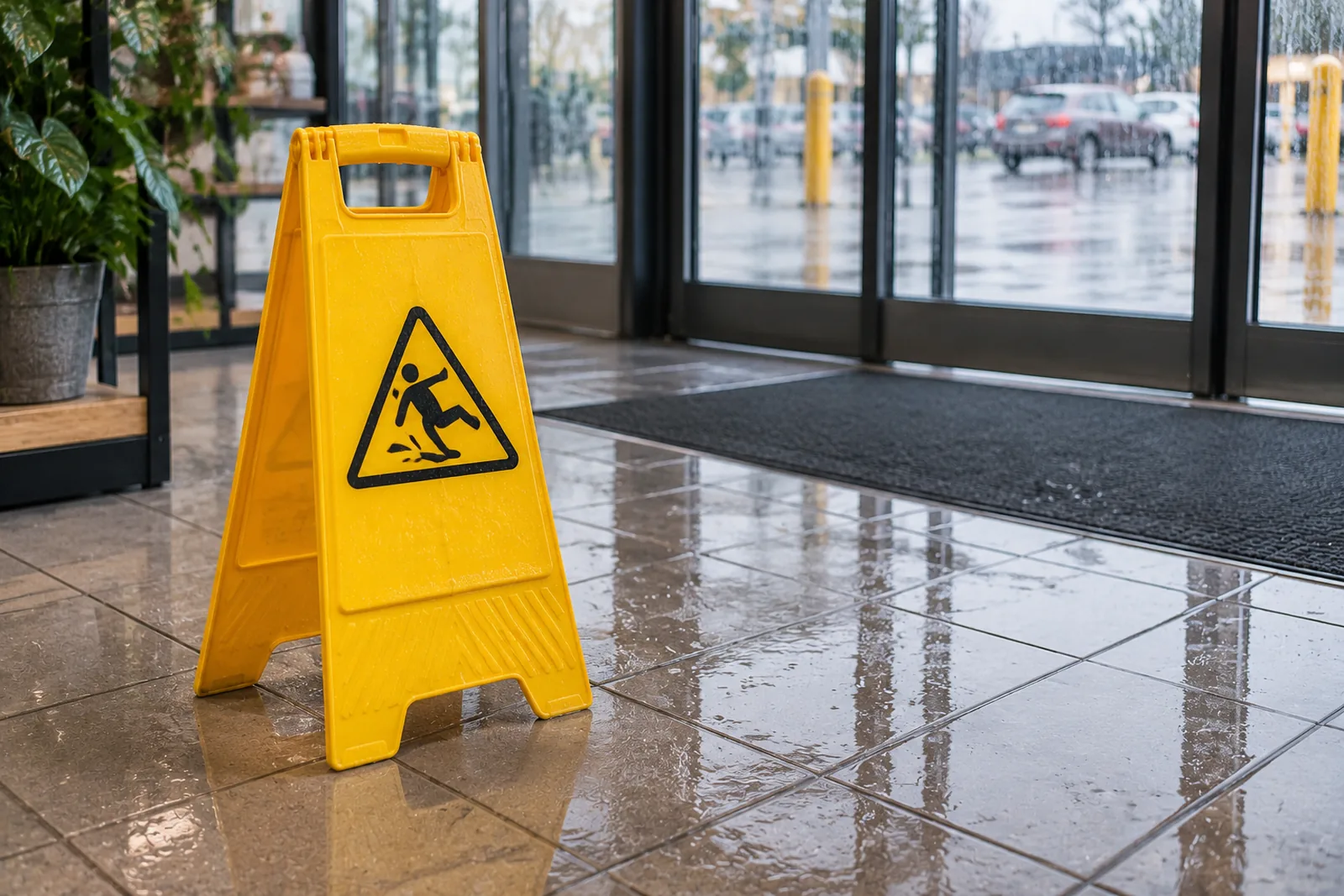
Say a yellow sign stood by the front doors of a Burlington and you slipped 20 feet away by the shoe racks. Whether that sign helps the store depends on what it warned about, where it stood, when it went up, and what you already knew.
Two Texas rules, and the question each one answers
- Known or obvious danger (Austin v. Kroger), which asks whether the store owed a duty to warn about or fix this hazard at all. [S9]
- Proportionate responsibility (Chapter 33), which asks how much of the fault was yours if the store is liable. [S14]
Keep the timing straight.
Warnings, with a hypothetical example of each
- Placed before the fall, on your route, such as a yellow sign at the front entrance mat on a rainy afternoon.
- Placed after the fall, such as a cone set down by an employee who came to help.
- Placed somewhere else, such as a sign by the restrooms while the spill was near checkout.
A cone set out during cleanup is different from a barrier placed before the fall, and a sign in another aisle may not cover your route.
Did the warning match the actual danger?
A warning matters only if it addressed the hazard that hurt you, at the place and time you encountered it.
What to record, with a hypothetical example of each
- What the sign said, such as "Caution: wet floor."
- Where it stood, such as six feet inside the doors, facing the parking lot.
- When it appeared, such as a witness saying it went up after the fall.
- What blocked it, such as a rolling rack of coats that stood between the sign and the aisle.
- What hazard it addressed, such as water, while the fall happened on a mat with a curled edge.
No automatic rule says signs always defeat a claim or never matter. The facts decide it.
Area status and what it may show
- Closed with tape or stanchions, which may show the store tried to keep shoppers out.
- Marked with a sign but open, which may show a warning was given and the route stayed in use.
- Used under an employee's direction, such as "Go around this way," which may affect the analysis.
- Photos taken afterward, which should show the whole route and don't prove where a sign stood before the fall.

What if you already knew about the hazard?
Tell your lawyer if you saw the object, used the path earlier, got a warning, or had a limitation that affected how you walked.
Austin v. Kroger point | What it means |
|---|---|
General rule | There's generally no duty to warn of or make safe a hazard that is open and obvious or known to the invitee. [S9] |
Criminal-activity exception | A separate rule applies when the danger comes from a third party's criminal act. [S9] |
Necessary-use exception | It can apply when the invitee had to use the dangerous premises and the owner should have anticipated the invitee couldn't avoid the risk despite knowing about it. [S9] |
Case context | Austin was an employee case, not a shopper case. |
Prior awareness can decide whether the claim goes forward at all, not just trim damages by a small amount.
Route questions, with a hypothetical example of each
- Whether another route was open, such as a second entrance that was locked that morning.
- Whether it was safe, such as another route that crossed an unlit loading area.
- Whether staff directed you, such as an employee who said, "Use this door, the other one is closed."
Was it just more convenient? Convenience alone doesn't automatically establish necessary use.
How does the store argue you were at fault?
Expect the adjuster to point at your phone, your shoes, your route, or the sign, and ask for the proof behind each point.
Defense point | The counter-question |
|---|---|
"She was looking at her phone." | Does the video actually show that, and would it have changed anything? |
"His sandals caused the fall." | Can a shoe style explain a fixture that broke? |
"She walked past the cone." | Was the cone on her route, or two aisles over? |
"The video shows him jogging to the register." | If it does, that counts, even though it hurts. |
A fault percentage can't fill in a missing duty or a causation gap. [S14]
Your percentage and its effect under Chapter 33
- 0 percent, no reduction.
- 30 percent (hypothetical), damages reduced by 30 percent.
- 51 percent or more, no recovery.
How should you prepare your account before a deposition?
Go over your original statements, photos, and route with your lawyer so the account is accurate, not rehearsed.
Do | Don't |
|---|---|
Separate what you saw before the fall from what you noticed after | Fill gaps with guesses. |
Say when a time or distance is an estimate | State estimates as exact facts. |
Share prior injuries and conditions | Hide them and hope they don't come up. |
Hiding a hard fact usually creates a bigger credibility problem than the fact itself.
Why candor helps
- A realistic evaluation, because your lawyer can assess the store's failure and your circumstances together.
- Fewer surprises in the medical records, because prior injuries are addressed in liability and damages.
Questions about warnings and fault
Short answers to common questions.
Does seeing the hazard automatically end my case?
No single answer fits every case. The duty rule, its limited exceptions, causation and the facts need individual review. [S9]
Can someone else share responsibility?
Possibly, when the law and the evidence support it. Several parties require coordinated fault and settlement analysis. [S14]
You can contact The Law Firm of Aaron A. Herbert, P.C. with the route, photos, warnings, and any statements you gave. Aaron Herbert is Board Certified in Personal Injury Trial Law by the Texas Board of Legal Specialization. [S1] The Law Firm of Aaron A. Herbert, P.C. is not affiliated with or endorsed by Burlington Stores, Inc.
Tell us about your Burlington injury or call (214) 200-4878.
More from the Burlington knowledge hub
- Texas Burlington injury knowledge hub, with all the Burlington guides in one place.
- How to file and litigate a Texas Burlington injury claim, the full process from evidence through trial.
Sources
- S1. State Bar of Texas, Aaron Alan Herbert profile.
- S9. Austin v. Kroger Texas, L.P., 465 S.W.3d 193 (Tex. 2015).
- S14. Texas Civil Practice and Remedies Code chapter 33.
Each source above was checked on October 31, 2026, and the key holdings were rechecked on November 2, 2026.

ABOUT THE ATTORNEY
Aaron A. Herbert
Founding Attorney
Board Certified in Personal Injury Trial Law
Aaron founded The Law Firm of Aaron A. Herbert in 2010 to focus on developing each client's case and seeking its maximum value. For over a decade, he has represented people seriously injured in major accidents and industrial catastrophes, pursuing trial verdicts and settlements while working to reduce the stress of litigation.
Education
- Texas A&M University · B.S., Criminal Justice, 1999
- University of Oklahoma College of Law · J.D., 2002; graduated in the top of his class
Trial experience & approach
Aaron earned numerous jury verdicts at boutique personal injury litigation firms. According to his biography, he spent a year as the top-earning litigation attorney at a firm that frequently appeared in verdict searches as having one of the highest numbers of trial wins in Texas. At another Dallas personal injury firm, he moved from managing pre-litigation attorney to managing litigation attorney over seven years as the firm grew into one of Dallas's largest personal injury firms.
His biography describes a reputation as one of America's most aggressive trial lawyers, with noteworthy recoveries from judges and juries and substantial pretrial settlements. Most of those settlements included confidentiality agreements requested by the defense. Aaron has said the recoveries were justified by the injuries and losses involved, which no amount of money could make someone choose to experience.
His approach combines passion, preparation, persistence and courtroom imagination. He believes a well-supported, engaged and motivated team working cooperatively helps deliver strong representation, with the goal of achieving the best possible result for every client.
Dallas roots, military service & publication
Born and raised in Dallas, Aaron enlisted in the United States Marine Corps after high school and later received an Honorable Discharge. He completed his university and law degrees after his military service and became a lifelong Sooners football fan in law school.
Publication: “Litigating Dog Bite Cases,” Texas Dog Law Seminar, Dallas, 2009.
Professional affiliations & recognition
Professional affiliations and recognition listed in Aaron’s biography:
- State Bar of Texas
- American Bar Association
- Association of Trial Lawyers of America (now American Association for Justice)
- Texas Trial Lawyers Association
- Dallas Trial Lawyers Association
- Dallas Bar Association
- Tarrant County Bar Association
- Million Dollar Advocates Forum
- The National Trial Lawyers – Top 100 Trial Lawyers