
After a Burlington injury, ask quickly for the store's video, reports, and records to be kept, and name the store, the spot, the time, and the camera views that matter. We found no public Burlington footage-retention period, so don't assume the video will still exist weeks later.
Question | Short answer |
|---|---|
How soon should I ask? | As soon as you safely can, ideally within days. |
Can I ask before hiring a lawyer? | Yes. You can tell the store in writing to keep the material, and a lawyer can follow up with a more precise request. |
Does preservation stop the store from cleaning or repairing? | No. Safety work can go ahead with reasonable photos and, where practical, the removed parts kept. |
Does missing video mean I win? | No. A judge decides what happens if evidence was lost. [S11] |
What shouldn't I do? | Don't go into staff-only systems, take store property, or recreate the fall. Safety and medical care come first. |
Ask for the minutes around the fall, not just the fall
A clip of the fall alone may not show the hanger landing on the floor, a rack being moved, an earlier complaint, or the cleanup.
What to ask for, with a hypothetical example of what it can answer
- The 30 to 60 minutes before the fall, for whether the hanger was in the walkway at 3:10 p.m., before your 3:45 fall.
- The minutes after, for who picked it up and whether a sign went out.
- The neighboring cameras, such as an end-of-aisle camera that may show a rolling rack being pushed in.
- The entrance and parking views, for rain being tracked in or the car that backed into you.
Keep the request tied to views and times that make sense, instead of asking for every camera indefinitely.
Questions about the video system, and why they matter
- Who controls the system, because it may be the store operator, a landlord or a security vendor.
- What was exported and in what format, because a phone recording of a monitor loses detail.
- Whether the camera clock was accurate, because a clock running seven minutes fast changes the timeline.
- What the camera can't show, because a small hanger, a blind spot or poor resolution can limit what it proves.
Keep the original files and use copies for zooming in or adding arrows, and note every change you make to a copy.
Read next: What to do in the first 72 hours after a Burlington injury, on the other early steps, from care to witnesses.
Records that explain what the store knew and did
Reports, photos, cleaning and inspection entries, work orders, complaints, vendor scopes, and messages can each fill in part of the story.
Records, with a hypothetical example of what each may show
- Incident report, such as what staff wrote down at 3:50 p.m.
- Staff photos, such as the aisle before anything was moved.
- Inspection or walk-through entries, for whether anyone checked that aisle that afternoon.
- Work orders, such as a ticket about a loose fitting-room bench from the week before.
- Vendor scope, for what the mat or fixture company was hired to do.
- Complaints, such as an earlier customer report about the same spot.
Ask what records actually existed at that store, because a standard printout can leave out attachments or status history, and a closed ticket doesn't always mean the work was done.
If a record is missing, what to ask and why
- Whether it was ever created, because some tasks aren't logged.
- Whether it was kept and whether it was searched for, because loss and a poor search are different problems.
- Who had it, because that person may know what happened to it.
Does a gap prove destruction? Not by itself. Disputes go through the discovery rules.
Keep the physical evidence and your own records
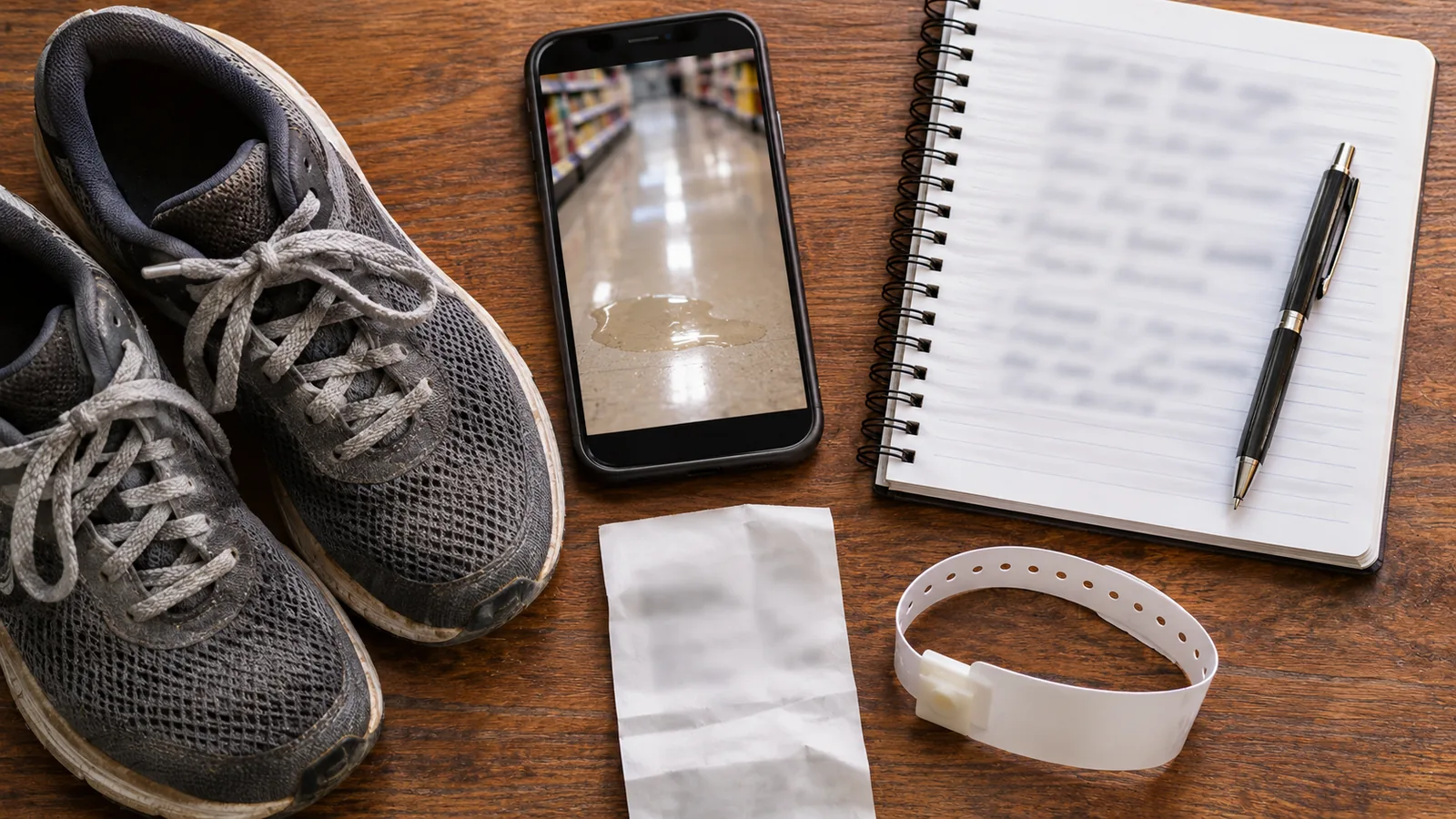
A mat, a rack part, a fixture, your shoes, or a garment can show how the injury happened.
Items and how to keep each one (hypothetical)
- A broken bench leg or rack wheel, with a request that it be tagged, photographed and stored, not thrown away.
- The entrance mat, with photos of its position and edges before it's replaced.
- Your shoes, bagged without cleaning them.
- Your phone, with the original photos and messages from that day.
An inspection plan can cover how the item is identified, photographed, stored, accessed, and tested, so both sides can rely on it later.
Your side of preservation
- Posts, messages and accounts, kept and not deleted, since preservation duties apply to the injured person too.
- Original photos, left unedited, since an altered image invites questions.
- Any accidental loss, reported to your lawyer right away, since backups and other sources may still exist.
What spoliation means, and what it doesn't
Under Brookshire Brothers v. Aldridge, the judge decides whether a party had a duty to keep evidence, whether it failed, and what proportionate remedy fits. [S11]
Spoliation question | What the court looks at |
|---|---|
Duty | Did the party know, or should it have known, that a claim was likely? |
Breach | Did it fail to take reasonable steps to keep the evidence? |
Remedy | A spoliation jury instruction is reserved for intentional destruction, or a negligent loss that left the other side with no meaningful way to prove its case. [S11] |
Lost video doesn't prove negligence, so the case still needs its own evidence. In H-E-B, LP v. Peterson (2026), the claim failed because nothing showed how long the puddle had been on the floor. [S5]
Instead of relying on a sanction
- Arguing about lost footage.
- Assuming the store hid something.
- Waiting for a ruling.
Build this proof, in the same order.
- Witnesses who saw the hazard earlier.
- A timeline from receipts, messages and reports.
- Your own photos and the physical evidence.
Questions about Burlington evidence
Should I send the store a letter myself?
You can. Keep it short: the store, the date, the time, the spot and a request to keep video and records.
Can the store fix the hazard right away?
Yes. Safety comes first; the request asks that it be documented and parts kept where practical.
Aaron Herbert is Board Certified in Personal Injury Trial Law by the Texas Board of Legal Specialization. [S1] Tell the firm about any repairs planned or records at risk. The Law Firm of Aaron A. Herbert, P.C. is not affiliated with or endorsed by Burlington Stores, Inc.
Tell us about your Burlington injury or call (214) 200-4878 with the store, the time, and what you know about repairs or records that may be lost.
More from the Burlington knowledge hub
- Texas Burlington injury knowledge hub, with all the Burlington guides in one place.
- How to file and litigate a Texas Burlington injury claim, the full process from evidence through trial.
Sources
Ref | Source |
|---|---|
S1 | State Bar of Texas, Aaron Alan Herbert profile. |
S5 | H-E-B, LP v. Peterson, No. 24-0310 (Tex. Apr. 10, 2026). |
S11 | Brookshire Brothers, Ltd. v. Aldridge, 438 S.W.3d 9 (Tex. 2014). |
Each source above was checked on October 31, 2026.

ABOUT THE ATTORNEY
Aaron A. Herbert
Founding Attorney
Board Certified in Personal Injury Trial Law
Aaron founded The Law Firm of Aaron A. Herbert in 2010 to focus on developing each client's case and seeking its maximum value. For over a decade, he has represented people seriously injured in major accidents and industrial catastrophes, pursuing trial verdicts and settlements while working to reduce the stress of litigation.
Education
- Texas A&M University · B.S., Criminal Justice, 1999
- University of Oklahoma College of Law · J.D., 2002; graduated in the top of his class
Trial experience & approach
Aaron earned numerous jury verdicts at boutique personal injury litigation firms. According to his biography, he spent a year as the top-earning litigation attorney at a firm that frequently appeared in verdict searches as having one of the highest numbers of trial wins in Texas. At another Dallas personal injury firm, he moved from managing pre-litigation attorney to managing litigation attorney over seven years as the firm grew into one of Dallas's largest personal injury firms.
His biography describes a reputation as one of America's most aggressive trial lawyers, with noteworthy recoveries from judges and juries and substantial pretrial settlements. Most of those settlements included confidentiality agreements requested by the defense. Aaron has said the recoveries were justified by the injuries and losses involved, which no amount of money could make someone choose to experience.
His approach combines passion, preparation, persistence and courtroom imagination. He believes a well-supported, engaged and motivated team working cooperatively helps deliver strong representation, with the goal of achieving the best possible result for every client.
Dallas roots, military service & publication
Born and raised in Dallas, Aaron enlisted in the United States Marine Corps after high school and later received an Honorable Discharge. He completed his university and law degrees after his military service and became a lifelong Sooners football fan in law school.
Publication: “Litigating Dog Bite Cases,” Texas Dog Law Seminar, Dallas, 2009.
Professional affiliations & recognition
Professional affiliations and recognition listed in Aaron’s biography:
- State Bar of Texas
- American Bar Association
- Association of Trial Lawyers of America (now American Association for Justice)
- Texas Trial Lawyers Association
- Dallas Trial Lawyers Association
- Dallas Bar Association
- Tarrant County Bar Association
- Million Dollar Advocates Forum
- The National Trial Lawyers – Top 100 Trial Lawyers