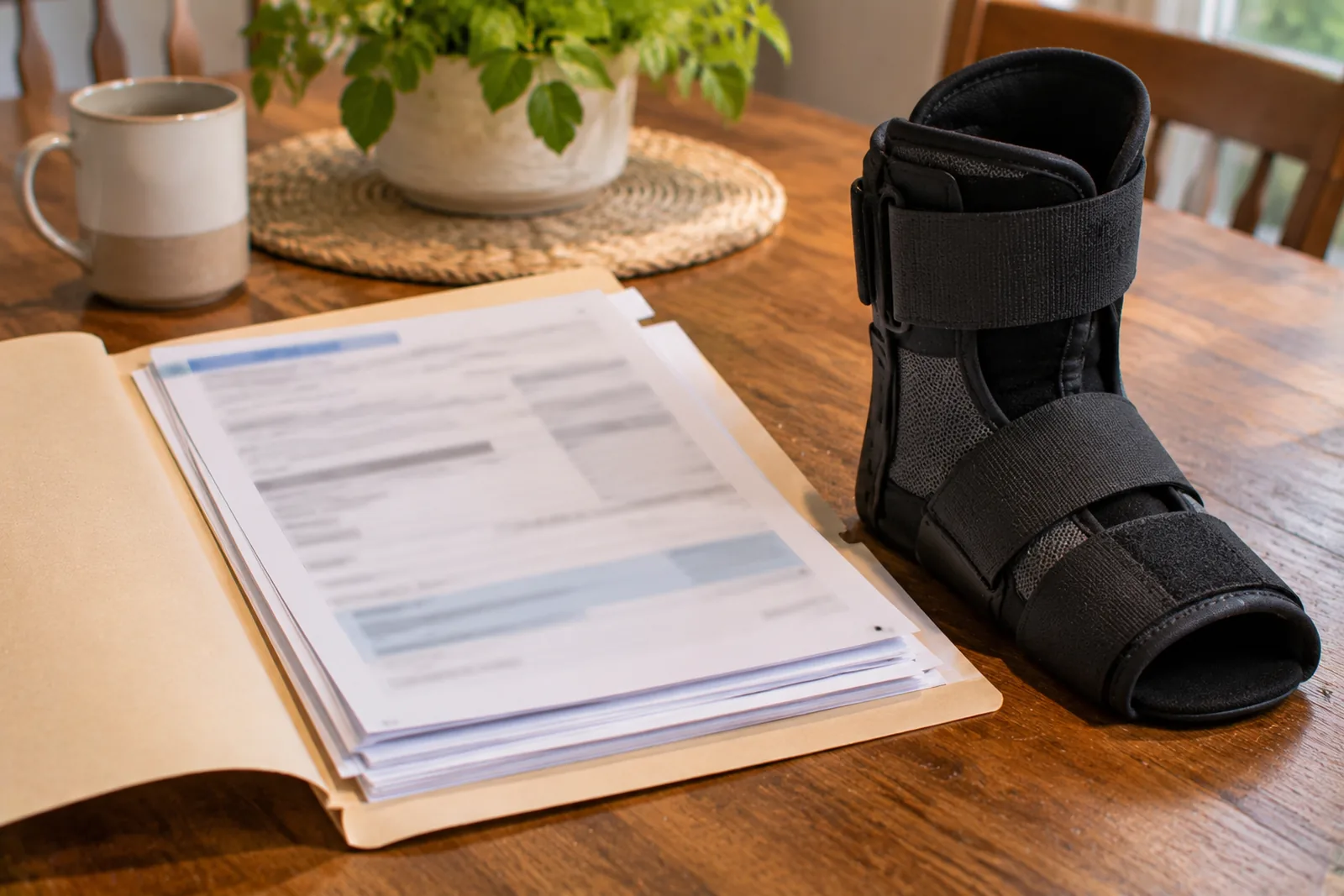
A Burlington injury settlement is valued from your own case: the liability proof, the medically connected harm, your losses, any shared fault, coverage, collection, expenses, and timing. Public research didn't establish a representative Texas Burlington settlement average or median, so a single verdict or an online range can't price your claim.
What drives value, with a hypothetical example of each
- Liability proof, such as footage showing the spill on the floor 30 minutes before the fall.
- Medical connection, such as an MRI and a surgeon's note tying a torn meniscus to the fall.
- Losses, such as six weeks of missed shifts at a warehouse job.
- Shared fault, such as a claim that the shopper was looking at her phone.
- Coverage and collection, meaning which company and which policy will actually pay.
A serious injury can support significant damages when responsibility and causation are proved, but it doesn't supply missing notice or identify an unknown object.
Weak spots medical bills don't fix
- No proof the store knew about the hazard, where notice still has to be proved.
- Nobody knowing what caused the fall, where the mechanism still has to be shown.
Build liability and damages together.
What did the fall actually cause?
Collect the records, imaging, treatment history, and medical opinions needed to show what changed and why it relates to the fall.
What to disclose
- Earlier symptoms and surgeries, because a worsened condition can be proved without pretending you were healthy before.
- Degeneration on imaging, because the doctor can explain what's new and what isn't.
- Earlier claims and later accidents, because the defense will find them anyway.
Treatment gaps and delayed symptoms need accurate explanations, not invented ones. Treatment should follow your medical needs, because unnecessary care doesn't make a sound damages case.
What to keep, with a hypothetical example of each
- Instructions and restrictions, such as "Ice and elevate, no stairs for two weeks."
- Appointments, such as a calendar showing each therapy visit.
- Receipts, such as pharmacy, brace and mileage receipts.

How are medical bills and future care proved?
Texas limits recoverable medical expenses to the amount actually paid or incurred by or on your behalf, under Section 41.0105. [S15]
Rule | What it means |
|---|---|
Section 41.0105 | Recovery is limited to amounts actually paid or incurred. [S15] |
Section 18.001 affidavit | Uncontroverted, it can be enough evidence that charges were reasonable and services necessary. [S16] |
What 18.001 doesn't do | It isn't evidence of causation or premises liability. [S16] |
Deadlines and counteraffidavits | Counsel should check the current statute and the court's orders. |
Future care needs a qualified foundation, a reasonable likelihood it will happen, and cost support. A doctor discussing options doesn't prove every procedure will happen, and the same harm can't be counted twice across categories.
Category | Example (hypothetical) |
|---|---|
Future medical | A surgeon says a knee replacement is reasonably likely within 10 years. |
Physical impairment | Can no longer kneel to garden. |
Exemplary damages | Require clear and convincing evidence and are capped, and they aren't automatic because the defendant is a large company. [S15] |
How do you prove lost earnings and daily limits?
Payroll, attendance, tax, business, and leave records can support lost work, and restrictions from your doctor connect them to the injury.
Situation | Proof |
|---|---|
Hourly employee | Pay stubs and a supervisor's list of missed shifts. |
Self-employed | Tax returns, with lost earnings separated from revenue changes that had other causes. |
Reduced earning capacity may need a vocational or economic expert.
Describe the practical effects on standing, carrying, driving, sleep, childcare, and work, and include what improved.
Witness | What they can say |
|---|---|
Spouse | "He stopped taking the kids to the park." |
Coworker | "She needed help lifting boxes for two months." |
A balanced account is more believable than one that leaves out everything you can still do.
What will you actually keep?
Fees, case expenses, medical balances, liens, reimbursement claims, and credits all come out before you're paid.
What to ask about each deduction from a $60,000 offer (hypothetical)
- What percentage applies to the attorney's fee under the written agreement?
- Which records, filing and expert costs come out as case expenses?
- Which providers or health plans will be repaid for medical balances and reimbursement claims, and how much?
- Do settlement credits for payments from other parties change the amount?
Under Chapter 33, recovery is barred if your share of responsibility is greater than 50 percent and otherwise reduced by your percentage. A verdict may also face motions, appeal, and collection problems. [S14]
Before you accept | Ask |
|---|---|
Release scope | Which claims and parties does it end? |
Alternatives | What happens if you go to trial instead? |
Written estimate | What's still unresolved in the distribution? |
Questions about settlement value
Short answers to common questions.
Is a settlement a multiple of medical bills?
Liability, causation, future needs, other losses, fault and collection can all change the assessment, so no reliable universal multiplier sets value.
Should I settle while I'm still treating?
Ongoing care doesn't extend the two-year filing deadline. [S12] Discuss your prognosis, what's still uncertain, deadlines, costs and the release.
You can ask The Law Firm of Aaron A. Herbert, P.C. about proof, valuation, expenses, communication, and trial preparation. Aaron Herbert is Board Certified in Personal Injury Trial Law by the Texas Board of Legal Specialization. No outcome is promised. [S1] The Law Firm of Aaron A. Herbert, P.C. is not affiliated with or endorsed by Burlington Stores, Inc.
Tell us about your Burlington injury or call (214) 200-4878.
More from the Burlington knowledge hub
- Texas Burlington injury knowledge hub, with all the Burlington guides in one place.
- How to file and litigate a Texas Burlington injury claim, the full process from evidence through trial.
- Texas injury claim value and litigation, on how Texas injury claims are valued in general.
Sources
- S1. State Bar of Texas, Aaron Alan Herbert profile.
- S12. Texas Civil Practice and Remedies Code chapter 16.
- S14. Texas Civil Practice and Remedies Code chapter 33.
- S15. Texas Civil Practice and Remedies Code chapter 41.
- S16. Texas Civil Practice and Remedies Code section 18.001.
Each source above was checked on October 31, 2026, and the statutes were rechecked on November 2, 2026.

ABOUT THE ATTORNEY
Aaron A. Herbert
Founding Attorney
Board Certified in Personal Injury Trial Law
Aaron founded The Law Firm of Aaron A. Herbert in 2010 to focus on developing each client's case and seeking its maximum value. For over a decade, he has represented people seriously injured in major accidents and industrial catastrophes, pursuing trial verdicts and settlements while working to reduce the stress of litigation.
Education
- Texas A&M University · B.S., Criminal Justice, 1999
- University of Oklahoma College of Law · J.D., 2002; graduated in the top of his class
Trial experience & approach
Aaron earned numerous jury verdicts at boutique personal injury litigation firms. According to his biography, he spent a year as the top-earning litigation attorney at a firm that frequently appeared in verdict searches as having one of the highest numbers of trial wins in Texas. At another Dallas personal injury firm, he moved from managing pre-litigation attorney to managing litigation attorney over seven years as the firm grew into one of Dallas's largest personal injury firms.
His biography describes a reputation as one of America's most aggressive trial lawyers, with noteworthy recoveries from judges and juries and substantial pretrial settlements. Most of those settlements included confidentiality agreements requested by the defense. Aaron has said the recoveries were justified by the injuries and losses involved, which no amount of money could make someone choose to experience.
His approach combines passion, preparation, persistence and courtroom imagination. He believes a well-supported, engaged and motivated team working cooperatively helps deliver strong representation, with the goal of achieving the best possible result for every client.
Dallas roots, military service & publication
Born and raised in Dallas, Aaron enlisted in the United States Marine Corps after high school and later received an Honorable Discharge. He completed his university and law degrees after his military service and became a lifelong Sooners football fan in law school.
Publication: “Litigating Dog Bite Cases,” Texas Dog Law Seminar, Dallas, 2009.
Professional affiliations & recognition
Professional affiliations and recognition listed in Aaron’s biography:
- State Bar of Texas
- American Bar Association
- Association of Trial Lawyers of America (now American Association for Justice)
- Texas Trial Lawyers Association
- Dallas Trial Lawyers Association
- Dallas Bar Association
- Tarrant County Bar Association
- Million Dollar Advocates Forum
- The National Trial Lawyers – Top 100 Trial Lawyers