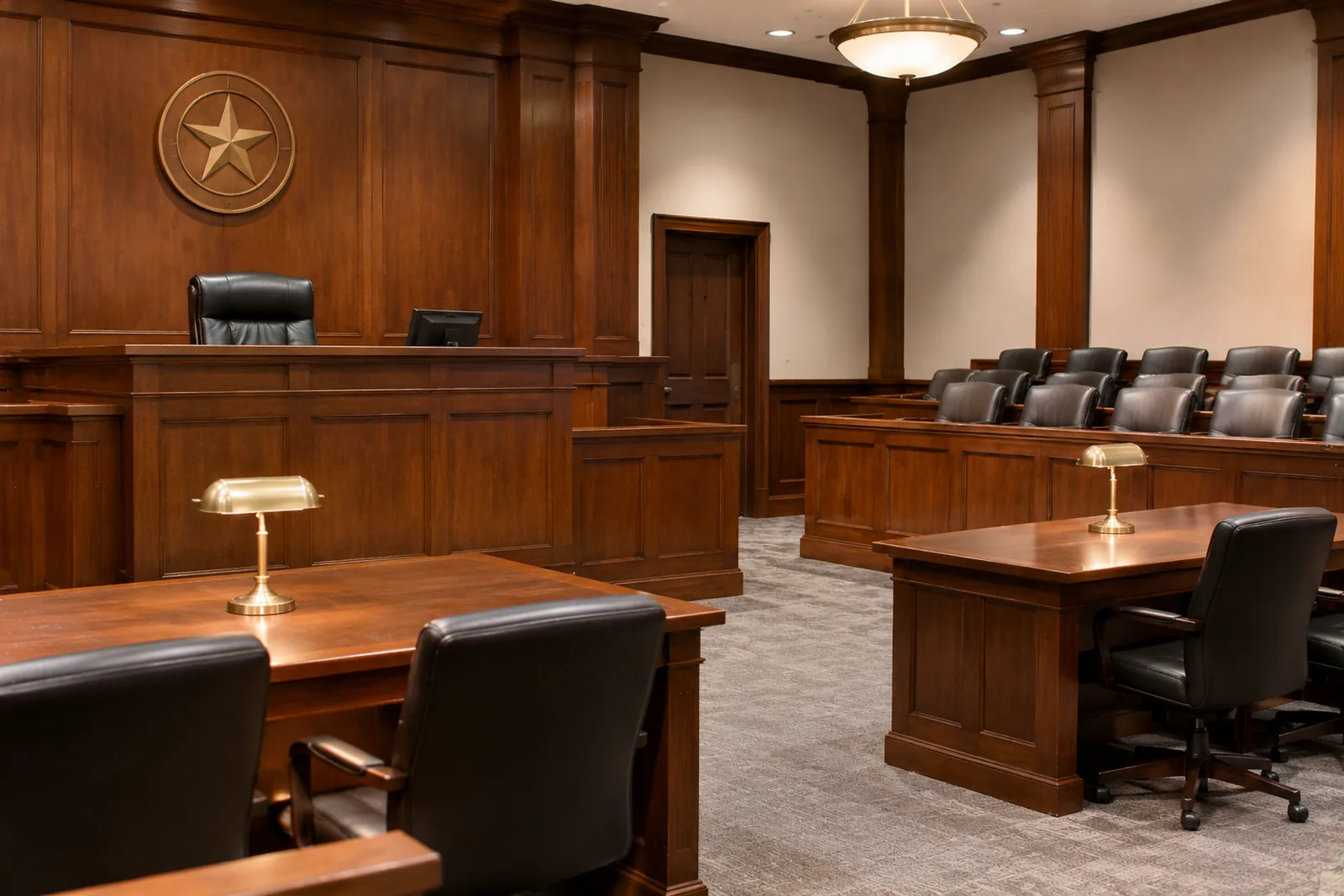
A Burlington injury lawsuit needs the right defendants, timely filing and service, admissible proof, and a plan that fits the court where the case is filed. Filing suit doesn't guarantee a bigger offer or a favorable verdict.
Stages, and what each is for
- Petition and service, for naming the right companies and getting them properly served.
- Discovery, for answering the disputed questions with records and testimony.
- Experts, for explaining technical failures, medical causation or future losses.
- Motions, for testing whether the evidence is enough to reach a jury.
- Mediation, for trying to settle with the trial record in view.
- Trial, for proving each required finding to a jury.
Texas generally allows two years to file a personal-injury lawsuit, subject to accrual rules, exceptions, and other provisions. A report, demand letter, or claim number doesn't extend that deadline. [S12, S22]
- Two years under Section 16.003, for the basic personal-injury deadline. [S12]
- Tolling under Section 16.001 while a person is under 18, for minors. [S12]
- Chapter 16's 10-year repose statutes, for construction and design work. [S12]
- A certificate of merit filed with the complaint, for licensed architects or engineers. [S22]
Who should be sued, and on what theory?
Confirm the operating company, the property owner, contractors, and anyone else involved for that store, date, and location.
Don't | Do |
|---|---|
Sue only the public parent company because its name is on the sign | Identify the company that controlled the area or did the work. |
Add affiliates without a basis | Name a company only when the evidence supports it. |
Premises conditions and ongoing activities are different theories.
Theory | Example (hypothetical) |
|---|---|
Premises condition | A rack base left sticking into the aisle. |
Negligent activity | A worker pushing a rack into a shopper. |
Alternative pleading | Fine where there's real uncertainty, as long as it leads to the right evidence. |
Under Keetch v. Kroger and United Scaffolding, Inc. v. Levine, an earlier act that left an obstacle isn't automatically an activity claim at the moment of injury, and the elements and jury findings have to match the theory. [S7, S8]
How should discovery be used?
Aim each request and deposition at the question most likely to decide the case.
Disputed issue | Discovery to use |
|---|---|
Notice | Surrounding footage, earlier reports, inspections, cleanup records, and witnesses. |
Control | Leases and evidence of who actually made maintenance decisions. |
Fixture failure | The retained parts, vendor records, and an expert inspection. |
Each witness has a different role, and the records can clear up location codes, timing, and conflicts.
Witnesses, and what they can cover
- A floor worker, on what they saw.
- The store manager, on authority and store practices.
- A vendor, on the scope of its work.
- A corporate representative, on topics properly designated in the deposition notice. [S17]
Privacy, privilege, and proportionality disputes go through the rules of civil procedure. [S17] On removal, a state-court case may be moved to federal court, which needs its own procedural analysis.

What changed for summary judgment in 2026?
For Texas summary-judgment motions filed on or after March 1, 2026, the response is due within 21 days after the motion is filed, except on leave of court or agreement of the parties. [S13]
Rule 166a point | What it means |
|---|---|
Older motions | The amendments apply only to motions filed on or after March 1, 2026. [S13] |
The old shorthand | Don't use the former response deadline out of habit. Check the current rule and the court's orders. [S13, S17] |
H-E-B, LP v. Peterson (2026) shows how missing timing evidence can end a spill case before trial: leaks elsewhere in the store and general inspection evidence didn't show how long that puddle existed. [S5]
What to audit early, with a hypothetical question for each
- On actual knowledge, is there a written report from before the fall?
- On duration, does any footage show the puddle earlier?
- On weak spots, which element would a no-evidence motion attack first?
How do mediation and trial work together?
Mediation should address the strongest defense, the supported damages, fault, coverage, cost, timing, and collection.
Before mediation, with a hypothetical example of each
- A distribution estimate, such as a written breakdown of fees, expenses and medical balances.
- A release review, such as whether the release would also end claims against the contractor.
- Chapter 33 effects, such as how a settlement with one party affects the others. [S14]
If the case goes to trial, testimony and exhibits are organized around the findings the jury must make.
Trial step | What to watch |
|---|---|
Jury selection | Questions about relevant attitudes, within court rules, without asking jurors to promise a verdict. |
Jury charge | Questions that fit a premises or activity theory, fault allocation, and damages. |
Objections | Preserved for appeal. |
After the verdict | Possible motions, appeal, enforcement, or further settlement. |
Questions about Burlington lawsuits
Short answers to common questions.
Do I always need an expert?
A technical failure, complex medical causation or future losses may need an expert, while some facts are within ordinary knowledge, so it depends on the issue.
Does filing a lawsuit end negotiations?
Cases often settle during litigation, so no, but talks don't replace deadlines or admissible evidence.
You can ask The Law Firm of Aaron A. Herbert, P.C. about evidence, experts, costs, communication, motions, and jury preparation. Aaron Herbert is Board Certified in Personal Injury Trial Law by the Texas Board of Legal Specialization. [S1] The Law Firm of Aaron A. Herbert, P.C. is not affiliated with or endorsed by Burlington Stores, Inc.
Tell us about your Burlington injury or call (214) 200-4878.
More from the Burlington knowledge hub
- Texas Burlington injury knowledge hub, with all the Burlington guides in one place.
- How to file and litigate a Texas Burlington injury claim, the full process from evidence through trial.
- Preserving Burlington video and injury evidence, on footage, records and physical items.
Sources
- S1. State Bar of Texas, Aaron Alan Herbert profile.
- S5. H-E-B, LP v. Peterson, No. 24-0310 (Tex. Apr. 10, 2026).
- S7. Keetch v. Kroger Co., 845 S.W.2d 262 (Tex. 1992).
- S8. United Scaffolding, Inc. v. Levine, 537 S.W.3d 463 (Tex. 2017).
- S12. Texas Civil Practice and Remedies Code chapter 16.
- S13. Supreme Court of Texas, Misc. Docket No. 26-9012 (Rule 166a amendments, effective March 1, 2026).
- S14. Texas Civil Practice and Remedies Code chapter 33.
- S17. Texas Rules of Civil Procedure.
- S22. Texas Civil Practice and Remedies Code chapter 150.
Each source above was checked on October 31, 2026, and Rule 166a was rechecked on November 2, 2026.

ABOUT THE ATTORNEY
Aaron A. Herbert
Founding Attorney
Board Certified in Personal Injury Trial Law
Aaron founded The Law Firm of Aaron A. Herbert in 2010 to focus on developing each client's case and seeking its maximum value. For over a decade, he has represented people seriously injured in major accidents and industrial catastrophes, pursuing trial verdicts and settlements while working to reduce the stress of litigation.
Education
- Texas A&M University · B.S., Criminal Justice, 1999
- University of Oklahoma College of Law · J.D., 2002; graduated in the top of his class
Trial experience & approach
Aaron earned numerous jury verdicts at boutique personal injury litigation firms. According to his biography, he spent a year as the top-earning litigation attorney at a firm that frequently appeared in verdict searches as having one of the highest numbers of trial wins in Texas. At another Dallas personal injury firm, he moved from managing pre-litigation attorney to managing litigation attorney over seven years as the firm grew into one of Dallas's largest personal injury firms.
His biography describes a reputation as one of America's most aggressive trial lawyers, with noteworthy recoveries from judges and juries and substantial pretrial settlements. Most of those settlements included confidentiality agreements requested by the defense. Aaron has said the recoveries were justified by the injuries and losses involved, which no amount of money could make someone choose to experience.
His approach combines passion, preparation, persistence and courtroom imagination. He believes a well-supported, engaged and motivated team working cooperatively helps deliver strong representation, with the goal of achieving the best possible result for every client.
Dallas roots, military service & publication
Born and raised in Dallas, Aaron enlisted in the United States Marine Corps after high school and later received an Honorable Discharge. He completed his university and law degrees after his military service and became a lifelong Sooners football fan in law school.
Publication: “Litigating Dog Bite Cases,” Texas Dog Law Seminar, Dallas, 2009.
Professional affiliations & recognition
Professional affiliations and recognition listed in Aaron’s biography:
- State Bar of Texas
- American Bar Association
- Association of Trial Lawyers of America (now American Association for Justice)
- Texas Trial Lawyers Association
- Dallas Trial Lawyers Association
- Dallas Bar Association
- Tarrant County Bar Association
- Million Dollar Advocates Forum
- The National Trial Lawyers – Top 100 Trial Lawyers