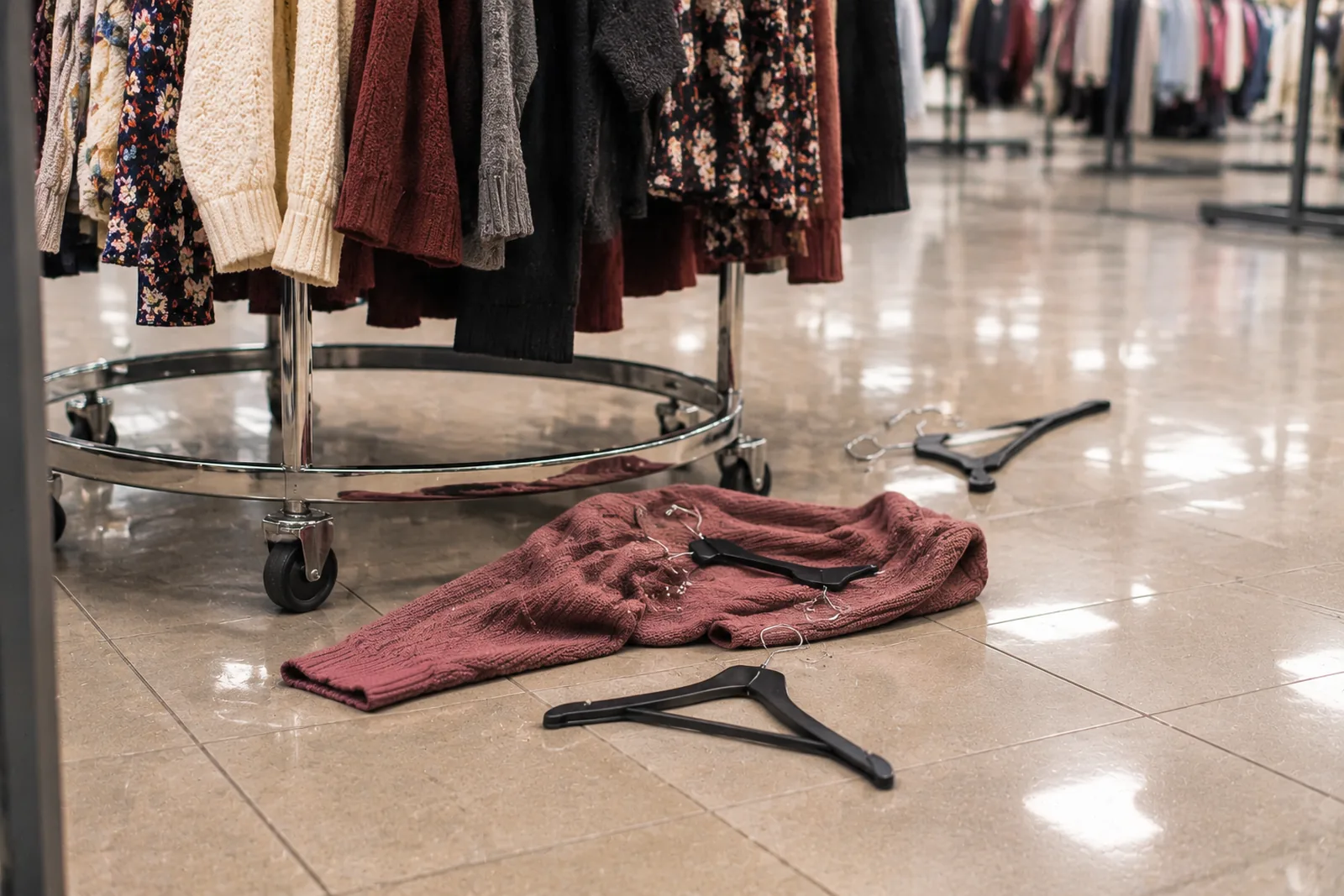
Your foot catches a plastic hanger under a round rack at Burlington and you go down. You may have a claim, but finding a hanger next to you afterward doesn't prove your foot touched it or that the store knew it was on the floor.
Each of these has to be shown. The examples are hypothetical.
- An unreasonably dangerous condition, such as a clear plastic hanger lying flat on light tile in the main aisle.
- Notice, such as a shopper telling a cashier about it 15 minutes before the fall.
- No reasonable care, such as nobody picking it up or blocking the aisle after the report.
- Causation, such as the hanger’s hook catching the shopper’s shoe so that she fell forward.
Start with how your foot moved, because the theory has to match what actually happened.
- Caught on a hook, a sleeve, or a loop of fabric.
- Slid on a slick garment bag or a plastic sleeve.
- Rolled on a round hanger clip or a dropped bead.
- Hit an edge, such as a rack base or a display platform, which may be a different hazard.
- Stepped past a hanger that was only nearby. It can matter without being the proven cause, so match the theory to what the footage will show.
How do you document the item and the route?
Photograph the scene from a safe spot with close shots of the item and wide shots that include fixed landmarks. The examples are hypothetical.
- A close shot, such as the hanger next to the toe of your shoe, before anyone touches it.
- A wide shot, such as the aisle, the round rack and the end-cap sign that marks the location.
- A shot of the lighting and contrast, such as a clear hanger on pale tile under bright lights.
- A shot of any changes, such as a second photo after an employee picked the hanger up.
Keep the original files and work only from copies for any labels or arrows.
Do
- Note who moved what before your photo.
- Keep your shoes and clothing as they were.
- Ask a lawyer about keeping the item.
Don’t
- Move items and present the new arrangement as the original scene.
- Wash or throw away the shoes you wore.
- Take store property without authority.
Ask each witness what they personally saw, and get their contact details while they're still in the store.
- The shopper behind you, for where your foot made contact.
- A shopper from earlier, who can say the hanger was on the floor before you got there.
- An employee, for whether anyone reported it and what happened next.
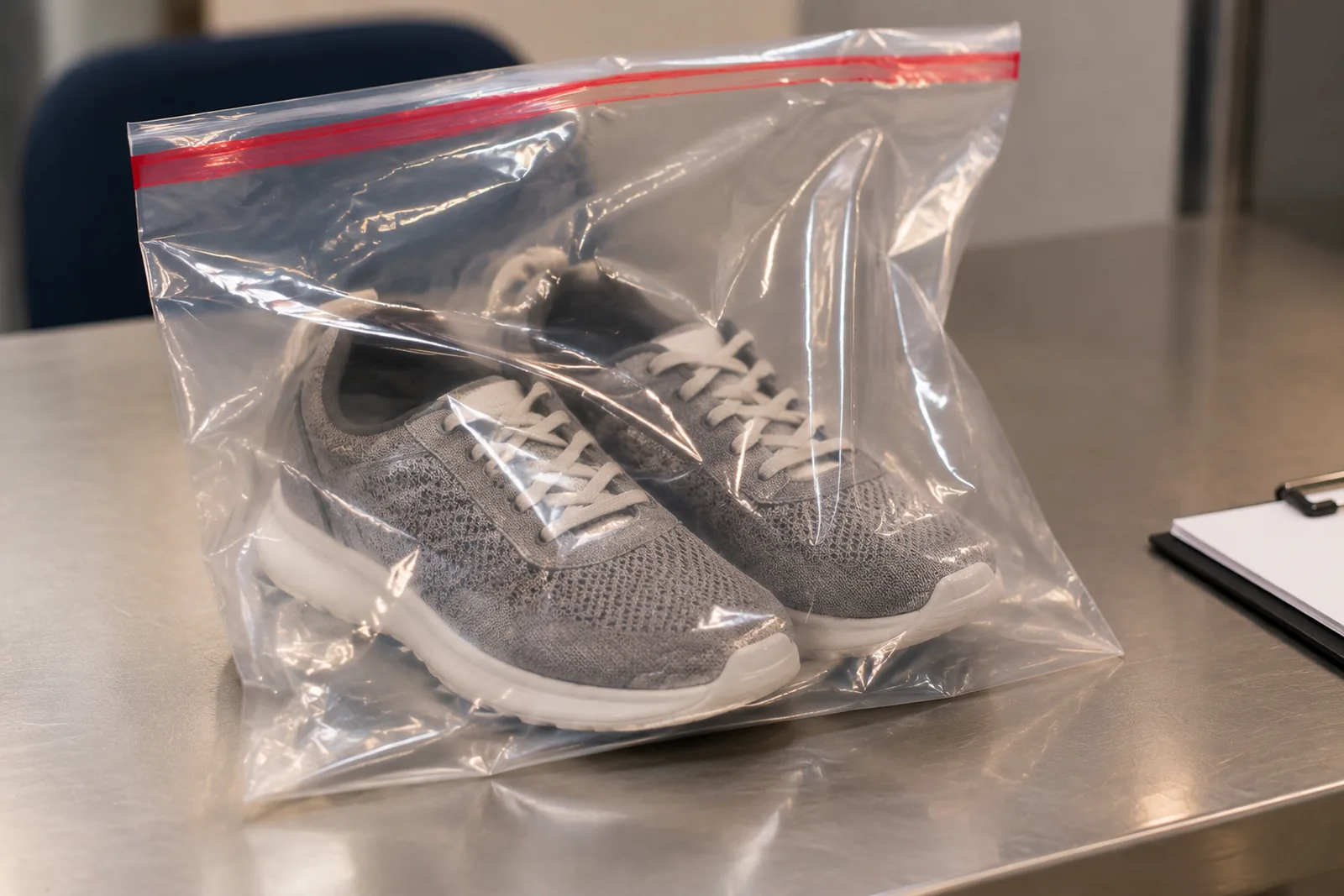
Does the store have to know the item was there?
Usually yes: a premises claim needs proof that the store knew about the item, or that it was there long enough that the store should have found it.
Actual knowledge | Example (hypothetical) |
|---|---|
An earlier report | "There's a hanger on the floor by the shoe racks," said to a cashier. |
An employee saw it | A worker stepped over it while carrying a stack of boxes. |
Cleanup started | An employee picked up two hangers but missed a third. |
Not enough alone | A worker carrying hangers elsewhere in the department. |
In Wal-Mart Stores, Inc. v. Reece, the Texas Supreme Court held that proximity alone doesn't prove constructive notice without evidence of how long the hazard existed. H-E-B, LP v. Peterson (2026) ties that proof to the specific hazard, place, and time. Neither case involved Burlington, but both state Texas law. [S5, S6]
Duration evidence can look like these hypothetical examples.
- Aisle-camera footage showing the hanger on the floor from 2:05 p.m.
- A photo of the cluttered aisle that a shopper took 20 minutes before the fall.
- A note in the store log about hangers in that aisle.
What if an employee was working nearby?
If a worker actively moved an item into you, that may be a negligent-activity claim, but an item left on the floor after earlier work usually calls for a premises claim.
Situation | Likely theory |
|---|---|
A worker swung a box of hangers into your path as you walked by | Negligent activity, if the injury came from the activity itself. [S7] |
A worker restocked earlier and left a hanger behind | Premises liability, based on the condition left on the floor. [S8] |
You call it "negligent merchandising" | The label doesn't avoid the premises elements. [S7, S8] |
Under Keetch v. Kroger, a worker creating the hazard can support an inference that the store knew, but it doesn't decide knowledge as a matter of law. United Scaffolding, Inc. v. Levine, a refinery-worker case, confirms that a condition left on property is a premises claim. [S7, S8]
Ask what the worker did, what was visible and what the evidence supports. The sequence matters more than the broadest negligence label.
How do you show the medical and practical harm?
Get appropriate care, describe how you fell, and tell the clinician about any earlier injuries.
Keep these. The examples are hypothetical.
- urgent-care notes and the orthopedic follow-up
- written restrictions, such as "No standing longer than 30 minutes for three weeks"
- a supervisor’s note listing missed shifts
- a short weekly log of what you couldn’t do
Before you accept a payment | Ask |
|---|---|
Release scope | Does it end every claim, including future care? |
Net amount | What will you keep after fees, costs, and medical balances? |
Proof and fault | How strong is notice, and could fault be shared? |
A small item can cause a serious injury, but the injury still needs a supported link to the fall. Generic settlement ranges can't replace an actual evaluation.
Questions about hanger and clothing trips
Question | Short answer |
|---|---|
Does a broken or flattened hanger show it was there a long time? | Not automatically. The fall, other shoppers, or cleanup may have changed it, so any timing inference needs a reliable basis. |
What if the video doesn't show the small object? | It can still show your route, movement, and timing. Other evidence may show contact, and counsel should explain what remains uncertain rather than overstate the recording. |
You can ask The Law Firm of Aaron A. Herbert, P.C. about identifying the item, preserving the timeline, and proving notice. Aaron Herbert is Board Certified in Personal Injury Trial Law by the Texas Board of Legal Specialization. [S1] The firm is not affiliated with or endorsed by Burlington Stores, Inc.
Tell us about your Burlington injury or call (214) 200-4878.
More from the Burlington knowledge hub
- Texas Burlington injury knowledge hub, with all the Burlington guides in one place.
- How to file and litigate a Texas Burlington injury claim, the full process from evidence through trial.
- What to do in the first 72 hours after a Burlington injury, covering care, reports, photos, and witnesses.
Sources
Each source below was checked on October 31, 2026, and the key holdings were rechecked on November 2, 2026.
- S1. State Bar of Texas, Aaron Alan Herbert profile.
- S5 and S6. H-E-B, LP v. Peterson, No. 24-0310 (Tex. Apr. 10, 2026); Wal-Mart Stores, Inc. v. Reece, 81 S.W.3d 812 (Tex. 2002).
- S7 and S8. Keetch v. Kroger Co., 845 S.W.2d 262 (Tex. 1992); United Scaffolding, Inc. v. Levine, 537 S.W.3d 463 (Tex. 2017).

ABOUT THE ATTORNEY
Aaron A. Herbert
Founding Attorney
Board Certified in Personal Injury Trial Law
Aaron founded The Law Firm of Aaron A. Herbert in 2010 to focus on developing each client's case and seeking its maximum value. For over a decade, he has represented people seriously injured in major accidents and industrial catastrophes, pursuing trial verdicts and settlements while working to reduce the stress of litigation.
Education
- Texas A&M University · B.S., Criminal Justice, 1999
- University of Oklahoma College of Law · J.D., 2002; graduated in the top of his class
Trial experience & approach
Aaron earned numerous jury verdicts at boutique personal injury litigation firms. According to his biography, he spent a year as the top-earning litigation attorney at a firm that frequently appeared in verdict searches as having one of the highest numbers of trial wins in Texas. At another Dallas personal injury firm, he moved from managing pre-litigation attorney to managing litigation attorney over seven years as the firm grew into one of Dallas's largest personal injury firms.
His biography describes a reputation as one of America's most aggressive trial lawyers, with noteworthy recoveries from judges and juries and substantial pretrial settlements. Most of those settlements included confidentiality agreements requested by the defense. Aaron has said the recoveries were justified by the injuries and losses involved, which no amount of money could make someone choose to experience.
His approach combines passion, preparation, persistence and courtroom imagination. He believes a well-supported, engaged and motivated team working cooperatively helps deliver strong representation, with the goal of achieving the best possible result for every client.
Dallas roots, military service & publication
Born and raised in Dallas, Aaron enlisted in the United States Marine Corps after high school and later received an Honorable Discharge. He completed his university and law degrees after his military service and became a lifelong Sooners football fan in law school.
Publication: “Litigating Dog Bite Cases,” Texas Dog Law Seminar, Dallas, 2009.
Professional affiliations & recognition
Professional affiliations and recognition listed in Aaron’s biography:
- State Bar of Texas
- American Bar Association
- Association of Trial Lawyers of America (now American Association for Justice)
- Texas Trial Lawyers Association
- Dallas Trial Lawyers Association
- Dallas Bar Association
- Tarrant County Bar Association
- Million Dollar Advocates Forum
- The National Trial Lawyers – Top 100 Trial Lawyers