In a lawsuit against Brookshire Grocery Company (BGC), a deposition can lock in what a witness saw, how she learned it, and which records back her up. It can't prove notice, breach, causation or damages by itself. A friendly witness still gets checked against the logs and the video.
7:40 p.m.: a floor-walk entry in the log. 8:09 p.m.: a cone on camera. Between the two, store witnesses under oath, and the company itself under Texas Rule of Civil Procedure 199.2(b)(1).
Hurt at a Brookshire's store? Tell us about your Brookshire's injury or call (214) 200-4878. Bring the store address, the date, what happened, any photos, witness names, and your medical providers. Contacting the firm doesn't create an attorney-client relationship.
What a deposition can test in a grocery case
A deposition is sworn testimony that may be used later. That makes it more than a casual interview, and it needs a purpose and a trial plan. Most of the exhibits come out of written discovery; see written discovery in a Brookshire's injury lawsuit and the Brookshire's injury claims and lawsuits guide.
One outline per claim
A deposition about a curled mat shouldn't reuse the outline from a leaking-scrubber case. For a hypothetical mat case at the east entrance, the outline pins down:
| Pin down | In the hypothetical mat case |
|---|---|
| The exact condition, and the 30 minutes or so before the fall. | A curled mat edge at the east entrance; the 30 minutes before the fall. |
| Each witness's role that evening, by name and shift. | The evening-shift front-end manager. |
| The records that can test the story: logs, reports, and camera footage. | The entrance log and camera 2. |
| The one or two facts the deposition has to settle. | Who saw or heard of the curled edge first; the last actual entrance check, and its record; the written mat policy against the evening shift's habits. |
One witness, one plan
The assistant manager on the closing shift, on one page:
| Her file | Entry |
|---|---|
| Ran | The front end and the drink area. |
| Works for | The operator, not the property owner. |
| Says | She walked the drink area at 7:40 p.m. |
| Signed or read | The incident report; the floor-walk log. |
| Solid on | Who was assigned; when the mop bucket came out. |
| Shaky on | Exact times; whether a cone was already out. |
| Exhibits | The report, the log page, stills from the camera over checkout lane 3. |
Her answers then get sorted by source: what she saw that evening, what she found out later and what she picked up while preparing.
Each witness knows a different slice
- The store manager, who may know the response, staffing and the store structure but not the floor before the fall
- A floor employee, who may know the approach route, cleaning and who walked the aisle but not company-wide policy or record retention
- The corporate representative, who may know the notice topics but may have no personal memory of the incident
- A maintenance technician, who may know the equipment's condition and service history but not what the shopper saw
Memory and preparation are different things. Whatever the outline, ask every witness what they saw themselves, which records they read, who told them what and what they're inferring.
The manager, under oath
A title isn't personal knowledge, so the questions start with what the manager actually controlled that day. They cover four areas.
- The job, such as duties that day, the boss above and authority to inspect, clean, repair or close an aisle
- Inspections, such as how they were assigned and logged, who did them, what happened when someone found a hazard and how practice compared with policy
- The response, such as when the manager heard, what the manager saw, the report, the cleanup and whether video was reviewed
- Notice, such as earlier complaints, repeated employee reports, known maintenance problems, similar incidents and what the manager read beforehand
The key line runs between the written policy and what happened that evening.
| Testimony (hypothetical) | What counsel still has to find out |
|---|---|
| "Employees inspect the aisle every thirty minutes." | Were they done that day? |
| "Walks are logged." | How, and does the log back it up? |
| "The aisle was safe." | Based on what look, and when? |
| "I don't remember." | Nothing more. Keep the answer; no pushing for a guess. |
| "The floor should be checked regularly," and no memory of the last aisle 9 check | A practice. No proof of a missed check, or of store knowledge. |
Three records from that shift test every one of those answers: the schedule, the log page and the footage.
Employees who were there
Employees near the fall may know about the floor, what customers were doing, inspections, cleanup and what happened before and after. Each one gets asked about:
- the floor before the fall, for the last look
- liquid, food, grease, debris or merchandise, for the condition itself
- any cleaning or inspection of that area
- a report from a customer or coworker, for notice
- telling a supervisor, for notice up the chain
- a report they wrote or signed, for a record to test
- the footage, for whether video shaped the memory
- who they've talked to, for other sources
Whether the employee "knew" about a hazard is only the start. What they saw, when, where they were standing and for how long all go on the record. So does what they did next: a report, a cone or a mop.
What happened between 7:40 and 8:09?
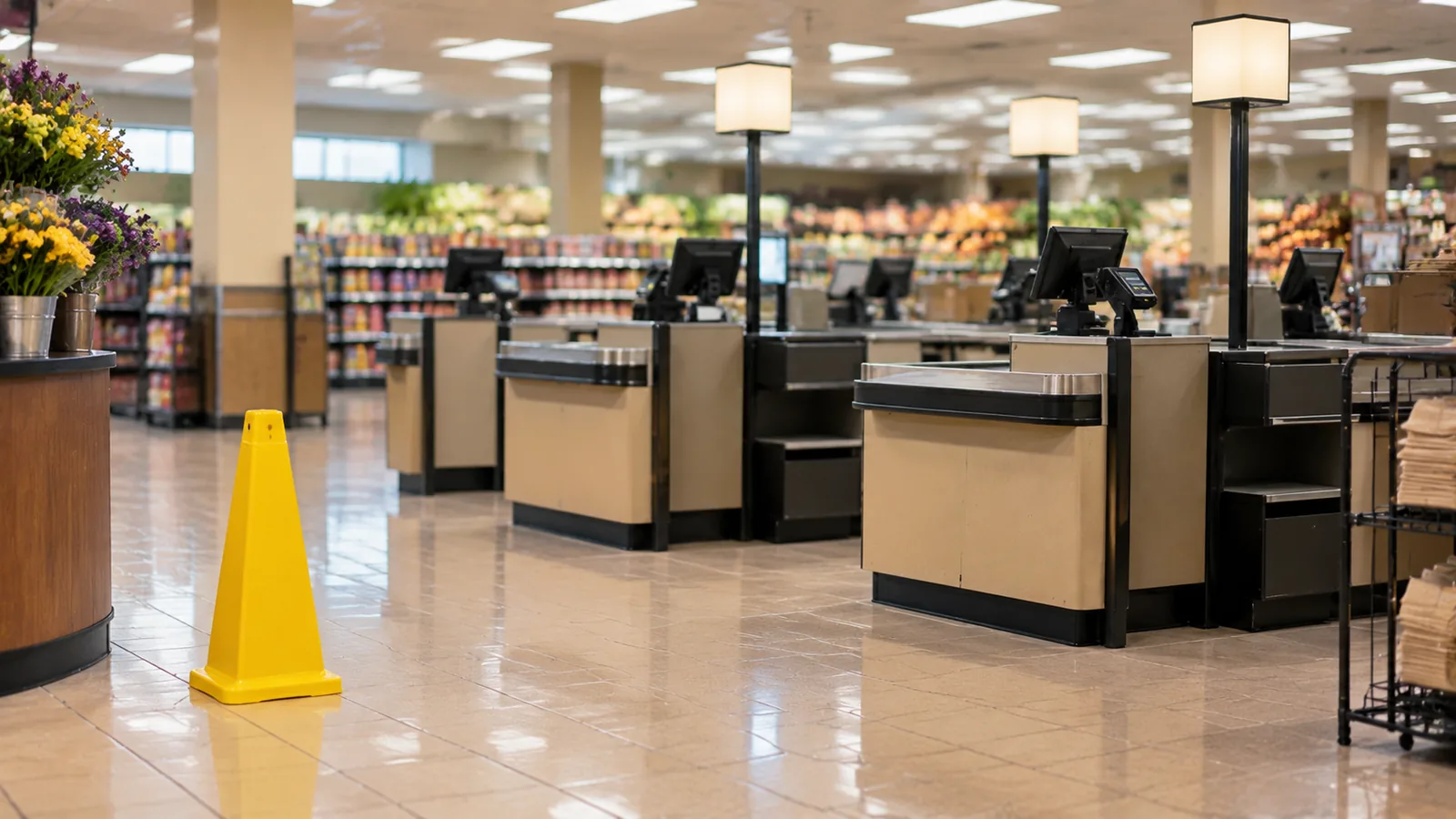
The log shows a floor walk at 7:40 p.m. The camera shows a cone at 8:09. Every minute between them needs a source the witness doesn't control.
| Time | Event | Where it shows up |
|---|---|---|
| 7:40 p.m. | A floor-walk entry | The log |
| 7:52 p.m. | A stocker pushes a cart past the area | Camera |
| 8:05 p.m. | A cashier calls the manager | The cashier's account |
| 8:09 p.m. | A cone appears | Camera |
People can remember what happened without remembering the clock. A leading question can turn an estimate into an exact interval, so the anchors come from sources that don't depend on the witness, and the outline says where the uncertainty is. A witness who refreshes memory from a log gets the entry put on the record, along with who wrote it and whether she remembers the event or is reading it.
The corporate representative
BGC itself can be deposed. Rule 199.2(b)(1) puts three duties on the two sides:
| What Rule 199.2(b)(1) requires | In practice |
|---|---|
| The notice must describe with reasonable particularity the matters on which examination is requested. | A vague topic gets a vague witness. |
| The organization must, a reasonable time before the deposition, designate one or more individuals to testify on its behalf and state the matters each will cover. | Check the designation against the topics. |
| Each designee must testify to matters known or reasonably available to the organization. | Prepared, not just present. |
Depositions follow the Texas Rules of Civil Procedure, as amended October 1, 2026, and the court's orders. Check the current rule text and procedure before serving the notice. Sample topics for a drink-station fall, aimed at the incident and the disputed practices:
- who owned and operated the store that day, and who controlled the drink area
- inspection and maintenance duties, and how inspections were recorded
- hazard policies, training and supervision
- cameras and footage retention
- incident reports and the company's own investigation
- vendor contracts
- earlier complaints, if relevant and similar
A topic like "all safety knowledge" is probably too vague. Unclear capacity is another problem, because a company representative and an individual employee testify differently. An unanswered noticed topic calls for building the record and asking for a proportionate remedy. It still doesn't make the facts favorable.
Maintenance and outside contractors
Refrigeration, plumbing, flooring, drains, cleaning or equipment may be involved, and then a contractor may have records the store doesn't. A service contract doesn't automatically mean the contractor owed or breached a duty to the customer. A review covers the contract, the conduct, the law and control. It also asks whether the contract has inspection or emergency duties and whether the store was told about a continuing risk.
A hypothetical contractor file might hold:
- a scope of nightly scrubbing of the main aisles
- three service calls for the same cooler in one month, for water pooling at the base
- a cleared drain line
- a fourth call two weeks later
- a recommended part, with a quote
Exhibits and pinning down facts
Exhibits make questions sharper. Each one has basics to establish, such as:
- the incident report's author and date
- the video's source, date, camera, timing and completeness
- who made a log or work order, and whether it records a report or a finding
- whether a photo shows the scene that day
- this store's version of a policy or contract that night, and who signed it
Each also has traps to watch for, such as missing pages, a marked-up copy in place of the original, video that isn't all there, a log time that doesn't fit the camera and the fall, unreadable prints, later changes to the scene or a national manual or later revision standing in for the store's own policy.
Skip "You knew the floor was dangerous, correct?" The clerk on the front-end walk gets smaller questions that a record can check: who assigned her the walk that evening, where she was at 7:50 p.m., what (if anything) she saw on the floor by the dispenser, whom she told, what her training said to do about liquid and what she did next. Then comes the verified copy of her discovery answers, and whether she still agrees with them.
When "every 20 minutes" turns out to be a target
| Accurate summary | Misleading summary |
|---|---|
| A 20-minute target; no specific inspection recalled. | She admitted no inspection occurred. |
| The log has no entry for that interval. | The store never inspected the aisle. (Only if she said so, or other proof shows it.) |
| Second clerk: checked the meat floor shortly before; no time or detail. | A reasonable inspection, untested against schedule, policy, log, and video. |
A check that shows a reasonable inspection just before the spill is good for the store. An inspection that didn't happen, wasn't logged or missed something you could see is good for the shopper.
Getting the injured shopper ready
The store's lawyer will probably ask about the fall, your medical history, later injuries, treatment, work, daily activities and damages. Being ready means:
- Listen to the question and answer only that.
- Tell the truth.
- Don't guess. A guess can be used against you later.
- Keep what you remember apart from what you learned afterward.
- Ask what a question means if you're not sure.
- Keep pain apart from what you can't do, and old symptoms apart from new ones.
- Say "I'm not sure" when you aren't; save "I don't remember" for what you don't.
- Another language? Ask how interpretation and translated documents are handled. Real translation problems go on the record.
- Fix an answer that comes out wrong on the record that day.
- Describe your limits and your recovery as they are, no bigger.
There's no script, because preparation isn't coaching. A lawyer who puts the fall at 3:00 when it was closer to 2:30 gets corrected by you.
Before you testify, your lawyer compares your account with what you said earlier, your medical timeline, your work records for any wage claim, earlier injuries and the support for each item of damages.
The transcript, afterward
The pages around each key answer get read too, because a correction can sit two pages later.
Some moments need a clear record as they happen: a witness who can't remember, testimony set against a document, an objection that changes the questioning and a witness who names missing records or people.
The summary sorts the testimony under five headings: for the claims, for the defense, impeachment, evidence problems and open questions. A disagreement isn't always impeachment, and a concession isn't always an admission.
After the key depositions
Once the key depositions are done, your lawyer will:
- update the notice timeline and plan proof for each disputed fact
- put follow-up witnesses on the calendar and ask for missing documents
- decide whether an expert is needed and revisit the defenses
- gather evidence to oppose summary judgment and plan trial designations
Expert planning is in experts and reliable testing in Brookshire's cases, and trial preparation in trial preparation and jury selection.
Before hiring a lawyer, ask how the firm handles:
- witness outlines
- preparing you without a script
- telling you what each deposition changed
- confirming representation, scope and fees
Frequently asked questions
Can I say I don't remember?
Only when it's true. "About ten minutes" is an estimate, so call it one. A guess, or an "I don't remember" that dodges something you know, can be used against you.
Does deposition testimony automatically become trial evidence?
No. Whether a transcript gets read to the jury depends on the procedure and evidence rules, whether the witness is available, objections, designations and rulings, so plan for that during the deposition.
Does a contractor's service contract prove the contractor is responsible?
Not by itself. A cleaning contract proves there was a contract. What the crew actually did that night, the governing law and evidence of control must all be examined.
Tell us about your Brookshire's injury
Get engagement, scope and fee terms in writing. Aaron Herbert is Board Certified in Personal Injury Trial Law by the Texas Board of Legal Specialization; certification isn't a promise about any result, and you can check it on the Texas Board of Legal Specialization profile.
Got the receipt, the photos, and the names? Tell us about your Brookshire's injury or call (214) 200-4878. The office is on the LBJ Freeway in Dallas, at 8330 Lyndon B. Johnson Freeway, Suite 700, 75243. Calling doesn't make us your lawyers; representation, scope, and fees get confirmed in writing first, and no result is guaranteed.
Related pages on Brookshire's injuries
- Texas Brookshire's grocery injury knowledge hub: every guide in one place.
- Brookshire's injury claims and lawsuits in Texas: the lawsuit through appeal.
- Written discovery in a Brookshire's injury lawsuit: the requests that supply exhibits.
- Experts and reliable testing in Brookshire's cases: when testimony points to an expert.
- Trial preparation and jury selection: testimony at trial.
- Texas grocery store injury lawyer: the firm's practice page.
Sources
- Texas Rules of Civil Procedure, as amended October 1, 2026, Rule 199.
- Texas Rules of Evidence, amendments effective July 2, 2026.
- Texas Judicial Branch, rules and standards.
We checked these sources on November 2, 2026. The Law Firm of Aaron A. Herbert, P.C. has no tie to Brookshire Grocery Company or to Brookshire Brothers, Ltd., and neither company sponsors or endorses this page. This page is general information, and nothing on it says any BGC store violated a duty. Your own facts, the law and any court orders decide your case.

ABOUT THE ATTORNEY
Aaron A. Herbert
Founding Attorney
Board Certified in Personal Injury Trial Law
Aaron founded The Law Firm of Aaron A. Herbert in 2010 to focus on developing each client's case and seeking its maximum value. For over a decade, he has represented people seriously injured in major accidents and industrial catastrophes, pursuing trial verdicts and settlements while working to reduce the stress of litigation.
Education
- Texas A&M University · B.S., Criminal Justice, 1999
- University of Oklahoma College of Law · J.D., 2002; graduated in the top of his class
Trial experience & approach
Aaron earned numerous jury verdicts at boutique personal injury litigation firms. According to his biography, he spent a year as the top-earning litigation attorney at a firm that frequently appeared in verdict searches as having one of the highest numbers of trial wins in Texas. At another Dallas personal injury firm, he moved from managing pre-litigation attorney to managing litigation attorney over seven years as the firm grew into one of Dallas's largest personal injury firms.
His biography describes a reputation as one of America's most aggressive trial lawyers, with noteworthy recoveries from judges and juries and substantial pretrial settlements. Most of those settlements included confidentiality agreements requested by the defense. Aaron has said the recoveries were justified by the injuries and losses involved, which no amount of money could make someone choose to experience.
His approach combines passion, preparation, persistence and courtroom imagination. He believes a well-supported, engaged and motivated team working cooperatively helps deliver strong representation, with the goal of achieving the best possible result for every client.
Dallas roots, military service & publication
Born and raised in Dallas, Aaron enlisted in the United States Marine Corps after high school and later received an Honorable Discharge. He completed his university and law degrees after his military service and became a lifelong Sooners football fan in law school.
Publication: “Litigating Dog Bite Cases,” Texas Dog Law Seminar, Dallas, 2009.
Professional affiliations & recognition
Professional affiliations and recognition listed in Aaron’s biography:
- State Bar of Texas
- American Bar Association
- Association of Trial Lawyers of America (now American Association for Justice)
- Texas Trial Lawyers Association
- Dallas Trial Lawyers Association
- Dallas Bar Association
- Tarrant County Bar Association
- Million Dollar Advocates Forum
- The National Trial Lawyers – Top 100 Trial Lawyers