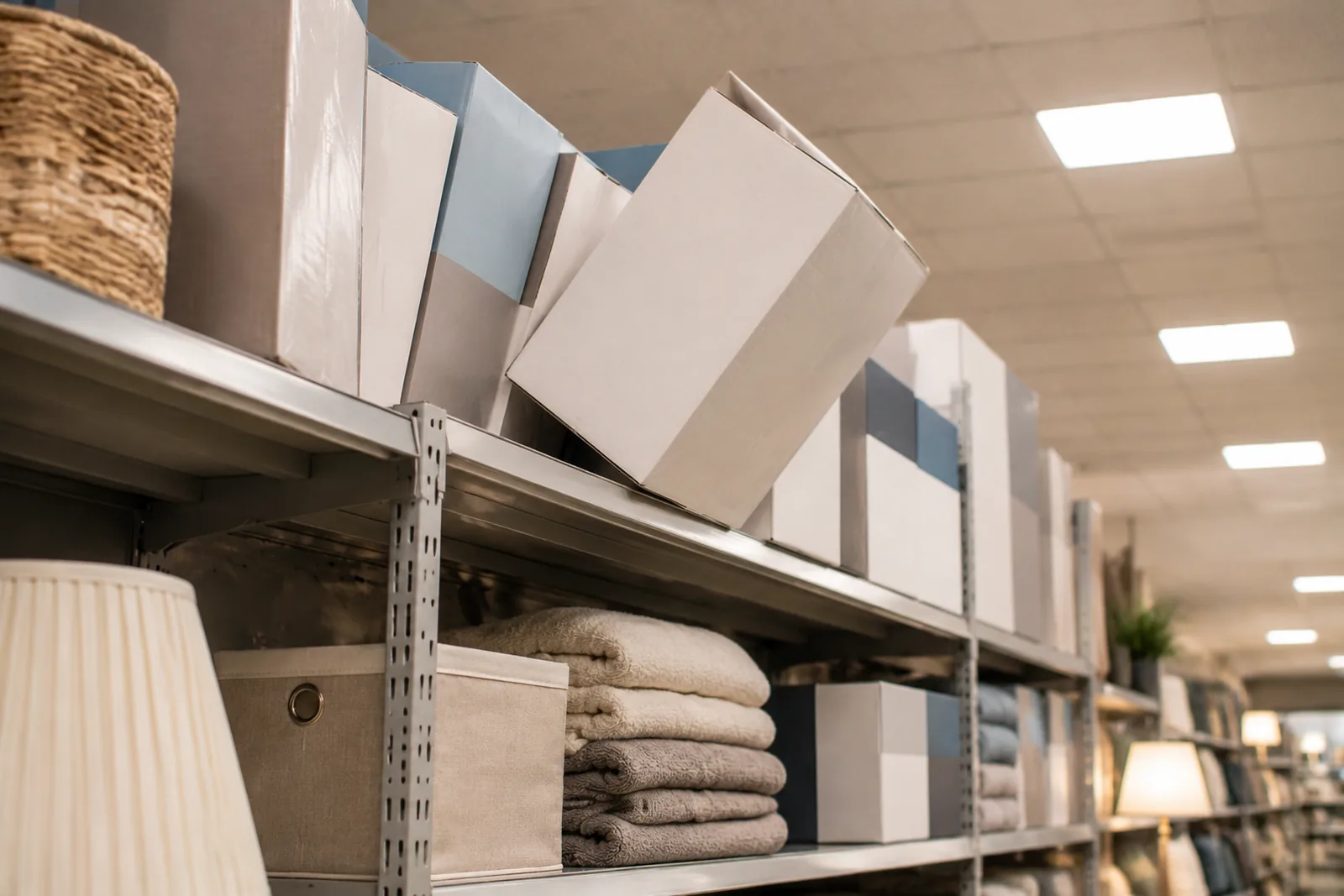
A boxed lamp drops from a top shelf at a Burlington and hits a shopper's shoulder. The first questions are what fell, why it fell, and who loaded or built that shelf, because a box falling doesn't prove anyone stacked it carelessly.
Possible causes can look like these hypothetical examples.
- active handling, where a worker on a ladder pulled one box and the box beside it slid off
- unstable stacking, such as boxed lamps stacked four high on a top shelf with no lip
- installation, as with a wall bracket anchored into drywall instead of a stud
- wear or damage, for instance a shelf clip bent after months of heavy loads
- a later change, here a shelf stop that someone removed during a reset
Get medical care and stay clear of any unstable display. Don't climb, pull on fixtures or remove parts to show what went wrong. A safe inspection protects the evidence without causing another injury.
Do | Don't |
|---|---|
Photograph the shelf and the fallen item from a safe spot | Climb the shelving to look. |
Ask the store to keep the broken part | Take the part home. |
Get witness names | Rearrange the fallen items. |
What made it fall?
Record the item, its support, the height, the arrangement, and the order of events before restocking or cleanup changes the scene.
Ask these. The examples are hypothetical.
- Was a worker handling goods at that moment, such as pulling stock from the top shelf?
- Did another shopper bump the display, such as a cart hitting the end cap on video?
- Did a fixed connection come loose, such as a bracket pulling out of the wall?
Case | Why it matters |
|---|---|
Rule | Texas law separates an ongoing activity from a condition left on the property. An earlier act that created a condition doesn't automatically count as an activity when the injury happens. [S7, S8] |
Keetch v. Kroger Co. | Activity recovery requires injury by or as a contemporaneous result of the activity itself. [S7] |
United Scaffolding, Inc. v. Levine | A condition left on the property is a premises claim, and the jury questions must match. The plaintiff was a refinery worker, not a shopper. [S8] |
Who was responsible for the shelf or display?
The store operator, a display vendor, an installer, a maintenance company, a manufacturer, or another party may need review based on their actual roles.
What to get depends on the party.
- the store operator's stocking practices and who loaded that shelf
- the display vendor's setup instructions and the date it was installed
- the installer's work order and how the fixture was anchored
- the maintenance company's inspection history and repairs
- the manufacturer's load ratings, if material
A supplier may have had no control over later stacking, while a contractor may have installed the connection that failed. A company in the records can look like these hypothetical examples.
- one that installed the failed bracket, such as a fixture contractor that anchored the shelf in March
- one that did unrelated work, such as a flooring company that redid the tile in another department
- one that supplied the merchandise, such as a lamp maker with no say in how the boxes were stacked
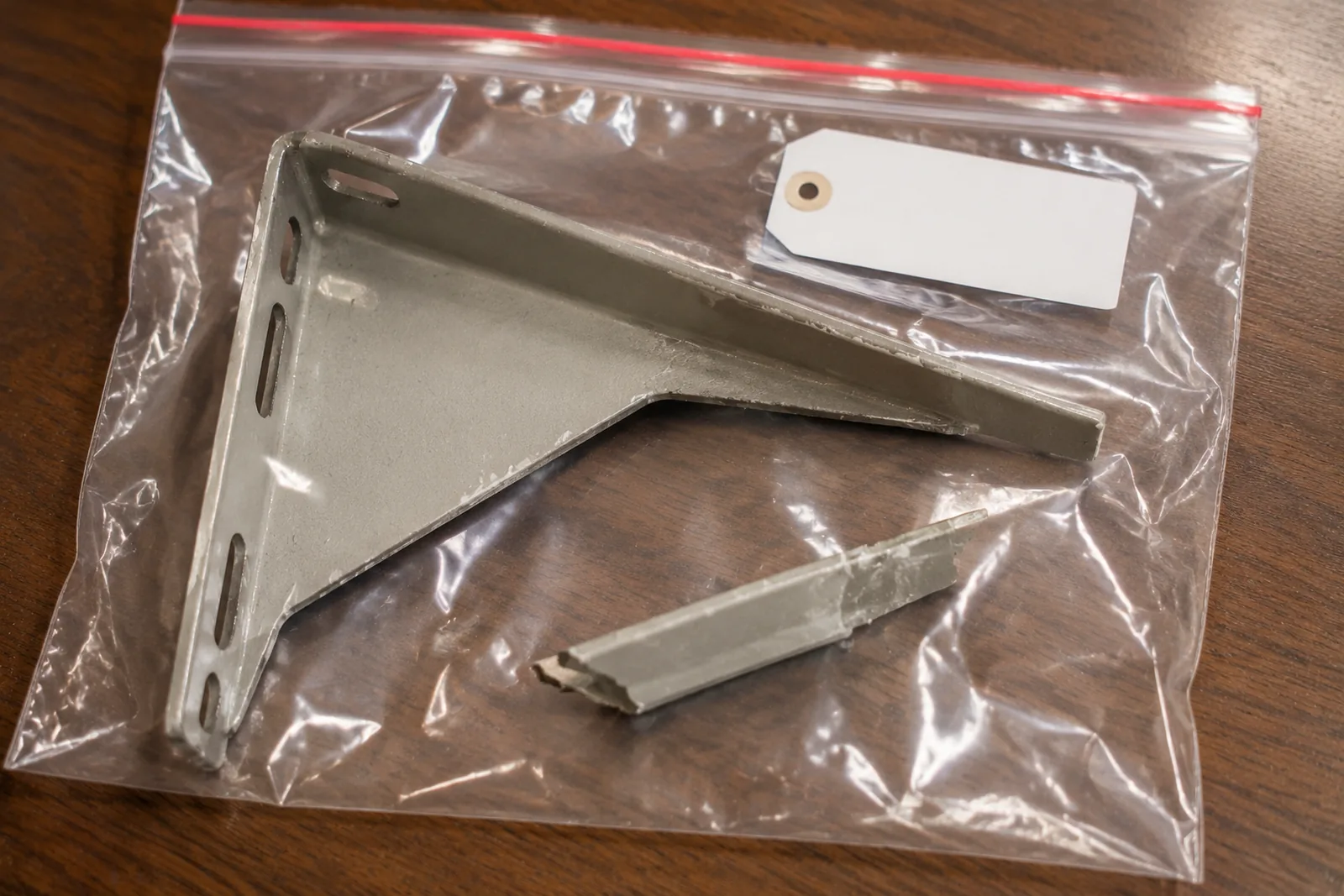
How should parts be kept and tested?
Ask for a reasonable protocol covering labels, photos, storage, access, sampling, and any destructive testing.
The steps can look like these hypothetical examples.
- identifying the bracket, with a photo of it where it was and a label
- storing the bracket in a sealed bag with a written chain of custody
- access for both sides' experts to inspect it before any testing
- repairs, with necessary safety repairs going ahead and photos and the old parts kept where possible
If parts are gone, find out three things.
- What existed, such as the bracket, the shelf clip or the whole fixture?
- Who had it, whether the store, the installer or a repair company?
- When and why was it lost, for example thrown out in a reset two days later?
Brookshire point | What it means |
|---|---|
The holding | Under Brookshire Brothers v. Aldridge, missing evidence doesn't automatically earn a spoliation instruction; the trial judge decides duty, breach, and a proportionate remedy. [S11] |
Who decides | The judge, not the jury. [S11] |
When an instruction is allowed | Intentional spoliation, or negligent loss that irreparably deprives a party of any meaningful ability to present a claim or defense. [S11] |
Practical lesson | It's better to stop the loss early than to fight about it later. |
Does a ceiling or building failure need different handling?
Yes, a ceiling tile, light fixture, or other building component may need engineering or construction analysis, and different deadlines can apply. Get project dates and professional roles early instead of assuming the two-year injury deadline protects every claim. [S12, S22]
- applicable codes, though a code concern still has to be tied to the event and the right defendant
- project dates, because Chapter 16 has 10-year repose statutes for those who design, construct or repair improvements [S12]
- professional roles, because claims arising from licensed architects' or engineers' services need a certificate of merit filed with the complaint [S22]
- inspection approvals, which are relevant but not a guarantee that nobody was negligent
Read more: Texas fallen merchandise injury lawyer, the firm's practice page on falling-merchandise injuries.
Questions about falling merchandise and fixtures
Can the store and the installer both be responsible? Possibly, if each had a duty and helped cause the fall. Chapter 33 divides fault and gives settlement credits, so you can't recover twice. [S14]
Does a severe injury prove the fixture was defective? No. How badly you were hurt and why the fixture failed need separate proof.
What about contractors? Finished work isn't automatically immune, but duty, negligence, causation and damages still have to be proved (Strakos v. Gehring). A company that did unrelated work shouldn't be blamed just for appearing in the records. [S21]
You can ask The Law Firm of Aaron A. Herbert, P.C. about keeping the parts, an inspection, the responsible companies, costs, and deadlines. Aaron Herbert is Board Certified in Personal Injury Trial Law by the Texas Board of Legal Specialization. [S1] The Law Firm of Aaron A. Herbert, P.C. is not affiliated with or endorsed by Burlington Stores, Inc.
Tell us about your Burlington injury or call (214) 200-4878.
More from the Burlington knowledge hub
- Texas Burlington injury knowledge hub, with all the Burlington guides in one place.
- How to file and litigate a Texas Burlington injury claim, the full process from evidence through trial.
- Preserving Burlington video and injury evidence, on footage, records and physical items.
Sources
Each source below was checked on October 31, 2026, and the key holdings were rechecked on November 2, 2026.
- S1. State Bar of Texas, Aaron Alan Herbert profile.
- S7. Keetch v. Kroger Co., 845 S.W.2d 262 (Tex. 1992).
- S8. United Scaffolding, Inc. v. Levine, 537 S.W.3d 463 (Tex. 2017).
- S11. Brookshire Brothers, Ltd. v. Aldridge, 438 S.W.3d 9 (Tex. 2014).
- S12. Texas Civil Practice and Remedies Code chapter 16.
- S14. Texas Civil Practice and Remedies Code chapter 33.
- S21. Strakos v. Gehring, 360 S.W.2d 787 (Tex. 1962).
- S22. Texas Civil Practice and Remedies Code chapter 150.

ABOUT THE ATTORNEY
Aaron A. Herbert
Founding Attorney
Board Certified in Personal Injury Trial Law
Aaron founded The Law Firm of Aaron A. Herbert in 2010 to focus on developing each client's case and seeking its maximum value. For over a decade, he has represented people seriously injured in major accidents and industrial catastrophes, pursuing trial verdicts and settlements while working to reduce the stress of litigation.
Education
- Texas A&M University · B.S., Criminal Justice, 1999
- University of Oklahoma College of Law · J.D., 2002; graduated in the top of his class
Trial experience & approach
Aaron earned numerous jury verdicts at boutique personal injury litigation firms. According to his biography, he spent a year as the top-earning litigation attorney at a firm that frequently appeared in verdict searches as having one of the highest numbers of trial wins in Texas. At another Dallas personal injury firm, he moved from managing pre-litigation attorney to managing litigation attorney over seven years as the firm grew into one of Dallas's largest personal injury firms.
His biography describes a reputation as one of America's most aggressive trial lawyers, with noteworthy recoveries from judges and juries and substantial pretrial settlements. Most of those settlements included confidentiality agreements requested by the defense. Aaron has said the recoveries were justified by the injuries and losses involved, which no amount of money could make someone choose to experience.
His approach combines passion, preparation, persistence and courtroom imagination. He believes a well-supported, engaged and motivated team working cooperatively helps deliver strong representation, with the goal of achieving the best possible result for every client.
Dallas roots, military service & publication
Born and raised in Dallas, Aaron enlisted in the United States Marine Corps after high school and later received an Honorable Discharge. He completed his university and law degrees after his military service and became a lifelong Sooners football fan in law school.
Publication: “Litigating Dog Bite Cases,” Texas Dog Law Seminar, Dallas, 2009.
Professional affiliations & recognition
Professional affiliations and recognition listed in Aaron’s biography:
- State Bar of Texas
- American Bar Association
- Association of Trial Lawyers of America (now American Association for Justice)
- Texas Trial Lawyers Association
- Dallas Trial Lawyers Association
- Dallas Bar Association
- Tarrant County Bar Association
- Million Dollar Advocates Forum
- The National Trial Lawyers – Top 100 Trial Lawyers