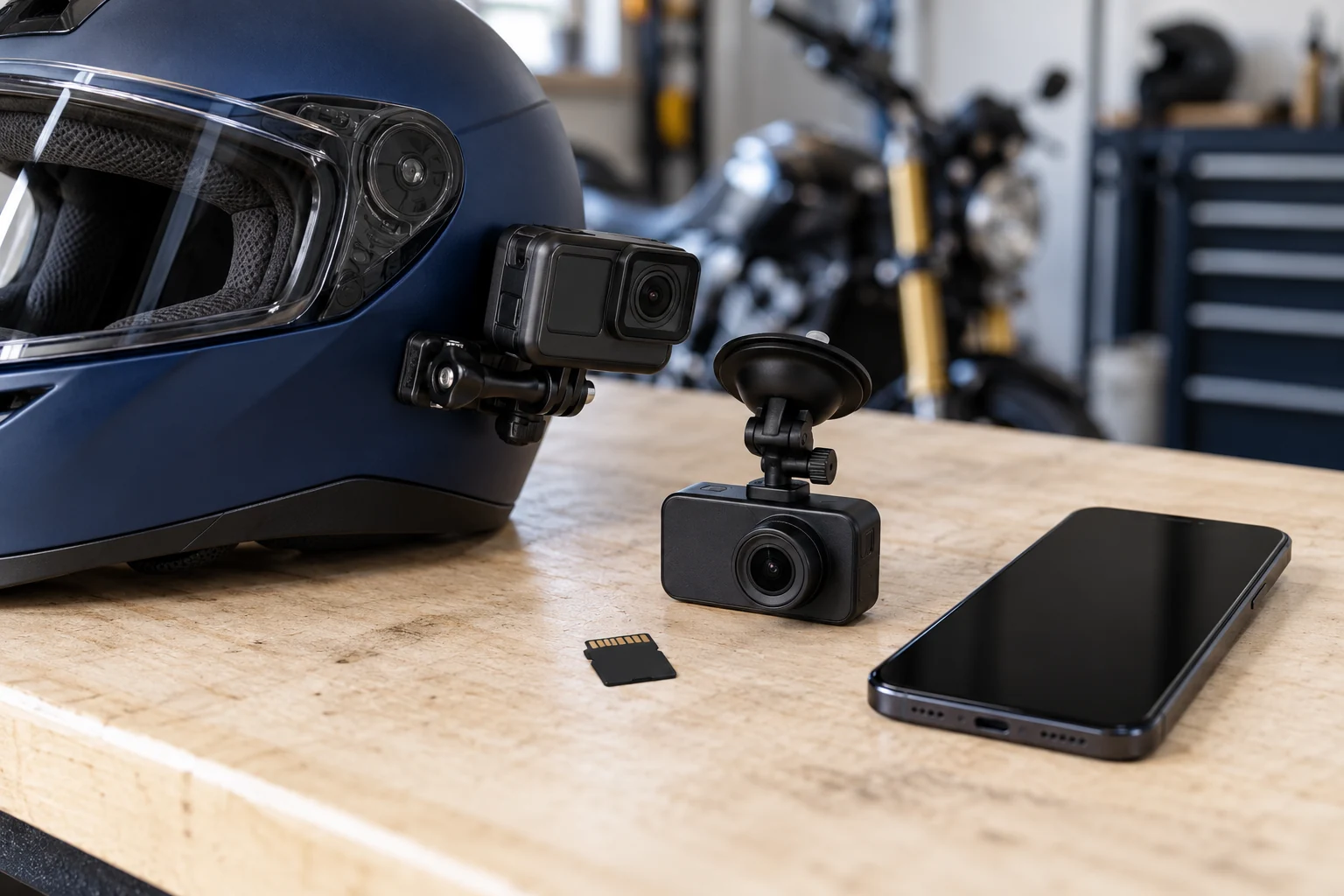
Preserving video, phone records and original digital evidence after a motorcycle crash.
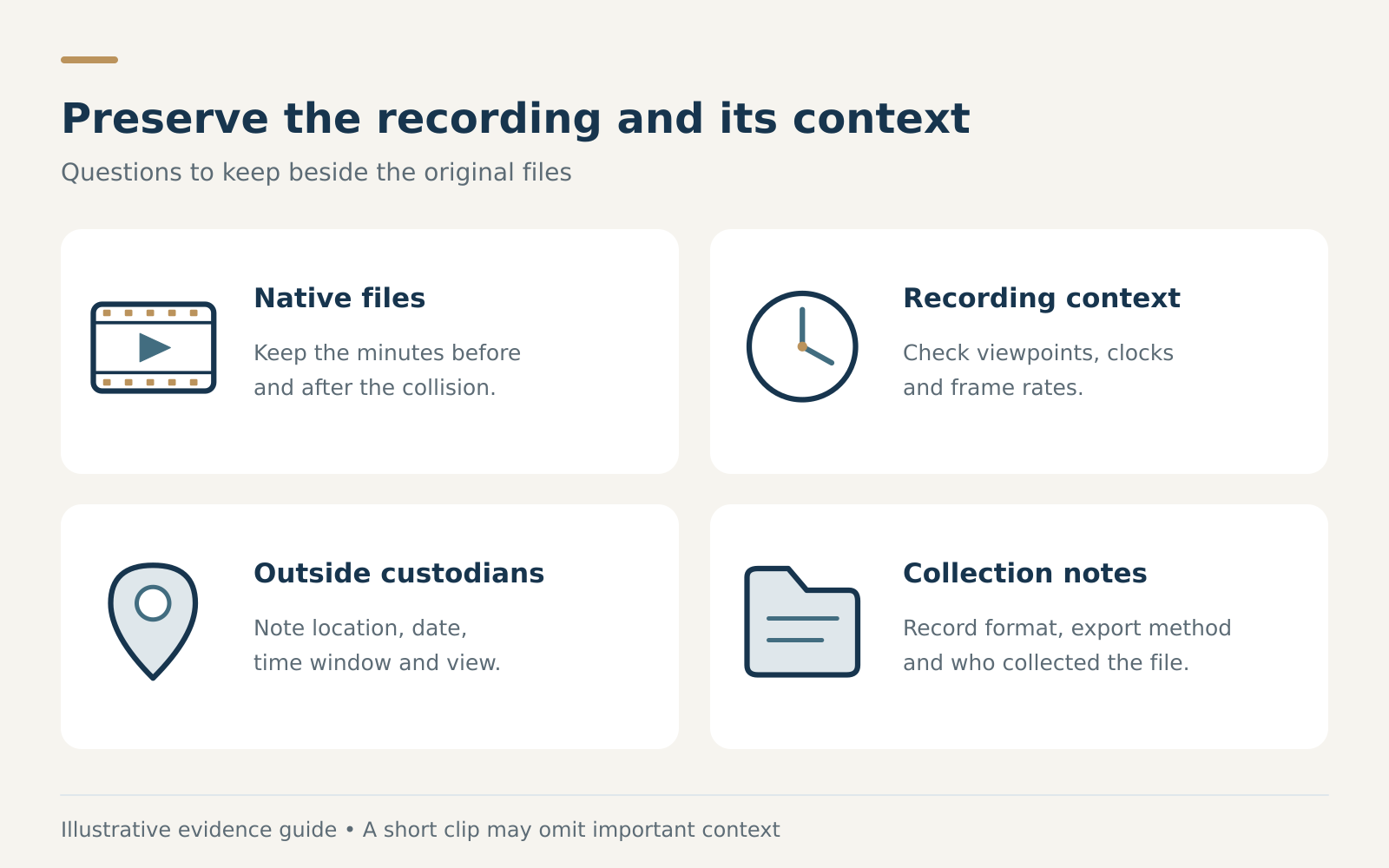
A clip that starts at impact may leave out the approach and the signal change. Before putting it on a timeline, find out which system recorded it. A helmet camera, a vehicle camera and a business camera can differ in viewpoint, clock settings, frame rate and how long they keep recordings. Even a phone’s timestamp needs checking: it may identify an export rather than the moment of recording. Keep the originals so those questions can be investigated.
Check your own devices and accounts for material worth saving:
- Helmet-camera and dash-camera files in their native form, with the minutes before and after the crash.
- Phone photos with their metadata. Keep an unaltered copy if you make a cropped version.
- Possible route records from a rideshare trip, navigation app or fitness device.
Let counsel know which tools you used. A location entry may be approximate and is not necessarily evidence of speed. Never access another person’s device or account.
For outside recordings, make a list of possible holders: businesses near the scene, transit vehicles, toll facilities, traffic agencies, other drivers and witnesses. The camera you saw on a building might not have been on, might have faced another direction or might overwrite footage quickly. Give counsel the location, date, time window and view that you are trying to locate. The next step depends on who has the material and how far the matter has progressed. It may involve a preservation request, consent, a subpoena, discovery or other court process.
Before an expert relies on a clip, someone needs to explain how it was obtained. Keep the collector’s name, format and export method with the file. Record any missing frames, clock offset or cut made from a longer recording. These are working limits on a speed or reaction-time analysis. A traffic light appearing in two videos can be a useful time marker, provided it is the very same change in both. Check other independent events as well. Enlarging a compressed still will not turn it into evidence of a position accurate to the millimeter.
When a requested recording is unavailable, find out whether it ever existed. Ask about the system’s retention settings, the date of any deletion and other possible copies. Those facts matter to a preservation dispute; the absence of a clip does not by itself establish spoliation. For related preservation and consultation questions, visit the motorcycle hub. The claims and litigation guide goes further into technical proof. Texas spoliation analysis is addressed in Brookshire Brothers v. Aldridge.
Can I rely on a screenshot? It may help identify a lead, but preserve the original recording and export information where possible.

ABOUT THE ATTORNEY
Aaron A. Herbert
Founding Attorney
Board Certified in Personal Injury Trial Law
Aaron founded The Law Firm of Aaron A. Herbert in 2010 to focus on developing each client's case and seeking its maximum value. For over a decade, he has represented people seriously injured in major accidents and industrial catastrophes, pursuing trial verdicts and settlements while working to reduce the stress of litigation.
Education
- Texas A&M University · B.S., Criminal Justice, 1999
- University of Oklahoma College of Law · J.D., 2002; graduated in the top of his class
Trial experience & approach
Aaron earned numerous jury verdicts at boutique personal injury litigation firms. According to his biography, he spent a year as the top-earning litigation attorney at a firm that frequently appeared in verdict searches as having one of the highest numbers of trial wins in Texas. At another Dallas personal injury firm, he moved from managing pre-litigation attorney to managing litigation attorney over seven years as the firm grew into one of Dallas's largest personal injury firms.
His biography describes a reputation as one of America's most aggressive trial lawyers, with noteworthy recoveries from judges and juries and substantial pretrial settlements. Most of those settlements included confidentiality agreements requested by the defense. Aaron has said the recoveries were justified by the injuries and losses involved, which no amount of money could make someone choose to experience.
His approach combines passion, preparation, persistence and courtroom imagination. He believes a well-supported, engaged and motivated team working cooperatively helps deliver strong representation, with the goal of achieving the best possible result for every client.
Dallas roots, military service & publication
Born and raised in Dallas, Aaron enlisted in the United States Marine Corps after high school and later received an Honorable Discharge. He completed his university and law degrees after his military service and became a lifelong Sooners football fan in law school.
Publication: “Litigating Dog Bite Cases,” Texas Dog Law Seminar, Dallas, 2009.
Professional affiliations & recognition
Professional affiliations and recognition listed in Aaron’s biography:
- State Bar of Texas
- American Bar Association
- Association of Trial Lawyers of America (now American Association for Justice)
- Texas Trial Lawyers Association
- Dallas Trial Lawyers Association
- Dallas Bar Association
- Tarrant County Bar Association
- Million Dollar Advocates Forum
- The National Trial Lawyers – Top 100 Trial Lawyers
Trial experience & approach
Aaron earned numerous jury verdicts at boutique personal injury litigation firms. According to his biography, he spent a year as the top-earning litigation attorney at a firm that frequently appeared in verdict searches as having one of the highest numbers of trial wins in Texas. At another Dallas personal injury firm, he moved from managing pre-litigation attorney to managing litigation attorney over seven years as the firm grew into one of Dallas's largest personal injury firms.
His biography describes a reputation as one of America's most aggressive trial lawyers, with noteworthy recoveries from judges and juries and substantial pretrial settlements. Most of those settlements included confidentiality agreements requested by the defense. Aaron has said the recoveries were justified by the injuries and losses involved, which no amount of money could make someone choose to experience.
His approach combines passion, preparation, persistence and courtroom imagination. He believes a well-supported, engaged and motivated team working cooperatively helps deliver strong representation, with the goal of achieving the best possible result for every client.
Dallas roots, military service & publication
Born and raised in Dallas, Aaron enlisted in the United States Marine Corps after high school and later received an Honorable Discharge. He completed his university and law degrees after his military service and became a lifelong Sooners football fan in law school.
Publication: “Litigating Dog Bite Cases,” Texas Dog Law Seminar, Dallas, 2009.
Professional affiliations & recognition
Professional affiliations and recognition listed in Aaron’s biography:
- State Bar of Texas
- American Bar Association
- Association of Trial Lawyers of America (now American Association for Justice)
- Texas Trial Lawyers Association
- Dallas Trial Lawyers Association
- Dallas Bar Association
- Tarrant County Bar Association
- Million Dollar Advocates Forum
- The National Trial Lawyers – Top 100 Trial Lawyers