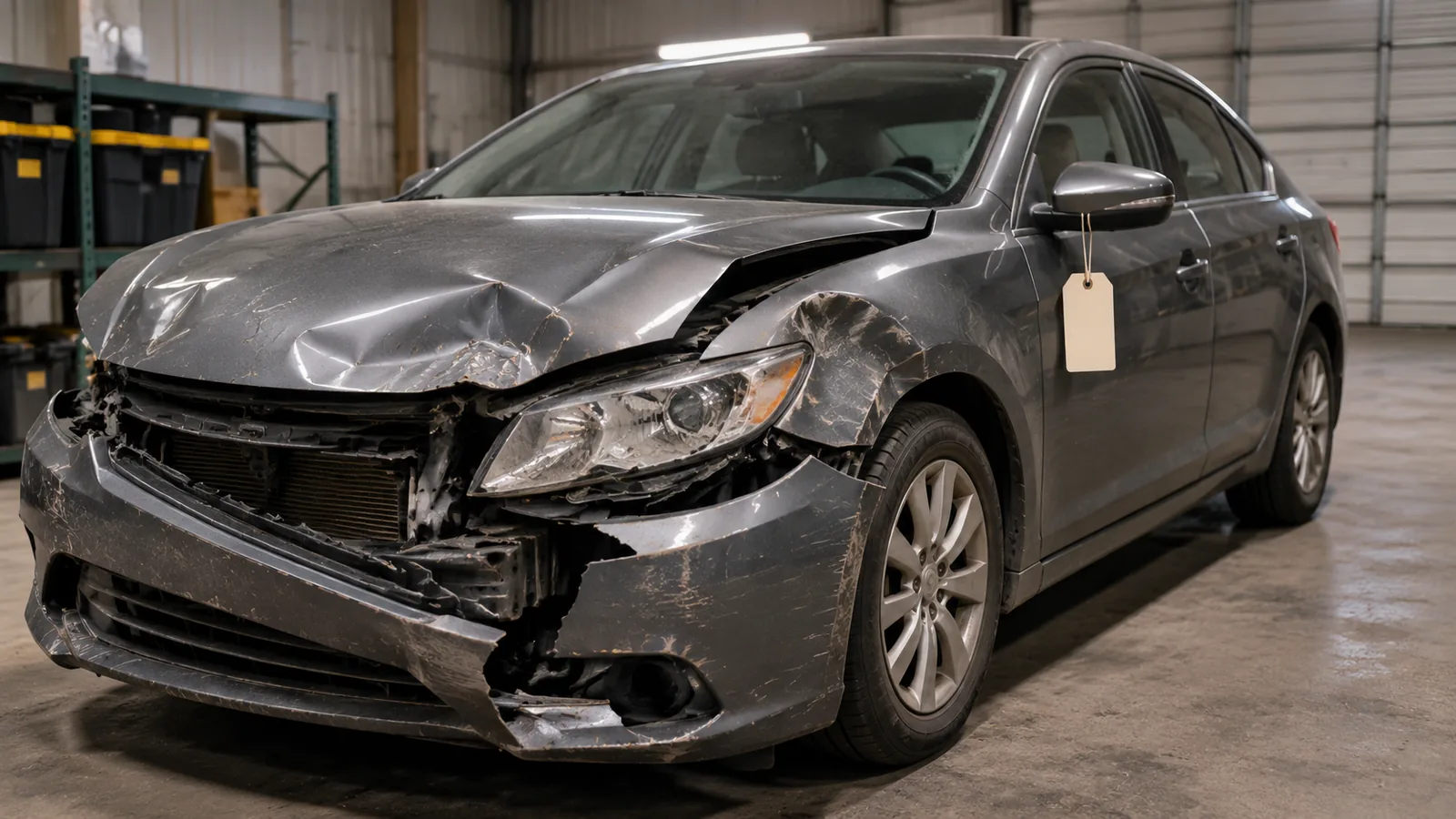
What evidence disappears first after a serious injury, how to ask others to keep it and what Texas courts can do when it's lost.
Short answer
Video usually goes first. Many store and traffic systems record over themselves on a loop, and a car's stored data can change the next time someone drives or repairs it. That's why preservation letters need to go out in days, not months.
Texas puts a duty to preserve on a party that should reasonably expect a claim. If relevant evidence is lost anyway, the trial judge decides what remedy fits.
Here's what tends to disappear, roughly in the order it goes:
- surveillance video on a recording loop
- vehicle event data and truck telematics
- the wrecked car, the broken ladder, or the machine, once a repair or salvage sale is scheduled
- texts and photos on a phone that gets traded in
- the memory of the clerk or driver who saw it happen
When does someone have to preserve evidence in Texas?
The Texas Supreme Court set the rule in Brookshire Bros. v. Aldridge, 438 S.W.3d 9 (Tex. 2014). A party has to preserve evidence once it knows or reasonably should know there's a substantial chance a claim will be filed and that evidence in its possession or control will be material and relevant.
The facts of that case are worth knowing. On September 2, 2004, Jerry Aldridge slipped and fell near a display table at a Brookshire Brothers grocery store. He reported his injuries five days later. The company's risk manager saved about eight minutes of surveillance video, from just before Aldridge entered the store until shortly after the fall.
The cameras ran on a loop of about 30 days, so everything else was recorded over. In August 2005, Aldridge's lawyer asked for roughly two and a half more hours of footage. It had been gone for almost a year.
How much warning counts as a "substantial chance"? The court said it means more than an abstract possibility or unwarranted fear. A serious crash with injuries and police at the scene will usually give that warning. A dated, specific letter still helps, because it pins down exactly when the other side knew.
Who has the evidence after a serious crash or workplace injury?
Evidence usually sits with several companies at once, and a letter to one doesn't reach the others. Say a delivery truck hits you outside a strip mall. The trucking company, its insurer, the tow yard, and the stores along the road may each hold a different piece.
The duty covers only what a party possesses or controls. So who has what? Here's a typical spread, and what to ask each one for:
| Who has it | What to ask them to keep |
|---|---|
| Trucking company or employer | Telematics, dash video, driver logs, and maintenance files. |
| Insurers | Photos, statements, appraisal files, and a salvage hold. |
| Tow yard or repair shop | The vehicles and removed parts, unrepaired until an inspection date is set. |
| Nearby stores and apartment complexes | Exterior footage for a narrow window, and the overwrite date. |
| City and state agencies | Traffic camera video, 911 audio, and dispatch logs, through the agency's own process. |
| Employer or property owner (workplace injury) | Incident reports, safety records, machine logs, and the equipment itself. |
For a crash-specific checklist, see how to preserve car crash video and vehicle data in Texas. What separates a strong letter from a weak one? The strong one names the date, the place, and the vehicles. It lists cameras, telematics, and dispatch by name, asks for written confirmation and the overwrite schedule, and goes to each custodian separately. The weak one demands "all documents" from one insurer and asks for nothing back.
How are vehicles, products and data inspected without damaging them?
Nobody should touch a wrecked truck or a failed saw until both sides have had a chance to look. A careful inspection runs in six steps:
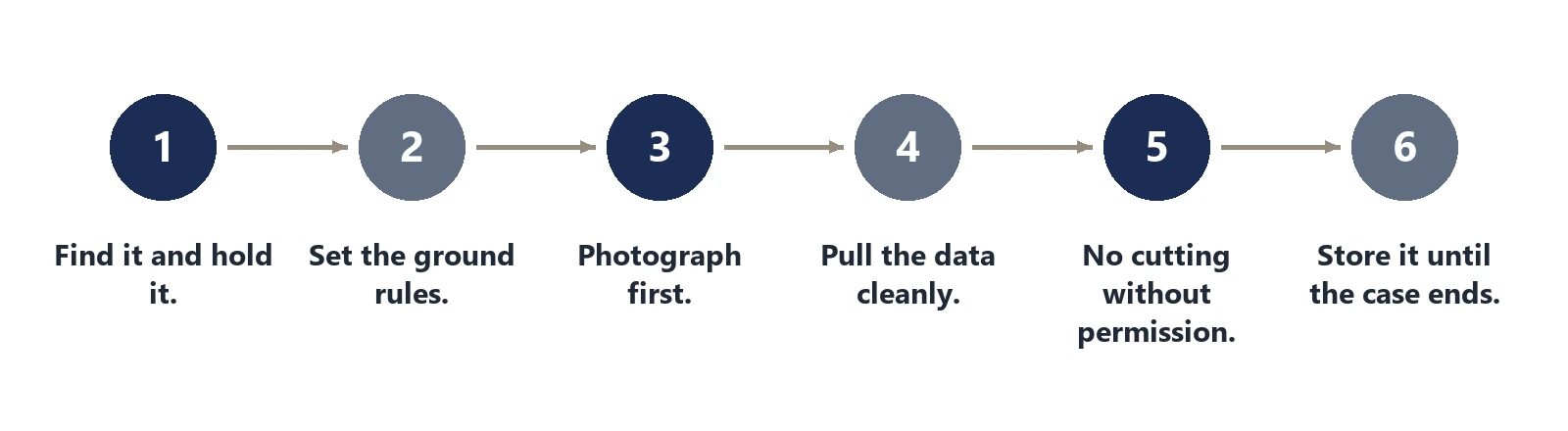
| Step | What it covers |
|---|---|
| 1. Find it and hold it | Storage location, owner, and any scheduled repair or sale. |
| 2. Set the ground rules | Who attends, which tools come out, and what gets photographed. |
| 3. Photograph first | Every side on video before anyone loosens a bolt. |
| 4. Pull the data cleanly | Native files, the tool and software version, and the examiner's notes. |
| 5. No cutting without permission | A court order or a written agreement first. |
| 6. Store it until the case ends | An agreed place, and an agreed answer on who pays. |
Step 5 has teeth. Rule 196.5 bars testing that destroys or materially alters an item without court authorization.
Once a suit is filed, Rule 196.4 lets you ask for the telematics file itself, in the form you name, as long as the request specifically asks for electronic data. Rule 196.7 can get your expert onto a plant floor, a stretch of road, or a storage lot to inspect, measure, photograph, or test. Before filing, Rule 202.1 lets a court authorize a deposition to perpetuate testimony or investigate a potential claim.
What should you do with your own phone and records?
The duty to preserve applies to helpful and unhelpful evidence alike, including what's on your devices. Picture this: three weeks after the crash, your cracked phone finally dies, and the store offers you a trade-in. That phone may hold your only crash-day photos.
Back it up before it leaves your hands, and keep the original photo files, not screenshots. Then skip these mistakes:
- trading in or factory-resetting a phone with crash-day photos or messages on it
- cropping or filtering a picture before your lawyer sees the original
- deleting a post about the injury, even one you regret
- posting new updates about the case or your recovery
- leaving out the photo that looks bad for you
Tell your lawyer everything, including the parts you'd rather skip. Your lawyer can deal with a bad fact. A hidden one is much harder.
What happens if evidence is lost or destroyed?
Under Brookshire Brothers, the trial judge, not the jury, decides whether spoliation happened and what remedy fits. The judge looks at duty, breach, harm, and a remedy that relates directly to the conduct without being excessive. Your notice letter, the other side's retention policy, and any substitute evidence all feed into that.
The jury instruction people ask about most is the hardest remedy to get. Here's how Brookshire Brothers treats it:
| Situation | Is a spoliation instruction available? |
|---|---|
| Destroyed with the specific intent to conceal discoverable evidence | Possible, if the court finds a lesser remedy won't cure the prejudice |
| Willful blindness, such as letting evidence be destroyed while knowing it's relevant | Treated as intentional spoliation |
| Negligent loss | Only if the other side is irreparably deprived of any meaningful ability to present its claim or defense |
| Routine overwrite before any duty arose | No spoliation, because no duty existed at the time |
Aldridge's own case shows how high that bar sits. His jury heard the spoliation evidence, got an instruction, and awarded him $1,063,664.99. The Supreme Court found no evidence that the store meant to conceal the video or that Aldridge lost any meaningful ability to present his claim. It reversed and sent the case back for a new trial.
For how this plays out with store video, see whether Walmart can delete surveillance video after a fall.
Key point: A sanction may never come. A duplicate copy, a second camera angle, or a witness who saw the spill can prove what the lost item would have shown.
Keep a dated log of every letter and every reply. Months later, a spoliation motion will ask what the other side knew and when.
Don't let the filing deadline slip while you gather evidence. Section 16.003 gives most injury claimants two years to sue, and discovery tools such as Rules 196.4 and 196.7 open up only once a suit is pending.
To keep the whole case in view, the Texas catastrophic injury claims guide and the Texas Catastrophic Injury and Damages Hub show how preserved evidence fits liability and damages proof.
Frequently asked questions
How fast should preservation letters go out?
Within days, if you can. The grocery store in Brookshire Brothers recorded over its video in about 30 days, and other systems may keep less. Send a separate letter to each custodian.
Can I take the other driver's car to have it inspected?
No. It isn't your property. Your lawyer can ask the owner or insurer to hold it, set up a joint inspection, or ask a court for an order.
Is a preservation letter a court order?
No. A letter gives notice and supports a later spoliation argument, but a court order is a separate step with its own legal showing.
Will the jury hear that the other side destroyed evidence?
Usually not, unless the judge allows it. Under Brookshire Brothers, courts generally keep spoliation evidence from the jury except as it relates to the merits, and a spoliation instruction requires specific findings.
What if my own evidence was lost before I hired a lawyer?
Tell your lawyer right away and explain what happened. An innocent loss explained early is far easier to handle than one the defense discovers later.
Sources
- Brookshire Bros., Ltd. v. Aldridge, 438 S.W.3d 9 (Tex. 2014), majority opinion: the grocery-video facts, when the duty to preserve arises, who decides spoliation, and when a jury instruction is allowed.
- Texas Rules of Civil Procedure (court-posted PDF): Rules 196.4, 196.5, 196.7, and 202.1 on electronic data, testing limits, entry on property, and pre-suit depositions.
- Tex. Civ. Prac. & Rem. Code § 16.003: the two-year filing deadline for most personal injury suits.
This article provides general information about Texas law, not legal advice. Every case depends on its facts, evidence, insurance, deadlines and governing law. Past results do not guarantee a similar outcome.

ABOUT THE ATTORNEY
Aaron A. Herbert
Founding Attorney
Board Certified in Personal Injury Trial Law
Aaron founded The Law Firm of Aaron A. Herbert in 2010 to focus on developing each client's case and seeking its maximum value. For over a decade, he has represented people seriously injured in major accidents and industrial catastrophes, pursuing trial verdicts and settlements while working to reduce the stress of litigation.
Education
- Texas A&M University · B.S., Criminal Justice, 1999
- University of Oklahoma College of Law · J.D., 2002; graduated in the top of his class
Trial experience & approach
Aaron earned numerous jury verdicts at boutique personal injury litigation firms. According to his biography, he spent a year as the top-earning litigation attorney at a firm that frequently appeared in verdict searches as having one of the highest numbers of trial wins in Texas. At another Dallas personal injury firm, he moved from managing pre-litigation attorney to managing litigation attorney over seven years as the firm grew into one of Dallas's largest personal injury firms.
His biography describes a reputation as one of America's most aggressive trial lawyers, with noteworthy recoveries from judges and juries and substantial pretrial settlements. Most of those settlements included confidentiality agreements requested by the defense. Aaron has said the recoveries were justified by the injuries and losses involved, which no amount of money could make someone choose to experience.
His approach combines passion, preparation, persistence and courtroom imagination. He believes a well-supported, engaged and motivated team working cooperatively helps deliver strong representation, with the goal of achieving the best possible result for every client.
Dallas roots, military service & publication
Born and raised in Dallas, Aaron enlisted in the United States Marine Corps after high school and later received an Honorable Discharge. He completed his university and law degrees after his military service and became a lifelong Sooners football fan in law school.
Publication: “Litigating Dog Bite Cases,” Texas Dog Law Seminar, Dallas, 2009.
Professional affiliations & recognition
Professional affiliations and recognition listed in Aaron’s biography:
- State Bar of Texas
- American Bar Association
- Association of Trial Lawyers of America (now American Association for Justice)
- Texas Trial Lawyers Association
- Dallas Trial Lawyers Association
- Dallas Bar Association
- Tarrant County Bar Association
- Million Dollar Advocates Forum
- The National Trial Lawyers – Top 100 Trial Lawyers