
Lawful Access, Original Files and Inspection Planning
Dashcam footage, surveillance, and vehicle data can help establish a crash sequence, but their value depends on prompt preservation and reliable interpretation. Retain the original material, identify its custodian, and arrange lawful access before alteration, automatic deletion, repair, or disposal removes information that cannot be recreated.

Identify every relevant source
Potential sources include the client's dashcam, another driver's recording, a witness's phone, a business camera, a fleet system, and available vehicle modules. Record which source may answer which question. A camera showing the approach may be more useful than one showing only the aftermath.
Do not assume a nearby camera recorded the roadway or that a traffic camera retains historical footage. Determine orientation, recording capability, retention, and the person who controls access. A prompt focused request may preserve the material, but retention and production remain separate steps.
For clients, save the original rather than only an edited clip. Identify the device, card, app, or cloud account. Avoid deleting unfavorable segments. Tell counsel if continuing to use a device could overwrite the recording so appropriate preservation can be arranged.
Preserve context and metadata
A forwarded file can be compressed or altered. Obtain native files where feasible and document who exported them, how, and when. Keep preserved originals separate from working copies. Retain associated information needed to explain camera time, location, orientation, and export settings.
Video clocks may be wrong. Before combining recordings, determine whether they can be synchronized through identifiable events. A display showing 8:01 on one camera and 8:02 on another does not necessarily establish a one-minute gap. Technical analysis may be needed when sequence turns on seconds.
An event-data record also has limits. Availability depends on the vehicle and event. A recorded value may describe a limited interval and may need correlation with scene measurements and other evidence. An event recorder does not show every maneuver, and engineering values do not independently diagnose injury.
Plan vehicle access before testing
Identify the vehicle owner, custodian, insurer, salvage status, and disposal schedule. Determine the investigation question and whether an expert inspection is justified. Preservation does not grant ownership or unrestricted access. An agreement, appropriate discovery, or court relief may be necessary.
An inspection protocol should define participants, photography, equipment, data acquisition, component handling, and any potentially destructive step. Preserve acquisition files and document tool versions where relevant. Give appropriate notice and resolve access disputes lawfully; do not use urgency as a reason to seize a vehicle or enter private property without authority.
If a component failure is suspected, preserve the component and relevant repair history. A reconstruction inspection and a product-defect inspection may require different expertise. Keep competing explanations open until the evidence supports a conclusion.
Handle missing evidence with a disciplined record
When material disappears, determine what existed, who controlled it, when loss occurred, whether a preservation duty applied, and what prejudice resulted. Missing evidence is not automatically proof that the opponent acted intentionally or that the client wins. A spoliation issue requires legal analysis and a remedy proportionate to the circumstances.
Counsel should record preservation requests, delivery, responses, policies, and known deletion events. Distinguish an unsupported suspicion from an established loss. Consider substitute evidence and whether further discovery can identify the system's operation. The goal remains proving the underlying claim; a missing-data dispute should not replace that work.
An illustrative surveillance problem
A store provides a short clip that appears to show a driver entering an intersection. The clip lacks the approach and displays an uncertain timestamp. Counsel should request preservation of the relevant interval, identify the export method, and evaluate clock accuracy before using it to calculate speed or signal timing. The shortened clip may still be useful, but it should not be described as answering questions outside its field of view.
Questions clients often ask
Can I repair my car
Ask whether inspection is needed before repairs alter relevant evidence, particularly in a serious or disputed case. Routine repairs do not always require indefinite delay, but the question should be assessed first.
Can the lawyer get the other driver's phone
Only through lawful, properly scoped methods when justified. Relevant information may be sought, but privacy, proportionality, possession, and procedural rules affect access.
Does a vehicle download establish fault
It can support analysis, but it must be interpreted with other evidence. Data limits and competing explanations remain important.
Vehicle data access requires legal authority
Texas Transportation Code section 547.615 addresses ownership and access to specified recording device information, with statutory exceptions. The federal Driver Privacy Act of 2015 also addresses event data recorder information and exceptions to the owner's or lessee's consent. Counsel should identify the actual device and applicable rules before authorizing access. Physical possession of a car, a repair estimate, or a preservation letter does not by itself answer every data access question.
An acquisition protocol should state who gives consent or which order authorizes access, who will perform the work, the permitted scope, and what files will be retained. If another party disputes access, seek a lawful resolution before extracting information. A case can be harmed by an avoidable access controversy even when the underlying data would be useful. Consent and custody should be documented separately because the person storing a vehicle may not own its electronic information.
The federal event data recorder framework in 49 C.F.R. Part 563 addresses covered vehicles and standardized information requirements. It does not mean every passenger car records every maneuver or that all crashes produce a complete dataset. Model, year, module, triggering criteria, overwrite conditions, and damage matter. Identify capabilities from the actual vehicle and reliable technical documentation. An unavailable field should remain unavailable rather than be filled with an assumption.
Ask what each digital source can actually prove
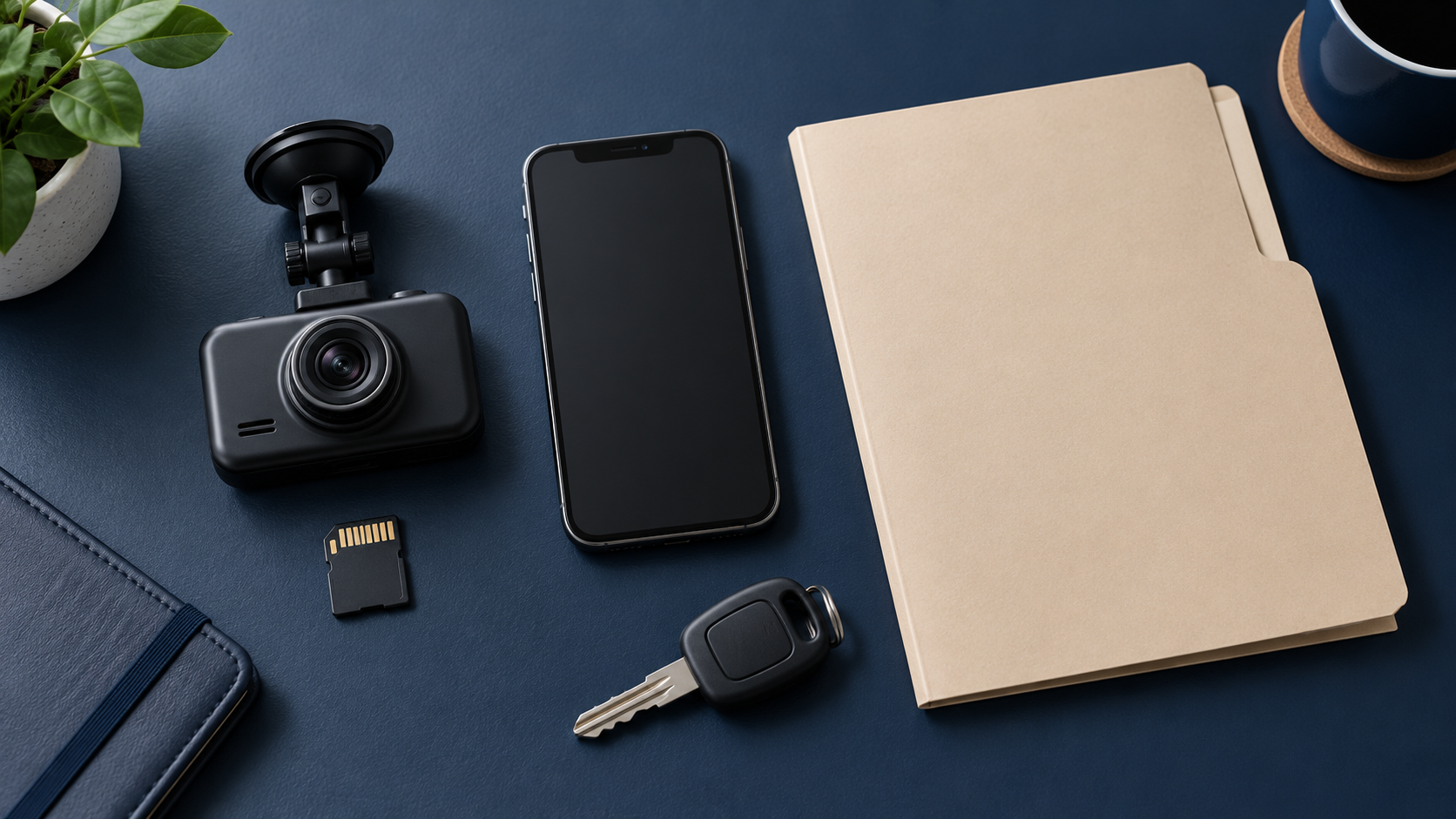
A dashcam may show the approach and contact, but its viewing angle may differ from the driver's. Event data may report selected values over a short window but not explain why a driver acted. Telematics may document location at intervals too wide to resolve a signal dispute. A phone log may show network activity without identifying a person touching the device. Counsel should list what each source supports, what it does not support, and which independent evidence can check it.
Time synchronization is a separate task. A surveillance recorder, phone, vehicle module, and dispatch system may use different clocks. Record time zones, offsets, daylight saving treatment, and any known clock drift. When an expert aligns sources through a visible common event, preserve that reasoning. A polished timeline is unreliable if its timestamps were simply copied into one column and treated as interchangeable.
Camera perspective deserves the same attention. A wide-angle lens can distort distances; a low frame rate can omit movement; motion triggering can leave gaps. Determine the camera's location at the event, not merely at a later visit. If the mounting position changed, document that change. Measurements drawn from video should disclose calibration and uncertainty. A screenshot with arrows can explain a theory, but it is not automatically a validated reconstruction.
Preserve originals and make processing reproducible
Keep the native export, associated player when necessary, metadata, export log, and information about the source system. Retain an untouched copy and use separate working files for enhancement, cropping, or annotation. A hash can help show that a file has not changed since a particular acquisition; it does not establish that the camera clock was correct or that the acquisition captured everything. Chain of custody should explain both integrity and completeness.
For vehicle acquisition, record identification, module location, battery or power condition, tool and software versions, acquisition messages, photographs, and any step that might alter data. An expert should distinguish a successful extraction from a valid interpretation. A warning message or inconsistent field is not something to delete from the final report because it complicates the presentation. Preserve it and explain whether it affects the opinion.
Rule 196.4 of the Texas Rules of Civil Procedure provides a framework for electronic discovery, including requesting electronic information and specifying a desired form. Counsel should also address proportionate scope and objections under the discovery rules. A request for a relevant crash interval and specified sources is usually easier to explain than a demand for an entire personal device. Privacy can be protected through narrowing, redaction, agreed review, or an appropriate order without assuming relevant evidence must be lost.
Missing evidence and spoliation require separate proof
Brookshire Brothers Ltd. v. Aldridge, 438 S.W.3d 9 (Tex. 2014), supplies the Texas framework for judicial spoliation analysis. Duty, breach, prejudice, and an appropriate remedy need examination. A lost recording does not automatically create an adverse jury instruction. Intentional destruction and the limited circumstances involving negligent loss must be analyzed within the opinion's standards. The judge determines the spoliation issue; counsel should not invite the jury to punish a missing file without the court's ruling.
Build the record with the retention system, custody, notices, likely existence of relevant material, and what comparable evidence remains. A claim that footage would have proved everything is weaker than an explanation of the specific approach interval no other source captured. Investigate whether a backup, second camera, insurer copy, repair shop acquisition, or witness device supplies the information. Mitigation of the loss can matter to both strategy and remedy.
Hypothetical expert and trial plan
A driver denies braking before a rear impact. A dashcam appears to show brake lights, but the vehicle dataset records values that initially seem inconsistent. The expert should examine the meaning and sampling of each field, whether the clip is synchronized, and whether the lights belong to the relevant car. Counsel should not select one source and suppress the other. The disagreement may be explainable, unresolved, or important to the theory.
At trial, establish authentication under Texas Rule of Evidence 901 and the technical opinion under Rule 702. Show the original evidence before any demonstrative when appropriate. Explain what the expert measured, how it was calculated, and how sensitive the conclusion is to plausible inputs. Cross examination should test assumptions and method rather than suggest every uncertainty makes digital evidence useless.
For injured clients, the benefit is preserving evidence that may answer a real dispute before an insurer or jury. It does not mean every vehicle should be downloaded or every recording guarantees recovery. Tell the firm where the car and original files are located, and ask which acquisition would materially improve the case. A board certified trial lawyer can connect that technical decision to the proof the claim actually requires.
Build a preservation plan that fits the evidence
A preservation letter should identify the event, the relevant materials, and the action needed to prevent loss. Its scope should be connected to the facts. For a private car collision, relevant items may include the vehicle, onboard modules, photographs, dashcam files, repair documentation, and a narrowly defined interval of phone or app activity. A demand for every electronic record a person has ever created is unlikely to be a useful starting point.
Preservation and production are different. Asking someone to retain a video does not itself compel delivery. Asking an insurer not to dispose of a vehicle does not transfer ownership or grant unrestricted inspection access. Counsel may need cooperation, a subpoena, a discovery request, an agreed protocol, or an appropriate court order. The plan must address lawful access as carefully as it addresses retention.
The client's own evidence deserves the same attention as the opponent's. Original videos should be retained before editing or posting. Relevant messages should not be deleted because they appear unfavorable. A damaged vehicle should not be altered without considering inspection needs. A client who preserves only selected material can create avoidable disputes about completeness, credibility, and missing context.
When a vehicle is at risk of disposal, identify the custodian, storage charges, ownership status, insurer handling the property claim, and any salvage transfer. Request a reasonable opportunity for inspection and determine whether a preservation agreement is available. In a serious case, consider whether judicial relief is necessary and available. Delay can be costly, but urgency does not authorize trespass or unilateral seizure.
Digital evidence requires attention to format. A forwarded clip may be compressed, lose metadata, or omit the minutes before and after the impact. Obtain the native file when possible and document its source, export method, and any changes. Keep a working copy separate from the preserved original. Record who received the file and where it is stored so the foundation can be explained later.
A preservation log makes the effort accountable. For each source, record the custodian, requested materials, date of request, delivery confirmation, response, follow-up date, and eventual disposition. This log helps counsel avoid assuming that a letter was sufficient. It also helps identify a missing production while there is still time to pursue it, rather than discovering the omission during expert preparation.
Use video with its limitations in view
Video can answer questions about position, direction, timing, lighting, and sequence. It can also mislead when the viewer assumes a camera sees the scene exactly as a driver did. Lens distortion, frame rate, camera angle, obstructions, exposure, and missing portions affect interpretation. A recording that looks decisive at first may require technical work before it supports a reliable conclusion.
Preserve the full relevant interval and identify whether the displayed time corresponds to actual time. Camera clocks may be inaccurate or use a different time zone. A reconstructionist can sometimes synchronize separate recordings through common events, but the method should be explained. Treating several timestamp displays as automatically synchronized can produce a false sequence.
Nearby surveillance may show only part of a roadway. Determine the camera's location and orientation at the time of the crash, whether it records continuously or through motion triggers, and whether it skipped frames. Ask how the file was exported and whether additional cameras captured the approach. A collision outside the image can still be illuminated by visible movement immediately before it.
For the injured person, preserve the original recording even if a shortened version seems easier to share. Tell counsel who controls the device or account and whether cloud retention is limited. Do not repeatedly upload the only copy through services that compress it. If the recording is stored on a removable card, avoid overwriting it with new use until appropriate preservation is arranged.
For counsel, plan authentication before building the demand around the video. Identify a witness with knowledge of the recording system or another available foundation. Consider whether an expert is needed for measurements or synchronization. A demonstrative based on footage should identify assumptions and differ clearly from the original evidence. The audience should understand which image is evidence and which is an explanatory illustration.
An ethical presentation does not hide unfavorable portions. If the footage shows the client moving unusually, assess the significance before producing a polished argument. There may be an innocent explanation, a genuine responsibility issue, or an unrelated event. Accurate early evaluation prevents a damaging surprise and helps the client decide whether a disputed-fault settlement is reasonable.
Inspect vehicles and interpret event data carefully
A vehicle inspection may document crush patterns, contact points, tires, brakes, restraints, lighting, component failures, and available electronic information. The objectives should be defined before the inspection. An ordinary cosmetic property claim may not justify the same investigation as a rollover, serious injury, disputed impact sequence, or suspected product defect.
Some vehicles store event data related to a qualifying incident. Availability depends on the vehicle, module, event, equipment, and applicable access rules. The presence of a modern vehicle does not guarantee a recoverable crash record. Data may describe only a limited interval and may require correlation with physical evidence and other sources. An event recorder is not a continuous video of every maneuver.
The inspection protocol should identify participating experts, scope, equipment, photography, data acquisition, handling of components, and whether any step could alter evidence. Preserve the acquisition files and information about tool versions. Destructive testing requires particular care, adequate notice where appropriate, and suitable agreements or orders. Document the condition before any step that changes it.
A speed value does not independently determine negligence or injury. Counsel should ask what the measurement represents, what uncertainties apply, whether tires or vehicle conditions affect it, and how it aligns with the scene. Likewise, an impact estimate is not a medical diagnosis. Engineering evidence and clinical evidence answer different questions and should be connected through qualified analysis rather than a marketing claim.
If a suspected defect is involved, identify the component, product history, recalls if relevant, prior repairs, and the theory of failure. The possibility of a defect does not mean the driver was faultless or the manufacturer liable. Product claims can require different proof, parties, defenses, and preservation methods. An inspection should keep legitimate alternative explanations open.
Clients should tell the firm before authorizing salvage, repairs that alter relevant components, or disposal of a seriously damaged vehicle. Counsel can advise whether inspection matters and what arrangements are feasible. The goal is a proportionate investigation. Preserving every vehicle indefinitely is unnecessary, but losing a vehicle before a key question is assessed can remove evidence that cannot be recreated.
Prepare experts and challenge opinions on their merits
An expert's usefulness depends on qualifications, reliable reasoning, sufficient facts, and a connection to the disputed question. The expert should receive the necessary information, including material that complicates the preferred theory. Counsel should understand the method well enough to identify assumptions, limits, and questions likely to arise in cross-examination.
Plan disclosures and reports around the scheduling order and applicable rules. A strong substantive opinion can encounter procedural difficulty if deadlines are missed or the disclosure does not identify its basis adequately. Keep a calendar for each expert and track whether new evidence requires supplementation. Do not treat expert preparation as a task to begin only after mediation fails.
For medical experts, identify the condition, causal reasoning, baseline, alternative causes, treatment necessity, prognosis, and restrictions within the witness's expertise. For reconstruction experts, identify inputs, measurements, uncertainties, and competing scenarios. For economic experts, identify the underlying medical and vocational assumptions. Consistency across opinions is essential, but consistency should come from shared facts rather than coordinated exaggeration.
An opposing opinion should be tested through its actual reasoning. Determine what records were reviewed, what information was omitted, whether the method fits the case, and whether conclusions exceed the inputs. A disagreement alone does not make an opinion inadmissible. A focused challenge should distinguish a flaw in reliability from an issue that is properly addressed through cross-examination.
Clients can help by reporting additional treatment, employment changes, or later incidents promptly. An expert who works from an outdated chronology may be surprised by information the client thought was insignificant. Timely updates allow the opinion to be evaluated and supplemented appropriately. The lawyer should explain which developments are important and provide a manageable way to report them.
Expert expenses should remain proportionate to the issues and practical recovery. Some cases need several disciplines; others can be developed effectively with fewer. Explain why a proposed expert is needed, what question the expert will answer, and how the expense affects the client. A larger team is not automatically a better strategy.
How specialized trial preparation can help your claim
The legal work described here matters because it helps the firm evaluate lawful vehicle and digital evidence access. It can preserve a useful source, identify an unsupported insurer position, or reveal a genuine risk before you make an irreversible decision. It also provides a plan for presenting the issue through admissible evidence if settlement does not resolve it.
Aaron A. Herbert is Board Certified in Personal Injury Trial Law by the Texas Board of Legal Specialization. The firm's published background describes substantial jury trial experience, and its case results report significant client recoveries. Review those credentials and results alongside the investigation your own case requires. Previous outcomes do not guarantee a similar result; the facts, proof, law, and available recovery sources differ.
If you are considering hiring counsel after a Texas crash, request a free consultation with The Law Firm of Aaron A. Herbert PC or call 214 200 4878. Tell the office about the issue addressed in this article and any approaching deadline. Ask who would handle the case, what work is needed, and how fees and expenses are addressed before signing an agreement.
Attorneys and referral partners can use the same contact page to request a case or litigation discussion. Identify procedural dates and confirm acceptance before transferring responsibility. Representation begins only when the firm accepts the matter.
Read the Texas car accident claims and litigation guide or return to the Texas Car Accident Knowledge Hub for related resources.
Related car accident resources
- What to Do After a Texas Car Accident
- Fault in Texas Multi Vehicle and Intersection Crashes
- Texas Car Accident Lawsuit and Trial Preparation (Coming soon)
Legal sources
Texas Rules of Civil Procedure effective October 1 2026.
Texas Transportation Code chapter 547 section 547.615.
Driver Privacy Act of 2015 Public Law 114 94 sections 24301 and 24302.
49 CFR Part 563 Event Data Recorders.
This article provides general information about Texas law. Application depends on the facts, policy, court orders, and law governing the particular claim. Hypothetical examples are illustrations rather than reported firm cases.

ABOUT THE ATTORNEY
Aaron A. Herbert
Founding Attorney
Board Certified in Personal Injury Trial Law
Aaron founded The Law Firm of Aaron A. Herbert in 2010 to focus on developing each client's case and seeking its maximum value. For over a decade, he has represented people seriously injured in major accidents and industrial catastrophes, pursuing trial verdicts and settlements while working to reduce the stress of litigation.
Education
- Texas A&M University · B.S., Criminal Justice, 1999
- University of Oklahoma College of Law · J.D., 2002; graduated in the top of his class
Trial experience & approach
Aaron earned numerous jury verdicts at boutique personal injury litigation firms. According to his biography, he spent a year as the top-earning litigation attorney at a firm that frequently appeared in verdict searches as having one of the highest numbers of trial wins in Texas. At another Dallas personal injury firm, he moved from managing pre-litigation attorney to managing litigation attorney over seven years as the firm grew into one of Dallas's largest personal injury firms.
His biography describes a reputation as one of America's most aggressive trial lawyers, with noteworthy recoveries from judges and juries and substantial pretrial settlements. Most of those settlements included confidentiality agreements requested by the defense. Aaron has said the recoveries were justified by the injuries and losses involved, which no amount of money could make someone choose to experience.
His approach combines passion, preparation, persistence and courtroom imagination. He believes a well-supported, engaged and motivated team working cooperatively helps deliver strong representation, with the goal of achieving the best possible result for every client.
Dallas roots, military service & publication
Born and raised in Dallas, Aaron enlisted in the United States Marine Corps after high school and later received an Honorable Discharge. He completed his university and law degrees after his military service and became a lifelong Sooners football fan in law school.
Publication: “Litigating Dog Bite Cases,” Texas Dog Law Seminar, Dallas, 2009.
Professional affiliations & recognition
Professional affiliations and recognition listed in Aaron’s biography:
- State Bar of Texas
- American Bar Association
- Association of Trial Lawyers of America (now American Association for Justice)
- Texas Trial Lawyers Association
- Dallas Trial Lawyers Association
- Dallas Bar Association
- Tarrant County Bar Association
- Million Dollar Advocates Forum
- The National Trial Lawyers – Top 100 Trial Lawyers
Trial experience & approach
Aaron earned numerous jury verdicts at boutique personal injury litigation firms. According to his biography, he spent a year as the top-earning litigation attorney at a firm that frequently appeared in verdict searches as having one of the highest numbers of trial wins in Texas. At another Dallas personal injury firm, he moved from managing pre-litigation attorney to managing litigation attorney over seven years as the firm grew into one of Dallas's largest personal injury firms.
His biography describes a reputation as one of America's most aggressive trial lawyers, with noteworthy recoveries from judges and juries and substantial pretrial settlements. Most of those settlements included confidentiality agreements requested by the defense. Aaron has said the recoveries were justified by the injuries and losses involved, which no amount of money could make someone choose to experience.
His approach combines passion, preparation, persistence and courtroom imagination. He believes a well-supported, engaged and motivated team working cooperatively helps deliver strong representation, with the goal of achieving the best possible result for every client.
Dallas roots, military service & publication
Born and raised in Dallas, Aaron enlisted in the United States Marine Corps after high school and later received an Honorable Discharge. He completed his university and law degrees after his military service and became a lifelong Sooners football fan in law school.
Publication: “Litigating Dog Bite Cases,” Texas Dog Law Seminar, Dallas, 2009.
Professional affiliations & recognition
Professional affiliations and recognition listed in Aaron’s biography:
- State Bar of Texas
- American Bar Association
- Association of Trial Lawyers of America (now American Association for Justice)
- Texas Trial Lawyers Association
- Dallas Trial Lawyers Association
- Dallas Bar Association
- Tarrant County Bar Association
- Million Dollar Advocates Forum
- The National Trial Lawyers – Top 100 Trial Lawyers