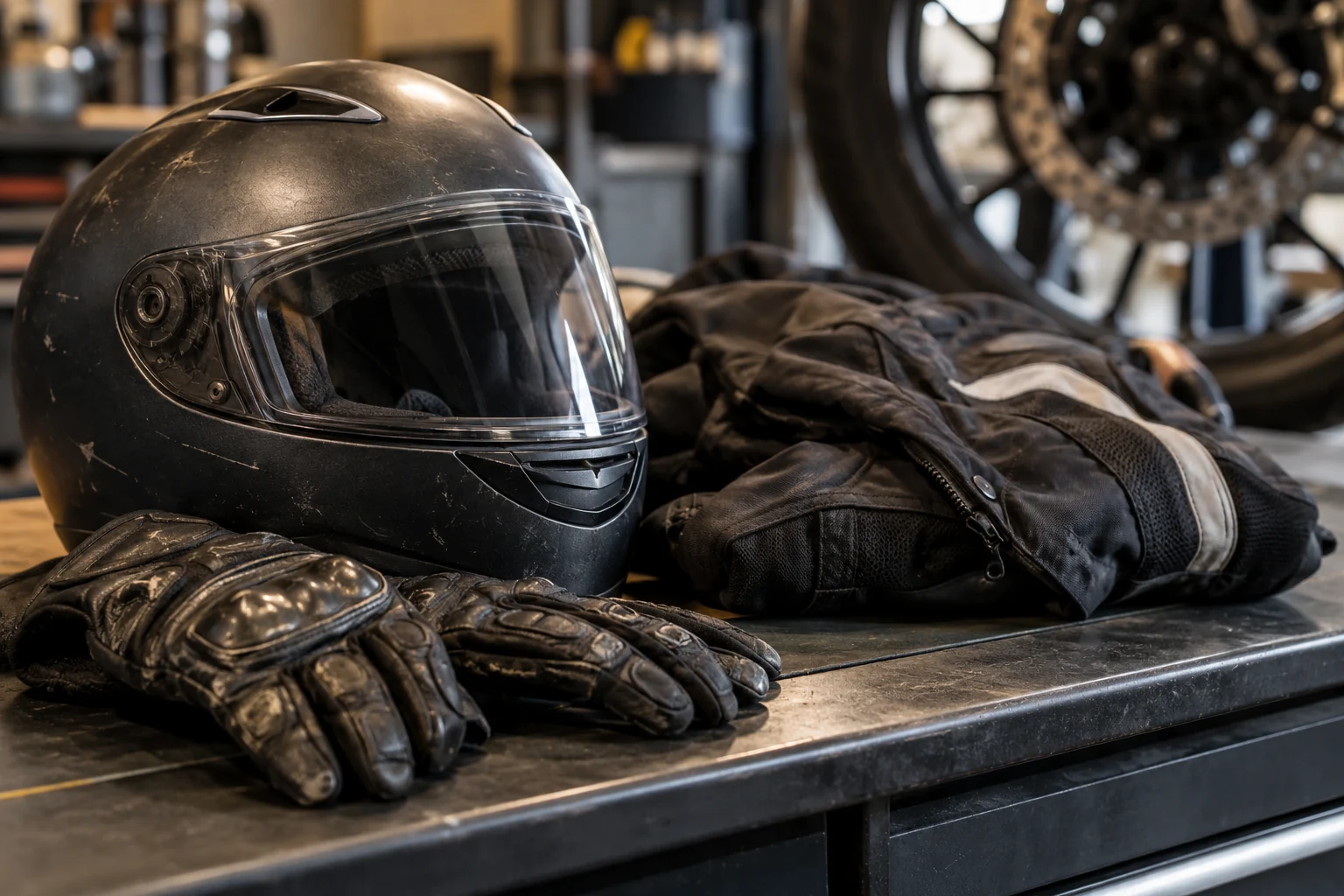
Preserving a motorcycle, helmet and riding gear after a crash.
Do not test-ride a damaged motorcycle. If you can lawfully and safely keep it available for inspection, discuss doing so with counsel when its condition could answer a disputed question. Repairs or a move to salvage may change the brakes, tires, lights, controls or impact marks before an expert sees them. Keep the helmet, jacket, gloves and boots as well; they may help locate contact. The condition of any one item does not, by itself, establish who caused the crash.
First locate the bike and identify who can authorize its release. Get the towing and storage paperwork, any photos and the dates by which a release or disposal decision must be made. Before agreeing to salvage or major repairs, ask counsel whether the evidence issue calls for a hold or a documented examination. Storage is not free, and charges can mount. The decision needs to be made promptly with the value of the evidence in mind. Photograph the whole motorcycle and the details without taking components apart.
Keep each piece of gear as it was recovered, with a label identifying it. A helmet crack has to be considered alongside the helmet’s condition before the crash, how it fit and what happened to it afterward. An intact-looking helmet cannot tell you whether a head injury occurred. Abrasions on clothing may help explain movement across pavement; the injury itself still needs medical evidence. When litigation is foreseeable, document the gear before anyone washes it or throws it away.
An inspection needs a record of the item’s identifiers and location, who held it, who attended and the order of testing. Some examination methods change the evidence: cutting a part is an obvious example, and an electronic download may also affect stored data. In a dispute, an agreed procedure or court direction may be needed. If a repair has already happened, look for invoices, removed parts, photographs and the technician’s notes. Replacing a part after the crash does not automatically concede that it failed beforehand.
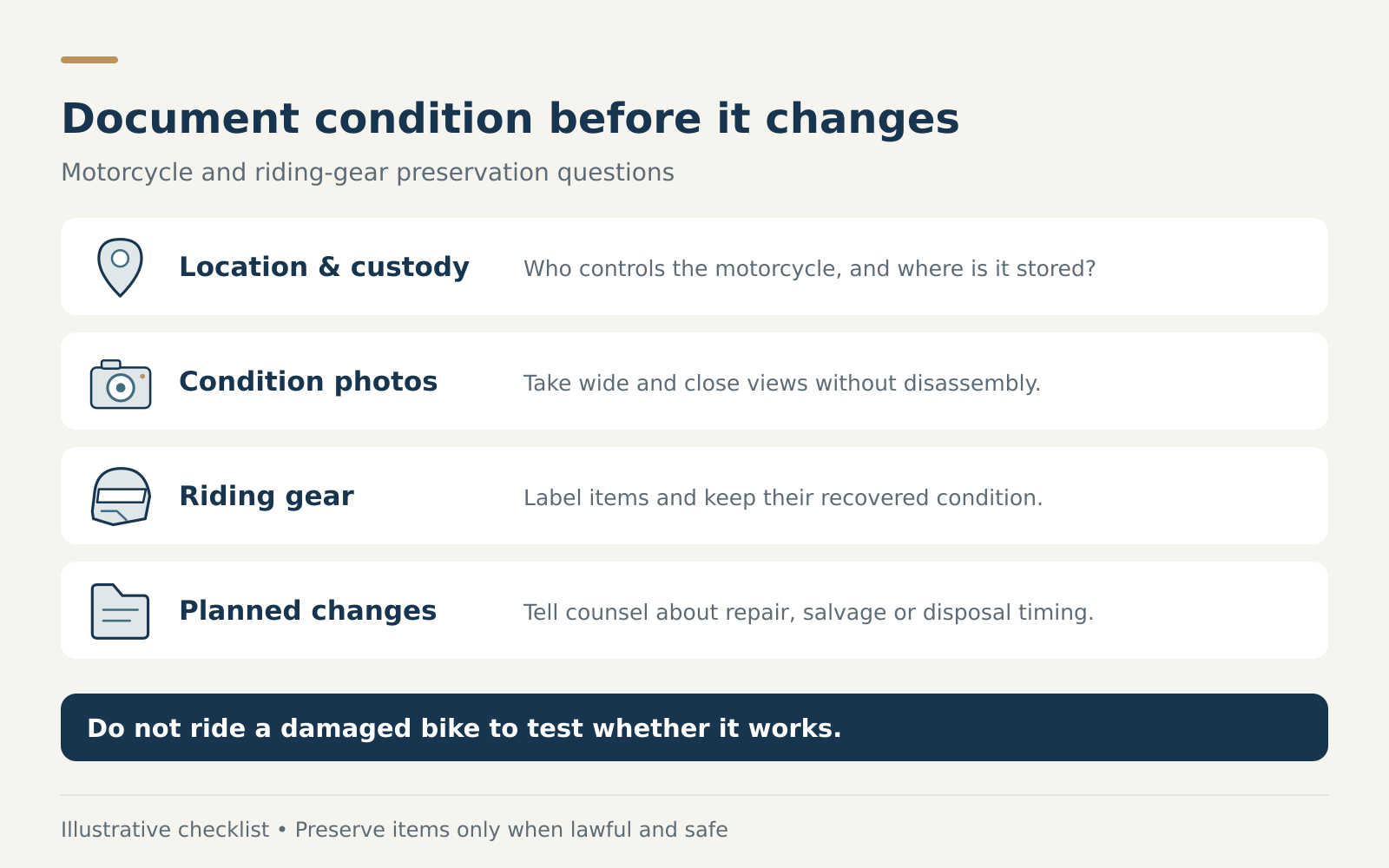
The Texas motorcycle pillar covers vehicle and product questions. Visit the hub to continue, or the Dallas motorcycle accident service page to discuss an imminent salvage or inspection issue. The time-sensitive point is to tell counsel what will happen to the bike and when.
What if the motorcycle was already sold for salvage? Find out who received it and look for the transfer records, earlier photos and inspection material. Losing access to the bike can make proof harder. It does not, by itself, mean the claim is over.

ABOUT THE ATTORNEY
Aaron A. Herbert
Founding Attorney
Board Certified in Personal Injury Trial Law
Aaron founded The Law Firm of Aaron A. Herbert in 2010 to focus on developing each client's case and seeking its maximum value. For over a decade, he has represented people seriously injured in major accidents and industrial catastrophes, pursuing trial verdicts and settlements while working to reduce the stress of litigation.
Education
- Texas A&M University · B.S., Criminal Justice, 1999
- University of Oklahoma College of Law · J.D., 2002; graduated in the top of his class
Trial experience & approach
Aaron earned numerous jury verdicts at boutique personal injury litigation firms. According to his biography, he spent a year as the top-earning litigation attorney at a firm that frequently appeared in verdict searches as having one of the highest numbers of trial wins in Texas. At another Dallas personal injury firm, he moved from managing pre-litigation attorney to managing litigation attorney over seven years as the firm grew into one of Dallas's largest personal injury firms.
His biography describes a reputation as one of America's most aggressive trial lawyers, with noteworthy recoveries from judges and juries and substantial pretrial settlements. Most of those settlements included confidentiality agreements requested by the defense. Aaron has said the recoveries were justified by the injuries and losses involved, which no amount of money could make someone choose to experience.
His approach combines passion, preparation, persistence and courtroom imagination. He believes a well-supported, engaged and motivated team working cooperatively helps deliver strong representation, with the goal of achieving the best possible result for every client.
Dallas roots, military service & publication
Born and raised in Dallas, Aaron enlisted in the United States Marine Corps after high school and later received an Honorable Discharge. He completed his university and law degrees after his military service and became a lifelong Sooners football fan in law school.
Publication: “Litigating Dog Bite Cases,” Texas Dog Law Seminar, Dallas, 2009.
Professional affiliations & recognition
Professional affiliations and recognition listed in Aaron’s biography:
- State Bar of Texas
- American Bar Association
- Association of Trial Lawyers of America (now American Association for Justice)
- Texas Trial Lawyers Association
- Dallas Trial Lawyers Association
- Dallas Bar Association
- Tarrant County Bar Association
- Million Dollar Advocates Forum
- The National Trial Lawyers – Top 100 Trial Lawyers
Trial experience & approach
Aaron earned numerous jury verdicts at boutique personal injury litigation firms. According to his biography, he spent a year as the top-earning litigation attorney at a firm that frequently appeared in verdict searches as having one of the highest numbers of trial wins in Texas. At another Dallas personal injury firm, he moved from managing pre-litigation attorney to managing litigation attorney over seven years as the firm grew into one of Dallas's largest personal injury firms.
His biography describes a reputation as one of America's most aggressive trial lawyers, with noteworthy recoveries from judges and juries and substantial pretrial settlements. Most of those settlements included confidentiality agreements requested by the defense. Aaron has said the recoveries were justified by the injuries and losses involved, which no amount of money could make someone choose to experience.
His approach combines passion, preparation, persistence and courtroom imagination. He believes a well-supported, engaged and motivated team working cooperatively helps deliver strong representation, with the goal of achieving the best possible result for every client.
Dallas roots, military service & publication
Born and raised in Dallas, Aaron enlisted in the United States Marine Corps after high school and later received an Honorable Discharge. He completed his university and law degrees after his military service and became a lifelong Sooners football fan in law school.
Publication: “Litigating Dog Bite Cases,” Texas Dog Law Seminar, Dallas, 2009.
Professional affiliations & recognition
Professional affiliations and recognition listed in Aaron’s biography:
- State Bar of Texas
- American Bar Association
- Association of Trial Lawyers of America (now American Association for Justice)
- Texas Trial Lawyers Association
- Dallas Trial Lawyers Association
- Dallas Bar Association
- Tarrant County Bar Association
- Million Dollar Advocates Forum
- The National Trial Lawyers – Top 100 Trial Lawyers