
The answer depends on what actually caused the injury, who controlled the display, and what the store knew before it happened.
What is the short answer?
Costco can be liable, but the injury alone does not prove it. You generally need evidence of what caused the event, who controlled the display or the work, what the store knew or should have known beforehand, and that a reasonable response would have prevented the injury.
| What you need to show | Example of proof |
|---|---|
| What caused the event. | Video, witnesses, and the display's condition. |
| Who controlled the display or work. | Stocking assignments and vendor contracts. |
| What the store knew or should have known. | Prior reports or how long the condition existed. |
| That a reasonable response would have prevented it. | Policies, timing, and testimony. |
A 40-pound case of water landing on your shoulder tells you something went wrong. It doesn't tell a jury who did it.
Is it a condition or an activity?
This sounds like a technicality. It once cost an injured worker a verdict of nearly $2 million.
The case is United Scaffolding, Inc. v. Levine, 537 S.W.3d 463 (Tex. 2017). A pipefitter at a Port Arthur refinery stepped on a loose sheet of plywood on a scaffold and dropped through a hole up to his arms. The contractor had put that scaffold up about a week before. The case went to the jury as ordinary negligence, and the jury sided with him.
On appeal, the Texas Supreme Court reversed and rendered judgment for the contractor. Nobody was building anything when he fell. The scaffold had been standing for a week, so what hurt him was a condition, and a premises claim needs jury findings the general negligence question never asked for.
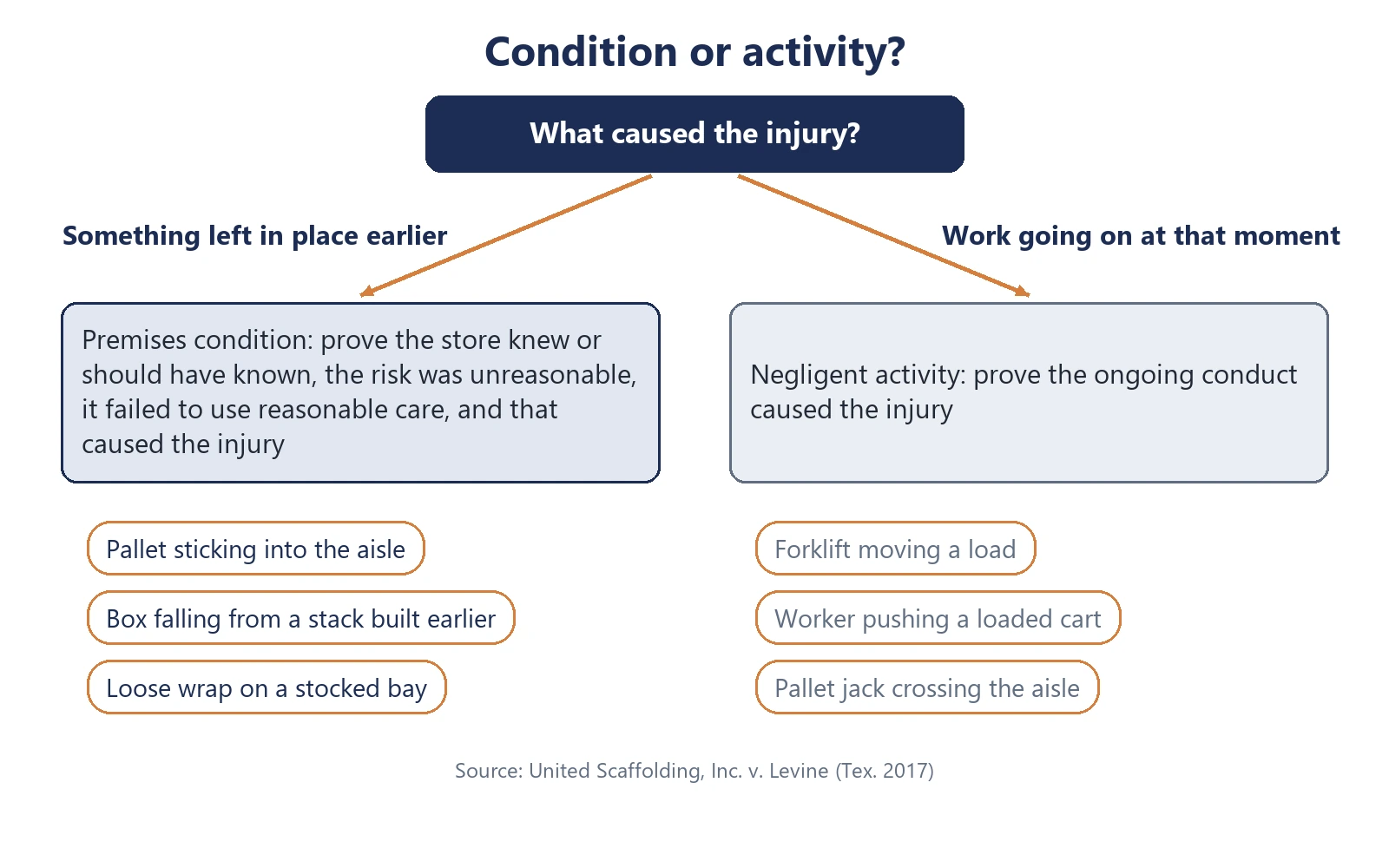
Here is how the two theories differ:
| Theory | What it requires |
|---|---|
| Premises condition. | Knowledge of the condition, unreasonable risk, failure to use reasonable care, and causation. |
| Negligent activity. | Injury caused by ongoing activity at the time, not by a condition it left behind. |
What this means at Costco:
- A pallet left sticking into the aisle is a premises condition.
- A forklift moving a load into a member is negligent activity.
- A product falling from a stack built earlier is usually a premises condition.
- A box knocked down by another shopper depends on who caused it and what the store knew.
How do you reconstruct the display?
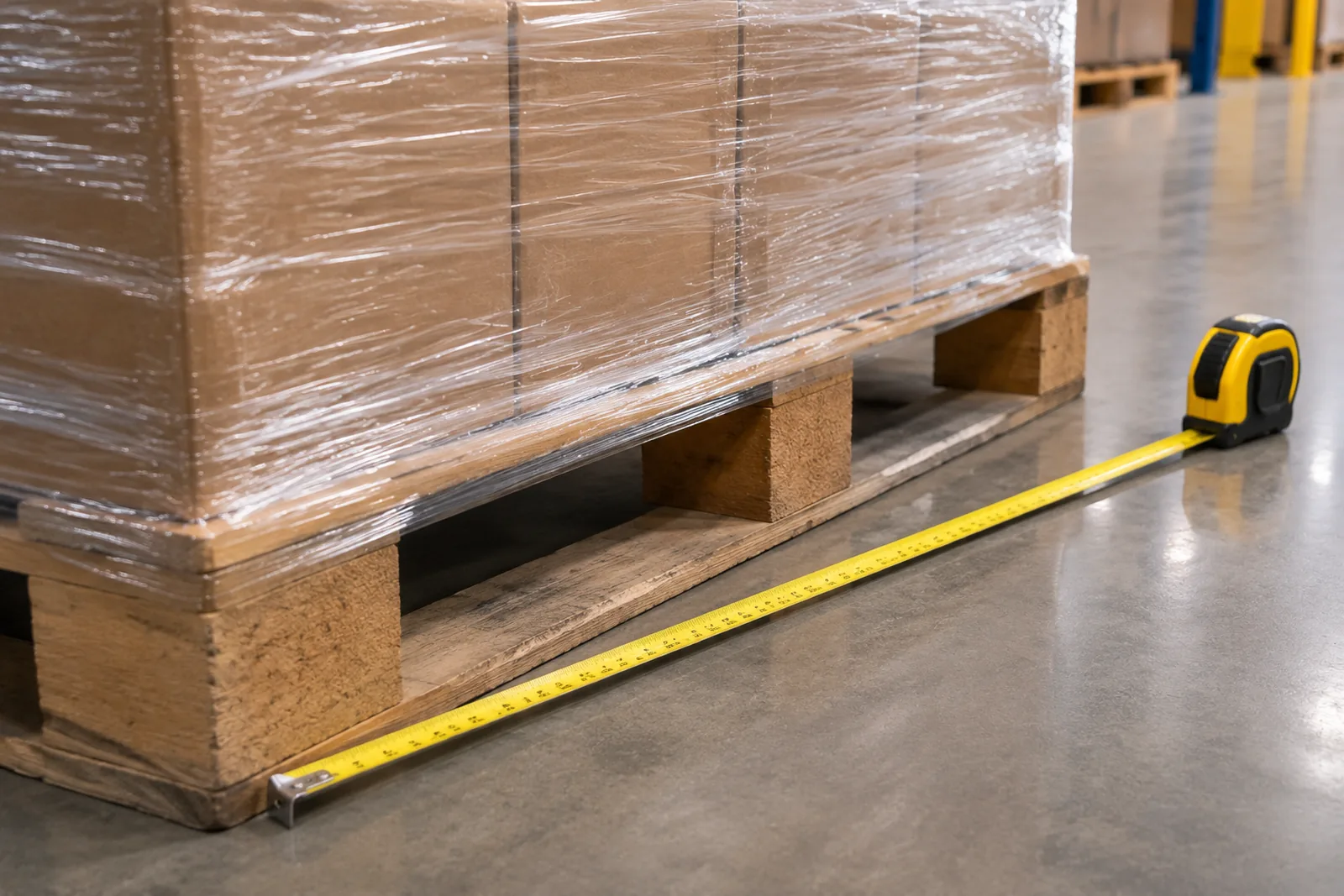
Photograph the whole bay before anyone restacks it. Once a worker squares up the pallet, the evidence is gone. Get these on your phone:
- shelf and pallet heights, with something in the frame for scale
- the shrink wrap and supports, or the lack of them
- how the cases were stacked and which way they faced
- aisle width and how close a cart had to pass
- the view you had as you walked up
Your photos show the bay after. The store's records show it before: who built it and on what shift, what each case weighed according to its label, whether anyone reported that bay wobbling last week, and what the overhead camera saw at 9 a.m. Ask for all of it by bay number. (Our guide on what evidence should be preserved after a Costco injury has the first-day list.)
What does a dispute look like?
Here is a hypothetical example, not an actual case. A member reaches for a bag of rice and a 20-pound box of canned tomatoes lands on her wrist. The overhead video starts a half-second late. The box is already falling.
What each side will say:
- The employee: another shopper had been pulling cases off that stack since 10 a.m.
- The member: she never touched the tomatoes, only the rice next to them.
- The photo taken at noon: a gap two rows down that nobody can explain.
If she did touch the case, expect a comparative-fault argument under Chapter 33. If a vendor's crew built that bay, expect a second defendant.
What role do experts play?
An expert can explain why a documented setup was unstable. An expert cannot invent the setup. "Bulk goods are heavy" is not an opinion anyone should pay for.
| Expert task | Limit |
|---|---|
| Measure loads and supports. | Must use real measurements. |
| Explain stacking risks. | Must be based on the actual display, not a restacked one. |
| Compare alternative setups. | Should show each option if the original is unclear. |
What to do now: Photograph the bay from where you stood, write down the time, and keep the product label or a photo of it. Then ask the warehouse to keep the overhead video.
Frequently asked questions
Does a heavy box falling on me prove Costco was careless?
No. You still need proof of how the display was set up and what the store knew.
What if another shopper moved the stack?
That fact may shift some or all of the responsibility.
Can a vendor be responsible?
Yes, if the vendor built or controlled the display.
For the full case plan, read How to Litigate a Costco Injury Case in Texas or visit the Costco injury claims in Texas hub.
Sources
- United Scaffolding, Inc. v. Levine, 537 S.W.3d 463 (Tex. 2017)
- Texas Civil Practice and Remedies Code Chapter 33
This article is general information, not legal advice. Reading it does not make you our client, and every claim turns on its own facts and deadlines.

ABOUT THE ATTORNEY
Aaron A. Herbert
Founding Attorney
Board Certified in Personal Injury Trial Law
Aaron founded The Law Firm of Aaron A. Herbert in 2010 to focus on developing each client's case and seeking its maximum value. For over a decade, he has represented people seriously injured in major accidents and industrial catastrophes, pursuing trial verdicts and settlements while working to reduce the stress of litigation.
Education
- Texas A&M University · B.S., Criminal Justice, 1999
- University of Oklahoma College of Law · J.D., 2002; graduated in the top of his class
Trial experience & approach
Aaron earned numerous jury verdicts at boutique personal injury litigation firms. According to his biography, he spent a year as the top-earning litigation attorney at a firm that frequently appeared in verdict searches as having one of the highest numbers of trial wins in Texas. At another Dallas personal injury firm, he moved from managing pre-litigation attorney to managing litigation attorney over seven years as the firm grew into one of Dallas's largest personal injury firms.
His biography describes a reputation as one of America's most aggressive trial lawyers, with noteworthy recoveries from judges and juries and substantial pretrial settlements. Most of those settlements included confidentiality agreements requested by the defense. Aaron has said the recoveries were justified by the injuries and losses involved, which no amount of money could make someone choose to experience.
His approach combines passion, preparation, persistence and courtroom imagination. He believes a well-supported, engaged and motivated team working cooperatively helps deliver strong representation, with the goal of achieving the best possible result for every client.
Dallas roots, military service & publication
Born and raised in Dallas, Aaron enlisted in the United States Marine Corps after high school and later received an Honorable Discharge. He completed his university and law degrees after his military service and became a lifelong Sooners football fan in law school.
Publication: “Litigating Dog Bite Cases,” Texas Dog Law Seminar, Dallas, 2009.
Professional affiliations & recognition
Professional affiliations and recognition listed in Aaron’s biography:
- State Bar of Texas
- American Bar Association
- Association of Trial Lawyers of America (now American Association for Justice)
- Texas Trial Lawyers Association
- Dallas Trial Lawyers Association
- Dallas Bar Association
- Tarrant County Bar Association
- Million Dollar Advocates Forum
- The National Trial Lawyers – Top 100 Trial Lawyers