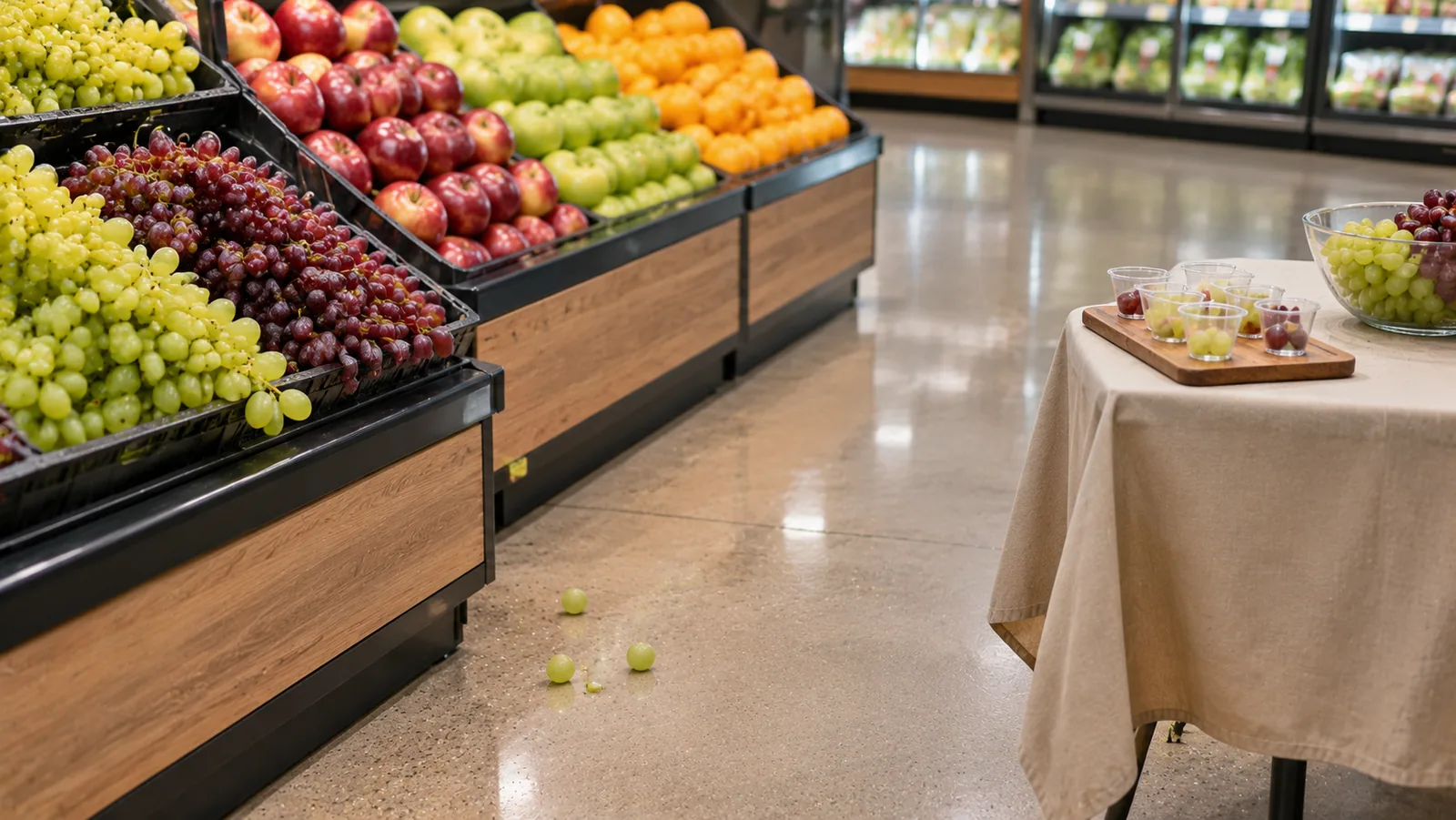
A Texas claim over a fall at an H-E-B produce or sampling display needs evidence that ties a specific hazard on the floor to the store's knowledge, a lack of reasonable care, and your injury. The display standing nearby proves none of that.
In 1999 a shopper who fell near two grape displays lost at the Texas Supreme Court, because a sampling display alone isn't proof of negligence [S7].
So you'll need more than "it happened in produce." Save these the same day:
- A note or photo marking the exact spot where your foot slid.
- Your original, unedited phone photos.
- The names and numbers of anyone who saw the floor.
- Any text, receipt, or video showing when the grapes or water got there.
Keetch v. Kroger Co. (Tex. 1992) lists four things you must prove [S9]:
- H-E-B knew, or reasonably should have known, about the grape, the leaf, or the water where you fell [S9].
- That condition on the floor posed an unreasonable risk of harm, apart from the display that stood nearby [S7, S9].
- H-E-B failed to use reasonable care to reduce or eliminate the risk [S9].
- That failure was the proximate cause of your fall and your injuries [S9].
A sampling table, the misters, or a fruit bin in the area doesn't establish any of these elements on its own [S7].
To have a lawyer look at what happened, tell us about your H-E-B injury or call (214) 200-4878. Bring the store address, incident date, injury details, photos, and witness names.
Start with how you actually fell in produce
A slide, a trip, and a slip in water each raise different proof questions, so the mechanism comes first.
Did your foot slide on a grape or crushed fruit?
Then the questions are what was on the floor, where it came from, and how long it had been there.
Did your shoe catch a display base or pallet?
Here the issue shifts to whether the display itself was placed or built in a way that created an unreasonable risk.
Did you step into water beside a bin under the misters?
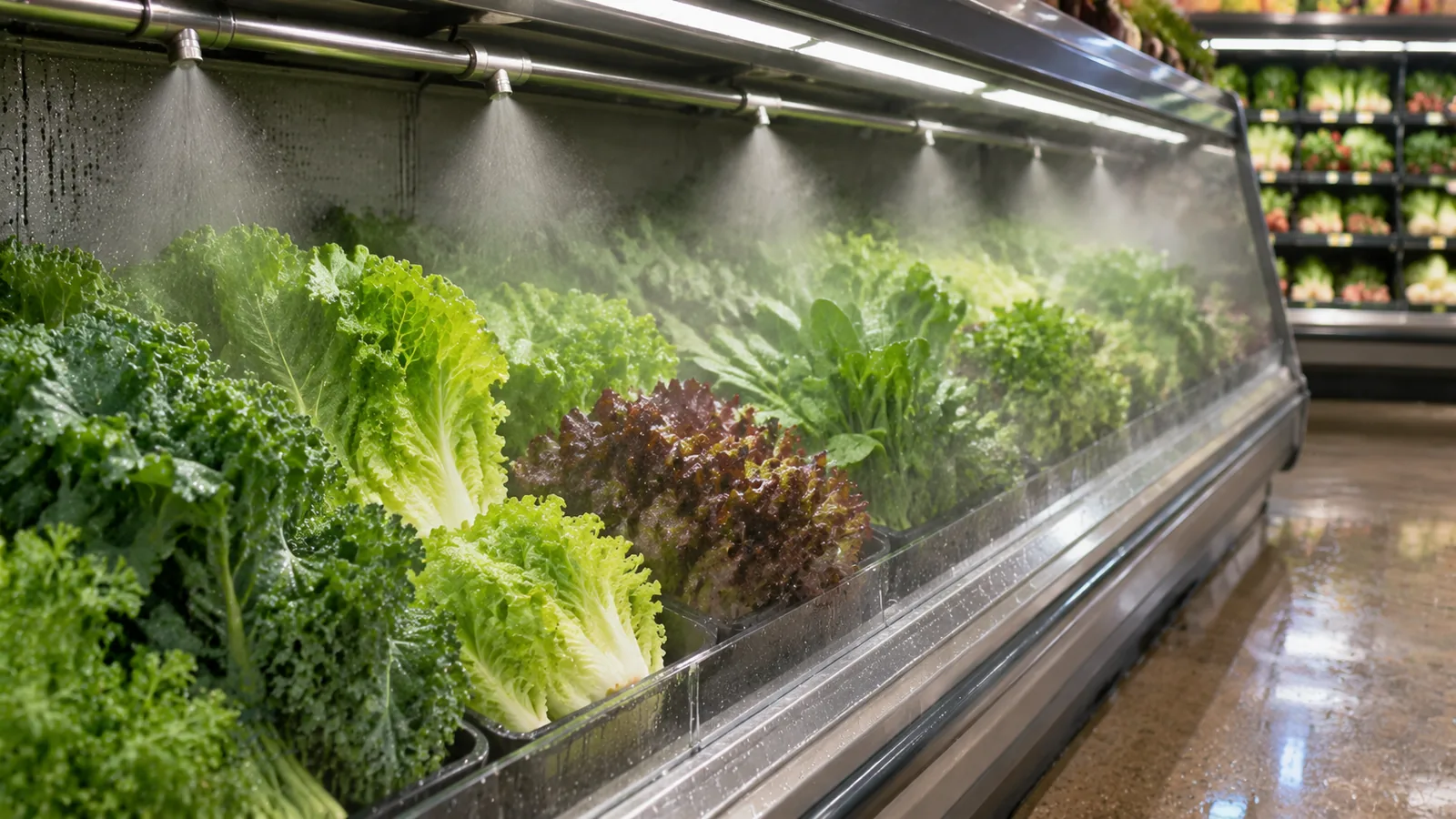
You'll need to know whether the water came from the misters, ice, a leaking case, a customer, or cleanup.
Did you lose your balance near a sample stand without knowing why?
Witnesses or video may show the cause. A guess won't carry the claim.
Describe only what you personally saw. Don't assume nearby fruit caused the fall just because it happened in produce. Here's how three hypothetical statements compare.
| Hypothetical statement | Why it helps or hurts |
|---|---|
| "My right foot slid on something wet by the grape bin, and I saw a smashed grape under my shoe." | It's a direct observation with a place and a substance. |
| "I didn't see anything before I fell, but my friend saw water there a few minutes earlier." | It's honest about what you saw and points to a witness who may know the timing. |
| "The sample stand made me fall." | It names a display, not a condition, which is the gap Resendez describes [S7]. |
The first two give a lawyer something to test; the third invites the same answer H-E-B won in 1999.
The 1999 grape display case against H-E-B
A shopper went down near two grape displays in an H-E-B store and sued. That's H.E. Butt Grocery Co. v. Resendez, 988 S.W.2d 218 (Tex. 1999) [S7]. One display held bagged grapes; the other had a bowl of loose grapes for sampling.
What did the store have in place? The opinion lists it [S7]:
- The sample bowl was level, sat on ice, and was recessed about five inches.
- The tables had three-inch railings.
- The floor was non-skid, and mats surrounded the tables.
- Warning cones stood nearby.
On March 11, 1999, in a per curiam opinion, the Texas Supreme Court reversed and rendered judgment for H-E-B. A customer sampling display alone, it said, isn't evidence of a condition posing an unreasonable risk of harm [S7].
What could those added facts look like? Four hypothetical examples:
- A grape and a wet streak in the aisle directly under the sample bowl, at the point of contact.
- A shopper who told a produce clerk about grapes on the floor 20 minutes before the fall.
- A clerk restocking the bin who dropped grapes and moved on to the next display.
- No mat covering the floor where shoppers stood to take samples.
Photograph the display and your point of contact
When it's safe, take wide photos of the whole display and close photos of the exact place your foot made contact, from more than one angle.
- The full display and the aisle around it, showing the layout, mats, cones, and the route shoppers used.
- The exact spot where your foot slid or caught, so the hazard ties to the fall and not the department.
- The substance on the floor and on your shoe, which may show whether it was tracked or crushed.
- Signs, cones, or mats, or the lack of them, before anyone changes the scene.
Don't rearrange produce for a photo, and don't present a later condition as the original scene. If cleanup moved things, write down what changed and when:
- An employee swept up the grapes: note the time, the employee's name or description, and what was removed.
- A cone went out after you fell: photograph it and note that it wasn't there before.
- The display was refilled or moved: write down how it looked before, and ask witnesses what they saw.
How to prove H-E-B knew about the produce
Texas recognizes two routes to notice, and they need different evidence [S6, S8].
| Notice route | What it takes |
|---|---|
| Actual notice | Someone at the store knew about this hazard before the fall, such as a clerk who was told about the grapes. |
| Constructive notice | The hazard sat long enough that a reasonable inspection would have found it; an employee standing nearby isn't enough by itself [S6, S8]. |
Most produce cases end up on the second route, which means timing evidence decides them.
Under Wal-Mart Stores, Inc. v. Reece (Tex. 2002), a clerk working near a spill doesn't prove notice unless you also show how long it was there [S8]. H-E-B, LP v. Peterson (Tex. 2026) went further and required evidence tying the specific danger to the relevant time and place [S6].
What should you do this week? Work through these steps:
- Screenshot every text, call log, or post from the produce aisle before you fell.
- Ask H-E-B in writing to keep the store video from before and after the fall, not just the clip of it; blind spots and clock differences need care.
- Call each witness and write down what they saw and how they know what time it was.
- Note whether the fruit was crushed or tracked, and who walked through first; traffic, your fall, or a mop can change it, so it needs a reliable factual basis before it says anything about time.
See how to prove H-E-B knew about a spill for the full notice rules.
Recurring spills and the Taylor problem
A shopper at a Brookshire store stepped up to the self-service soft drink machine and slipped on partially melted ice on the tile [S10]. An employee testified that ice fell from that dispenser every day. Three mats sat in front of it, and they didn't cover the floor. The case is Brookshire Grocery Co. v. Taylor, 222 S.W.3d 406 (Tex. 2006).
The Court held the dispenser wasn't itself unreasonably dangerous. The only unreasonably dangerous condition was the ice on the floor. With no evidence of how long that ice had been there, there was no constructive notice, and the Court reversed and rendered [S10].
So a history of similar spills can be relevant, but "produce always falls" doesn't automatically prove H-E-B knew about your hazard [S10]. Check whether any records concern the same location and mechanism.
Who dropped the grape? The answer changes what you have to show:
- A clerk misting or restocking the bin. Under Keetch, a store that creates the condition may be inferred to know about it, but that isn't knowledge as a matter of law [S9].
- A vendor or demo worker at a sample stand. The worker's identity, conduct, and observations may matter, but a vendor's presence alone doesn't prove responsibility [S9].
- Another shopper who dropped fruit. The claim usually turns on notice and how long the fruit was on the floor [S6, S8].
Document your injuries without inflating the case
Get the medical care you need, and describe your symptoms and prior conditions accurately. Keep these records:
- Medical records and bills showing the diagnosis, the treatment, and the cost of care.
- Work restrictions, missed-time records, and receipts.
- Notes on daily tasks you can't do or now do differently.
- Records of earlier conditions, so it's clear what changed after the fall.
A serious injury can support substantial damages when causation and legal responsibility are proved. It doesn't supply a missing notice element, though, and settlement value has to be assessed case by case.
If water from a cooler or refrigerated case was involved, read H-E-B refrigeration leaks and wet floors. For falls in other stores, see Texas grocery store falls.
Frequently asked questions
Does a smashed grape prove it sat there a long time?
No, not by itself. Carts, other shoppers, your own fall, or a mop may have smashed it. Someone needs a reliable factual basis before reading duration into how it looks.
What if a sample vendor dropped the grapes?
The vendor could share responsibility if the evidence shows a relevant duty and that its worker helped cause the fall. Just being in the department doesn't prove that.
Who can review my produce fall?
The Law Firm of Aaron A. Herbert, P.C. can look at how you fell, the Resendez issue, your notice evidence, the video, and your medical proof. Aaron Herbert is Board Certified in Personal Injury Trial Law by the Texas Board of Legal Specialization [S1], which isn't a guarantee or a ranking.
Tell us about your H-E-B injury
Bring the store address, incident date, injury details, photos, and witness names. Tell us about your H-E-B injury or call (214) 200-4878.
Related pages on H-E-B injuries
- Texas HEB injury knowledge hub: every guide in one place.
- How to file and litigate a Texas HEB injury claim: the claim and lawsuit process.
Sources
- [S1] State Bar of Texas, Aaron Alan Herbert, Bar No. 24036761. Board certification.
- [S6] H-E-B, LP v. Peterson, No. 24-0310 (Tex. Apr. 10, 2026).
- [S7] H.E. Butt Grocery Co. v. Resendez, 988 S.W.2d 218 (Tex. 1999).
- [S8] Wal-Mart Stores, Inc. v. Reece, 81 S.W.3d 812 (Tex. 2002).
- [S9] Keetch v. Kroger Co., 845 S.W.2d 262 (Tex. 1992). Premises elements and store-created conditions.
- [S10] Brookshire Grocery Co. v. Taylor, 222 S.W.3d 406 (Tex. 2006). The condition at the time and place of injury.

ABOUT THE ATTORNEY
Aaron A. Herbert
Founding Attorney
Board Certified in Personal Injury Trial Law
Aaron founded The Law Firm of Aaron A. Herbert in 2010 to focus on developing each client's case and seeking its maximum value. For over a decade, he has represented people seriously injured in major accidents and industrial catastrophes, pursuing trial verdicts and settlements while working to reduce the stress of litigation.
Education
- Texas A&M University · B.S., Criminal Justice, 1999
- University of Oklahoma College of Law · J.D., 2002; graduated in the top of his class
Trial experience & approach
Aaron earned numerous jury verdicts at boutique personal injury litigation firms. According to his biography, he spent a year as the top-earning litigation attorney at a firm that frequently appeared in verdict searches as having one of the highest numbers of trial wins in Texas. At another Dallas personal injury firm, he moved from managing pre-litigation attorney to managing litigation attorney over seven years as the firm grew into one of Dallas's largest personal injury firms.
His biography describes a reputation as one of America's most aggressive trial lawyers, with noteworthy recoveries from judges and juries and substantial pretrial settlements. Most of those settlements included confidentiality agreements requested by the defense. Aaron has said the recoveries were justified by the injuries and losses involved, which no amount of money could make someone choose to experience.
His approach combines passion, preparation, persistence and courtroom imagination. He believes a well-supported, engaged and motivated team working cooperatively helps deliver strong representation, with the goal of achieving the best possible result for every client.
Dallas roots, military service & publication
Born and raised in Dallas, Aaron enlisted in the United States Marine Corps after high school and later received an Honorable Discharge. He completed his university and law degrees after his military service and became a lifelong Sooners football fan in law school.
Publication: “Litigating Dog Bite Cases,” Texas Dog Law Seminar, Dallas, 2009.
Professional affiliations & recognition
Professional affiliations and recognition listed in Aaron’s biography:
- State Bar of Texas
- American Bar Association
- Association of Trial Lawyers of America (now American Association for Justice)
- Texas Trial Lawyers Association
- Dallas Trial Lawyers Association
- Dallas Bar Association
- Tarrant County Bar Association
- Million Dollar Advocates Forum
- The National Trial Lawyers – Top 100 Trial Lawyers