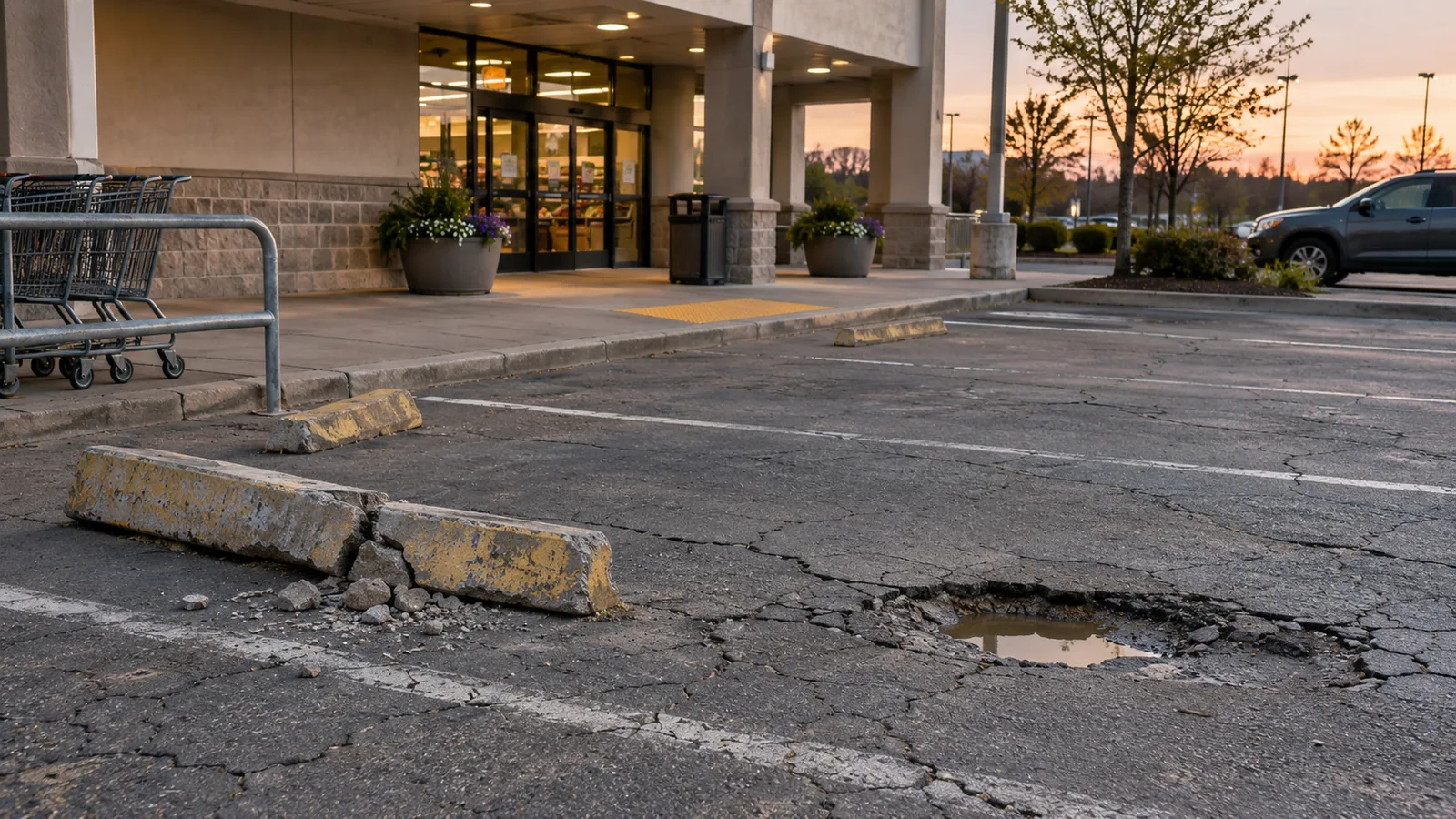
A pothole in an H-E-B parking lot can support a Texas injury claim. The grocery sign out front can't tell you who controlled that aisle or that stretch of sidewalk [S9]. The store operator, a landlord, a property manager, or a contractor may have had it. Control comes first, and what that party knew comes second.
| What caught your foot | The first thing to pin down |
|---|---|
| A pothole in the drive aisle | Its size, depth, spot, and repair history |
| An exposed wheel-stop anchor | How high it stuck up, for how long, and who maintained the wheel stops |
| Oil or a spilled drink near the cart corral | Where it came from and how long it sat there [S6, S8] |
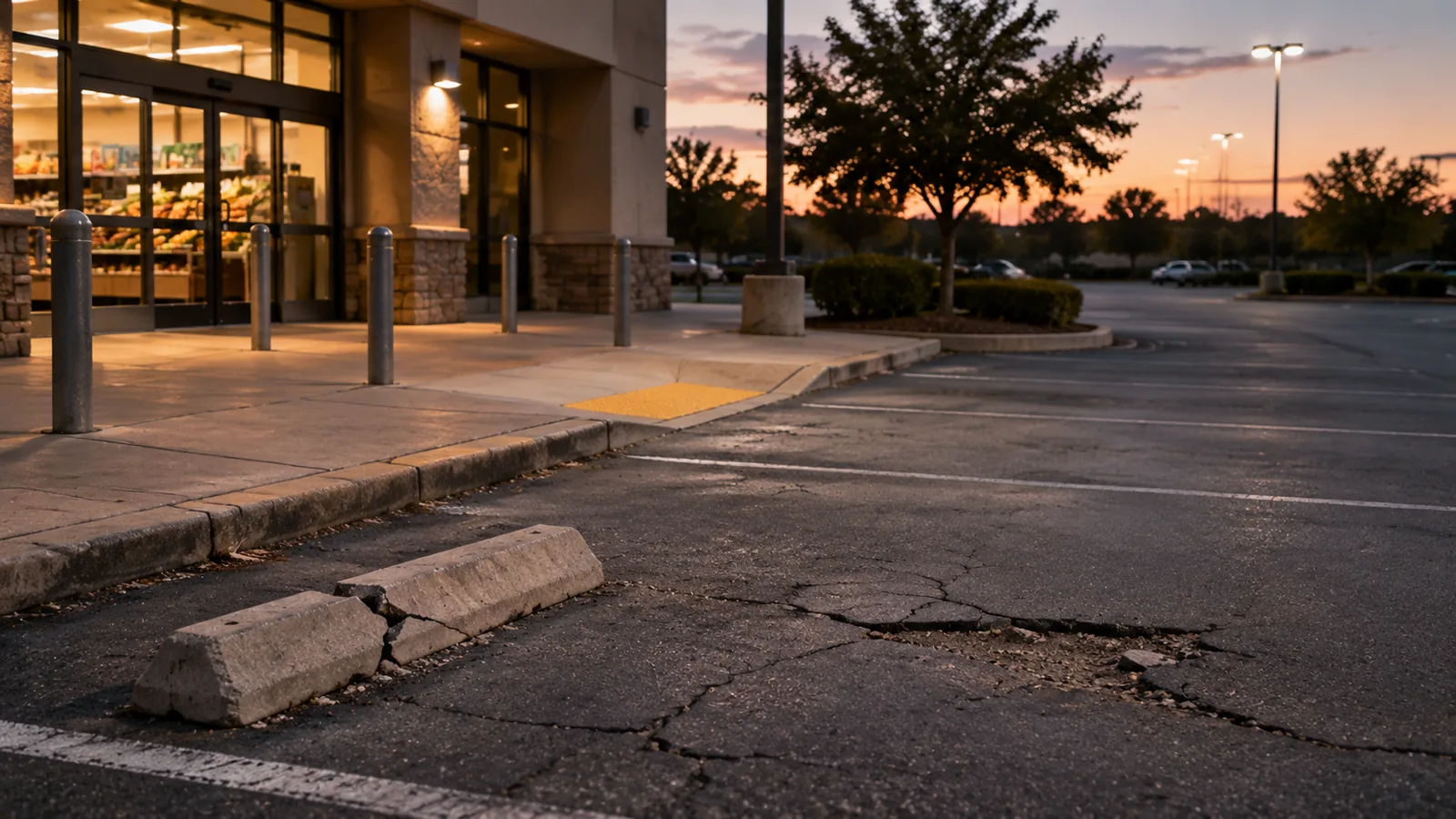
| A cracked curb at the sidewalk | Who controlled the curb, and whether anyone reported or repaired it |
| A raised walkway edge by the curbside pickup spaces | The height, the markings, and the lighting |
To have a lawyer look at the lot and the route you took, tell us about your H-E-B injury or call (214) 200-4878. Bring the store address, incident date, injury details, photos, and witness names.
Once you know who controlled the spot, Keetch v. Kroger Co. (Tex. 1992) sets four elements against that party [S9]:
- It knew, or should have known, about the hole, the anchor, or the spill.
- The hole, anchor, or spill was an unreasonable risk of harm to people walking in.
- It didn't fix it, and didn't cut the risk with a cone, a patch, or a cleanup either.
- That failure caused your fall and your injuries.
What should you photograph before the patch crew shows up?
Suppose it's 7:40 p.m. at dusk, in a light rain, and you're pushing an empty cart north across the drive aisle in row F, headed for the main entrance, and your foot drops into a pothole three spaces from the cart corral.
Before anyone fills that hole, get:
- A photo of the pothole with your car or the row F sign in the frame.
- A close photo with a coin or a ruler beside it for scale.
- A wide shot from the direction you were walking.
- The light pole with the row sign, and the yellow curb at the fire lane.
- The names and numbers of anyone who saw you go down.
- The shoes you had on, kept as they are.
Write the row, the space, your direction, the entrance you were heading for, and the light that evening on the same page.
Which photo actually proves it?
A picture of a worn-out lot doesn't show which defect caught your foot. Compare the two kinds of proof:
| General proof | Proof tied to your fall |
|---|---|
| Cracked pavement across the whole lot | The pothole your foot went into, with your car or a row sign in the frame |
| "The lot is always in bad shape." | A complaint about that same spot before you fell |
| Roof-camera video of the parking lot | Video of you reaching the exact spot and losing your balance |
A store camera far across the lot may catch your route and miss the small point of contact. A companion who was beside you can say where you first lost your balance. Your original photo files carry the date and time. If none of that shows the exact spot, don't assume the closest crack did it. And if a photo can't show how long a spill was there, it can't answer that question.
Store, landlord, or contractor?
Who fixes the potholes in front of your H-E-B? Often the lease answers that, and sometimes the people with shovels answer it differently.
| Who may have controlled the spot | What tends to show it |
|---|---|
| The store operator | Its workers filling potholes or sweeping by the entrance; vendors it hired |
| The shopping-center owner or landlord | A lease clause putting common areas, sidewalks, and lighting on the owner |
| A property manager | Lot patrol notes, complaint emails, and repair approvals |
| A paving, sweeping, or lighting contractor | Work orders, invoices, and the dates and scope of its job |
A landlord isn't liable for everything a tenant does, and the store isn't off the hook just because someone else owns the land. Suppose the lease gives upkeep to the owner, yet H-E-B workers have patched holes by the doors for a year. That habit may show control no matter what the lease says.
What about the crew that patched the hole last spring? Back in 1962, Strakos v. Gehring ended the rule that let a contractor walk away once the owner accepted its work [S25]. The crew can be sued. You'd still prove it was negligent and that its patch caused your fall. Its work order shows the job, the dates, the spot, and any warning it posted; a name on a vendor list shows nothing.
Was it an old crack or a fresh spill?
A slab that's been sunken since summer leaves a trail. Look for earlier complaints, work orders, repair history, and photos from different dates. A sunken drain or a raised edge is the same.
Fresh oil by the cart corral is harder. Take Wal-Mart Stores, Inc. v. Reece (Tex. 2002) [S8]. The spill was clear liquid, roughly pizza-sized, by a Wal-Mart snack bar. An off-duty employee bought a drink right in front of it and never saw it. No one knew how long it had been there, so the Court reversed and rendered a take-nothing judgment [S8].
Since H-E-B, LP v. Peterson (Tex. 2026), you need evidence tying this danger to this time and place [S6]. Say you fell at 6:30:
- 6:12, another shopper's photo shows the oil
- 6:15, a friend's text mentions it
- 6:20, the cart attendant pushes a train of carts right past it
The lot camera might even catch the moment it first appeared.
A worker nearby, or a complaint about general upkeep, may not be enough [S6, S8].
Was it too dark to see the hole?
Lighting proof comes in a few forms, and each one shows something different:
- Your phone photo in night mode, which may show a brighter lot than you saw.
- A photo's time stamp, for whether it was 7:40 or 9:15.
- An expert's measurements, for light levels, contrast and the sight line on your route.
- Records of a dead pole, for when it went out and who knew.
A dead pole is like any other hazard: somebody had to know it was out. Codes and accessibility rules count only if they cover that lot and connect to how you got hurt.
What will H-E-B say you did wrong?
Were you on your phone? Did you cut across the drive aisle? Your lawyer needs that on day one, because H-E-B's lawyers will ask:
| What H-E-B may argue | What answers it |
|---|---|
| "You cut through the drive aisle." | Whether a marked walkway ran from your space to the door |
| "You were looking at your phone." | Whether the screen was even on; a grocery list in hand isn't a call |
| "Anyone could see that pothole." | Rain on the asphalt, a parked truck's shadow, dusk |
| "There was a cone right there." | Two rows over, or facing the other way |
| "Something else made you fall." | Your medical history and a witness to the moment |
Fault then becomes a percentage under Chapter 33 [S16]. Say the jury finds $50,000 in damages and puts 30 percent on you: a covered claim falls to $35,000. Above 50 percent, a claimant generally recovers nothing [S16]. Settlement credits and the other allocation rules get worked out case by case.
What does the injury claim need, and by when?
Your medical records prove the injury, but causation needs proof of its own. Work-loss records show the shifts and pay you lost.
The general deadline is two years after the claim accrues, with exceptions [S14]. For cars and carts in the lot, read H-E-B curbside, cart, and pedestrian injuries. H-E-B warning signs and shared fault covers warnings and your own conduct, and Texas parking lot injuries covers lot claims at other stores.
Frequently asked questions
Can I claim against H-E-B if a landlord maintains the lot?
Find out who patched and swept that spot. Suppose the lease puts the lot on the landlord, but H-E-B's own crew has been filling the potholes. H-E-B may still answer for that spot.
Is every pothole an unreasonable danger?
Size, location, use, visibility, condition, and how you fell all get weighed. No single rule covers every pothole.
What if I slipped on oil instead?
For a fresh spill, the key is how long it was there. An employee nearby may not be enough [S6, S8].
Who can review a parking lot fall?
Call The Law Firm of Aaron A. Herbert, P.C. with your photos, the row number, and the time you fell. Aaron Herbert is Board Certified in Personal Injury Trial Law by the Texas Board of Legal Specialization [S1]. That isn't a guarantee or a ranking.
Tell us about your H-E-B injury
Bring the store address, incident date, injury details, photos, and witness names. Tell us about your H-E-B injury or call (214) 200-4878.
Related pages on H-E-B injuries
- Texas HEB injury knowledge hub: every guide in one place.
- How to file and litigate a Texas HEB injury claim: the claim and lawsuit process.
Sources
- [S1] State Bar of Texas, Aaron Alan Herbert, Bar No. 24036761. Board certification.
- [S6] H-E-B, LP v. Peterson, No. 24-0310 (Tex. Apr. 10, 2026).
- [S8] Wal-Mart Stores, Inc. v. Reece, 81 S.W.3d 812 (Tex. 2002).
- [S9] Keetch v. Kroger Co., 845 S.W.2d 262 (Tex. 1992). Premises elements.
- [S14] Tex. Civ. Prac. & Rem. Code ch. 16.
- [S16] Tex. Civ. Prac. & Rem. Code ch. 33.
- [S25] Strakos v. Gehring, 360 S.W.2d 787 (Tex. 1962).

ABOUT THE ATTORNEY
Aaron A. Herbert
Founding Attorney
Board Certified in Personal Injury Trial Law
Aaron founded The Law Firm of Aaron A. Herbert in 2010 to focus on developing each client's case and seeking its maximum value. For over a decade, he has represented people seriously injured in major accidents and industrial catastrophes, pursuing trial verdicts and settlements while working to reduce the stress of litigation.
Education
- Texas A&M University · B.S., Criminal Justice, 1999
- University of Oklahoma College of Law · J.D., 2002; graduated in the top of his class
Trial experience & approach
Aaron earned numerous jury verdicts at boutique personal injury litigation firms. According to his biography, he spent a year as the top-earning litigation attorney at a firm that frequently appeared in verdict searches as having one of the highest numbers of trial wins in Texas. At another Dallas personal injury firm, he moved from managing pre-litigation attorney to managing litigation attorney over seven years as the firm grew into one of Dallas's largest personal injury firms.
His biography describes a reputation as one of America's most aggressive trial lawyers, with noteworthy recoveries from judges and juries and substantial pretrial settlements. Most of those settlements included confidentiality agreements requested by the defense. Aaron has said the recoveries were justified by the injuries and losses involved, which no amount of money could make someone choose to experience.
His approach combines passion, preparation, persistence and courtroom imagination. He believes a well-supported, engaged and motivated team working cooperatively helps deliver strong representation, with the goal of achieving the best possible result for every client.
Dallas roots, military service & publication
Born and raised in Dallas, Aaron enlisted in the United States Marine Corps after high school and later received an Honorable Discharge. He completed his university and law degrees after his military service and became a lifelong Sooners football fan in law school.
Publication: “Litigating Dog Bite Cases,” Texas Dog Law Seminar, Dallas, 2009.
Professional affiliations & recognition
Professional affiliations and recognition listed in Aaron’s biography:
- State Bar of Texas
- American Bar Association
- Association of Trial Lawyers of America (now American Association for Justice)
- Texas Trial Lawyers Association
- Dallas Trial Lawyers Association
- Dallas Bar Association
- Tarrant County Bar Association
- Million Dollar Advocates Forum
- The National Trial Lawyers – Top 100 Trial Lawyers