
Your H-E-B claim is worth what its proof supports. Nobody publishes a typical Texas settlement, and no multiplier applies. A serious injury can't fill a gap in proof that the store knew about the danger.
Suppose you broke your wrist by the produce scales and a friend says these cases "settle for three times the bills." That rule of thumb isn't reliable. These are the things that move the number:
| What moves the number | What it takes |
|---|---|
| Liability [S9] | Proof H-E-B knew, the risk was unreasonable, it didn't act, and that caused your fall |
| What the fall changed medically | Records and qualified medical opinions |
| Medical expenses | Amounts actually paid or incurred [S17] |
| Earnings, earning capacity, pain, impairment, disfigurement | Separate support for each one |
| Your share of fault | Chapter 33 can reduce or bar recovery [S16] |
| Insurance and collection | The practical ceiling |
| Fees, costs, liens, and credits | They come out of any gross figure |
To have a lawyer look at your medical proof, tell us about your H-E-B injury or call (214) 200-4878. Bring the store address, incident date, injury details, photos, and witness names.
Why can't anyone quote you a number online?
Public research didn't turn up a mean or median for Texas H-E-B settlements. A reported verdict may have been reduced or appealed later, or it involved different injuries and facts. A severe injury doesn't supply missing proof that the store knew about the hazard or caused the harm. And no current H-E-B policy limit is public, whatever you've heard; H-E-B insurance limits and public injury data explains what is and isn't known.
What you can control is the paperwork. From day one, keep:
- Every medical record and bill.
- Explanation-of-benefits statements from your health plan.
- Pay stubs, tax returns, and work-restriction notes.
- A short dated journal of what you can't do.
How do you prove what the fall caused?
- Records and imaging, for the diagnosis and how it changed
- Treatment history from before the fall, for your baseline
- A qualified medical opinion, for whether the fall caused the condition or made it worse
Disclose the old stuff: prior pain, an earlier surgery, degeneration, a past car wreck, and anything that happened after the fall. The defense will find it anyway. An old back problem doesn't sink an aggravation claim. The question is what changed after the fall, and the evidence has to tie that change to it.
Report a missed month of physical therapy as it happened. Don't add treatment just to build the claim; follow what your doctor says you need. Keep discharge instructions, medication information, restrictions, and appointment records as they pile up.
Which two statutes shape the medical bills?
Two Texas statutes do most of the work on medical bills [S17, S18]. Neither one answers whether the fall caused your injury.
| Rule | What it does | What it doesn't do |
|---|---|---|
| §41.0105 | Caps the medical-expense claim at what was actually paid or incurred by you or for you [S17] | Tell anyone which visits the fall caused |
| §18.001 affidavit | An uncontroverted affidavit can support that charges were reasonable and services necessary [S18] | Serve as evidence of causation [S18] |
| Counteraffidavits and objections | Contest an affidavit under the statute's procedures [S18] | Excuse anyone from checking current deadlines and requirements with a lawyer |
No expense affidavit proves liability. The premises claim still needs its own evidence [S9].
What about future care and the harm you can't bill for?
What usually carries each loss
- Future care, through a qualified recommendation, how likely it is, when it would happen, its reasonable cost and its link to the fall
- Pain and mental anguish, through your own words, backed by what your sister or a coworker saw
- Physical impairment, through tasks you can't do anymore, like lifting a laundry basket
- Disfigurement, through photos of the scar and a doctor's description
- Lost money, through payroll, tax and business records
Listing every possible procedure as a sure expense costs credibility. So does counting the same harm under two or three labels.
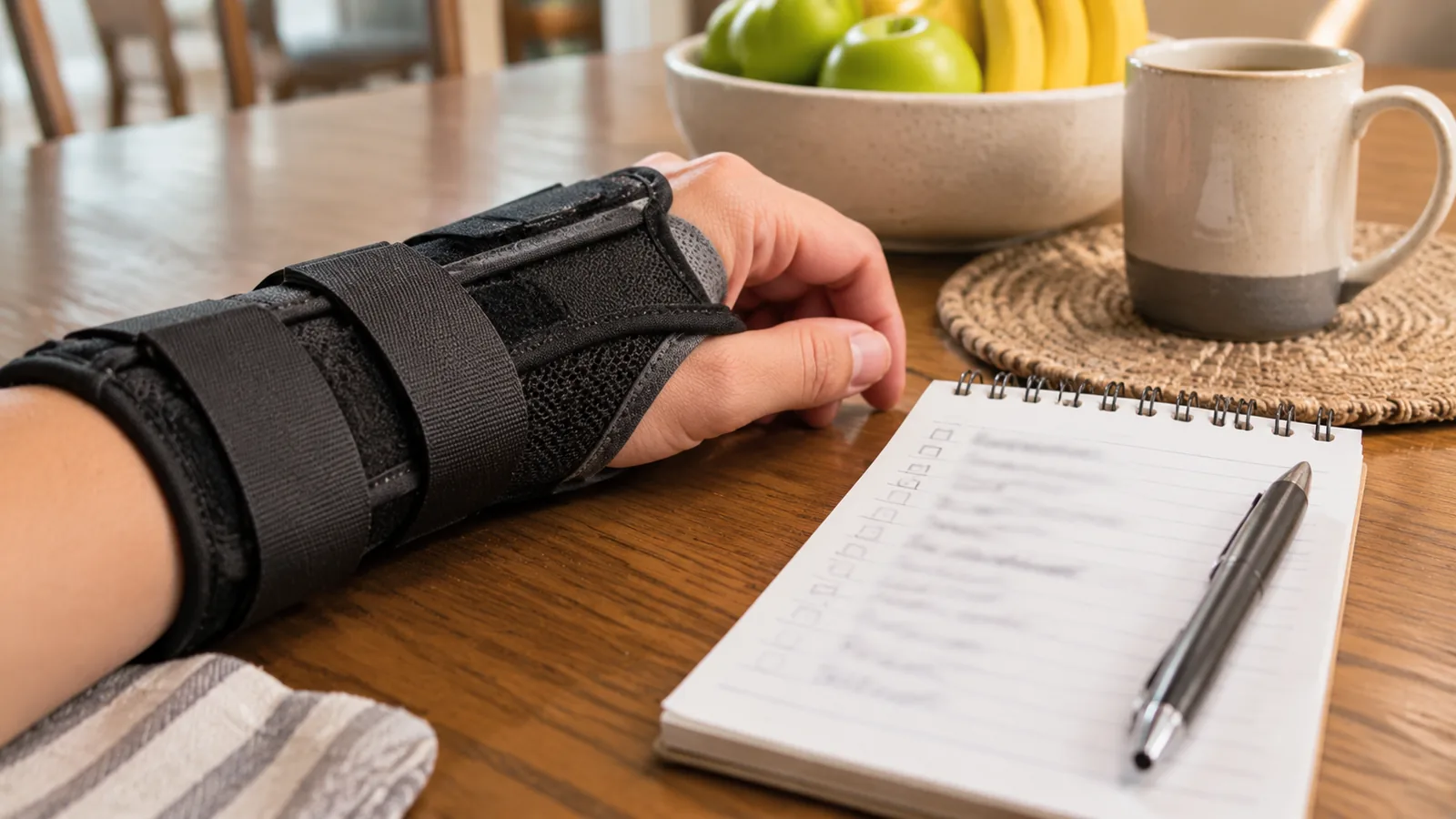
How do you describe lost work and daily life?
A cashier paid by the hour proves lost pay with pay stubs, the time sheet showing the missed shifts, and the doctor's work note. A self-employed roofer uses tax returns and job records to show which jobs he turned down after the fall, and which slow months had nothing to do with it. Reduced earning capacity is a bigger claim than a few missed shifts. It may need a vocational expert or an economist.
Daily-life limits are most believable when they're specific and include what got better.
| Vague | More useful |
|---|---|
| "I can't do anything anymore" | "I can stand at the stove about ten minutes before my back locks up." |
| "My life is ruined" | "I stopped carrying my toddler up the stairs, and my spouse handles bath time now." |
| A coworker calling you "badly hurt" | The coworker saying they covered your stocking shifts, with no medical conclusions |
| Leaving out progress | "I'm driving again for short trips, but not to Houston." |
Why is the gross offer bigger than your check?
Fees, costs, medical balances, liens, reimbursement claims, and credits come out first. Here is one worked example:
- Gross settlement: $100,000
- Fee under the written agreement in this example: $33,333
- Litigation expenses: $8,000
- Medical balances and liens: $18,000
- Left for the client: about $40,667
Fault and other parties change the figure again. Chapter 33 can reduce or bar recovery in covered cases [S16]. A settlement with another participant may affect what's left [S16]. Even a verdict can face motions, an appeal, and collection problems; see H-E-B lawsuits, summary judgment, and trial.
Read the release as closely as the dollar amount. If you're still in treatment, talk through what resolving future claims means before you sign.
What should you bring when you ask about value?
A lawyer can give you a more useful evaluation when the liability, medical, and loss records are in one place. Put these in one folder before the call:
- scene photos and witness names
- the preservation letter, if you sent one
- medical records and bills, for causation and the paid-or-incurred amounts [S17]
- explanation-of-benefits statements from your health plan
- pay stubs or tax returns
- adjuster and lienholder letters
- your journal of daily limits
Frequently asked questions
Do my medical bills prove the fall caused my injury?
No. A §18.001 affidavit covers two things: whether the charges were reasonable and whether the care was necessary [S18]. It isn't evidence of causation [S18]. That link comes from a doctor.
Can I recover the full amount on the original bill?
A $12,000 hospital bill that your health plan paid at $4,100 is measured by what was actually paid or incurred under Section 41.0105 [S17]. The $12,000 isn't the number.
Should I accept an offer before I finish treatment?
Once signed, a release can close off future claims, including a surgery you haven't had yet. Read it before you weigh the number, and talk through your prognosis, what's still uncertain, and the release terms first.
Does an old injury kill the claim?
People with an earlier knee surgery still bring valid aggravation claims. The evidence has to tie the fall to what changed.
Who can review the value of an H-E-B claim?
Bring your medical records, bills, and any offer letter to The Law Firm of Aaron A. Herbert, P.C. for a value review. Aaron Herbert is Board Certified in Personal Injury Trial Law by the Texas Board of Legal Specialization [S1], which isn't a guarantee or a ranking. Nobody can promise a result.
Tell us about your H-E-B injury
Bring the store address, incident date, injury details, photos, witness names, and your medical records. Tell us about your H-E-B injury or call (214) 200-4878.
Related pages on H-E-B injuries
- Texas HEB injury knowledge hub: every guide in one place.
- How to file and litigate a Texas HEB injury claim: the claim and lawsuit process.
Sources
- [S1] State Bar of Texas, Aaron Alan Herbert, Bar No. 24036761. Board certification.
- [S9] Keetch v. Kroger Co., 845 S.W.2d 262 (Tex. 1992).
- [S16] Tex. Civ. Prac. & Rem. Code ch. 33.
- [S17] Tex. Civ. Prac. & Rem. Code ch. 41, §41.0105.
- [S18] Tex. Civ. Prac. & Rem. Code ch. 18, §18.001.

ABOUT THE ATTORNEY
Aaron A. Herbert
Founding Attorney
Board Certified in Personal Injury Trial Law
Aaron founded The Law Firm of Aaron A. Herbert in 2010 to focus on developing each client's case and seeking its maximum value. For over a decade, he has represented people seriously injured in major accidents and industrial catastrophes, pursuing trial verdicts and settlements while working to reduce the stress of litigation.
Education
- Texas A&M University · B.S., Criminal Justice, 1999
- University of Oklahoma College of Law · J.D., 2002; graduated in the top of his class
Trial experience & approach
Aaron earned numerous jury verdicts at boutique personal injury litigation firms. According to his biography, he spent a year as the top-earning litigation attorney at a firm that frequently appeared in verdict searches as having one of the highest numbers of trial wins in Texas. At another Dallas personal injury firm, he moved from managing pre-litigation attorney to managing litigation attorney over seven years as the firm grew into one of Dallas's largest personal injury firms.
His biography describes a reputation as one of America's most aggressive trial lawyers, with noteworthy recoveries from judges and juries and substantial pretrial settlements. Most of those settlements included confidentiality agreements requested by the defense. Aaron has said the recoveries were justified by the injuries and losses involved, which no amount of money could make someone choose to experience.
His approach combines passion, preparation, persistence and courtroom imagination. He believes a well-supported, engaged and motivated team working cooperatively helps deliver strong representation, with the goal of achieving the best possible result for every client.
Dallas roots, military service & publication
Born and raised in Dallas, Aaron enlisted in the United States Marine Corps after high school and later received an Honorable Discharge. He completed his university and law degrees after his military service and became a lifelong Sooners football fan in law school.
Publication: “Litigating Dog Bite Cases,” Texas Dog Law Seminar, Dallas, 2009.
Professional affiliations & recognition
Professional affiliations and recognition listed in Aaron’s biography:
- State Bar of Texas
- American Bar Association
- Association of Trial Lawyers of America (now American Association for Justice)
- Texas Trial Lawyers Association
- Dallas Trial Lawyers Association
- Dallas Bar Association
- Tarrant County Bar Association
- Million Dollar Advocates Forum
- The National Trial Lawyers – Top 100 Trial Lawyers