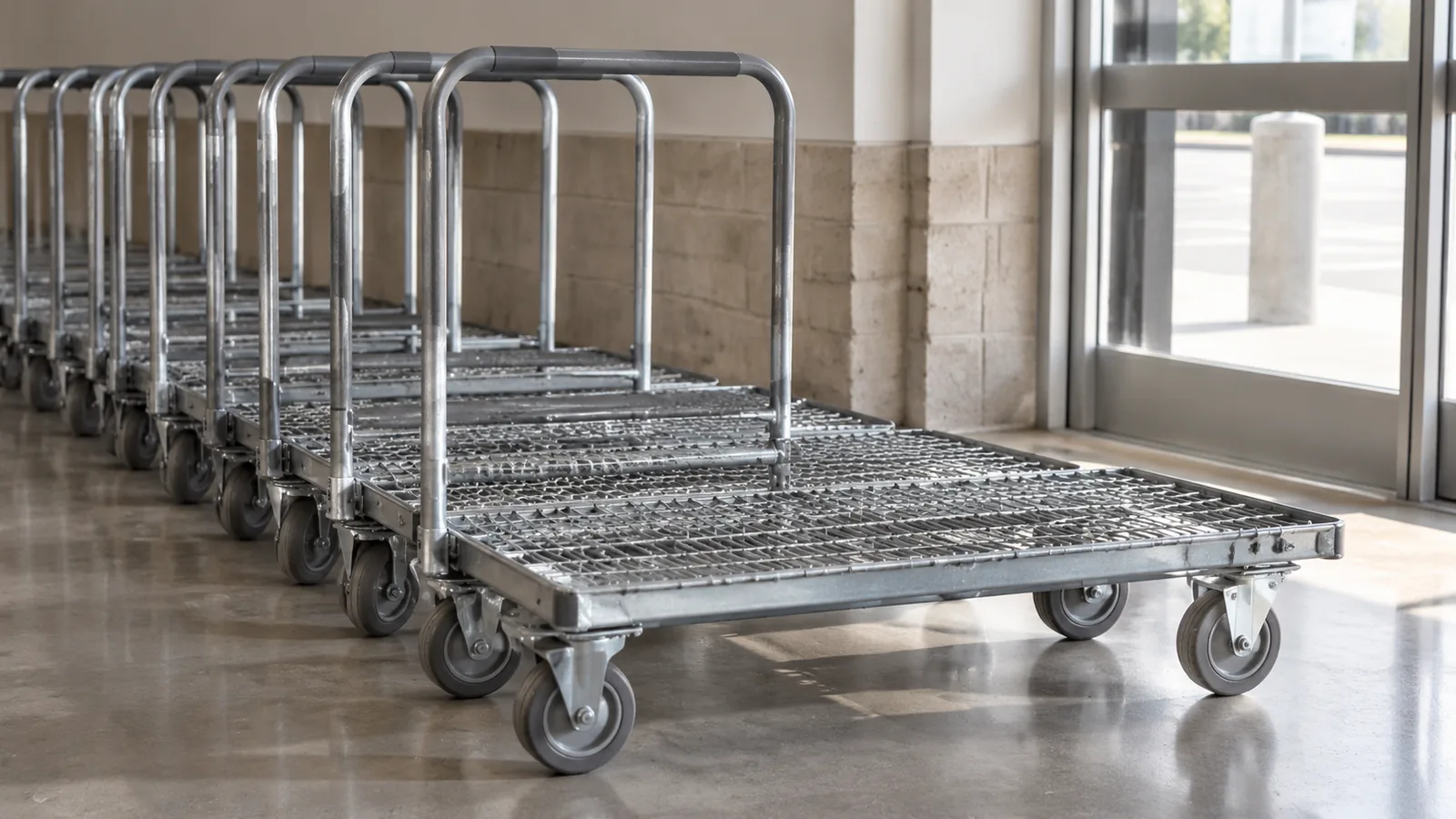
A runaway cart, a broken wheel and a pallet jack driven by a worker are different claims with different proof.
What is the short answer?
Start with one question: who was moving or controlling the thing that hit you? A worker standing next to a pallet jack isn't proof he was driving it.
After that, it's sorting. Was it moving at all? If it was, look at whoever had their hands on it. Was something wrong with it before you ever walked in, like a bad wheel or a dead brake? That's a premises or product question. And did another shopper or a vendor set things in motion? Then the blame may be split.
Which kind of equipment injury was it?
Picture four Saturday afternoons at the same warehouse. A loose flatbed cart rolls out of a corral in the lot and clips your hip. A cart wheel locks up mid-aisle and the handle jams into your ribs. A worker pushing a loaded cart around an endcap runs into you. A pallet jack crosses the main aisle without anyone watching for shoppers.
Those aren't one claim. The loose cart raises questions about who left it and whether the store should have found it. The failed wheel is about who supplied and maintained that cart. The collision with the worker is negligent activity. The pallet jack is about operator conduct, training and lookout.
Why does the label matter?
Ask the pipefitter in United Scaffolding, Inc. v. Levine, 537 S.W.3d 463 (Tex. 2017). He slipped on loose plywood on a refinery scaffold that a contractor had built a week earlier, and a jury found for him on an ordinary negligence question. The Texas Supreme Court took the win away. A week-old scaffold is a condition, not ongoing work, so his case had to be tried as a premises claim. It wasn't, and he left with nothing.
So a cart left in the way is usually a premises condition, while a collision during ongoing work may be an activity claim.
| Theory | Key proof |
|---|---|
| Premises condition. | The store knew or should have known of the hazard. |
| Negligent activity. | The operator's conduct at the moment of injury. |
| Defective unit. | The specific unit, its repairs, and who maintained it. |
What evidence should you keep?
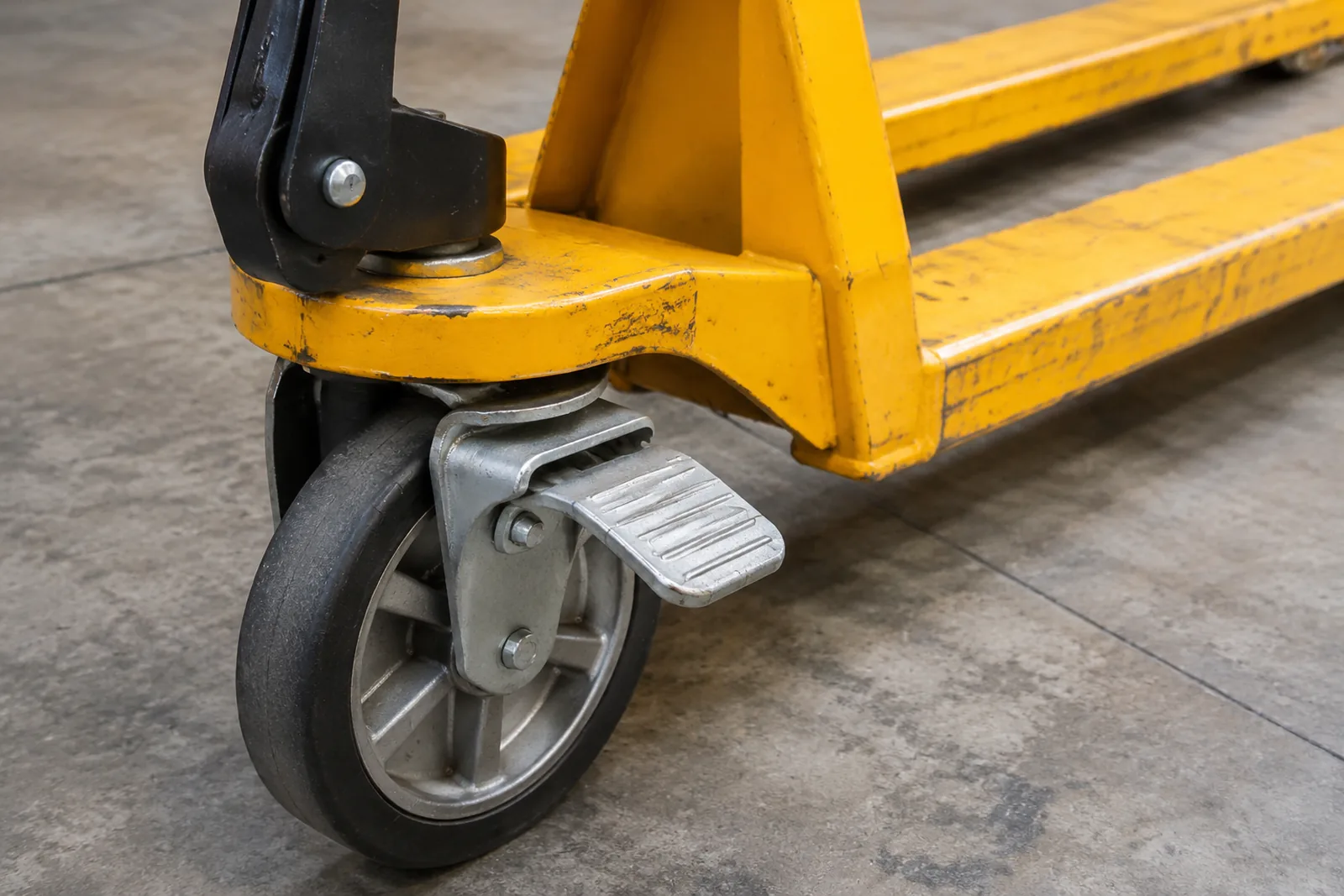
Identify the exact unit, not just the model. Before it rolls back into the fleet, get:
- the cart or jack ID, serial or asset number, if one is visible
- photos of the wheels, brakes and handle
- what was loaded on it
- the scene: grade, distance, and what you could see
- whether the equipment had a warning sound, and whether it used it
From the store, you want that unit's repair tickets (has cart 214 been pulled for a sticky wheel before?), who was assigned to the task, what training they had on that machine, and every camera angle on the approach and the hit. Our guide on what Costco surveillance video a lawyer should request lists the views.
What does a dispute look like?
Here is a hypothetical example, not an actual case. A member says a pallet jack clipped her cart near the dairy cooler. The incident report says the jack was parked. On camera, the worker walks into frame and then the shelving blocks the view, right at the moment that matters. The defense says she turned into a parked jack.
One of them is wrong. Start with the other side of that shelving, since there's often a second camera there. Ask the worker where he was headed and what was on the forks. Then put both the cart and the jack on a floor sketch, one second before and one second after. Last, find out who pays him. A contractor's name on that paycheck means another defendant.
How does shared fault work?
Texas lets the jury split the blame. The rules sit in Chapter 33 of the Civil Practice and Remedies Code:
| Rule | What it means |
|---|---|
| Section 33.003. | The jury assigns a percentage to each person who caused the harm. |
| Section 33.001. | A claimant who is more than 50 percent responsible recovers nothing. |
| Section 33.004. | A defendant may ask to name a responsible third party. |
If Costco says you were looking at your phone, it has to back that up with timing and sight-line proof. Saying it isn't enough.
What to do now: Photograph the cart or jack and its ID before it goes back into use, note the time, and write down the names of any workers nearby.
Frequently asked questions
Is Costco always responsible for its carts?
No. It depends on who controlled the cart and what caused the injury.
What if a contractor drove the equipment?
The contractor may be responsible, along with anyone who controlled the work.
Can my phone use be used against me?
It can be raised, but the defense must connect it to the injury.
For the full case plan, read How to Litigate a Costco Injury Case in Texas or visit the Costco injury claims in Texas hub.
Sources
- Texas Civil Practice and Remedies Code Chapter 33
- United Scaffolding, Inc. v. Levine, 537 S.W.3d 463 (Tex. 2017)
This article is general information, not legal advice. Reading it does not make you our client, and every claim turns on its own facts and deadlines.

ABOUT THE ATTORNEY
Aaron A. Herbert
Founding Attorney
Board Certified in Personal Injury Trial Law
Aaron founded The Law Firm of Aaron A. Herbert in 2010 to focus on developing each client's case and seeking its maximum value. For over a decade, he has represented people seriously injured in major accidents and industrial catastrophes, pursuing trial verdicts and settlements while working to reduce the stress of litigation.
Education
- Texas A&M University · B.S., Criminal Justice, 1999
- University of Oklahoma College of Law · J.D., 2002; graduated in the top of his class
Trial experience & approach
Aaron earned numerous jury verdicts at boutique personal injury litigation firms. According to his biography, he spent a year as the top-earning litigation attorney at a firm that frequently appeared in verdict searches as having one of the highest numbers of trial wins in Texas. At another Dallas personal injury firm, he moved from managing pre-litigation attorney to managing litigation attorney over seven years as the firm grew into one of Dallas's largest personal injury firms.
His biography describes a reputation as one of America's most aggressive trial lawyers, with noteworthy recoveries from judges and juries and substantial pretrial settlements. Most of those settlements included confidentiality agreements requested by the defense. Aaron has said the recoveries were justified by the injuries and losses involved, which no amount of money could make someone choose to experience.
His approach combines passion, preparation, persistence and courtroom imagination. He believes a well-supported, engaged and motivated team working cooperatively helps deliver strong representation, with the goal of achieving the best possible result for every client.
Dallas roots, military service & publication
Born and raised in Dallas, Aaron enlisted in the United States Marine Corps after high school and later received an Honorable Discharge. He completed his university and law degrees after his military service and became a lifelong Sooners football fan in law school.
Publication: “Litigating Dog Bite Cases,” Texas Dog Law Seminar, Dallas, 2009.
Professional affiliations & recognition
Professional affiliations and recognition listed in Aaron’s biography:
- State Bar of Texas
- American Bar Association
- Association of Trial Lawyers of America (now American Association for Justice)
- Texas Trial Lawyers Association
- Dallas Trial Lawyers Association
- Dallas Bar Association
- Tarrant County Bar Association
- Million Dollar Advocates Forum
- The National Trial Lawyers – Top 100 Trial Lawyers