
A wet floor sign doesn't automatically defeat a Brookshire Grocery Company (BGC) injury claim. A missing sign doesn't automatically prove one either. The legal question is whether the store used reasonable care about a condition that posed an unreasonable risk and caused the injury.
A cleaning contractor's floor scrubber was leaving water behind at the ends of the aisles in a Brookshire's in Comanche. The nearest "wet floor" cone was assumed to be at least 20 feet away. In 2014 a Texas appeals court said that cone was some evidence of a warning, but not conclusive evidence that the warning was adequate.
So a cone somewhere in the store doesn't settle anything. If you fell, save these the same day:
- A photo from the direction you walked in, showing what you could see.
- A photo of every cone or sign, and where it stood.
- The time, from your receipt or a text you sent.
- The names of anyone who saw the floor or the cone before you fell.
| A warning question asks | It doesn't ask |
|---|---|
| Where the cone stood, and when it went out | Whether there was a cone somewhere in the store |
| What a shopper could see walking up | What the ceiling camera saw |
| Whether it warned of this hazard | Whether it warned of anything at all |
| Whether there was a safe way around | How badly someone got hurt |
BGC is the Tyler, Texas grocer whose stores operate under Brookshire's, Super 1 Foods, Spring Market, FRESH by Brookshire's, Reasor's, and FRESH by Reasor's. The cases below are other people's cases, stated the way the courts decided them. They don't show that any Brookshire's or Super 1 Foods location violated a duty, and the example conditions are hypothetical things to check, not findings about a store.
Hurt at a BGC store? Tell us about your Brookshire's injury or call (214) 200-4878. Bring the store address, the date, what happened, photos, witness names, and your medical providers. Contacting the firm doesn't create an attorney-client relationship.
The Comanche scrubber case: Dimmitt
That 2014 case is Dimmitt v. Brookshire Grocery Co., No. 11-12-00129-CV (Tex. App.—Eastland June 26, 2014) (mem. op.). The scrubber was the contractor's, and it leaked extra water every time it turned at an aisle end. The trial court had granted traditional summary judgments. The Eastland court reversed them and sent the case back, and in 2015 the Supreme Court of Texas denied review.
It wasn't a damages award or a recovery. The case simply went back to the trial court.
Was the cone in the shopper's path, or 20 feet away?
Distance and line of sight are the first facts to pin down.
Did it warn of a mopped floor or of standing water?
A generic sign may not describe the hazard the shopper actually hit.
When did it go out?
A cone set out after the fall says nothing about the warning before it.
Does a fall prove the warning failed?
A fall by itself doesn't prove the warning failed. Nobody should assume it did, including the person who fell.
The ruffled mat in Bullard: Bowman
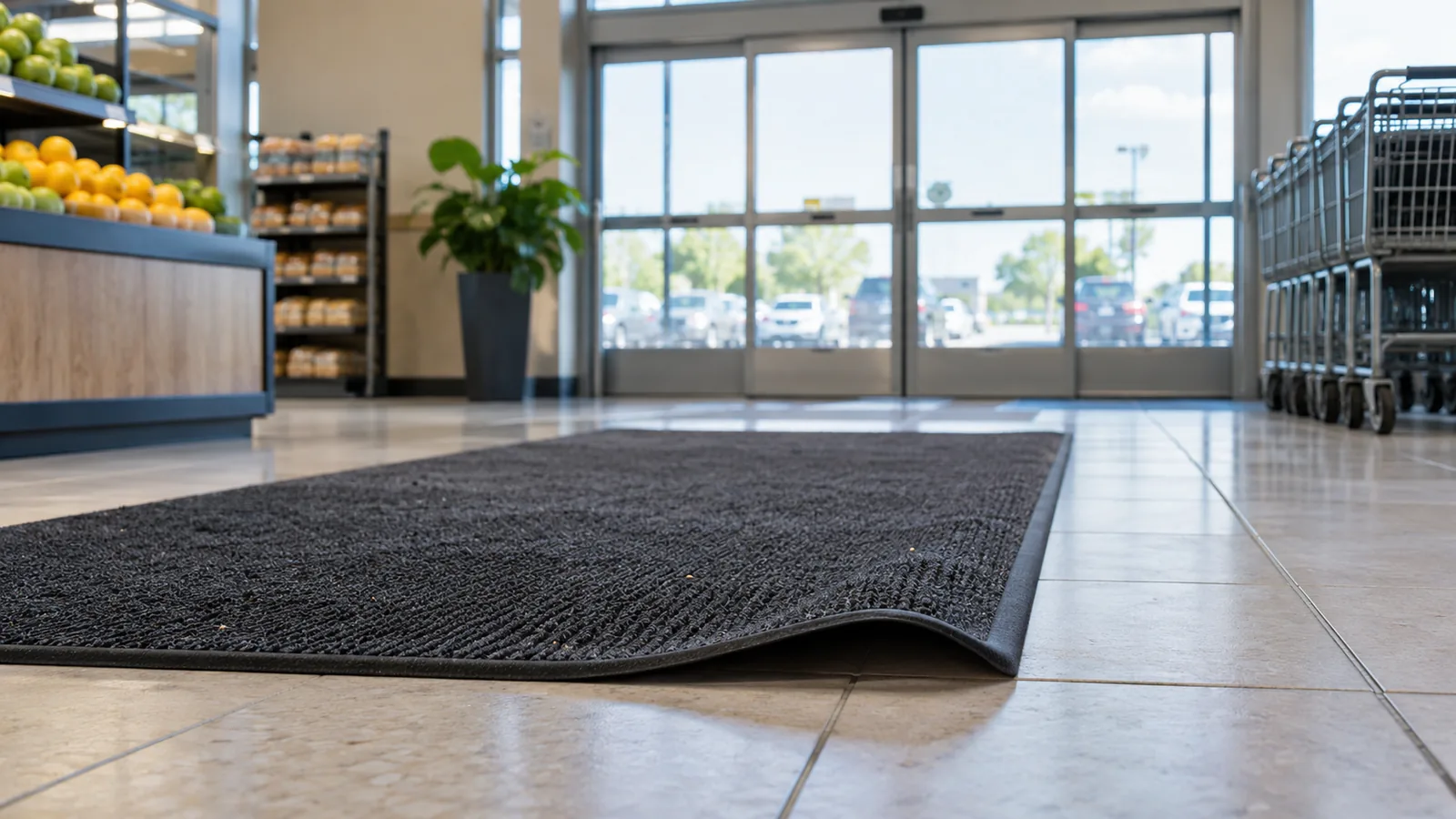
A shopper tripped on a floor mat at the exit of the Bullard, Texas store. In Bowman v. Brookshire Grocery Co., 317 S.W.3d 500 (Tex. App.—Tyler 2010), the claimed condition was the mat's "ruffled" edge, not the mat itself. Nobody could show how long the ruffle had been there, and the court affirmed a no-evidence summary judgment for the store.
That's the lesson for mat cases: notice is measured against one feature, like a raised edge. "Mats get kicked around" isn't evidence. The prior-incident reports in Bowman are covered in proving store notice in a Brookshire's slip-and-fall claim.
If it's safe and lawful, note these:
- How high the edge sat, and how far it was from the door.
- Where the mat was compared with where it usually lies.
- The mat's size and the floor under it.
A mat's look after a fall can fool you.
| After the fall, the mat is | What could explain it | What can help sort it out |
|---|---|---|
| Flat | It was smoothed out, or it was flat all along. | Video from before the fall. |
| Bunched | The fall moved it, or it was bunched beforehand. | Witness testimony and earlier footage. |
Only evidence from before the fall tells you which one happened.
What exactly made you fall?
A photo of some debris nearby doesn't help if you can't connect it to the fall. Each hypothetical hazard below points to different facts:
- A broken jar of salsa, for which jar, where it landed and when it broke.
- Grease near the deli, for where it came from and whether it reached the walkway.
- A loose grape, for which one and how close it was to where you went down.
- A curled entrance mat, for the edge, its height and the time.
- A tipping stack of cases, for how it was stacked and by whom.
- A blocked aisle, for what blocked it and for how long.
- A pothole in the lot, for the exact defect and who controls that piece of pavement.
Describe what you saw before guessing what it was.
| Observation | What it does and doesn't show |
|---|---|
| Clear liquid | It may be water, a cleaning solution, or something else. |
| A shiny floor | It may look slippery without any contaminant on it. |
| A photograph | It shows color and location but can't establish friction by itself. |
Shoes, the way you were moving, the lighting, and the floor surface can all matter to a qualified expert later.
The meat counter and the refrigerated case
Falling next to a case doesn't mean the case leaked. Water near a cooler can come from several places.
| Possible source | What to look for |
|---|---|
| A defrost cycle | The unit's defrost schedule. |
| A stocker loading trays of chicken | Who was stocking, and when. |
| A torn package | The package, or a photo of it. |
| A clogged floor drain | Maintenance records for the drain. |
| A mop that just went by | The cleaning log and the video. |
Two facts matter most. Had anyone reported that unit for leaks? And did anyone see liquid there before the fall?
What if the case "always leaked"?
Then the work orders matter: the ones that name the unit and the date, plus the original service report, not a note saying the unit "had issues." If the technician found no connection to the floor, that goes in the file too. A repair made after the fall is its own question; using it as proof of earlier carelessness takes careful evidentiary analysis, because it isn't automatically admissible.
Rain at the front door
For example, a shopper who falls at the Super 1 Foods entrance at 5:15 on a rainy Friday, with people shaking off umbrellas all around, should save:
- Your route from the parking space to the spot you fell.
- When the rain started and stopped.
- Where each mat was lying.
- Where tile meets mat, or tile meets concrete.
- The lighting, and where the umbrella bags or stand sat.
Rain doesn't make a store automatically liable for every wet entrance. Ordinary outdoor conditions get their own duty analysis.
| Weather-related fall (hypothetical) | The specific condition to identify |
|---|---|
| Slipped just inside the door during a storm | Water on the tile past the end of the mat. |
| Tripped on the entrance mat | A raised or ruffled edge. |
| Fell on the sidewalk outside | The outdoor surface and who controls it. |
One storm, three different legal questions.
Could you see the warning from where you walked?
A warning counts only if it warned of the actual hazard from the direction you came. Take photos from the spot you'd have seen the aisle, before you stepped into it. Then ask:
- Did a shelf or endcap hide the cone?
- What was at eye level?
- Did glare hide the liquid or the sign?
- Were carts or people in the way?
- Did the cone warn of this spill, or of something a few feet over?
- Did it go out before or after the fall?
A cone you can see in a photo taken during cleanup doesn't prove it was there earlier.
| Warning evidence | What it proves |
|---|---|
| A photo of a cone taken after the fall | That a cone stood there when the photo was taken. |
| Video showing the cone before the fall | Where the cone stood, and when. |
| A witness who saw the cone earlier | Depends on how the witness knows the time. |
If a witness says the cone was already out, ask exactly where it stood and how they know what time it was.
When a box falls or a cart hits you
These claims may be about what someone was doing, not about the floor. Texas courts look at the facts rather than the label on the claim.
| What hit you (hypothetical) | What a lawyer asks first |
|---|---|
| A case of canned tomatoes slides off the top shelf onto your shoulder | How it was stacked, who touched it last, and whether anyone was moving it. |
| A worker steering twelve carts clips your hip | Whether the claim is really about what the employee was doing right then. |
| A pallet jack catches your ankle | Who was driving, and how fast. |
Calling everything "premises liability" or "ordinary negligence" doesn't decide it. Ask, through proper requests, that the store keep the item, the packaging information, the display setup, and the names of the employees involved.
Who controls the parking lot?
A pothole, a curb, a drain, or a dark walkway can involve a landlord, a tenant, a maintenance contractor, or all three. Four documents usually sort it out.
| Document | What it shows |
|---|---|
| The lease | Who agreed to maintain which area. |
| The site plan | Where the store's space stops and the shopping center's starts. |
| A paving contract | Who's supposed to fix the asphalt and the lights. |
| Repair invoices from last spring | Who actually did. |
Don't assume the store controls every surface near its door. See identifying the correct Brookshire's defendant.
If a driver backs into you, that's the driver's negligence. Owning the lot doesn't make the store answer for every driver's mistake. If a property condition also played a part, the question is whether that condition is actionable on its own and whether a duty applies.
What the camera saw vs. what the shopper saw
You walk out of produce toward a wet aisle in this example. A cone stands on the far side of a tall display. The ceiling camera sees it plainly. From five and a half feet off the floor, you don't.
A lawyer checks four things here:
- Your route, set beside the camera view.
- The angles, measured if that makes sense.
- Whether the display moved.
- How high the camera hangs.
Before you meet a lawyer
Be ready to say whether you saw the danger before you fell and whether anything blocked your view. Then bring what you have.
- Your photos, for what the scene looked like before cleanup.
- The receipt, for the store and a time near the fall.
- The incident report number and the manager’s name, so the report can be requested.
- Your shoes, if they might matter, since the defense may bring them up.
- Witness names and numbers for the people who saw the floor, the cone or the fall.
Aaron Herbert is Board Certified in Personal Injury Trial Law by the Texas Board of Legal Specialization. That says nothing about whether a particular hazard was actionable, and it doesn't guarantee a recovery.
Three questions to ask any lawyer:
- How will you show when the warning went out?
- What does the store's video show, and who's asking for it?
- What are the weakest facts in my case?
Does the fall match the injury?
The injury should fit the way you went down.
| How you went down | What the evidence should match |
|---|---|
| Your foot shot forward and you landed on your back | The video and the bruise on your hip should look like a slip. |
| Your toe caught | The spot where the mat edge curled up. |
| A box hit your shoulder | The box and where it struck. That's not a floor case at all. |
Nobody remembers every movement in a sudden fall. When you don't, say so, and look for video, witnesses, or records to fill the gap. And a mechanism that's medically possible doesn't prove every claimed condition came from it.
If several hazards show up in the photos, the evidence has to connect one of them to the fall. A cracked tile near a wet spot may not matter if you slipped somewhere else. A cone may warn about one area and not the next.
How deep is too deep? McIntire's parking-lot divot
The divot was about three-quarters of an inch deep, out in a grocery parking lot. A customer stepped in it and was seriously hurt. In 2022, ruling per curiam in United Supermarkets, LLC v. McIntire, 646 S.W.3d 800, the Texas Supreme Court held it wasn't unreasonably dangerous as a matter of law, despite the injury.
Whether a condition is unreasonably dangerous is usually a question for the jury. Some conditions just aren't, as a matter of law. A fracture, surgery, or permanent impairment doesn't prove the risk was unreasonable. The focus is the condition and how customers came across it.
Facts that bear on it, with hypothetical examples:
- Size and surface, such as a puddle 2 feet across on glazed tile.
- Concealment, such as clear liquid on a light gray floor.
- Lighting and glare, such as ceiling lights reflecting across the aisle.
- A normal walking path, such as the main aisle in front of the dairy case.
- Obstructions, such as a stack of cases narrowing the aisle.
- A known problem, such as a cooler with earlier leak tickets.
- Precautions, such as the lack of a cone in that aisle.
- A safety standard or industry practice, only if a qualified witness supports it and it’s admissible.
- A foreseeable injury, such as a slip and a fall backward.
Three photos tell different stories. A close-up after the fall shows the substance. An eye-level shot from the approach shows what you could see. A wide shot shows the warnings, displays, and lighting.
What an expert can and can't do
An expert can answer a defined question:
- How slippery was the floor with that substance on it?
- Why did the display fall?
- Could that unit have produced the liquid found?
- Could a shopper have seen the hazard?
- Where do shoppers usually look and walk?
- What would a reasonable store have done under applicable standards?
An expert can't fill a notice gap. In H-E-B, LP v. Peterson, No. 24-0310 (Tex. Apr. 10, 2026), the Supreme Court didn't need to resolve every dispute over the shopper's expert evidence, because it didn't establish how long the puddle had been there. Bring in an expert for a specific question backed by reliable facts, not for a broad opinion that the store should have been safer. See expert witnesses in a Brookshire's injury case.
Make it safe or warn: McIntire and Levine
Under McIntire and United Scaffolding, Inc. v. Levine, 537 S.W.3d 463 (Tex. 2017), a premises owner or occupier can generally meet its duty by making the premises reasonably safe, or by adequately warning invitees of concealed, unreasonably dangerous conditions it knows or should know about.
The precaution has to fit the hazard:
- Clean up the spill.
- Fix the leaking case.
- Take down the unstable display.
- Secure the pallets or shelving.
- Block off an area that can't be fixed right away.
- Put a conspicuous warning at a concealed hazard.
- Give shoppers a safe way around a wet aisle.
- Maintain a scrubber or cooler that's known to leak.
"They should have inspected more often" isn't enough. The claim has to name what the store could have done, and when, and how it would have lowered the risk.
| Weak breach claim | Stronger breach claim (hypothetical) |
|---|---|
| "They should have inspected more." | A clerk saw the puddle at 3:05 p.m. and could have coned it before the 3:20 p.m. fall. |
| "The store was careless." | The mop crew left the scrubber's trail of water without anyone mopping behind it. |
Does a missed sweep make the store liable?
H-E-B had an inspection protocol in Peterson. The Court said it didn't show how long the puddle had been there, and it didn't by itself prove constructive notice. An internal policy, the Court added, doesn't set a duty higher than ordinary care.
So in a Brookshire's case, the sweep log is evidence. It can show the 2:45 check of aisle 9, what the clerk wrote, and whose aisle it was. It isn't the legal standard.
Was there a wet-floor sign, and did she see it?
A yellow cone in the aisle is evidence of care. It isn't a verdict. For any sign, six things get checked:
- Video and witness timing, for whether it was there before the fall.
- Eye-level photos from the approach, for whether customers could see it.
- The sign itself, or a clear photo of it, for whether its wording described the hazard.
- Photos of the aisle and what narrowed it, for whether there was a safe way around.
- Video or photos of the barrier in place, for whether a barrier actually blocked access.
- The same photos, taken from where she walked, for whether the sign itself was in the walkway.
What the shopper actually knew can affect both duty and comparative responsibility. A shopper who saw the cone and walked around it helps the store's warning argument. One who saw the puddle and stepped in anyway raises both questions. And if she couldn't see either one, the concealed-condition argument gets stronger.
If a jury puts some of the blame on her
A hypothetical jury finds $10,000 in damages and puts 30 percent of the blame on the shopper. She recovers $7,000, because Section 33.012 of the Texas Civil Practice and Remedies Code cuts damages by her percentage. Had the jury said 51 percent, she'd recover nothing. Section 33.001 bars a claimant found more than 50 percent responsible in an action governed by Chapter 33.
The store will raise its other defenses too: open and obvious, no unreasonable risk, no notice, and causation. They come up in the answer, at depositions, in expert challenges, and at trial.
These are claims to investigate, not to accept.
Open and obvious: what Austin did and didn't decide
Austin v. Kroger Texas, L.P., 465 S.W.3d 193 (Tex. 2015), answered a certified question about an employer's duty to an employee. It wasn't a shopper case. The Court discussed the general rule that a premises owner ordinarily has no duty to warn or protect an invitee from a danger that's open and obvious or actually known, subject to recognized exceptions. Don't carry all of that over to a customer claim without looking at the facts and the exceptions.
With clear liquid, the case turns on her walk up to it:
- glare from the overhead lights
- liquid the same color as the tile
- a display blocking the view
- an aisle layout pulling her eyes to the shelves
- whether she actually knew it was there
A photo taken after the fall isn't enough to answer these.
Answering the store's defenses
What the store argues, and where to look:
| The store argues | Where to look |
|---|---|
| She was on her phone | The video and phone records. |
| She was distracted | What she was doing and where the hazard was. |
| She wasn't watching her step | What was visible from the approach. |
| Her shoes were bad | The shoes and the floor. |
| She knew the store | How often she shopped there, and whether the hazard was new. |
| She ignored a warning | Whether one was there and visible. |
| She knew about the hazard | What she actually saw. |
| "Too minor to matter" | Document the size and the setting. McIntire matters most for parking lots and walking surfaces, and a serious injury doesn't answer it. |
| "We didn't know" | Reports, earlier sightings, and anything an employee caused. |
| "It appeared seconds before" | Video or witnesses that put it there earlier. |
| "No duration evidence" | Any timed observation. |
| "The source is speculation" | Tie the source to the floor at that time and place. |
| "She's relying on inspection policy" | Point to evidence about this hazard, and ask for footage of the area before the fall. |
Before mediation, her account, the video, and the incident report go side by side. Her medical records run from well before the fall to well after it. Where they conflict, that gets sorted out then, not at trial.
Frequently asked questions
There's a cone in the manager's photo. Was it there when I fell?
It was there at 4:15, when the photo was taken. That's all the photo proves. The video, the original photo files, and the witnesses can show when employees responded and where the warnings stood. Any later photo should carry the time it was really taken.
Should I take some of the liquid home in a water bottle?
Leave it on the floor. It could be hazardous, and a bottle of aisle liquid with no record of where it came from proves little. Take photos and write down the color, smell, and size of the spill instead. A lawyer can look at lawful ways to preserve and test it that keep people safe and protect chain of custody and reliability.
Does a dirty floor prove the store knew about the spill?
A sticky floor in aisle 2 says little about the puddle in aisle 9. Notice is about the hazard that hurt you. Was it the same condition? Was it there before the fall? What did the store know, or what could it reasonably have found?
I was reading a cereal box. Is my claim over?
That's one fact among many. Visibility, where the warning stood, your route, distraction, and the legal duty all count too.
What should a site diagram show?
Three things, drawn by hand is fine:
- an X where you fell and an arrow for the way you were walking
- the displays, cones, equipment, and cameras you remember
- who drew it, where each detail came from, and which measurements are guesses
Did Dimmitt end in a recovery for the shopper?
The court of appeals reversed the summary judgments and sent the case back to the trial court. That wasn't a damages award.
Tell us about your Brookshire's injury
Got the receipt, the photos, and the names? Tell us about your Brookshire's injury or call (214) 200-4878. The office is on the LBJ Freeway in Dallas, at 8330 Lyndon B. Johnson Freeway, Suite 700, 75243. Calling doesn't make us your lawyers; representation, scope, and fees get confirmed in writing first, and no result is guaranteed.
Related pages on Brookshire's injuries
- Texas Brookshire's grocery injury knowledge hub: every guide in one place.
- Brookshire's injury claims and lawsuits in Texas: the claim and lawsuit through appeal.
- Proving store notice in a Brookshire's slip-and-fall claim: notice and duration evidence.
- Identifying the correct Brookshire's defendant: operators, owners, contractors, and control.
- Expert witnesses in a Brookshire's injury case: when experts help, and their limits.
- Texas slip and fall lawyer: the firm's slip-and-fall practice page.
Sources
- Dimmitt v. Brookshire Grocery Co., No. 11-12-00129-CV (Tex. App.—Eastland June 26, 2014) (mem. op.).
- Bowman v. Brookshire Grocery Co., 317 S.W.3d 500 (Tex. App.—Tyler 2010).
- United Supermarkets, LLC v. McIntire, 646 S.W.3d 800 (Tex. 2022) (per curiam).
- United Scaffolding, Inc. v. Levine, 537 S.W.3d 463 (Tex. 2017).
- H-E-B, LP v. Peterson, No. 24-0310 (Tex. Apr. 10, 2026).
- Austin v. Kroger Texas, L.P., 465 S.W.3d 193 (Tex. 2015).
- Texas Civil Practice and Remedies Code, Chapter 33, §§ 33.001 and 33.012.
- Texas Judicial Branch, rules and standards.
We checked these sources on November 2, 2026. The Law Firm of Aaron A. Herbert, P.C. has no tie to Brookshire Grocery Company. It has no tie to Brookshire Brothers, Ltd., either. Neither company sponsors or endorses this page. This page is general information. Your own facts, the law, and any court orders decide your case.

ABOUT THE ATTORNEY
Aaron A. Herbert
Founding Attorney
Board Certified in Personal Injury Trial Law
Aaron founded The Law Firm of Aaron A. Herbert in 2010 to focus on developing each client's case and seeking its maximum value. For over a decade, he has represented people seriously injured in major accidents and industrial catastrophes, pursuing trial verdicts and settlements while working to reduce the stress of litigation.
Education
- Texas A&M University · B.S., Criminal Justice, 1999
- University of Oklahoma College of Law · J.D., 2002; graduated in the top of his class
Trial experience & approach
Aaron earned numerous jury verdicts at boutique personal injury litigation firms. According to his biography, he spent a year as the top-earning litigation attorney at a firm that frequently appeared in verdict searches as having one of the highest numbers of trial wins in Texas. At another Dallas personal injury firm, he moved from managing pre-litigation attorney to managing litigation attorney over seven years as the firm grew into one of Dallas's largest personal injury firms.
His biography describes a reputation as one of America's most aggressive trial lawyers, with noteworthy recoveries from judges and juries and substantial pretrial settlements. Most of those settlements included confidentiality agreements requested by the defense. Aaron has said the recoveries were justified by the injuries and losses involved, which no amount of money could make someone choose to experience.
His approach combines passion, preparation, persistence and courtroom imagination. He believes a well-supported, engaged and motivated team working cooperatively helps deliver strong representation, with the goal of achieving the best possible result for every client.
Dallas roots, military service & publication
Born and raised in Dallas, Aaron enlisted in the United States Marine Corps after high school and later received an Honorable Discharge. He completed his university and law degrees after his military service and became a lifelong Sooners football fan in law school.
Publication: “Litigating Dog Bite Cases,” Texas Dog Law Seminar, Dallas, 2009.
Professional affiliations & recognition
Professional affiliations and recognition listed in Aaron’s biography:
- State Bar of Texas
- American Bar Association
- Association of Trial Lawyers of America (now American Association for Justice)
- Texas Trial Lawyers Association
- Dallas Trial Lawyers Association
- Dallas Bar Association
- Tarrant County Bar Association
- Million Dollar Advocates Forum
- The National Trial Lawyers – Top 100 Trial Lawyers