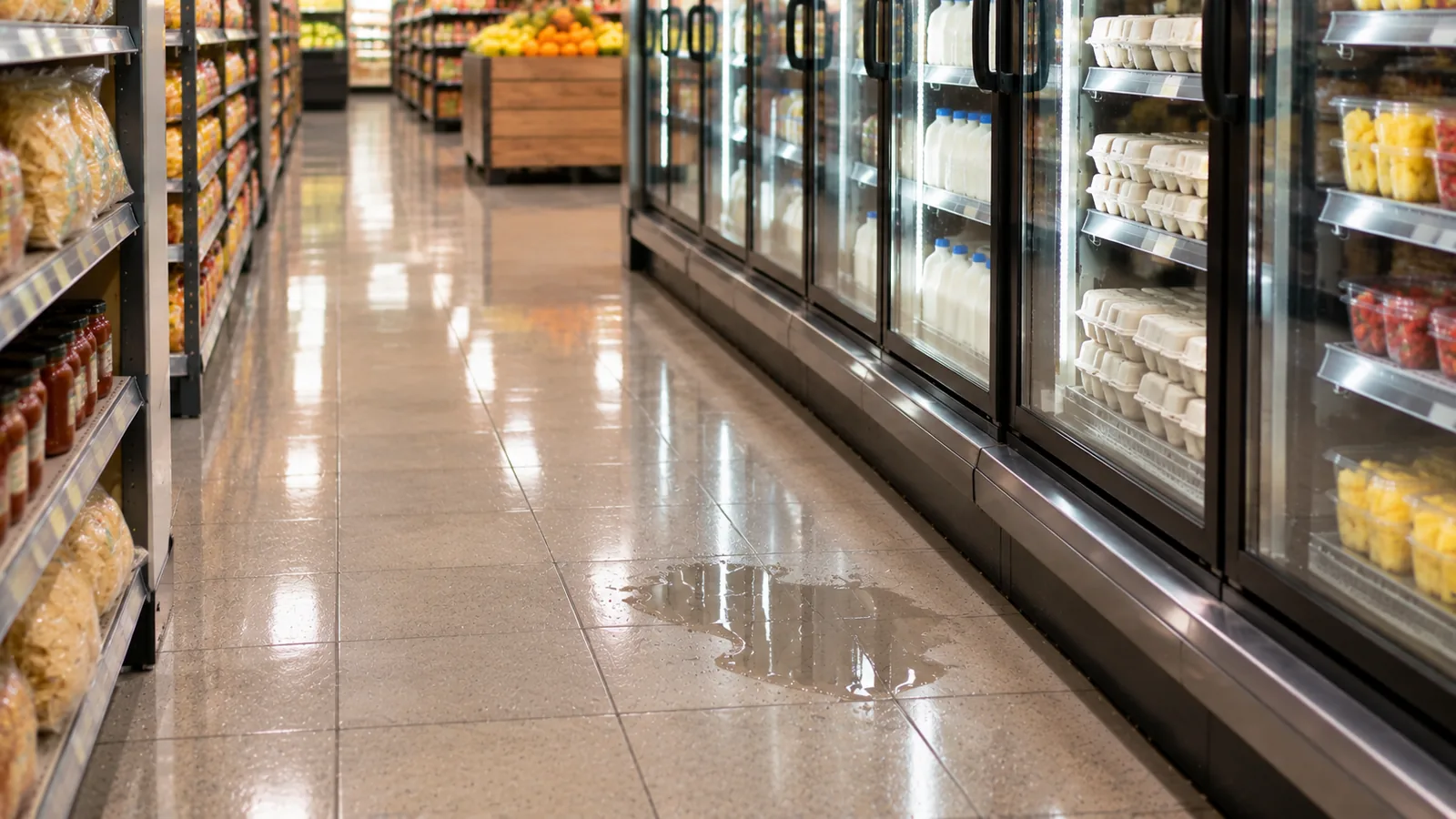
At 4:35 p.m. on a Tuesday at a Super 1 Foods, in the hypothetical this page follows, a shopper steps on a grape beside the third produce table and breaks her wrist. The aisle was busy, and a stocker was working two tables away.
Can she prove the store knew about that grape? Only with evidence about that grape:
- Who saw or reported it, and when.
- How long it sat on the floor.
- Where it was, down to the spot.
To prove notice in a Brookshire Grocery Company (BGC) slip-and-fall claim, the evidence has to show the store knew, or reasonably should have discovered, the particular hazard before the fall.
BGC is the Tyler, Texas grocer whose stores operate under Brookshire's, Super 1 Foods, Spring Market, FRESH by Brookshire's, Reasor's, and FRESH by Reasor's. These are general legal points and other people's cases, stated as the courts gave them; they don't establish that any BGC store violated a duty or predict any result. Brookshire Bros., Ltd. v. Aldridge, discussed below, involved Brookshire Brothers, a different company, not BGC.
Hurt at a BGC store? Tell us about your Brookshire's injury or call (214) 200-4878. Bring the store address, the date, what happened, photos, witness names, and your medical providers. Contacting the firm doesn't create an attorney-client relationship.
The melted ice that wasn't enough: Taylor
A shopper at a Brookshire's slipped on partially melted ice on the tile in front of a self-service soft drink dispenser. In Brookshire Grocery Co. v. Taylor, 222 S.W.3d 406 (Tex. 2006), the trial court had granted Taylor partial summary judgment on premises liability and rendered judgment on the jury's damages, and the court of appeals affirmed.
Then the Texas Supreme Court took the case. It reversed and rendered judgment that Taylor take nothing. Justice Hecht wrote the opinion. Justice Johnson concurred, and Justice O'Neill dissented, joined by Justice Medina.
Why did the store win?
The dispenser wasn't itself an unreasonably dangerous condition; the condition was the ice, and there was no evidence of how long it had been on the floor, so there was no constructive notice.
Does Taylor mean a drink area can never support a claim?
The majority looked at one dispenser and one record with no proof of how long the ice sat. It didn't hold that drink areas are off-limits for claims. When you cite it, keep the majority, the concurrence, and the dissent apart.
Name the exact condition first
Knowledge is measured against the particular condition and nothing broader. So the first job is naming it.
- "The produce section is always slippery," better stated as a grape beside the third produce table that caused the fall at 4:35 p.m.
- "The front entrance is dangerous when it rains," better stated as water tracked past the end of the entrance mat that formed a puddle on the tile.
- "The deli has problems," better stated as clear liquid collected in front of the deli case where shoppers line up.
In each of these hypothetical examples, the better version names a thing, a place, and a time that evidence can test.
The way the condition is described decides which notice question gets asked.
| The condition as described | The notice question |
|---|---|
| "The whole drink area was dangerous" | Too broad. The court still asks about the particular hazard. |
| A piece of ice on the tile | Who knew of that ice, or how long it was there? |
| Liquid pooled under a fixture | When did it reach the walkway, and who saw it? |
| A defect in a fixture or mat | When did it develop, and did anyone report it? |
| An employee doing something at the time | Would an activity theory fit better? |
Calling the whole produce section dangerous doesn't get around this. The claim is about one grape, and that grape is what has to be proved.
The four elements, from Keetch to Peterson
She came in to buy groceries, so she's an invitee. Her list of things to prove comes from three Texas Supreme Court cases: Keetch v. Kroger Co., 845 S.W.2d 262 (Tex. 1992), United Scaffolding, Inc. v. Levine, 537 S.W.3d 463 (Tex. 2017), and H-E-B, LP v. Peterson, which restated it in 2026.
| Element | What it means |
|---|---|
| Knowledge | Actual or constructive knowledge of a condition on the premises. |
| Unreasonable risk | The condition posed an unreasonable risk of harm. |
| Lack of reasonable care | No reasonable care to reduce or eliminate the risk. |
| Proximate cause | That failure proximately caused the injury. |
Condition claim or something else? Levine draws the line
Levine separates condition claims from activity claims. Before choosing a cause of action, name the conduct or condition that caused the injury.
| What happened | Theory it may implicate |
|---|---|
| A slip on water, grease, meat residue, or food | Premises liability for a dangerous condition. |
| A trip over a display, pallet, mat, cord, or merchandise | Premises liability, depending on who placed and controlled it. |
| A falling product or unsecured display | Premises liability or negligent activity, depending on whether someone was moving it. |
| An employee's affirmative conduct, such as running equipment | Ordinary negligence. |
A defective cart may raise premises or product issues, and a parking-lot collision may involve negligent operation, supervision, or premises theories.
Don't plead every conceivable theory without a factual and legal basis. Take a hypothetical pallet jack sitting in the main aisle by the dairy wall at 7 a.m. The overnight stocking crew left it there when their shift ended. That's the source, the people who controlled it, and the conduct, all pinned down before anyone files anything.
Did the store know, or should it have known?
Actual knowledge and constructive knowledge need different proof.
| Route | What it asks | Typical proof |
|---|---|---|
| Actual knowledge | Did the store or an appropriate employee know about this hazard before the fall? | A prior report, an employee's sighting, or a record naming the condition. |
| Constructive knowledge | Was it there long enough that the store had a reasonable chance to find it? | Video, or a timed earlier sighting. |
Most grocery cases turn on the second route, because shoppers rarely have proof an employee saw the spill.
For the hypothetical grapes at Super 1 Foods, work through the sources in order.
- People. Did a shopper tell the produce clerk about the grapes before 4:35? Get who heard it, when, and the exact words.
- Cameras. Does a clip show the grapes hitting the floor, or lying there? Note the camera and the clip times.
- Earlier sightings, and how each witness knows what time it was.
- Paper: a log or ticket with an author and a time stamp.
A job assignment that puts someone in the department doesn't show the person saw the floor.
What the store actually knew
Actual knowledge exists when the defendant or an appropriate agent knows about the condition before the injury. Each kind of evidence leaves something to pin down, as in these hypothetical examples.
- A stocker’s report of water by the milk case around 3:50, for whether 3:50 came from a clock and who he told.
- A shopper’s report to the cashier at lane 4, for the cashier’s name and the words she remembers.
- An employee who knocked the jar off the shelf while restocking, for when and whether he went for a mop.
- The 3:30 floor walk sheet that says "spill, aisle 7," for who wrote it and whether it’s this spill.
- The manager’s 2:15 text about the cooler, for the sender, the phone and which cooler.
- A work order for that case dated the morning of the fall, for whether it names this leak and this spot.
- Camera footage of a clerk walking toward the puddle with a mop, for the clip time against the fall time.
Timing is everything. A manager who finds a spill after the fall proves it existed when the manager arrived, not that anyone knew before.
| After-the-fall fact | What it doesn't automatically prove |
|---|---|
| An employee admits the floor was wet after the incident. | Pre-incident knowledge. |
| A manager photographs the spill after the fall. | When the spill first existed. |
| A cleanup log entry follows the fall. | That anyone knew of the hazard beforehand. |
Each one confirms the hazard; none of them dates it.
What does an actual-knowledge case look like?
In one hypothetical, a shopper tells a meat-department employee that water is collecting near a refrigerated display. The employee nods but doesn't block the area or call for a mop. Several minutes later a second shopper slips there.
What should be preserved there?
The first shopper's contact information, the employee's name, footage showing the conversation and its time, and records of the location and what happened next.
The Reece test for constructive notice
Is it more likely than not that the condition sat there long enough for the owner to have a reasonable chance to find it? That one question is the time-notice rule from Wal-Mart Stores, Inc. v. Reece, 81 S.W.3d 812, 814-17 (Tex. 2002).
Courts weigh the condition's longevity, the owner's proximity to it, and its conspicuity. An employee's proximity, without more, isn't enough.
| Constructive notice needs | Constructive notice can't rest on |
|---|---|
| Evidence supporting a reasonable inference that the particular condition existed long enough to be discovered. | A guess about when the liquid reached the floor. |
| A connection to the time and place of injury. | A general record of past spills. |
| Proof that holds up under Peterson. | Arguments the Supreme Court rejected in that case. |
The left column is what a response to a no-evidence motion has to show.
What makes a notice proposition precise?
It names a person, a communication, a place, and a sequence. "Someone must have seen the spill" becomes "a stocker restocking the cereal aisle at 2:05 p.m. walked within a few feet of it."
What can each kind of evidence prove?
Take the milk spill in aisle 7.
- 2:05 p.m.: the camera over the aisle shows the jug tipping.
- 2:10 p.m.: a shopper sees the same puddle.
- 2:22 p.m.: the milk is still there when she falls.
- 2:25 p.m.: your daughter's photo shows where the puddle was and what it looked like, but not how long it had been there.
A maintenance ticket ties a leaking case to the floor only if it names the place and the time.
The toy-aisle puddle: Peterson
The puddle was clear, and it sat in a toy aisle at an H-E-B. The shopper who slipped in it sued, and the case reached the Texas Supreme Court as H-E-B, LP v. Peterson, No. 24-0310. On April 10, 2026, the store won. Nothing in her evidence showed how long the puddle had been there, so there was no fact issue on constructive knowledge. The Court reversed the court of appeals and reinstated summary judgment.
| What the shopper offered in Peterson | What the Court decided |
|---|---|
| Prior roof leaks elsewhere in the store | Knowledge of a water source must correlate to the dangerous condition at the time and place of injury. |
| Rain had stopped about two hours before the fall | A possible source, not evidence of when water reached the floor. |
| Evidence of a drip from above | It addressed cause, not how long the puddle remained. |
| The size of the puddle | Size alone didn't let a jury infer how long it had been there. |
| The store's inspection practices | They didn't establish duration, and an internal policy doesn't impose a higher standard of care. |
None of those items substitutes for proof of duration.
A party responding to a no-evidence summary judgment motion must produce some evidence of the condition's duration. The Court applied existing precedent, including Reece, Aldridge, and City of San Antonio v. Rodriguez, 931 S.W.2d 535 (Tex. 1996), which held that knowing a roof leaks isn't knowing about the puddle.
What Peterson does
It requires some evidence that the particular condition existed long enough to afford a reasonable opportunity to discover it, when constructive notice is challenged by a no-evidence motion, and it rejects evidence that doesn't establish the hazard's own duration.
What Peterson doesn't do
It doesn't eliminate claims about spills, leaks, or other transient conditions, require a time-stamped video for a set number of minutes, or create a bright-line rule that a spill must exist for a fixed time.
Cause isn't duration
Peterson separates evidence about where a hazard came from from evidence of how long it existed. These hypothetical pairs show the gap.
| Evidence of cause | Evidence of duration |
|---|---|
| A leaking cooler. | Video showing water spreading from 2:10 p.m. to 2:30 p.m. |
| An overflowing ice bin. | A shopper who saw the same ice twenty minutes before the fall. |
| A broken jar on a shelf above. | A stocker's report time-stamped before the fall. |
The left column explains where the hazard came from. Only the right column says how long it sat there.
A refrigeration ticket from Monday doesn't put water in the aisle on Tuesday. Last year's roof invoice doesn't either, and neither does a leak over in the bakery.
Getting from a leak to a puddle takes four links, and each one needs its own record:
- A work order shows the dairy case was leaking.
- A technician's note says it was still dripping that afternoon.
- Video or a timed witness puts the water in the walkway.
- Something shows how long it sat there.
Ask the technician what was observed, when the equipment ran, whether water was on the floor, and whether any record names the accident area. Targeted requests are in written discovery in a Brookshire's injury lawsuit.
How much paper? The service history on the case near the fall, what people saw that day, and a note on what each record proves. Five years of maintenance files from every store won't help.
The shopper who saw water at 4:20
Nobody knows when the spill started. But a shopper saw water in that spot at 4:20, and the fall came at 4:35. Here's the hypothetical sequence, bad facts included.
| Time (hypothetical) | Event | What has to hold up |
|---|---|---|
| 4:20 p.m. | A witness sees water. | She reliably identifies the condition, place, and time. |
| 4:25 p.m. | A stocker passes the spot on video. | The clip shows him near enough to see it. |
| 4:33 p.m. | A second shopper drops a bottle nearby. | An alternative explanation the analysis must address. |
| 4:35 p.m. | The fall, in the same spot. | The location matches the 4:20 sighting. |
Fifteen minutes is the strongest interval here, but the 4:33 bottle has to be dealt with honestly.
A photo taken after the fall can't prove the 4:20 sighting. And if the tape shows a customer dropping a drink at 4:33, pretending it doesn't won't help anyone.
Other stores' reports: Bowman
A shopper tripped on a floor mat at the exit of the Bullard, Texas store. In Bowman v. Brookshire Grocery Co., 317 S.W.3d 500 (Tex. App.—Tyler 2010), the claimed condition was the mat's "ruffled" edge, not the mat itself.
The shopper offered 118 mat-related incident reports from 75 other Brookshire stores over four years. They didn't show actual knowledge at Bullard, there was no evidence of how long the ruffle existed, and the court affirmed a no-evidence summary judgment for the store.
What does Bowman mean for your file of old incident reports?
A curled mat at some other store, hypothetically in Longview, says little about the exit mat in Bullard. Reports from the same store, the same door, and the same month carry more weight. And 118 reports, the court said, still didn't show the store knew about this mat.
The particular condition at that time and place
Peterson emphasizes the dangerous condition at the time and place of injury, not an earlier or different condition that might have produced it. Knowledge has to concern the specific condition, not that grocery floors can be slippery.
| Too general | The specific hazard | The knowledge question |
|---|---|---|
| The meat department floor is often wet. | A puddle 3 feet from the case at 1:50 p.m. | What did the store know about that puddle? |
| Mats sometimes curl. | The exit mat's edge was raised when the shopper walked out. | Who knew that edge was up, and since when? |
| Pallets end up in aisles. | A pallet in aisle 4 | Who parked it, how long did it sit, and whose job was it to move it? |
| Displays get overloaded. | A paper-towel display that toppled | Who built it, who loaded it, and did anyone see it leaning? |
The middle column is what the knowledge element is measured against.
Aldridge: eight minutes of saved video at a Brookshire Brothers store
Jerry Aldridge slipped on grease from a rotisserie-chicken container near a display. About eight minutes of video survived. The rest got recorded over.
What did the Supreme Court decide?
It's a spoliation case. The trial court decides whether spoliation happened and picks the remedy. A jury instruction is reserved for intentional spoliation, or for negligent loss that irreparably deprived the other side of any meaningful ability to present its case.
Why does Aldridge come up in notice cases?
Peterson described the Aldridge video as showing employees repeatedly passing a large grease spill within five minutes before the fall, which was some evidence of constructive knowledge. In Peterson itself, there was no evidence of the puddle's duration or that an employee encountered it.
What's the lesson for a Brookshire's case?
Ask whether evidence places employees close enough to the hazard, at a relevant time, to support an inference that they had an opportunity to discover it.
Two employees assigned to the grocery side that afternoon is weak proximity evidence. So is a manager who was "on the floor." In a hypothetical with stronger proof, video shows a stocker stepping around the spill at 3:12 p.m. and again at 3:15, and the manager walking the bakery aisle within feet of it before the 3:18 fall.
A shift schedule puts someone in the building. A clip at 3:12 puts someone next to the spill.
What time did the spill start?
Often nobody knows. The timeline can still box it in, as long as each line says how it's known. In the hypothetical aisle 7 case:
| Time | Event | How it's known |
|---|---|---|
| 1:45 p.m. | Aisle 7 cleaned | Established: cleaning log and video. |
| After 1:45 | The spill happened sometime later | Inference; it only narrows the window. |
| 2:10 p.m. | Spill present | Established: witness or recording. |
| 2:22 p.m. | The fall | Established: video and incident report. |
Look at the third column. A log, a clip, or a witness backs every "established" line. The line after 1:45 is only an inference, and it keeps that label instead of turning into a guessed time.
The request for that case asks for the aisle 7 camera from 1:30 to 2:40 p.m., plus the cameras on either side for the same window. Footage is usually the first thing to go; see preserving Brookshire's surveillance video.
Water by the meat case
A meat department has water, blood, juice, ice, and cleaning solution in it all day. None of that, by itself, proves the store knew about one puddle in the customer aisle.
Where exactly was she standing?
In the customer aisle, behind the counter, or in a spot only employees use. Each one changes the duty.
What was on the floor, and where did it come from?
Blood, water, or ice; the display case, the ice machine, a mop, or a torn package. Someone has to be able to say.
Did anyone know before she fell?
An employee's report, a customer's comment at the counter, or video of the puddle spreading while a clerk walked past.
Did a sign or mat go out?
And if so, at what minute, before the fall or after?
How long had it been there?
That's the piece Peterson requires, and the hardest one to find.
A seafood case that drips every time it defrosts doesn't prove it was defrosting at 2 p.m. that Tuesday. An ice bin that overflows on busy Saturdays doesn't prove the ice sat long enough to be found that day.
Evidence that can show duration
Any of these can help, but only if it's authentic, admissible, and about this hazard on this day.
- Surveillance footage, kept as the original file with the footage around it, not just the clip of the fall.
- Witnesses, for where they stood, what they saw, for how long and the exact spot.
- Employee testimony, for the time, place, task and what they saw, not just the department.
- Electronic inspection records, though a checked box doesn’t prove anyone walked the aisle.
- Refrigeration alarms and temperature logs, for this case and this spot only.
- Residue or cart tracks, though size or appearance alone doesn’t prove duration.
- Complaints and incident reports, such as one made before the fall that may show actual knowledge, or one made after it that may show nothing about prior notice.
Proximity and how visible the spill was still count after Peterson. They just can't stand in for proof of how long a spill sat, and neither can its size.
The best version of the proof reads like a stopwatch. For example, suppose the camera shows liquid on the floor at 3:02. A clerk restocks the endcap three feet away at 3:10. The tile is dark and the light is bright, so the puddle shines. The fall comes at 3:21.
When the store made the mess
A stocker who knocked a jar of pickles off the shelf knew about the mess he made. So did the clerk who heard a shopper say "there's water by the milk." When the store's own conduct created the hazard, a different theory may fit better than constructive notice.
Equipment cases work the same way, and under any theory, duty, breach, causation, and damages each need proof.
| Equipment | What still has to be shown |
|---|---|
| A floor scrubber that leaks | Its water was on the floor, and the store knew or should have known. |
| A cooler with a bad door seal | A line from the seal to the walkway at the minute of the fall. |
What's still missing before discovery?
List every gap twice: before suit, and again before answering a no-evidence motion. The dairy-case hypothetical has four.
| Gap | Next step |
|---|---|
| Photos show clear liquid, but nobody knows what it was. | Call the employee who mopped it. |
| A witness puts it there at 4:20, but her time isn't confirmed. | Check the receipt and her phone. |
| A stocker was assigned to dairy, but no camera covers that end. | Request the cameras next to it. |
| Lighting photos exist, but nobody has measured the glare. | Measure it. |
The written assessment covers six things:
- Control, such as who ran the store and whether a contractor handled maintenance.
- Cause, such as a premises defect, an activity, a product or something else.
- Knowledge, such as what shows the store knew, or how long it sat.
- Risk and care, such as what the store could have done about it.
- Mechanism, such as whether the way she fell matches her records.
- Defenses, such as her being partly at fault, the hazard being open and obvious or another explanation.
It ends with strengths, weak spots, missing evidence, and next steps. It doesn't end with a settlement number that has nothing behind it.
Before the first request goes out, three things are in the file:
- the operator's name from the property records and the maintenance contract, not the sign
- her approach photos and the date of every doctor visit
- two targets after Peterson: how long the dairy-case spill sat, and who passed close enough to find it
A binder of general safety procedures answers neither target. Neither does last year's bakery leak.
For the motion stage under the rewritten Rule 166a, see responding to summary judgment in a Brookshire's injury case. For the whole lawsuit, there's the Brookshire's injury claims and lawsuits guide, and current rules are on the Texas Judicial Branch site (viewed November 2, 2026).
Questions to ask any lawyer you consider
Ask which element of your claim is weakest right now, and what evidence could change that. Ask how they'll prove when the hazard first existed. Then ask what happens if the video doesn't help.
Frequently asked questions
A stocker was ten feet away when I fell. Does that prove notice?
Only if he could have seen the spill. With his back turned, restocking soup, he may not have. Video of him stepping around the puddle would be a different case. The court looks at where he stood, his job that hour, the minutes, and what the video or witnesses show.
Is there a minimum number of minutes a spill must exist?
Nobody can point to a stopwatch number that settles every case. A 30-minute inspection schedule, or an industry number nobody can source, isn't proof about this puddle.
Can the store's safety policy prove the case?
A floor-walk policy helps a lawyer find records, tasks, and witnesses. It doesn't set the legal standard of care, and it doesn't show how long this spill sat.
Did Taylor hold that a drink area can never support a claim?
The Court held something narrower: the dispenser wasn't the condition, the ice was, and nobody showed how long the ice had been there. So Taylor took nothing.
Is Aldridge a Brookshire's case?
It's a Brookshire Brothers case. Brookshire Bros., Ltd. v. Aldridge involved a separate company, and its holding concerns spoliation.
Do incident reports from other stores prove notice?
In Bowman, 118 reports from 75 other stores didn't show actual knowledge at the Bullard store. Reports from other places rarely carry that much weight.
Does a big puddle prove it was there a long time?
Peterson held that size alone didn't let a jury infer how long the puddle had been on the floor.
Does knowing the roof leaks mean the store knew about the puddle?
Under Rodriguez, as Peterson applied it, knowing a roof leaks isn't knowing about the puddle at the time and place of the fall.
Tell us about your Brookshire's injury
Aaron Herbert is Board Certified in Personal Injury Trial Law by the Texas Board of Legal Specialization. No result is promised.
Got the receipt, the photos, and the names? Tell us about your Brookshire's injury or call (214) 200-4878. The office is on the LBJ Freeway in Dallas, at 8330 Lyndon B. Johnson Freeway, Suite 700, 75243. Calling doesn't make us your lawyers; representation, scope, and fees get confirmed in writing first, and no result is guaranteed.
Related pages on Brookshire's injuries
- Texas Brookshire's grocery injury knowledge hub: every guide in one place.
- Brookshire's injury claims and lawsuits in Texas: the claim and lawsuit through appeal.
- Preserving surveillance video after a Brookshire's injury: saving footage before it's recorded over.
- Written discovery in a Brookshire's injury lawsuit: targeted record requests.
- Summary judgment in a Brookshire's injury case: no-evidence motions and duration evidence.
- Texas retail and grocery store injury lawyer: the firm's store-injury practice page.
Sources
- H-E-B, LP v. Peterson, No. 24-0310 (Tex. Apr. 10, 2026).
- Brookshire Grocery Co. v. Taylor, 222 S.W.3d 406 (Tex. 2006).
- Bowman v. Brookshire Grocery Co., 317 S.W.3d 500 (Tex. App.—Tyler 2010).
- Wal-Mart Stores, Inc. v. Reece, 81 S.W.3d 812 (Tex. 2002).
- Brookshire Bros., Ltd. v. Aldridge, 438 S.W.3d 9 (Tex. 2014).
- City of San Antonio v. Rodriguez, 931 S.W.2d 535 (Tex. 1996).
- Keetch v. Kroger Co., 845 S.W.2d 262 (Tex. 1992).
- United Scaffolding, Inc. v. Levine, 537 S.W.3d 463 (Tex. 2017).
- Texas Judicial Branch, rules and standards.
We checked these sources on November 2, 2026. The Law Firm of Aaron A. Herbert, P.C. has no tie to Brookshire Grocery Company. It has no tie to Brookshire Brothers, Ltd., either. Neither company sponsors or endorses this page. This page is general information. Your own facts, the law, and any court orders decide your case.

ABOUT THE ATTORNEY
Aaron A. Herbert
Founding Attorney
Board Certified in Personal Injury Trial Law
Aaron founded The Law Firm of Aaron A. Herbert in 2010 to focus on developing each client's case and seeking its maximum value. For over a decade, he has represented people seriously injured in major accidents and industrial catastrophes, pursuing trial verdicts and settlements while working to reduce the stress of litigation.
Education
- Texas A&M University · B.S., Criminal Justice, 1999
- University of Oklahoma College of Law · J.D., 2002; graduated in the top of his class
Trial experience & approach
Aaron earned numerous jury verdicts at boutique personal injury litigation firms. According to his biography, he spent a year as the top-earning litigation attorney at a firm that frequently appeared in verdict searches as having one of the highest numbers of trial wins in Texas. At another Dallas personal injury firm, he moved from managing pre-litigation attorney to managing litigation attorney over seven years as the firm grew into one of Dallas's largest personal injury firms.
His biography describes a reputation as one of America's most aggressive trial lawyers, with noteworthy recoveries from judges and juries and substantial pretrial settlements. Most of those settlements included confidentiality agreements requested by the defense. Aaron has said the recoveries were justified by the injuries and losses involved, which no amount of money could make someone choose to experience.
His approach combines passion, preparation, persistence and courtroom imagination. He believes a well-supported, engaged and motivated team working cooperatively helps deliver strong representation, with the goal of achieving the best possible result for every client.
Dallas roots, military service & publication
Born and raised in Dallas, Aaron enlisted in the United States Marine Corps after high school and later received an Honorable Discharge. He completed his university and law degrees after his military service and became a lifelong Sooners football fan in law school.
Publication: “Litigating Dog Bite Cases,” Texas Dog Law Seminar, Dallas, 2009.
Professional affiliations & recognition
Professional affiliations and recognition listed in Aaron’s biography:
- State Bar of Texas
- American Bar Association
- Association of Trial Lawyers of America (now American Association for Justice)
- Texas Trial Lawyers Association
- Dallas Trial Lawyers Association
- Dallas Bar Association
- Tarrant County Bar Association
- Million Dollar Advocates Forum
- The National Trial Lawyers – Top 100 Trial Lawyers