Your fall case against a Super 1 Foods store is set for trial in four weeks. The file is three inches thick. There's one video clip from the camera over the produce cooler, and three depositions.
The jury won't read the file. It will answer a short list of questions, and trial preparation in a Brookshire Grocery Company (BGC) case means lining up admissible evidence behind each one.
| Preparation needs | What preparation can't do |
|---|---|
| A clear theory tied to the legal elements. | Turn a large file into a strong case by volume alone. |
| Witnesses who testify from what they know. | Replace a missing element with an opening statement. |
| Damages supported category by category. | Promise that the brand name or an emotional story produces a verdict. |
| A plan for disputed evidence and objections. | Make an exhibit admissible just because it was produced in discovery. |
BGC is the Tyler, Texas grocer whose stores operate under Brookshire's, Super 1 Foods, Spring Market, FRESH by Brookshire's, Reasor's, and FRESH by Reasor's. None of this says any of those stores was negligent, and court orders control each step.
The jury decides the floor, not the company
Twelve people will decide what the floor by the produce cooler looked like at 2:41 that afternoon, what the store knew, whether it used reasonable care, and what the fall caused. Whether a big grocer should pay isn't one of their questions.
Check before trial
- The exact spot in each exhibit, because one photo of the wrong aisle undercuts everything.
- Changes since the fall that have to be disclosed, such as new flooring, a moved display or a remodeled entrance.
- Who can say how the floor-walk log was made and kept.
- The video's source, clock and completeness, which a witness or a stipulation has to cover.
Start with the jury questions
Work out the likely jury questions first. Then match every element and every damages category to a witness or an exhibit, and look hard at the last column.
| Charge item (hypothetical) | Proof source | Gap check |
|---|---|---|
| Knowledge of the condition | Floor-walk log, employee testimony, video timeline. | Is there evidence of how long the spill was there? |
| Unreasonable risk | Photos, witness description of size and location. | Is the condition described, or only the fall? |
| Failure to use reasonable care | Cone placement, cleanup timing, staffing. | Who saw the cone, and where was it? |
| Proximate cause | Shopper's account, treating physician. | Does a medical witness connect fall and injury? |
| Past medical expenses | Billing records and affidavits. | Are the amounts actually paid or incurred? |
Every blank in that last column is work to do now. An opening statement can't fill a missing fact. Find the gaps early enough for lawful discovery, or for a change in theory.
A theme the record can carry
| Theme or hypothetical fact | What it needs, or how the theme shifts |
|---|---|
| "A store that ignored every safety rule" | Proof that may not exist. |
| "A spill, a missed chance to clean it, and a broken wrist" | Proof of each piece, including knowledge. |
| A cone stood 20 feet from the spill, at the far end of the aisle. | The warning wasn't where a shopper on that route would see it. |
| An employee walked the aisle twice in the hour before the fall. | What could that employee have seen? |
| Nothing shows how long the liquid sat. | Rethink the notice theory before trial, not during closing. |
Keep it plain and honest about what's disputed. A theme that reaches past what any witness can say, or hides the defense's best point, costs you the jury's trust on everything else.
The trial notebook and the exhibit log
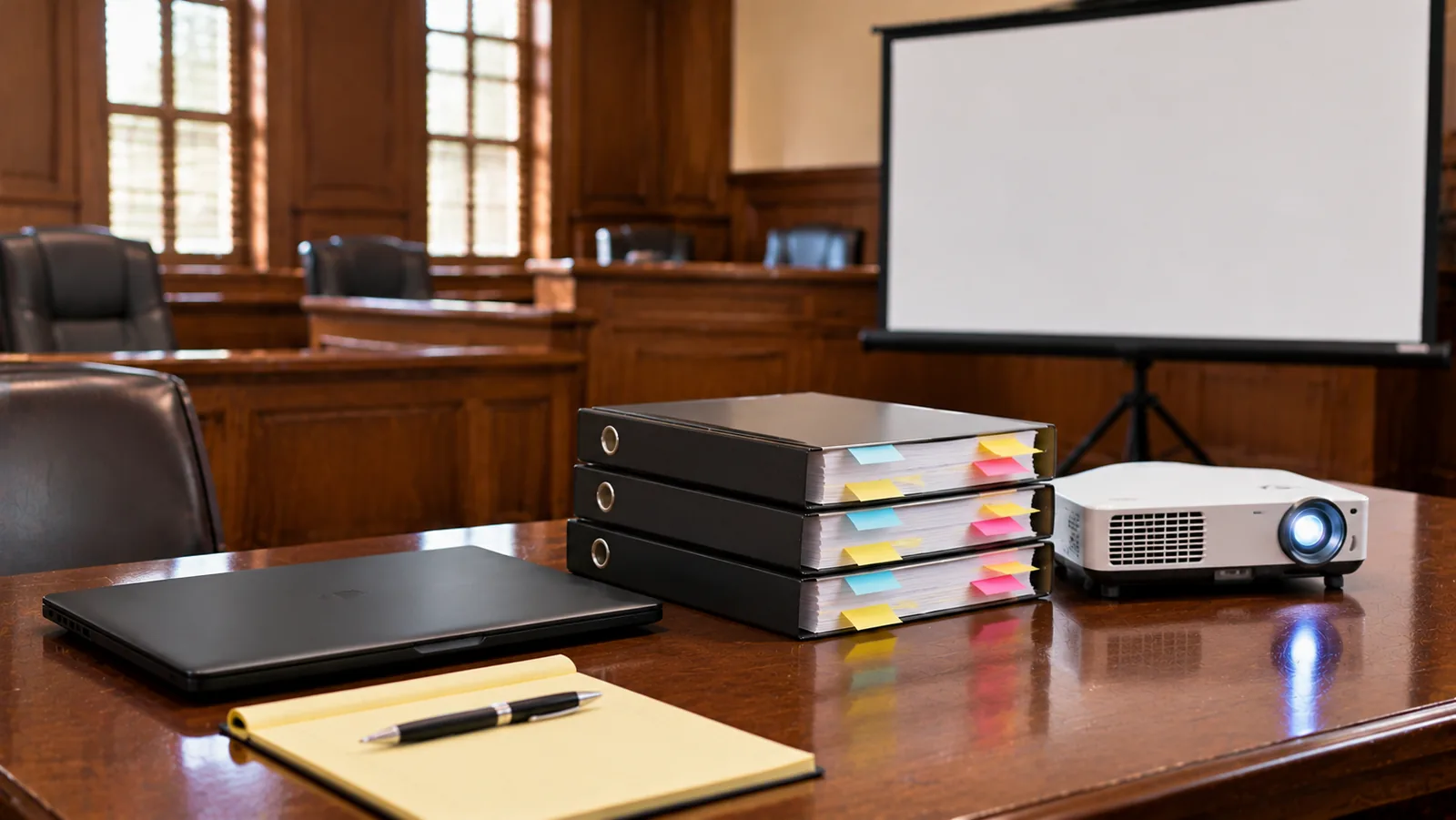
Picture the binder on counsel table. Tab 1 is the pretrial order. Tab 4 is the medical chronology. Tab 7 is the cross outline for the store manager. If a fact takes a minute to find, it's filed wrong.
Exhibit P-14 shows what one log entry looks like.
| Log field | Hypothetical entry for P-14 |
|---|---|
| Description | Still frame from the camera above the produce cooler, 2:41 p.m. |
| Source | Native video export produced by the defendant. |
| Purpose | Shows the spill's location relative to the cone. |
| Authentication | Corporate representative or stipulation. |
| Expected objection | Completeness; the defense may want the full clip. |
| Ruling needed | Pretrial ruling on admissibility of the still. |
Filling in those last three lines early keeps an exhibit from dying at the bench.
Produced isn't the same as admissible
Authentication (Rule 901), hearsay, relevance, completeness, and other rules still apply to documents that came out in discovery. The questions change with the type of exhibit.
What to answer before trial
- Store photos, for whether they fairly show the scene and what's changed since.
- Surveillance video, for its source, clock accuracy, completeness and any enhancement.
- Incident reports, for who wrote them, when and from what knowledge.
- Inspection logs, for how they were kept and whether entries were made at the time.
- Policies, for whether they're relevant (a policy alone doesn't set the legal standard).
- Medical records and images, for foundation and who will explain them.
- Bills, for which amounts were paid or incurred (Section 41.0105 stops there).
Keep the originals, since the defense and the court may want the native file. Keep demonstratives separate. Keep video clips in context, disclose clock issues, enhancement, or speed changes, test playback on the courtroom's equipment, and keep a record of exactly what the jury saw.
Deposition excerpts and the order of witnesses
Say the stocker's deposition runs 140 pages. The jury may hear four minutes of it. You pick those minutes by page and line, the defense adds its own lines for context, and the judge rules on objections before the clip plays.
| Designation problem (hypothetical) | Fix |
|---|---|
| Playing "Yes, I walked aisle 7" without "but not until after the fall." | Include both answers. |
| Reading a manager's policy description as if it were a memory of that day. | Pair it with testimony about what actually happened. |
In the produce-cooler case, Dana goes first. She was two carts back and saw the fall. The stocker who logged the 2:05 walk comes next, then the doctor, and the client last.
A week out, someone calls each witness. The stocker quit in June and moved to Shreveport. Her deposition clip is ready in case she doesn't come.
Getting witnesses ready, honestly
Before trial, show the client the empty courtroom. The instructions fit on an index card: "Answer only the question. Read the page first. If you don't know, say so."
Nobody hands her answers. At her deposition she called the floor "shiny." If she now says "a puddle," her lawyer asks what changed, because the defense will ask on cross.
Pain gets described in ordinary words with concrete limits, like carrying groceries or climbing stairs. Diagnosis belongs to the doctors.
Demonstratives, limine motions, and fights over evidence
- A layout diagram, matching the floor plan on the incident date
- A camera map, matching what each camera actually covered
- A timeline, matching video, records or medical dates
- An anatomy drawing, matching the diagnosis
- An enlargement, matching the original, unaltered
- An expense chart or summary, matching the admitted evidence
Decide whether each one is a teaching aid or substantive evidence, because the foundation may differ.
A motion in limine asks the court to deal with prejudicial or inadmissible topics before the jury hears them: unrelated old injuries, unsupported fraud accusations, insurance, irrelevant finances, improper character evidence, settlement talks, unrelated incidents, unsupported medical opinions, and suggestions that a party is rich or poor.
A limine ruling generally doesn't preserve an evidence objection by itself. If it's granted, approach the bench before the subject comes up. If the other side brings it up anyway, object right away and get a ruling. If it's denied, object when the evidence is offered.
Responses to prepare
- Qualifications, methodology and fit with the facts, for a challenge to expert reliability under Rule 702.
- Foundation, disclosure and causation support, for a challenge to the medical evidence.
- The evidence for each category and period, for a challenge to a damages category.
Say the judge keeps out the floor-walk log on day two because nobody can vouch for it. The stocker who wrote the 2:05 entry can still tell the jury what she saw. A stipulation to the entry works too.
The trial chronology
The chronology lays out events in an order the admissible evidence supports, with the source and the element for each.
A hypothetical chart:
| Event | Source (element) |
|---|---|
| She walks in | Entrance camera, register receipt time (background). |
| She heads to the department | Aisle camera (causation). |
| The condition exists or develops | Video, photos, employee testimony (condition and risk). |
| Employees inspect or pass by | Floor-walk log, video (knowledge). |
| She reaches the condition | Her testimony, video (causation). |
| She falls | Video, witnesses (causation). |
| The fall is reported | Incident report (response). |
| The store responds | Manager testimony (reasonable care). |
| Treatment begins | First-visit records (damages and causation). |
| The injury and losses develop | Treating physician, client, employer records (damages). |
Mock trials and the defense's best facts
A mock trial should lead to specific changes, not a warm feeling. Warning signs:
- Mock jurors can't explain the notice theory back.
- They doubt the link between the fall and the injury.
- They see damages with no exhibits behind them.
- They tune out the technical experts.
- They adopt the defense's explanation on their own.
- They notice the charge doesn't match the testimony.
- They call the theme exaggerated.
List the defense's best evidence and decide what to acknowledge.
- A prior back condition, which is central to medical causation but not to whether an employee saw a spill.
- The shopper looking at a shelf, which matters for proportionate responsibility but not for whether the store knew about the condition.
A bad fact usually hurts one element, not the whole case.
Jury selection in a Texas civil case
Rule 226a of the Texas Rules of Civil Procedure covers the court's admonitory instructions, and other rules govern qualifications and strikes. A juror who stocked shelves at a Super 1 Foods can still serve. Sample open-ended questions:
- "What comes to mind when you hear that someone sued a store after a fall?"
- "Who do you think is responsible for watching the floor in a grocery store?"
- "How do you judge whether someone is in pain?"
- "How would a prior back problem affect how you view a new injury?"
- "Does anyone have strong feelings about lawyers' fees?"
- "Has anyone worked in claims handling or for a large retailer?"
- "Would you expect every store to have video of every aisle?"
- "Can you decide based on what's shown in court, not what you imagine?"
- "Could you follow the court's instructions on damages even if you'd prefer a different rule?"
Can jurors decide on "more likely than not"?
Explore whether they understand the preponderance standard: deciding what's more likely true, without certainty. Don't suggest the plaintiff wins just because she got hurt, and don't imply the criminal standard applies.
What about strong assumptions?
Invite jurors to explain them. "Customers should always watch where they walk": can you still weigh what the store did? "Stores are responsible for every fall": can you follow the knowledge requirement? "A store can't prevent every accident": could you still find a failure of reasonable care if it's proved? "Someone who doesn't report right away wasn't hurt": can you consider delayed symptoms? Views on treatment gaps, degenerative findings, pain without a visible injury, paid experts, and future care get the same treatment.
What do follow-up questions sound like?
If a juror says, hypothetically, "I fell at a store once and nobody helped me," ask how that would affect them here. If a juror managed a grocery store for ten years, ask whether they'd hold either side to how their own store did things.
A challenge for cause rests on the juror's own words showing a bias that prevents fair consideration, so make the record before moving on. Be ready to explain a peremptory strike if required, and object to the other side's strike on time. Peremptory challenges can't be used on constitutionally impermissible discriminatory grounds.
| Improper commitment question | Proper alternative |
|---|---|
| "Will you promise to award money if she proves she fell?" | "Can you consider all the damages categories the court gives you?" |
| "Will you reject the defense that she wasn't looking?" | "Can you weigh evidence about where she was looking along with everything else?" |
What the client should hear about trial
Being ready for trial can help in negotiation, but it doesn't force anyone to pay a particular amount. Even thorough preparation leaves disputed facts and an uncertain verdict. Expect waiting, and arguments outside the jury's presence. Know who'll answer your questions during trial and how settlement offers will reach you.
Motions and appeals may follow; see post-trial motions and appeals. Testimony from manager, employee, and corporate depositions may be used at trial, witness testimony, jury questions, and closing argument covers the presentation, and the Brookshire's injury claims and lawsuits guide covers investigation through appeal.
Frequently asked questions
Will every photograph be shown to the jury?
Only evidence the court admits or allows can be used. Being in a binder isn't enough.
Does preparing for trial rule out settlement?
A case can settle the week before trial, or on day two, if the client approves an acceptable agreement.
How can I get ready to attend trial?
Ask your lawyer about the schedule, interpretation, and any accommodations. Don't contact jurors, and talk with witnesses only the way your lawyer advises.
Will the lawyer tell me what to say on the stand?
Preparation covers the process and the documents. The testimony has to be your own truthful account.
Tell us about your Brookshire's injury
Aaron Herbert is Board Certified in Personal Injury Trial Law by the Texas Board of Legal Specialization. That's not a promise about any result. Ask any lawyer how they'd sequence witnesses, explain uncertain timing, present losses without duplication, and what the trial plan needs, costs, and risks; get engagement, scope, and fees in writing from The Law Firm of Aaron A. Herbert, P.C. before work begins.
Got the receipt, the photos, and the names? Tell us about your Brookshire's injury or call (214) 200-4878. The office is on the LBJ Freeway in Dallas, at 8330 Lyndon B. Johnson Freeway, Suite 700, 75243. Calling doesn't make us your lawyers; representation, scope, and fees get confirmed in writing first, and no result is guaranteed.
Related pages on Brookshire's injuries
- Texas Brookshire's Grocery Company injury knowledge hub: every guide in one place.
- Brookshire's injury claims and lawsuits in Texas: the full lawsuit.
- Store manager, employee, and corporate depositions: designations.
- Witness testimony, jury questions, and closing argument: the charge at trial.
- Post-trial motions and appeals: after the verdict.
- Texas retail and grocery store injury lawyer: the firm's statewide store-injury page.
Sources
- Texas Rules of Civil Procedure, as amended October 1, 2026, Rule 226.
- Texas Rules of Evidence, amendments effective July 2, 2026, Rules 401.
- Texas Civil Practice and Remedies Code, Chapter 41, Section 41.0105.
- Texas Judicial Branch, rules and standards.
- Texas Board of Legal Specialization profile, Aaron Alan Herbert.
- State Bar of Texas profile, Aaron Alan Herbert, State Bar No. 24036761.
We checked these sources on November 2, 2026. The Law Firm of Aaron A. Herbert, P.C. has no tie to Brookshire Grocery Company. It has no tie to Brookshire Brothers, Ltd., either. Neither company sponsors or endorses this page. This page is general information. Your own facts, the law, and any court orders decide your case.

ABOUT THE ATTORNEY
Aaron A. Herbert
Founding Attorney
Board Certified in Personal Injury Trial Law
Aaron founded The Law Firm of Aaron A. Herbert in 2010 to focus on developing each client's case and seeking its maximum value. For over a decade, he has represented people seriously injured in major accidents and industrial catastrophes, pursuing trial verdicts and settlements while working to reduce the stress of litigation.
Education
- Texas A&M University · B.S., Criminal Justice, 1999
- University of Oklahoma College of Law · J.D., 2002; graduated in the top of his class
Trial experience & approach
Aaron earned numerous jury verdicts at boutique personal injury litigation firms. According to his biography, he spent a year as the top-earning litigation attorney at a firm that frequently appeared in verdict searches as having one of the highest numbers of trial wins in Texas. At another Dallas personal injury firm, he moved from managing pre-litigation attorney to managing litigation attorney over seven years as the firm grew into one of Dallas's largest personal injury firms.
His biography describes a reputation as one of America's most aggressive trial lawyers, with noteworthy recoveries from judges and juries and substantial pretrial settlements. Most of those settlements included confidentiality agreements requested by the defense. Aaron has said the recoveries were justified by the injuries and losses involved, which no amount of money could make someone choose to experience.
His approach combines passion, preparation, persistence and courtroom imagination. He believes a well-supported, engaged and motivated team working cooperatively helps deliver strong representation, with the goal of achieving the best possible result for every client.
Dallas roots, military service & publication
Born and raised in Dallas, Aaron enlisted in the United States Marine Corps after high school and later received an Honorable Discharge. He completed his university and law degrees after his military service and became a lifelong Sooners football fan in law school.
Publication: “Litigating Dog Bite Cases,” Texas Dog Law Seminar, Dallas, 2009.
Professional affiliations & recognition
Professional affiliations and recognition listed in Aaron’s biography:
- State Bar of Texas
- American Bar Association
- Association of Trial Lawyers of America (now American Association for Justice)
- Texas Trial Lawyers Association
- Dallas Trial Lawyers Association
- Dallas Bar Association
- Tarrant County Bar Association
- Million Dollar Advocates Forum
- The National Trial Lawyers – Top 100 Trial Lawyers