Eight months into a lawsuit over a fall by the ice machine at a Super 1 Foods, the store files a motion. It says there's no evidence it knew about the water. You have 21 days.
A grocery injury lawsuit against Brookshire Grocery Company (BGC) can end right there, before any jury sees it. That's why getting ready for summary judgment starts during the investigation, not the week the motion shows up.
| A response must | What won't work |
|---|---|
| Identify admissible proof for each challenged element. | Insisting the injury deserves a jury trial. |
| Connect that proof to the grounds the motion actually raised. | A strong argument on an issue the motion didn't raise. |
| Follow the current version of Texas Rule of Civil Procedure 166a. | A form copied from an older case. |
BGC is the Tyler, Texas grocer whose stores operate under Brookshire's, Super 1 Foods, Spring Market, FRESH by Brookshire's, Reasor's, and FRESH by Reasor's. These are general legal points; every motion is decided on its own record, rule version, and court orders. The examples are hypothetical and don't describe a real BGC motion or any firm result.
What the store usually argues
Summary judgment can knock out claims, defenses, or parties. In a Texas grocery case, the store usually says one element can't be proved, and the motion's own wording tells you which.
| Store argument | What it claims | How it might read (hypothetical) |
|---|---|---|
| No knowledge | Nothing shows the store knew or should have known. | "No evidence BGC knew or should have known of the water." |
| No duty | The store didn't control the area, or owed no duty for this condition. | "A contractor controlled the floor-care work." |
| No unreasonable risk | The condition wasn't unreasonably dangerous. | "A small, flat mat edge isn't unreasonably dangerous." |
| No reasonable-care breach | The store did what was reasonable. | "The store placed a warning cone." |
| No causation | The condition didn't cause the fall, or the fall didn't cause the injuries. | "Her knee condition predates the fall." |
| No recoverable damages | The losses aren't legally recoverable or weren't proved. | "No evidence the charges were paid or incurred." |
Video gets recorded over and memories fade, so the work starts early. Aim written discovery at the elements most likely to be attacked, and build the record with deposition questions. The written discovery guide for Brookshire's injury lawsuits covers the records a response needs.
Three BGC cases, three elements
These are other people's cases, not firm results.
Bowman: the Bullard exit mat
In Bowman v. Brookshire Grocery Co., 317 S.W.3d 500 (Tex. App.—Tyler 2010), a shopper tripped on a "ruffled" exit-mat edge. The shopper offered 118 mat-related reports from 75 other Brookshire stores over four years. They didn't show actual knowledge at Bullard, nothing showed how long the ruffle existed, and the no-evidence summary judgment for the store was affirmed.
Taylor: melted ice by the drink dispenser
In Brookshire Grocery Co. v. Taylor, 222 S.W.3d 406 (Tex. 2006), the hazard was partially melted ice in front of a self-service soft drink dispenser. The dispenser wasn't an unreasonably dangerous condition; the ice was, and nobody could show how long it had been there. The Texas Supreme Court reversed and rendered that the shopper take nothing.
Dimmitt: the contractor's scrubber in Comanche
In Dimmitt v. Brookshire Grocery Co., No. 11-12-00129-CV (Tex. App.—Eastland June 26, 2014) (mem. op.), a contractor's scrubber left extra water at the aisle ends. The store kept control and still owed the invitee duty, and a general warning was some evidence, but not conclusive evidence, of an adequate warning. The traditional summary judgments were reversed and remanded. That wasn't a damages award.
Other-store proof hits the same wall Bowman did. A torn-mat report from a BGC store in Longview may show the company knew mats can fail. It doesn't show anyone knew about the mat at this exit.
The same goes for a photo taken after the fall. It shows the condition, not when it formed.
The rule changed on March 1, 2026
The Rule 166a in older opinions isn't the one that governs a motion filed this spring. The Supreme Court of Texas rewrote it effective March 1, 2026, in Misc. Docket No. 26-9012.
The rewrite covers motions filed on or after that date. Apart from the deadlines, it isn't meant to change the law. So an older opinion's holding still counts, even when its subsection labels and day counts don't.
Before counting any days, pull four things: the operative rule and its transition provisions, the local rules and standing orders for that court (Dallas and other counties issued their own), the scheduling order, and the docket's filing date and certificate of service.
| Read the motion for | In the ice-machine motion (hypothetical) |
|---|---|
| Who moved | The operating company |
| Which claim | Premises liability only, not negligent activity |
| Which element | Actual or constructive knowledge |
| What evidence | One inspection-log page and a manager's declaration |
| What relief | Take nothing on the premises claim |
What's a traditional motion?
It falls under Rule 166a(a)(1), (b)(2)(C), and (h)(2). The store has to state specific grounds and produce its own evidence.
What's a no-evidence motion?
It falls under Rule 166a(a)(2), (b)(2)(D), and (h)(3). The store files after adequate time for discovery and names the elements it's challenging. The court must grant it unless the response produces evidence raising a genuine issue of material fact.
Both kinds have to carry the titles Rule 166a(b)(2) requires. A combined motion may need a separate answer to each ground.
On a no-evidence ground, Texas courts have long asked for more than a scintilla of probative evidence on each challenged element. Speculation and conclusions don't count.
The deadlines in one place
- The response is due within 21 days after the motion is filed, unless the court grants leave or the parties agree (Rule 166a(d)(1)).
- More time to get evidence takes an affidavit or declaration explaining why the evidence can't yet be presented (Rule 166a(d)(3)).
- The reply is due within 7 days after the response, with no new grounds (Rule 166a(e)).
- The hearing or submission can't come within 35 days after filing; it's generally within 60 days, up to 90 in listed situations (Rule 166a(g)(1)).
- A signed written ruling comes within 90 days after the hearing or submission (Rule 166a(i)).
- Evidence and affidavit form are governed by Rule 166a(j).
- Form defects in affidavits aren't grounds for reversal unless specifically pointed out by objection with an opportunity, but refusal, to amend (Rule 166a(j)(4)).
A hypothetical calendar, which you'd check against the real orders:
- April 1: the store files its motion.
- April 22: your response is due.
- April 29: the reply is due, if your response went in April 22.
- Early May: the 35-day period ends, and the earliest hearing or submission comes after it.
Which element, which evidence
The exact elements depend on the person's status, the claim, the store's relationship to the premises, and the facts. A premises-condition claim and a negligent-activity claim have different elements. Control decides who owes the duty, as in Dimmitt, and a store isn't an insurer of its customers' safety.
The chart for the ice-machine case:
| Element | Evidence (hypothetical) | Foundation |
|---|---|---|
| Constructive knowledge | A witness saw the same liquid in aisle 9 about 12 minutes before the fall (deposition pages 31 to 34). | Personal knowledge; timing anchored to a register receipt. |
| Unreasonable risk | Photos of clear liquid on smooth tile. | Authenticated by the photographer. |
| Reasonable care | The manager admits no cone was placed (deposition page 52). | Party testimony. |
| Causation | The treating physician's causation opinion. | Qualifications and reliability under Tex. R. Evid. 702. |
Cite exact pages, like deposition pages 31 to 34. Pointing at a whole deposition can hide a gap.
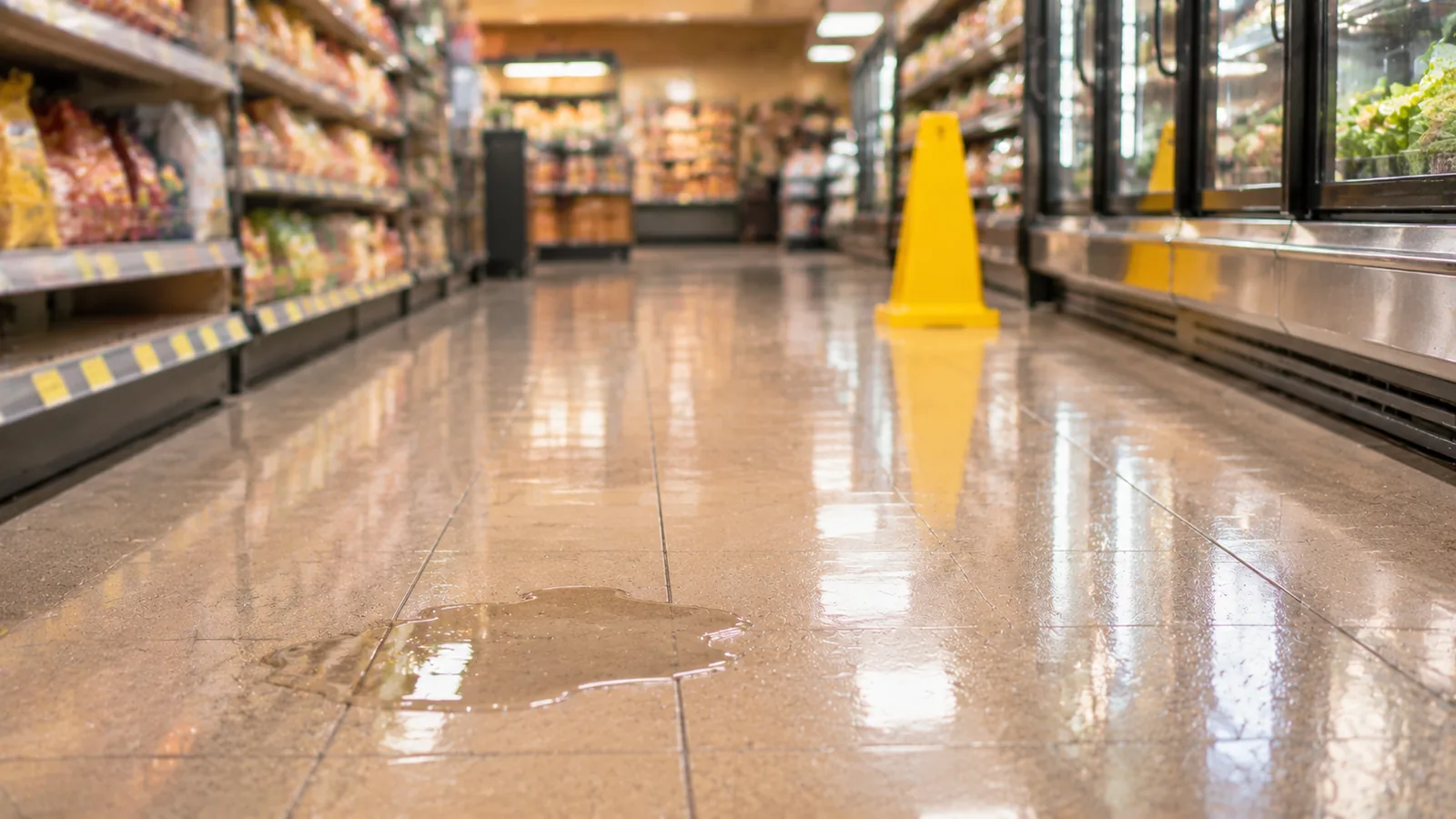
How long was it there? Peterson, Reece, and Gonzalez
Constructive knowledge usually turns on whether the store had a reasonable chance to find the hazard. That takes some evidence of how long it existed.
In H-E-B, LP v. Peterson, No. 24-0310 (Tex. Apr. 10, 2026), a shopper slipped on a clear puddle in a toy aisle. The Texas Supreme Court held that a party answering a no-evidence motion has to produce some evidence of how long the condition existed to raise a fact issue on constructive notice at the time and place of injury. It reinstated summary judgment for the grocer.
Wal-Mart Stores, Inc. v. Reece, 81 S.W.3d 812 (Tex. 2002), set the time-notice rule: an employee's proximity to a hazard, without more, isn't enough. Wal-Mart Stores, Inc. v. Gonzalez, 968 S.W.2d 934 (Tex. 1998), is a companion case; the evidence about the condition has to support a reasonable inference of how long it was there.
| Evidence | What Peterson says it shows |
|---|---|
| Rain, a drip from a rafter, and puddle size | Cause, not duration. |
| Earlier roof leaks elsewhere in the store | Not notice of this puddle at this time and place. |
| An internal inspection policy | It doesn't impose a higher standard of care. |
Aldridge isn't a Brookshire's case
Brookshire Bros., Ltd. v. Aldridge, 438 S.W.3d 9 (Tex. 2014), involved Brookshire Brothers, a separate Lufkin company. It's mainly a spoliation decision. The trial court decides whether spoliation happened and what remedy fits, and an instruction is reserved for intentional spoliation or negligent loss that irreparably deprived the party of any meaningful ability to present its case.
In Aldridge, a customer slipped on grease from a rotisserie-chicken container, and about eight minutes of video survived. Peterson later read it as employees passing a large grease spill again and again in the five minutes before the fall. That's some evidence of constructive knowledge, so the case still comes up on notice.
Building the timeline
Every entry needs a time and a source: a sweep log, a video stamp, a service ticket, a witness who checked her phone.
The evidence has to be about the same condition in the same place, and it has to fit the theory that was pleaded. Something on the floor at the moment of the fall, by itself, generally won't prove constructive knowledge.
| Weak | Stronger (hypothetical) |
|---|---|
| "The store must have known." | "Witness A saw the water at 3:12 p.m.; the fall was at 3:24 p.m.; video shows two employees in the aisle at 3:16 p.m." |
| "Someone at the store knew." | A cashier radioed about the spill 15 minutes before the fall (actual notice). |
| "It had been there a while." | Video shows the puddle in place for 25 minutes (constructive notice). |
The guide to store notice in a Brookshire's slip and fall covers both theories.
Evidence that counts, and evidence that doesn't
Start with two pieces: the last inspection before the fall and the video from the cameras over that aisle.
- Surveillance video, for timing, employee traffic and the condition itself.
- Employee and corporate-representative testimony, for what the store saw, heard or did.
- Inspection, incident and maintenance records, for the last walk-through, the report and the repair history.
- Earlier complaints, where admissible, for a recurring problem at the same spot.
- Experts, when appropriate, for floor friction, lighting or biomechanics.
- Medical records and causation opinions, for the link from the fall to the injury.
A lawyer's summary of what a witness will say shows nothing; use the signed declaration or deposition excerpt. An earlier summary, an unauthenticated screenshot or a paraphrase shows nothing until the underlying exhibit comes in.
"The store should have known" is a conclusion. "I saw water by the ice machine at 3:12" is a fact, and Rule 166a(j) wants facts from personal knowledge.
If the declaration estimates time, it should say what the estimate rests on. If it repeats someone else's report, deal with the hearsay.
Don't put words in a witness's mouth
| Witness says | Don't turn it into | Do |
|---|---|---|
| "The floor was wet for a while." | "Exactly 25 minutes." | Ask what events anchor the estimate and preserve the uncertainty. |
| "It was the aisle by the bakery." | An aisle number the witness never gave. | Use photos or diagrams to clarify, without suggesting the answer. |
A careful, qualified statement can beat a precise one that falls apart. The testimony has to be the witness's own. A deposition may work better for a hostile witness or a complicated topic, and a business record may answer a question better than memory.
What if key evidence isn't in yet?
Say the produce-aisle video still hasn't come in by the response date. Rule 166a(d)(3) calls for an affidavit or declaration explaining why it can't be presented yet.
An unanswered request doesn't delay the ruling on its own. Get the court to rule on the request, and keep working toward the deadline.
Answering a no-evidence motion
Work through the motion one element at a time.
- Name the element the way the motion does; the hypothetical ice-machine motion says "No evidence BGC knew or should have known of the water."
- Answer what's actually argued, here knowledge rather than how bad the injury is.
- Cite the evidence by page, such as deposition pages 31 to 34.
- Show it's admissible, here through personal knowledge with timing anchored to a receipt.
- Explain the genuine issue, here water seen in the same aisle 12 minutes earlier.
- Address the notice cases: Peterson, Reece and Gonzalez.
- Ask for denial on the knowledge ground.
Post-fall photos prove the condition, not how long it was there. A repair invoice from the bakery is a different problem in a different place. The witness who saw water 12 minutes earlier may prove duration, if her timing holds up.
Answering a traditional motion
Here the store carries the load. It has to state specific grounds and prove them.
Did it actually establish its right to judgment? Do its exhibits back the facts in its brief? Does your evidence create a real dispute? And is it really a no-evidence motion wearing a traditional label?
| Store exhibit (hypothetical) | Question to ask |
|---|---|
| An inspection entry for aisle 9 at 3:00 p.m. | Is it generic, or is the location unclear? Prove it with competent evidence. |
| A manager's declaration that "the floor was checked" | Who checked, when, and how does the manager know? |
| "An employee knew of the spill" | Did that employee see it, hear about it, or help cause it? |
Objections, filing, and the hearing
Most objections have a known cure.
- Hearsay, cured by an exception or a witness with personal knowledge.
- Authentication, cured by a custodian's or witness's declaration.
- No personal knowledge, cured by a witness who has it.
- Expert reliability, cured by qualifications and method under Tex. R. Evid. 702.
- A form defect in an affidavit, which under Rule 166a(j)(4) isn't grounds for reversal unless an objection pointed it out and the other side refused a chance to amend.
- Any objection at all, which has to be specific, on time and ruled on; filing alone doesn't preserve it.
Before you file, open every exhibit in the filed copy. Check the certificate of service against what really happened, have any proposed order ready, and make sure the response was actually filed, not just saved. An appeals court sees only the record.
There's no live testimony at a summary judgment hearing. Answer an admissibility question with the foundation and the rule, and answer a gap question by pointing to the timing evidence by page.
After the ruling
| After the ruling, get | Why |
|---|---|
| The signed written order | A comment from the bench may not settle finality or start every deadline. |
| The list of claims and parties left | If the premises claim goes but negligent activity stays, the charge plan, discovery, and settlement value all change. |
| The post-judgment and appeal dates | They may already be running. |
A denial sends the disputed issues forward. It isn't a verdict for the plaintiff. If the motion is granted in full, look at finality, post-judgment remedies, and appeal right away; see the guide to post-trial motions and appeals in a Brookshire's case. The full timeline is in the guide to Brookshire's injury claims and lawsuits in Texas.
Frequently asked questions
Can the judge decide my case without hearing me testify live?
The judge can, on the grounds raised. Your testimony comes in written form, like a deposition excerpt or a declaration.
Does a denial mean I'll win at trial?
A denial leaves the disputed issues for later. Trial burdens, admissibility, credibility, and new evidence still matter.
Should my response include every document in the file?
Include the evidence that answers the challenged grounds, with exact exhibit references, and leave the rest of the file out.
Can I appeal right away if the motion is granted?
It depends on the signed order and the law. Some rulings decide only part of a case.
What should I ask after the court rules?
Ask for the actual order, which claims and parties are left, what deadlines follow, and what the ruling changes about trial or settlement.
Is Brookshire Bros., Ltd. v. Aldridge a Brookshire's case?
It involved Brookshire Brothers, a separate company, and its main holding is about spoliation.
Tell us about your Brookshire's injury
Aaron Herbert is Board Certified in Personal Injury Trial Law by the Texas Board of Legal Specialization; you can check it on the Texas Board of Legal Specialization profile. That's not a promise about any result. Ask any lawyer how they prepare for dispositive motions from day one, what notice evidence they'd use, how they track the current Rule 166a deadlines and local orders, and whether they'll tell you about a gap that could limit your claim; confirm engagement, scope, and fees in writing.
Got the receipt, the photos, and the names? Tell us about your Brookshire's injury or call (214) 200-4878. The office is on the LBJ Freeway in Dallas, at 8330 Lyndon B. Johnson Freeway, Suite 700, 75243. Calling doesn't make us your lawyers; representation, scope, and fees get confirmed in writing first, and no result is guaranteed.
Related pages on Brookshire's injuries
- Texas Brookshire's grocery injury knowledge hub: every guide in one place.
- Brookshire's injury claims and lawsuits in Texas: the full case.
- Proving store notice in a Brookshire's slip and fall: duration evidence.
- Written discovery in a Brookshire's injury lawsuit: building the record.
- Post-trial motions, appeals, and protecting a judgment: after a ruling.
- Fort Worth retail and grocery store injury lawyer: the firm's Fort Worth store-injury page.
Sources
- Supreme Court of Texas, Misc. Docket No. 26-9012.
- Texas Rules of Civil Procedure, as amended October 1, 2026, Rule 166.
- H-E-B, LP v. Peterson, No. 24-0310 (Tex. Apr. 10, 2026).
- Wal-Mart Stores, Inc. v. Reece, 81 S.W.3d 812 (Tex. 2002).
- Wal-Mart Stores, Inc. v. Gonzalez, 968 S.W.2d 934 (Tex. 1998).
- Brookshire Bros., Ltd. v. Aldridge, 438 S.W.3d 9 (Tex. 2014).
- Bowman v. Brookshire Grocery Co., 317 S.W.3d 500 (Tex. App.—Tyler 2010).
- Brookshire Grocery Co. v. Taylor, 222 S.W.3d 406 (Tex. 2006).
- Texas Rules of Evidence, amendments effective July 2, 2026, Rule 702.
- Texas Judicial Branch, rules and standards.
We checked these sources on November 2, 2026. The Law Firm of Aaron A. Herbert, P.C. has no tie to Brookshire Grocery Company. It has no tie to Brookshire Brothers, Ltd., either. Neither company sponsors or endorses this page. This page is general information. Your own facts, the law, and any court orders decide your case.

ABOUT THE ATTORNEY
Aaron A. Herbert
Founding Attorney
Board Certified in Personal Injury Trial Law
Aaron founded The Law Firm of Aaron A. Herbert in 2010 to focus on developing each client's case and seeking its maximum value. For over a decade, he has represented people seriously injured in major accidents and industrial catastrophes, pursuing trial verdicts and settlements while working to reduce the stress of litigation.
Education
- Texas A&M University · B.S., Criminal Justice, 1999
- University of Oklahoma College of Law · J.D., 2002; graduated in the top of his class
Trial experience & approach
Aaron earned numerous jury verdicts at boutique personal injury litigation firms. According to his biography, he spent a year as the top-earning litigation attorney at a firm that frequently appeared in verdict searches as having one of the highest numbers of trial wins in Texas. At another Dallas personal injury firm, he moved from managing pre-litigation attorney to managing litigation attorney over seven years as the firm grew into one of Dallas's largest personal injury firms.
His biography describes a reputation as one of America's most aggressive trial lawyers, with noteworthy recoveries from judges and juries and substantial pretrial settlements. Most of those settlements included confidentiality agreements requested by the defense. Aaron has said the recoveries were justified by the injuries and losses involved, which no amount of money could make someone choose to experience.
His approach combines passion, preparation, persistence and courtroom imagination. He believes a well-supported, engaged and motivated team working cooperatively helps deliver strong representation, with the goal of achieving the best possible result for every client.
Dallas roots, military service & publication
Born and raised in Dallas, Aaron enlisted in the United States Marine Corps after high school and later received an Honorable Discharge. He completed his university and law degrees after his military service and became a lifelong Sooners football fan in law school.
Publication: “Litigating Dog Bite Cases,” Texas Dog Law Seminar, Dallas, 2009.
Professional affiliations & recognition
Professional affiliations and recognition listed in Aaron’s biography:
- State Bar of Texas
- American Bar Association
- Association of Trial Lawyers of America (now American Association for Justice)
- Texas Trial Lawyers Association
- Dallas Trial Lawyers Association
- Dallas Bar Association
- Tarrant County Bar Association
- Million Dollar Advocates Forum
- The National Trial Lawyers – Top 100 Trial Lawyers