
In the first 72 hours after an injury at a Brookshire's store, get medical care, report the fall to the manager, and photograph the scene if you can do it safely. That night, write down what happened and start one folder for every receipt and paper. Over the next two days, gather your medical records, log each call, and talk with a lawyer before store video is recorded over.
It's 4:40 on a Saturday afternoon at a Brookshire's, in the example this page follows. You turn into the dairy aisle with a basket on one arm, your heel hits a clear puddle in front of the yogurt case, and you're on the tile before you can grab anything.
Your wrist is throbbing and your jeans are soaked. A stocker runs for a mop. Somebody asks if you're okay. What do you do first?
| When | What gets done |
|---|---|
| Saturday, before you leave | Urgent care or the ER, a report to the manager, photos if you can stand. |
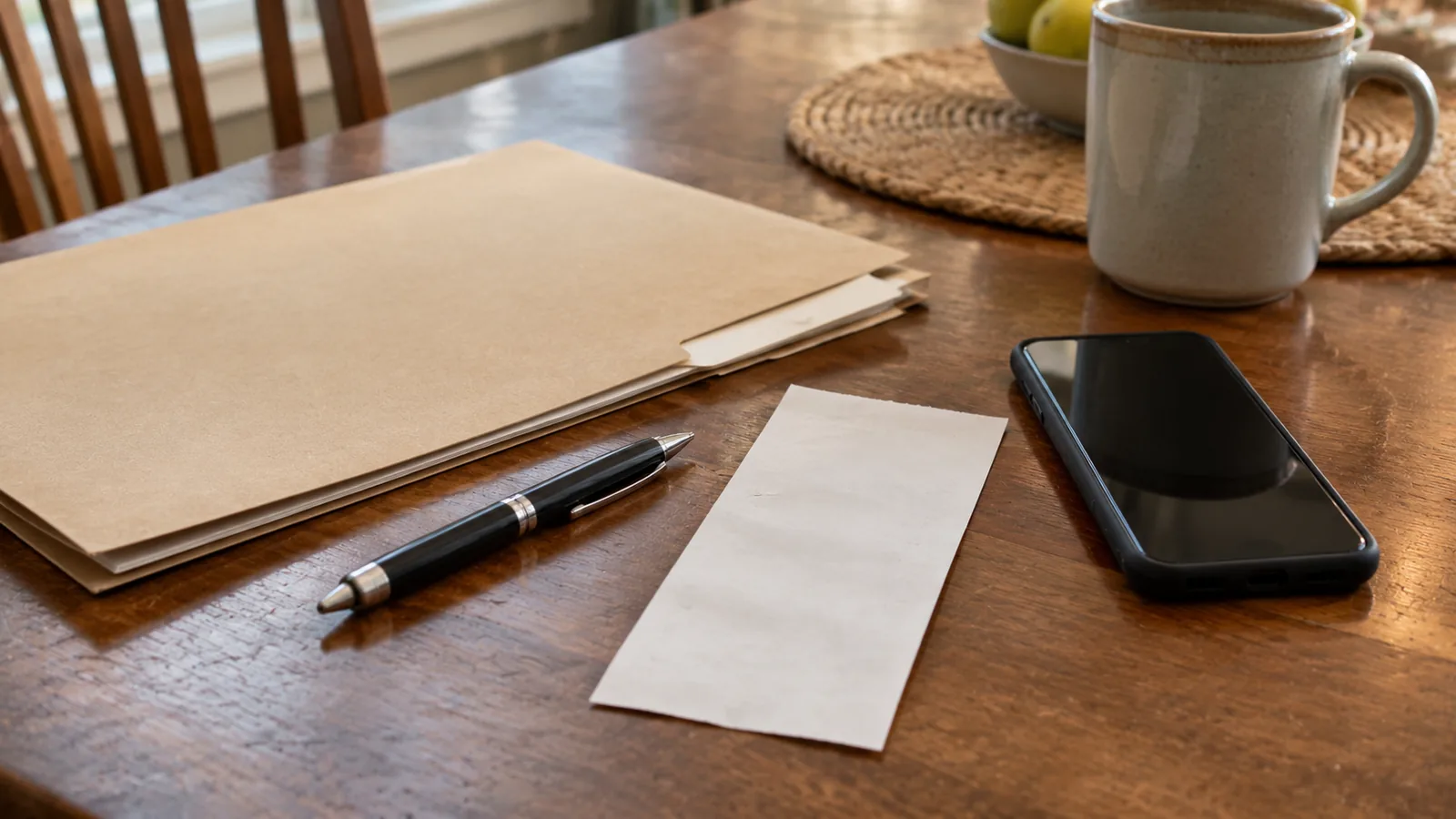
| Saturday night | A written account at the kitchen table, and one folder for every receipt and paper. |
| Sunday and Monday | Medical records, a call log, and a talk with a lawyer. |
Why the rush? Stores record over video, and the mop is already on its way. But 72 hours isn't a filing deadline. Texas law sets that separately, and nobody can promise the video or the witnesses will still be around on Monday.
The times, aisles, and people in this page's examples are hypothetical. None of it describes a real incident at a store run by Brookshire Grocery Company (BGC), and nothing here says a Brookshire's store violated a duty.
Hurt at a Brookshire's store? Tell us about your Brookshire's injury or call (214) 200-4878. Have the store address, the date, what happened, your photos, witness names, and your medical providers handy. Contacting the firm doesn't create an attorney-client relationship.
Before you leave the parking lot
BGC runs six banners: Brookshire's, Super 1 Foods, Spring Market, FRESH by Brookshire's, Reasor's, and FRESH by Reasor's. "The grocery store on Main" tells a lawyer nothing about where to send a preservation letter.
Grab a pen and write four things on the back of your receipt:
- The banner on the sign over the door.
- The street address and city.
- The store number, if the receipt shows one.
- The exact spot, like "dairy aisle, in front of the yogurt case."
Does it matter where in the store you fell?
It does. A fall by the coffee station raises different questions than a fall in the parking lot.
- An aisle or service counter, which the operator usually controls, though the evidence still has to show that.
- A self-service drink or coffee station, for equipment and refill records.
- An entrance or exit, for mats, doors and rain tracked in from outside.
- A curbside pickup lane, where a different team or contractor may handle the space.
- The lot or sidewalk, which may point to an owner, a landlord or a contractor.
Whatever spot you write down tells your lawyer whose records to ask for first.
What does the receipt prove?
Less than people think. Your sister's deli receipt from the FRESH by Brookshire's reads 4:52 p.m., but she paid while you were still in the cereal aisle. It shows when she stood at the register, not when you fell. The ceiling camera might read 4:47, and the woman who helped you up might say "right before five." All three go in the folder.
Should you get up off the floor?
Six people are watching, and a clerk is already holding a mop. If your hip screams when you shift, ask for an ambulance anyway.
| On the floor | What to do |
|---|---|
| Moving hurts | Stay put until it doesn't. |
| The paramedic asks how you are | Name the parts: "right wrist and left hip," not "I'm fine." |
| Your sister is standing there | Hand her your phone for photos and names. |
| The manager walks up | Give her the time, the yogurt case, and the puddle you saw. |
| She starts a report | Get her name and the incident number, even if they go on your hand. |
The manager asks how long the puddle was there. You have no idea, so that's what you tell her: "I don't know." Her report only proves you told the store about the fall. A guess in it, though, can follow you for two years.
Four photos from four distances
A close-up of a puddle can miss the shelf that was hiding the warning cone. So step back and shoot the scene four ways.
- An overall shot from the end cap, such as one of the whole dairy aisle and its surroundings.
- An approach shot from the bread aisle, such as what a shopper could see walking toward the milk case.
- A close-up, such as a streak of milky liquid with a cart track through it.
- The warnings, such as a yellow cone behind a stack of cases at the far end.
Your cousin texts you her photos that night. Ask her to keep the originals on her phone too, because a forwarded copy can lose the time stamp.
Then look up and around. What's within ten feet of the puddle?
| Within ten feet | Why a lawyer would ask |
|---|---|
| A refrigerated case | It might be leaking, or a carton got dropped in front of it. |
| Produce misters | They spray onto the floor. |
| The meat or deli counter | Grease and ice end up underfoot. |
| A floor drain or mat | Water pools there. |
| A stocker two aisles over | He may have seen something, or never looked down. |
None of that proves anything yet. Even the cone in your cousin's photo might have shown up after you fell.
Saturday night at the kitchen table
By Sunday you'll remember the fall a little differently, so write it down Saturday night. Split it four ways:
| Part of the account | Sample entry (hypothetical) |
|---|---|
| Before the fall | "I was looking at the yogurt shelf and didn't see anything on the floor." |
| Right after | "My jeans were wet, and there was a clear puddle about two feet wide." |
| What others told me | "A shopper said she'd almost slipped there a few minutes earlier." |
| What I'm not sure of | "I don't remember whether a cone was visible." |
If you later piece together what probably happened, label it that way. It shouldn't slowly turn into something you claim to have seen.
Start one folder for the physical stuff:
- The receipt and the card or app payment record.
- Any letter or email from the store, kept as it came.
- The shoes and clothes you had on, unwashed, until you've asked a lawyer about keeping them.
- Anything with a safety or sanitation problem. Ask how to preserve it, and don't collect hazardous material yourself.
Read next: Preserving store video and digital evidence, on asking for footage and original files before they're gone.
Each witness saw a different piece
The woman who watched you fall probably didn't walk that aisle ten minutes earlier. The man who did may not have seen you fall at all. That's why every name is worth getting.
| Witness (hypothetical) | What they might know | What they might not know |
|---|---|---|
| A shopper who saw you fall | How your body moved. | When the spill appeared. |
| A shopper who passed the aisle earlier | That the hazard was already there. | How you fell. |
| Someone who heard an employee mention a leak | Information about a leak. | Whether it was the same time or place. |
Get a name, a phone number, and one line about what each person saw.
How should you talk to a witness?
Write down what they say in their own words. Don't tell them what you need, don't hand them a statement you typed up, and don't trade their messy, uncertain version for a cleaner summary.
What if a witness speaks Spanish?
If you or a witness would rather use another language, ask how interpretation and translated documents are handled. Note that she prefers Spanish, and write her words as she said them, with your translation beside them. If her statement is ever disputed, an independent interpreter may have to handle it instead of your nephew.
The paperwork by Monday
Monday morning, the kitchen table holds a discharge sheet, a pharmacy bag, and a referral slip. Keep all of it. If that wrist gave you trouble years ago, the orthopedist should hear about it at the first visit.
- The discharge sheet, such as "Distal radius, splint, follow up in 5 days."
- The prescription, with the pharmacy label and the date you filled it.
- The referral slip, with the orthopedist's name and appointment time.
- A work note, such as "No lifting over 10 pounds with the right hand."
- Ride receipts, such as the Uber receipt from Saturday night.
Don't pick treatment to make a claim look bigger. You want good care and an honest record. More on that in medical records, causation, and damages after a store fall.
What should a call log look like?
Keep one line per call. Here's a sample from the dairy-aisle example.
| When | Who | What they wanted | What you said |
|---|---|---|---|
| Tue 10:15 a.m. | Dana, claims office (claim number as she read it) | A recorded statement and a signed medical authorization | "I'll call back." |
What should you ask before signing or recording anything?
- How could a recorded statement be used later?
- Which records does this authorization open up, and going back how many years?
- What do I give up if I take this money and sign a release?
- Does this "assistance" payment come with terms that affect my claim?
A lawyer can read the paperwork before you decide.
A worked example in the meat aisle
Suppose a shopper falls by a refrigerated meat display. Here's what each fact does and doesn't show.
| Fact (hypothetical) | Source | What it doesn't prove by itself |
|---|---|---|
| The shopper falls at 6:10 p.m. | Her account | How long the water was there. |
| Her daughter photographs a wet area and a cone near the end of a shelf at 6:14 p.m. | Phone metadata | Where the cone stood before the fall. |
| A receipt records a transaction at 6:03 p.m. | The register | The fall time. |
| A witness says an employee walked through shortly before the fall | The witness | Whether the floor was wet then. |
None of those facts proves the store knew. Put together, they give a lawyer a to-do list:
- Get the camera views that may show when the water showed up and who walked past it.
- Check whether the camera clock and the register clock agree.
- Interview the witness and separate what she saw from what she assumed.
- Find where the water came from, if the evidence allows.
- Tie every time and movement to a record or a person.
The cone matters too. But a photo taken after employees came running may not show where it stood before she fell.
Reading this three weeks later? Don't write the claim off. Some records may still be around. The video may be gone, though, and nobody can put the floor back the way it was. Speed helps the investigation. It can't fill in a missing legal element.
The deadline that doesn't wait
Section 16.003 of the Texas Civil Practice and Remedies Code generally gives two years to sue. For a fall on March 14, 2026, the usual last day lands in March 2028. Accrual rules and exceptions can move it.
None of these stops the clock:
- Opening an insurance claim.
- Filing a store incident report.
- Talking back and forth with an adjuster.
Filing and service should be handled well before the last day, not on it.
What a lawyer looks at first
| What the lawyer asks | Why it matters |
|---|---|
| Which company runs this store, and who owns the building? | The operator, owner, or a contractor could be the defendant. |
| Did you slip, trip, or get hit by something? | Each points to different records and witnesses. |
| Was it something on the floor, or something an employee was doing? | The two theories need different proof. |
| Did anyone tell the deli clerk about the puddle at 4:30? | Knowledge needs a time on it. |
| Has anyone asked for the dairy-case footage? | It's usually the first thing to disappear. |
More on the first question is in identifying the correct Brookshire's defendant.
So the lawyer's letter to the store names this Brookshire's, the yogurt case, and Saturday at 4:40, and keeps proof it was delivered. It doesn't ask for every record from every store.
What to bring to the first meeting
Bring the folder, even if it's half empty. In the dairy-aisle example, it holds six things.
- The Brookshire's receipt, for the store, the date and a time near the fall.
- The urgent care discharge sheet, for the first medical record.
- Eleven photos on your cousin's phone, for the scene before cleanup, with time stamps.
- Two phone numbers, for the witnesses.
- Dana's voicemail, for who from the claims office is calling, and when.
- The medical form you didn't sign, for what the insurer asked for.
You don't need to know the right company name or prove anything before you call. And bring the text where you guessed at a time. An honest gap is better than a guess filled in later.
Four questions to ask any lawyer
- How would you find out what caused the hazard and how it got there?
- How would you find out what employees knew?
- Which evidence is likely to disappear first?
- What's still unknown? You want an honest list, not a number.
One person keeps the folder
When a whole family helps, things get lost. Pick one record keeper. In our hypothetical, the shopper's son takes the job.
- The folder lives in one drawer, and the originals stay in it.
- The photo log says: "Daughter's phone, six photos, 6:14 to 6:16 p.m."
- Every call to the store gets the date, the number, who answered, and what they said.
- Only the son calls the store, so nobody asks for things twice in different ways.
For each witness, write down what that person can really describe. Someone who only saw the aftermath can talk about the aftermath. They can't say when the spill started. If you only have a first name, leave it that way. Don't fill in a last name or chase someone on a hunch.
A few lines a week is plenty, but ask your lawyer first whether the other side could see it. Week three of the dairy-aisle journal:
- Monday: PT. Still can't lift the laundry basket.
- Wednesday: Kim drove me to the store.
- Thursday: PT again. Walked to the corner without the brace.
- Weekend: slept through twice.
| Work paper | Keep it because |
|---|---|
| Your supervisor's text moving you to light duty | It dates the change. |
| The pay stub where your hours dropped | It shows the money. |
| An email saying they can't work around the restriction | It explains the gap. |
Keep them as they came, and don't turn them into a claim of permanent disability.
Before you sign anything
A release can settle much more than one medical bill. Check each of these first.
- The parties released, for whether it covers more companies than the store.
- The claims covered, for claims you haven't thought about.
- The amount paid, for whether it matches what was promised.
- Reimbursement or indemnity language, for obligations it can create for you.
- The attachments, so you get the complete document, not just the signature page.
A form called "assistance" or "acknowledgment" can still carry legal terms. Don't take someone's word that a signature is just routine.
Already signed the form the adjuster mailed you? Bring it in, with the check stub if there was one. Whether it holds up takes a real look, and a lawyer can't protect what's left of your rights without seeing what you signed.
"We don't have a report on that"
You call on Tuesday and the manager says there's no report. Write down her name, the time of the call, and her exact words. Keep the receipt, and note who was standing there on Saturday.
A missing report in one system doesn't mean nothing happened. A report that does exist doesn't prove negligence. A lawyer can ask how the store makes, stores, and searches its reports.
Sorting what you know on day three
By Monday night, the dairy-aisle file sorts into three piles.
- Confirmed, such as the store address, the urgent care visit and your cousin's original photos.
- Disputed, such as where the liquid came from, where the cone stood and when the puddle formed.
- Still to do, such as the camera footage, the witness interview and the orthopedist's records.
If the store or an insurer reaches out, keep the letter or voicemail and ask for the request in writing. Be polite, but don't accept a release or guess about how you'll recover. If you've hired a lawyer, send the call to them. Read next: Brookshire's injury claims and lawsuits in Texas.
For lawyers: the first client interview
She's on her second day of pain pills, and the splint itches. When she says "I'm not sure," write "not sure." Don't fill it in for her.
When did the customer arrive, and why?
It sets the start of the visit and its purpose.
What route did they take through the store?
It traces the path to the fall and the cameras along it.
Where exactly did they fall?
Every later record has to match this spot.
What were they doing right before?
Reading a label, carrying a case of water, or pushing a cart all affect what they could see.
Did they see the condition before falling?
It goes to how open the hazard was and what the customer knew.
What hit the floor first, and was it a full fall or a partial slip?
That's the mechanism of injury.
Did anyone see it, and did an employee come over?
It names witnesses and shows how the store responded.
Was an incident report made, and did the customer leave for treatment?
It points to a document to request and starts the medical timeline.
Then sort each statement by type.
| Statement type | Sample (hypothetical) | Evidentiary significance |
|---|---|---|
| Personal observation | "I saw clear liquid on the floor after I fell." | Direct testimony about the condition. |
| Witness statement | "Another shopper told me the liquid had been there for several minutes." | A lead to that shopper, whose own testimony matters. |
| Inference | "The store must have known because an employee was nearby." | A conclusion that still needs evidence; proximity alone isn't notice. |
Only the first row is direct testimony. The other two each mean more work.
Mapping the spot and the hazard
"Near the meat department" isn't good enough. Have the client mark a store diagram by hand, and don't let them guess at distances they don't remember.
- The aisle or department.
- The nearest display or fixture.
- Any refrigerated case.
- Which way they were walking.
- Where employees were standing.
- The nearest checkout or service desk.
- Each warning sign and where it stood.
- Ceiling cameras, if they noticed any.
The follow-up questions depend on how she went down.
| Kind of fall | Questions for the client |
|---|---|
| Spill | Milky or clear? One spot, or a trail toward the case? A torn yogurt lid nearby, or cart tracks through it? A mop bucket in the next aisle? |
| Trip | Merchandise, packaging, a pallet, or a mat? Could she see it, and was it in a normal walking path? Did it come from stocking? How was the lighting? |
| Falling merchandise | What fell, and from where? Stacked, hanging, or on display? Had she or another shopper touched it? Damaged shelves, or other items badly placed? |
A big, spread-out puddle may hint at where a spill came from. It won't say how long it sat. And the notes take facts, not conclusions: "the jar was on the top shelf, at the edge, with no lip" goes in, while "the display was unreasonably dangerous" stays out.
An old break in the same wrist
Her urgent care chart mentions a 2014 skateboarding fracture, from when she was 19 (in this hypothetical). It doesn't end the claim. The orthopedist will want to know how the wrist worked on Friday and what changed after Saturday, and the claim needs competent medical evidence tying the two together.
Ask about:
- The 2014 fracture, and any surgery, since it's the same body part.
- Arthritis or other chronic conditions, which may explain some symptoms.
- Old X-rays of that wrist, for the before picture.
- Medications that affect balance or healing, which may explain the fall or the recovery.
- What she couldn't do before the fall, for the baseline.
- Every doctor since Saturday, and any later accident, for the full timeline.
Getting this right early helps the team find evidence before it's gone and keeps unsupported allegations out of the case. Big statements about liability or value can wait for the evidence.
Frequently asked questions
The manager wants the report done now. Do I stay?
Go get treated. Your sister can talk to the manager while you're at urgent care, and a report written Monday should carry Monday's date.
Does an apology prove the store was negligent?
Employees say "I'm so sorry" to anyone who falls, and courtesy isn't knowledge of a hazard. Write down who said it and the exact words anyway. "I told them that cooler was leaking" would be a very different sentence.
Can a family member request the video?
A relative can ask the store to keep relevant footage. That doesn't guarantee the store hands it over, or that anyone gets every recording right away. Nobody should pretend to be a lawyer or investigator.
What if my back only started hurting Sunday?
Then tell the doctor it started Sunday. Pain that shows up a day late doesn't prove the fall caused it, and it doesn't prove the fall didn't.
Should I post photos on social media?
Hold off on new posts until you've asked a lawyer. A splint photo captioned "that slippery store" is public and tells half the story. Old posts are different: leave them up, since deleting relevant posts can cause its own problems.
Does the business have to pay my first medical bill?
Don't assume a reported accident means automatic payment. Liability coverage, any separate medical payments coverage, and voluntary help are three different things. Ask what a payment is for, and whether signing anything gives up rights or means paying money back later.
Is a Brookshire Brothers store the same company?
Brookshire Brothers is its own company, based in Lufkin. Brookshire's stores belong to Brookshire Grocery Company in Tyler, a separate business.
Is 72 hours my deadline to file?
No court counts the 72 hours. They're about evidence: video, photos, and names. The filing deadline comes from Section 16.003 of the Civil Practice and Remedies Code, generally two years, with its own rules and exceptions.
Do I need to know which company runs the store before calling a lawyer?
Bring the receipt and the store address. Sorting out the operator, the owner, and any contractor is part of the investigation.
Tell us about your Brookshire's injury
Got the receipt, the photos, and the names? Tell us about your Brookshire's injury or call (214) 200-4878. The office is on the LBJ Freeway in Dallas, at 8330 Lyndon B. Johnson Freeway, Suite 700, 75243. Calling doesn't make us your lawyers; engagement, scope, and fees get confirmed in writing first.
Aaron Herbert is Board Certified in Personal Injury Trial Law by the Texas Board of Legal Specialization. No result is promised.
Related pages on Brookshire's injuries
- Texas Brookshire's injury knowledge hub: every guide in one place.
- Brookshire's injury claims and lawsuits in Texas: the case from investigation through appeal.
- Preserving surveillance video and digital evidence after a store injury: footage and original files.
- Identifying the correct Brookshire's business and property defendants: the operator, owner, and contractors.
- Medical records, causation, and damages after a store fall: medical proof and losses.
Sources
- Texas Civil Practice and Remedies Code, Chapter 16, Section 16.003: the two-year period.
- Texas Judicial Branch, current statewide rules: viewed November 2, 2026.
- Brookshire Grocery Company, About Us: Tyler; six banners.
- Brookshire Brothers, About Us: Lufkin; a separate company.
Sources checked November 2, 2026. The Law Firm of Aaron A. Herbert, P.C. has no tie to Brookshire Grocery Company or Brookshire Brothers, Ltd., and neither company sponsors or endorses this page. What happens in your case depends on your own facts, the law, and any court orders, so treat this page as general information.

ABOUT THE ATTORNEY
Aaron A. Herbert
Founding Attorney
Board Certified in Personal Injury Trial Law
Aaron founded The Law Firm of Aaron A. Herbert in 2010 to focus on developing each client's case and seeking its maximum value. For over a decade, he has represented people seriously injured in major accidents and industrial catastrophes, pursuing trial verdicts and settlements while working to reduce the stress of litigation.
Education
- Texas A&M University · B.S., Criminal Justice, 1999
- University of Oklahoma College of Law · J.D., 2002; graduated in the top of his class
Trial experience & approach
Aaron earned numerous jury verdicts at boutique personal injury litigation firms. According to his biography, he spent a year as the top-earning litigation attorney at a firm that frequently appeared in verdict searches as having one of the highest numbers of trial wins in Texas. At another Dallas personal injury firm, he moved from managing pre-litigation attorney to managing litigation attorney over seven years as the firm grew into one of Dallas's largest personal injury firms.
His biography describes a reputation as one of America's most aggressive trial lawyers, with noteworthy recoveries from judges and juries and substantial pretrial settlements. Most of those settlements included confidentiality agreements requested by the defense. Aaron has said the recoveries were justified by the injuries and losses involved, which no amount of money could make someone choose to experience.
His approach combines passion, preparation, persistence and courtroom imagination. He believes a well-supported, engaged and motivated team working cooperatively helps deliver strong representation, with the goal of achieving the best possible result for every client.
Dallas roots, military service & publication
Born and raised in Dallas, Aaron enlisted in the United States Marine Corps after high school and later received an Honorable Discharge. He completed his university and law degrees after his military service and became a lifelong Sooners football fan in law school.
Publication: “Litigating Dog Bite Cases,” Texas Dog Law Seminar, Dallas, 2009.
Professional affiliations & recognition
Professional affiliations and recognition listed in Aaron’s biography:
- State Bar of Texas
- American Bar Association
- Association of Trial Lawyers of America (now American Association for Justice)
- Texas Trial Lawyers Association
- Dallas Trial Lawyers Association
- Dallas Bar Association
- Tarrant County Bar Association
- Million Dollar Advocates Forum
- The National Trial Lawyers – Top 100 Trial Lawyers