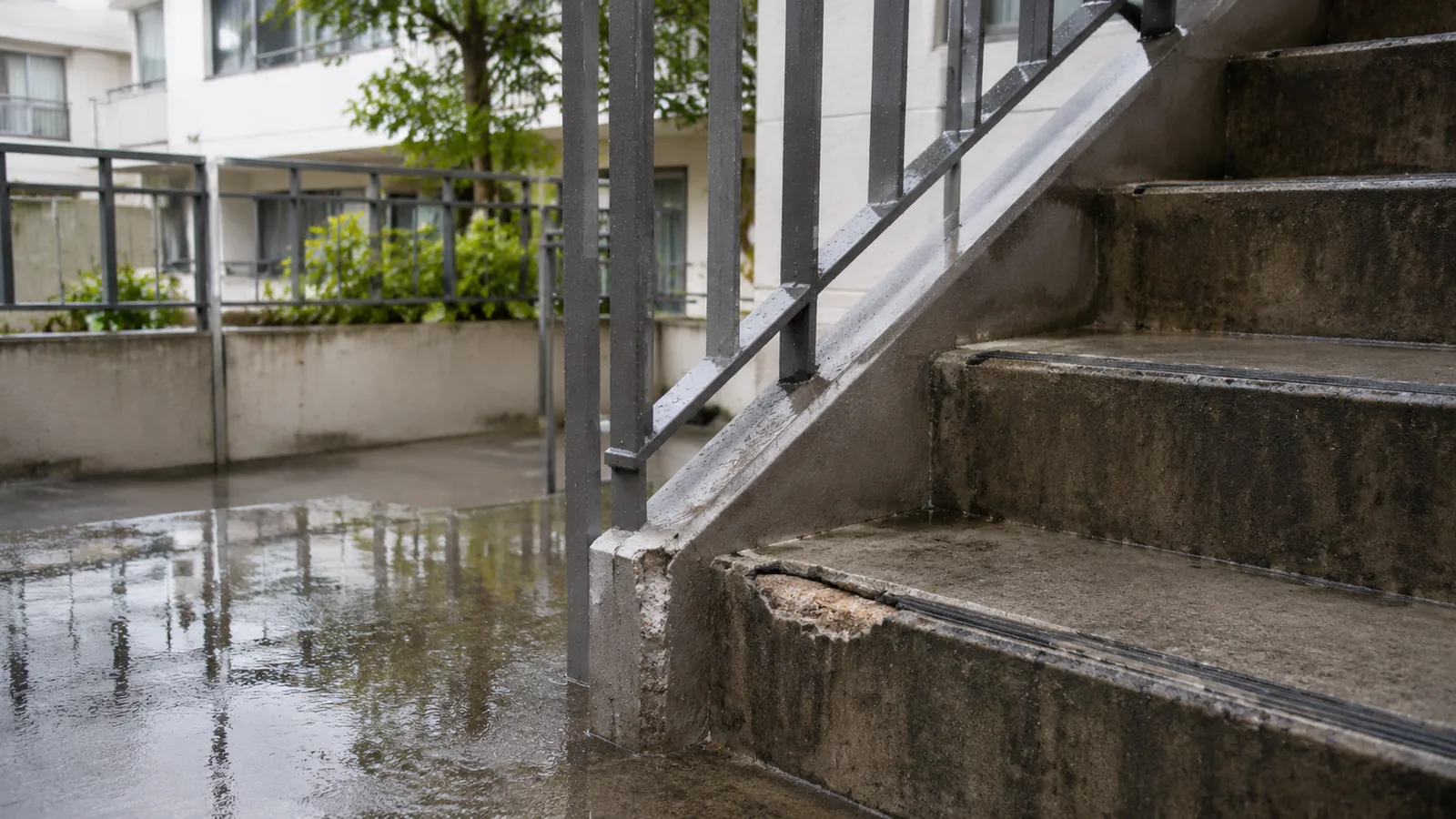
Illustration of a generic setting, not an actual property or incident.
A fall at an apartment complex can support a claim when the party responsible for the area failed to use the care the law requires and that failure caused the injury. Proof of the fall isn't enough on its own.
What the claim has to show, with a hypothetical example of each
- The exact condition, such as a loose stair nosing on the second-floor landing of Building 4.
- Who controlled it, such as common stairs the landlord kept control of [S26].
- Notice, such as a portal ticket about the nosing two weeks before the fall.
- How it caused the fall, such as your heel catching the raised edge and you falling forward.
If you were hurt on apartment stairs or a wet breezeway, tell us about your apartment injury or call (214) 200-4878.
Which conditions cause apartment falls?
Most apartment falls trace to a specific stair, walkway or drainage condition, and each one is proved differently.
What to record for each condition
- Which step, and whether it moved under your foot, for a broken tread or loose nosing.
- Where it flexed or cracked, for an unstable landing.
- Whether the rail gave way when you grabbed it, for a missing or loose handrail.
- Where the water came from and how long it had been there, for a wet breezeway.
- The height of the edge and the path you were walking, for uneven pavement or poor drainage.
- Which light was out and since when, for a dark stairwell.
A missing handrail may have a different causal role from the raised edge that caught your shoe, so keep the two separate.
Identify the mechanism and the exact location
Write down where and how you fell before memory fades: building, stair flight, landing, direction of travel and point of contact.
Question to answer | Why it matters |
|---|---|
Did a component move? | Points to a structural or repair defect. |
Did your foot slide or catch? | Separates a slick surface from a trip edge. |
Did the rail detach? | Shows a second failure that made the fall worse. |
Did you see water before the fall or only after? | Bears on notice and on your own knowledge. |
Honest uncertainty is better than a guessed explanation that later conflicts with video.
Evidence, and how to keep it
- Photos of the whole route, taken when it's safe, from the bottom and top of the stairs.
- Original files, meaning the phone originals and not only edited copies.
- Witness names, with numbers and unit numbers saved the same day.
- Shoes and clothing, stored as they are, unwashed and unrepaired.
A photo of unrelated damage elsewhere at the property may show general maintenance problems, but it doesn't prove the cause of your fall. Measurements and testing should be done carefully, with permission and documentation.
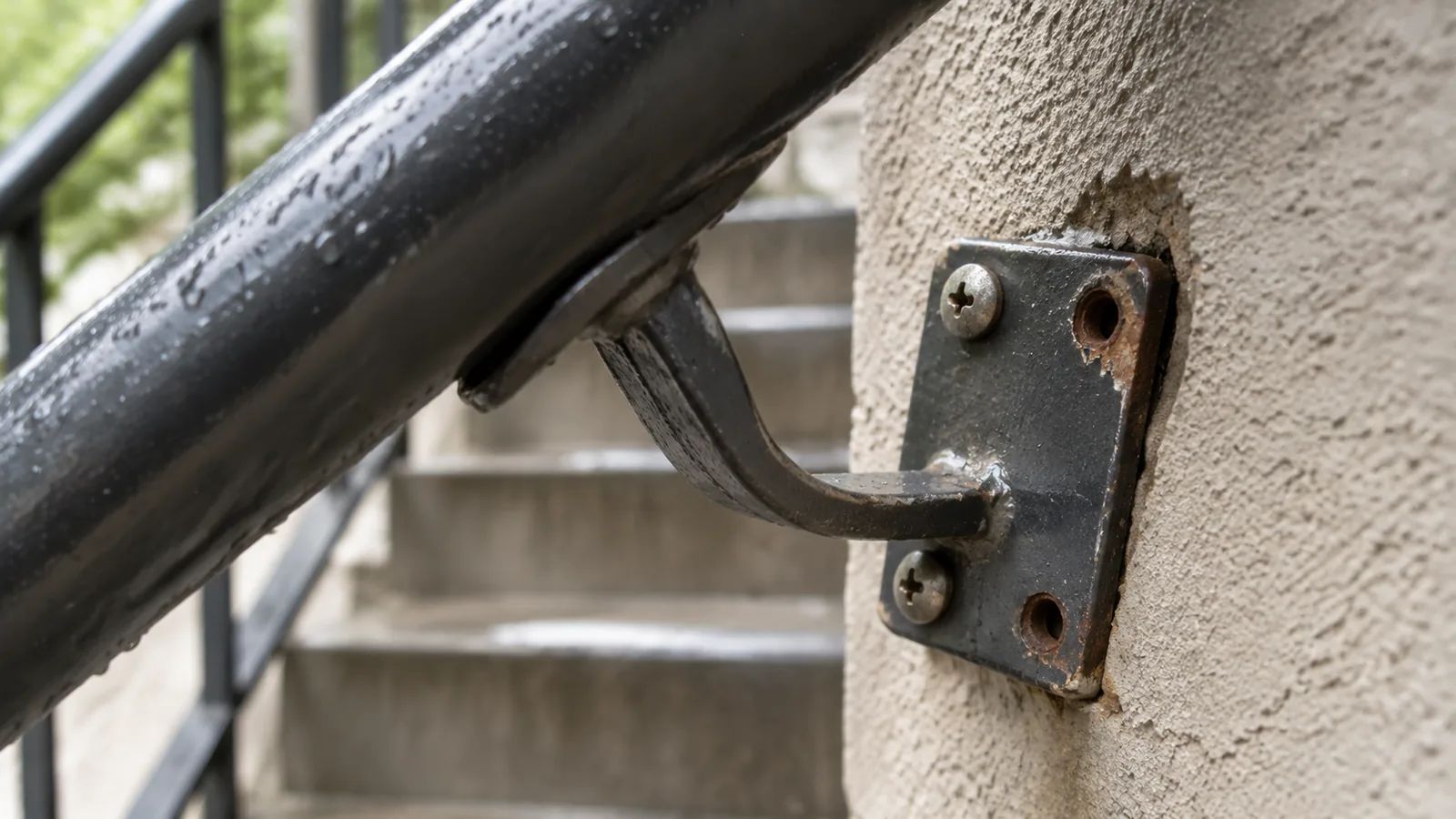
Notice and control can decide the case
A Texas landlord generally owes no duty for conditions inside a unit leased to and controlled by the tenant, but it can be responsible for common stairs and walkways it kept control of [S26].
Exception under Endsley | Hypothetical example |
|---|---|
Areas the landlord keeps control of | The shared stairs and breezeway outside your door [S26]. |
Concealed defects the landlord knew about at leasing | A cracked stair stringer painted over before move-in [S26]. |
Negligent repairs | A tread replaced with the wrong fasteners [S26]. |
In Parker v. Highland Park, a tenant's guest fell on a dark common stairway whose lights the landlord controlled, and the landlord's duty extended to the guest [S5-S6].
Records to save, and what each can show
- Your lease, for which areas are yours and which are common.
- Maintenance requests, to show that management was told about this stair [S4].
- Management messages, for who answered and what they promised.
- Prior reports about the same condition, for how long the problem existed.
For a temporary wet condition, constructive notice needs some evidence of how long that condition existed. In H-E-B v. Peterson (Tex. 2026), prior roof leaks elsewhere and inspection evidence didn't fill that gap [S7].
Type of condition | Proof that usually matters |
|---|---|
A puddle or spill that comes and goes | A dated report, a witness who saw it earlier, or video showing how long it was there [S7]. |
A long-standing defect like a rotted tread | Records of deterioration and what a reasonable inspection would have found. |
Prior knowledge needs an honest analysis
If you complained about the stair before you fell, tell your lawyer, because the same complaint can help and hurt.
Your complaint can | Why |
|---|---|
Show management knew | It's notice in writing. |
Support a defense argument that you knew of the danger | Texas law generally imposes no duty to warn of or make safe a known or obvious hazard, subject to exceptions [S6]. |
Fit the necessary-use exception | Austin v. Kroger describes Parker as covering a person who had to use the dangerous premises and couldn't avoid the risk [S5-S6]. |
Write down whether another safe route actually existed and anything management told you about using the stairs.
Defense arguments, and how each is evaluated
- Footwear, by whether the shoes actually contributed to this fall.
- Distraction or phone use, by what the video and witnesses show.
- Warnings, by where the sign was and whether it covered this hazard.
- Route choice, by whether another route was open and reasonable.
Under Chapter 33, you recover nothing if you're more than 50 percent responsible, and otherwise damages are reduced by your percentage [S15]. A fault percentage doesn't resolve a separate duty question.
Frequently asked questions
Does a code violation prove my case?
Not by itself. Whether the code applies, when it was adopted, the building date, later alterations, duty and causation still matter. A diagram of a modern stair standard doesn't set the rule for every Texas property.
Should I keep my shoes?
Yes, when they may be relevant. Keep them as they are and tell your lawyer where they are.
What should I bring to a lawyer?
Photos, the lease, the incident report, prior complaints, witness information and the medical records you have.
Who can review my fall?
Aaron Herbert is Board Certified in Personal Injury Trial Law by the Texas Board of Legal Specialization [S1]. Ask The Law Firm of Aaron A. Herbert, P.C. for a fact-specific evaluation. Certification isn't a promised result.
Tell us about your apartment injury
Bring your photos, lease and any portal tickets about the stair. Tell us about your apartment injury or call (214) 200-4878.
Related pages
- Texas apartment injury knowledge hub, with every apartment guide in one place.
- How a Texas apartment injury claim is built, on the claim and lawsuit process.
- What to do after an apartment injury, on first steps and evidence.
- Apartment repair notice and injury claims in Texas, on how a maintenance complaint fits an injury claim.
- Preserving evidence after a Texas apartment injury, on video, tickets and physical evidence.
- How Texas courts decide whether a property owner was negligent, on premises liability standards.
- Dallas slip and fall lawyer and Texas slip and fall lawyer, the firm's fall-injury pages.
Sources
- [S1] State Bar of Texas, Aaron Alan Herbert, Bar No. 24036761
- [S4] Texas Property Code Chapter 92
- [S5] Parker v. Highland Park, Inc. (Tex. 1978)
- [S6] Austin v. Kroger Texas, L.P. (Tex. 2015)
- [S7] H-E-B, L.P. v. Peterson, No. 24-0310 (Tex. Apr. 10, 2026)
- [S15] Civil Practice and Remedies Code Chapter 33
- [S26] Johnson County Sheriff's Posse, Inc. v. Endsley (Tex. 1996)

ABOUT THE ATTORNEY
Aaron A. Herbert
Founding Attorney
Board Certified in Personal Injury Trial Law
Aaron founded The Law Firm of Aaron A. Herbert in 2010 to focus on developing each client's case and seeking its maximum value. For over a decade, he has represented people seriously injured in major accidents and industrial catastrophes, pursuing trial verdicts and settlements while working to reduce the stress of litigation.
Education
- Texas A&M University · B.S., Criminal Justice, 1999
- University of Oklahoma College of Law · J.D., 2002; graduated in the top of his class
Trial experience & approach
Aaron earned numerous jury verdicts at boutique personal injury litigation firms. According to his biography, he spent a year as the top-earning litigation attorney at a firm that frequently appeared in verdict searches as having one of the highest numbers of trial wins in Texas. At another Dallas personal injury firm, he moved from managing pre-litigation attorney to managing litigation attorney over seven years as the firm grew into one of Dallas's largest personal injury firms.
His biography describes a reputation as one of America's most aggressive trial lawyers, with noteworthy recoveries from judges and juries and substantial pretrial settlements. Most of those settlements included confidentiality agreements requested by the defense. Aaron has said the recoveries were justified by the injuries and losses involved, which no amount of money could make someone choose to experience.
His approach combines passion, preparation, persistence and courtroom imagination. He believes a well-supported, engaged and motivated team working cooperatively helps deliver strong representation, with the goal of achieving the best possible result for every client.
Dallas roots, military service & publication
Born and raised in Dallas, Aaron enlisted in the United States Marine Corps after high school and later received an Honorable Discharge. He completed his university and law degrees after his military service and became a lifelong Sooners football fan in law school.
Publication: “Litigating Dog Bite Cases,” Texas Dog Law Seminar, Dallas, 2009.
Professional affiliations & recognition
Professional affiliations and recognition listed in Aaron’s biography:
- State Bar of Texas
- American Bar Association
- Association of Trial Lawyers of America (now American Association for Justice)
- Texas Trial Lawyers Association
- Dallas Trial Lawyers Association
- Dallas Bar Association
- Tarrant County Bar Association
- Million Dollar Advocates Forum
- The National Trial Lawyers – Top 100 Trial Lawyers