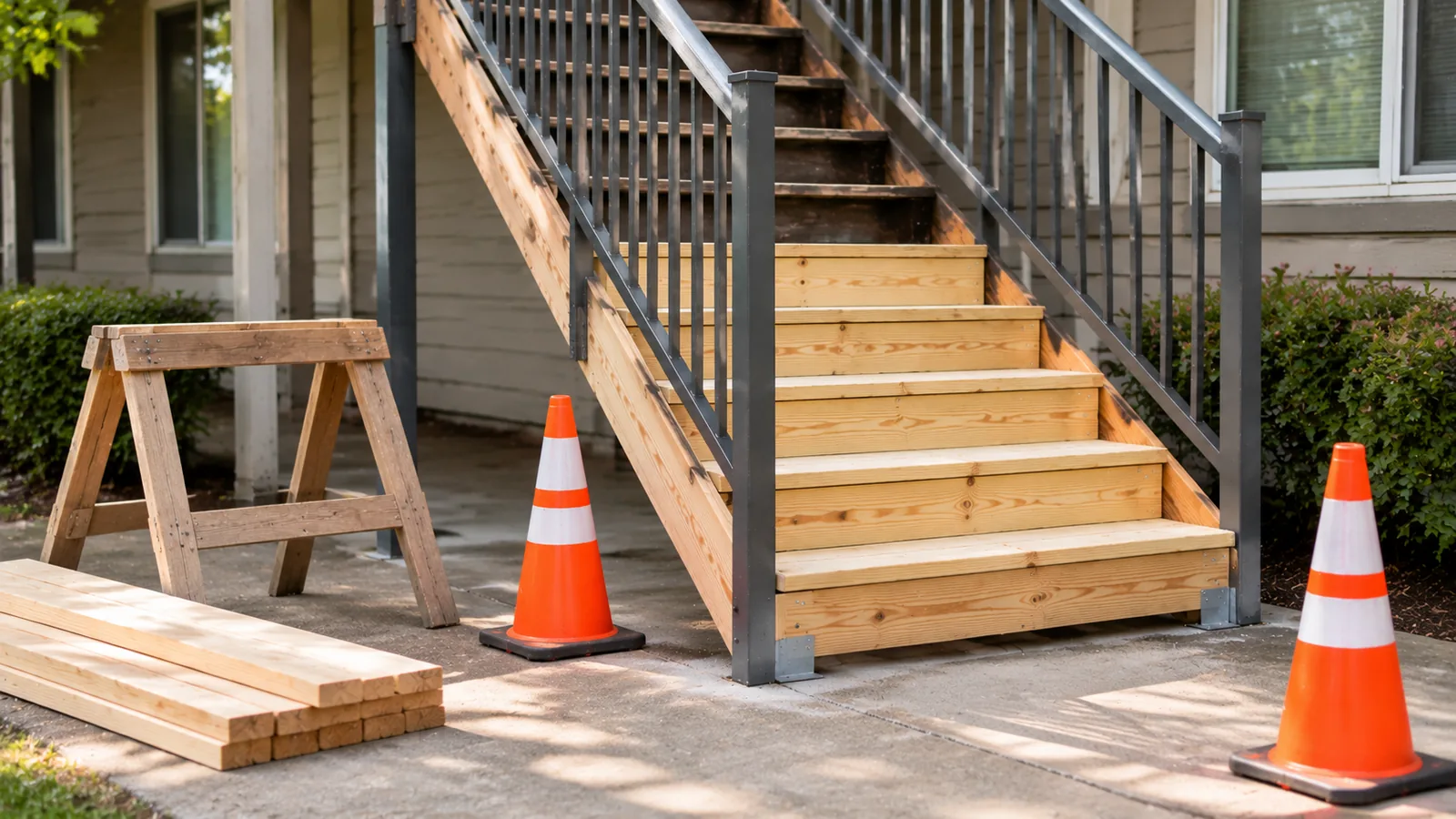
Illustration of a generic setting, not an actual property or incident.
Faulty construction or a bad repair can injure someone when a component fails, a work area turns unsafe, or a repair leaves a dangerous condition behind. The claim has to tie a specific piece of work to the injury.
Questions to answer first, and why each one matters
- Whether it was original construction, a renovation, an emergency patch or routine maintenance, because each points to a different party and deadline.
- Whether the injury happened during the work or after the crew left, because it decides whether the claim is about an activity or a condition [S22].
- Who chose the method, did the work, inspected it and accepted it, because those answers identify the defendants.
An invoice showing that a contractor visited isn't enough by itself. If a repair or construction defect hurt you at your apartment, tell us about your apartment injury or call (214) 200-4878.
Get the scope and the actual work history
The paperwork shows what a vendor agreed to do, and the failed part shows what it actually did.
What each of these records can show
- Contract or proposal, for the promised scope of work.
- Change orders, for what was added or dropped.
- Daily logs and photos, for what the crew did each day.
- Purchase receipts, for which materials went in.
- Emails and texts, for who approved what.
A work order that says "balcony repair" might mean new surface boards, not a fix to the structural connections. Compare the promised scope, the work actually done and the reason the part failed.
Facts to check, each with a hypothetical example
- A contractor's warning about other problems, such as rotted joists the crew noted in an email to the manager.
- A warning that reached a decision maker, such as one the manager forwarded to the owner's asset manager.
- An owner's refusal to pay for the work, proved with the budget record and testimony, not guesses from the building's condition.
A warning doesn't settle responsibility by itself, but it can shift who had control and knowledge.
Match the legal theory to the mechanism
Texas law separates injuries caused by ongoing work from injuries caused by a condition the work left behind, and the claim has to be framed the right way.
How the injury happened | Usual theory |
|---|---|
A board fell from scaffolding while the crew worked overhead | Negligent activity [S22]. |
A stair tread the crew installed last month gave way | Premises liability for a condition the work created [S22]. |
The landlord's own maintenance crew patched a railing badly | The negligent-repair exception to the lessor rule [S26]. |
In United Scaffolding v. Levine, the Texas Supreme Court held that a claim based on a condition a contractor's work created sounds in premises liability, and a general-negligence submission couldn't support the verdict [S22]. Calling every accident "negligent maintenance" doesn't avoid the required elements.
Rule | What it means |
|---|---|
Strakos v. Gehring | Texas rejected the accepted-work doctrine, so a contractor isn't immune just because its work was finished and accepted [S23]. |
Proof still required | Duty, breach, causation, and damages [S23]. |
A company that repaired a roof shouldn't be blamed for a stair failure without a supported connection.
Check filing requirements early
Claims against licensed design professionals carry a filing requirement, and deadlines for builders and designers can run out years before you expect.
Requirement | What it says |
|---|---|
Certificate of merit (Ch. 150) | A claim against a licensed architect, engineer, land surveyor, or landscape architect needs a certificate of merit filed with the first pleading that asserts the claim against that professional, with a narrow exception when limitations is about to expire [S12]. |
Design repose (§16.008) | 10 years from substantial completion for architects, engineers, interior designers, and landscape architects [S11]. |
Construction repose (§16.009) | 10 years from substantial completion for people who construct or repair improvements, with a two-year window if the injury happens in the last year [S11]. |
Ordinary injury limitations | Generally two years, which is only part of the calendar [S11]. |
Identify early who supplied engineering or architectural services and which part of that work is challenged. Don't leave it for routine expert discovery.
Dates and facts to collect
- Original completion, which starts the repose clock for the original builders [S11].
- Later repair dates, which may matter for the repair contractor.
- Warranties, which can affect some repose periods.
- Facts for exceptions, such as possession or control of the property [S11].
Don't assume every apartment project has the same deadline, or that a recent patch restarts every claim against the original builders.
Frequently asked questions
Can I sue the owner as well as the contractor?
The owner may have its own premises duty while the contractor caused a separate failure, so possibly. Chapter 33 then allocates fault and settlement credits [S15].
Does a permit approval mean the work was safe?
A permit approval is relevant evidence, not a guarantee, so no. Look at what the inspection covered, which standards applied and the defect you're alleging.
What should I ask Aaron Herbert?
Ask how the firm would identify contractors, preserve components, get qualified technical review, and handle filing prerequisites and costs. Aaron Herbert is Board Certified in Personal Injury Trial Law by the Texas Board of Legal Specialization [S1].
Tell us about your apartment injury
Bring photos of the work area, any contractor names or truck logos you saw and your maintenance requests. Tell us about your apartment injury or call (214) 200-4878.
Related pages
- Texas apartment injury knowledge hub, with every apartment guide in one place.
- How a Texas apartment injury claim is built, on the claim and lawsuit process.
- Who is liable for an apartment injury in Texas, on owners, managers, contractors and designers.
- Texas apartment balcony and walkway collapse claims, on structural failures.
- Texas apartment injury settlement value and lawsuit preparation, on what affects value.
- How Texas courts decide whether a property owner was negligent, on premises liability standards.
- Dallas premises liability lawyer and Fort Worth premises liability lawyer, the firm's property-injury pages.
Sources
- [S1] State Bar of Texas, Aaron Alan Herbert, Bar No. 24036761
- [S11] Civil Practice and Remedies Code Chapter 16
- [S12] Civil Practice and Remedies Code Chapter 150
- [S15] Civil Practice and Remedies Code Chapter 33
- [S22] United Scaffolding, Inc. v. Levine (Tex. 2017)
- [S23] Strakos v. Gehring (Tex. 1962)
- [S26] Johnson County Sheriff's Posse, Inc. v. Endsley (Tex. 1996)

ABOUT THE ATTORNEY
Aaron A. Herbert
Founding Attorney
Board Certified in Personal Injury Trial Law
Aaron founded The Law Firm of Aaron A. Herbert in 2010 to focus on developing each client's case and seeking its maximum value. For over a decade, he has represented people seriously injured in major accidents and industrial catastrophes, pursuing trial verdicts and settlements while working to reduce the stress of litigation.
Education
- Texas A&M University · B.S., Criminal Justice, 1999
- University of Oklahoma College of Law · J.D., 2002; graduated in the top of his class
Trial experience & approach
Aaron earned numerous jury verdicts at boutique personal injury litigation firms. According to his biography, he spent a year as the top-earning litigation attorney at a firm that frequently appeared in verdict searches as having one of the highest numbers of trial wins in Texas. At another Dallas personal injury firm, he moved from managing pre-litigation attorney to managing litigation attorney over seven years as the firm grew into one of Dallas's largest personal injury firms.
His biography describes a reputation as one of America's most aggressive trial lawyers, with noteworthy recoveries from judges and juries and substantial pretrial settlements. Most of those settlements included confidentiality agreements requested by the defense. Aaron has said the recoveries were justified by the injuries and losses involved, which no amount of money could make someone choose to experience.
His approach combines passion, preparation, persistence and courtroom imagination. He believes a well-supported, engaged and motivated team working cooperatively helps deliver strong representation, with the goal of achieving the best possible result for every client.
Dallas roots, military service & publication
Born and raised in Dallas, Aaron enlisted in the United States Marine Corps after high school and later received an Honorable Discharge. He completed his university and law degrees after his military service and became a lifelong Sooners football fan in law school.
Publication: “Litigating Dog Bite Cases,” Texas Dog Law Seminar, Dallas, 2009.
Professional affiliations & recognition
Professional affiliations and recognition listed in Aaron’s biography:
- State Bar of Texas
- American Bar Association
- Association of Trial Lawyers of America (now American Association for Justice)
- Texas Trial Lawyers Association
- Dallas Trial Lawyers Association
- Dallas Bar Association
- Tarrant County Bar Association
- Million Dollar Advocates Forum
- The National Trial Lawyers – Top 100 Trial Lawyers