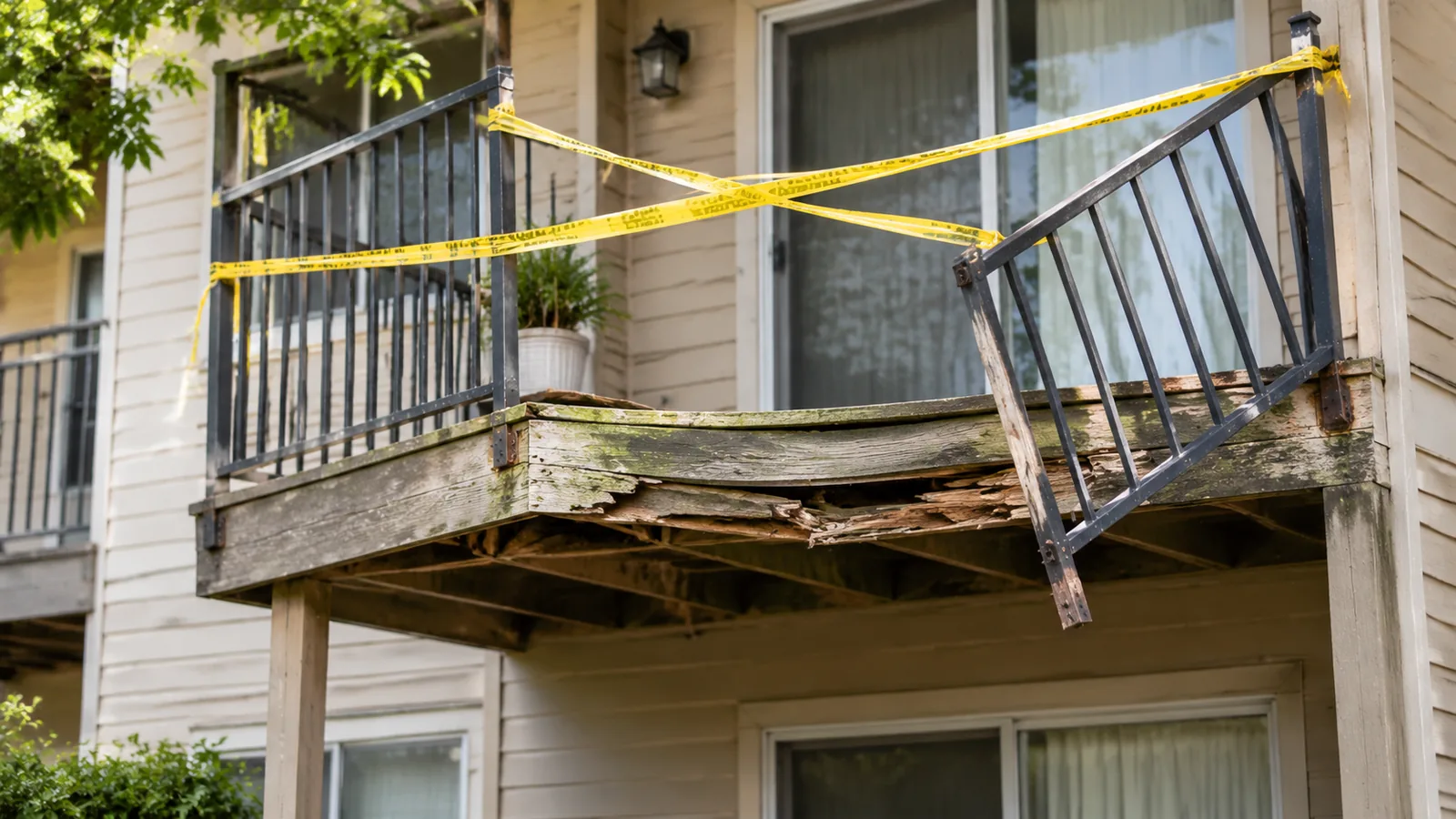
Illustration of a generic setting, not an actual property or incident.
A balcony or elevated walkway collapse calls for prompt medical care and a focused structural investigation. The failure alone doesn't show who was negligent.
What the case has to explain, with a hypothetical example of each
- What failed, such as the ledger board that held the balcony to the building pulling loose.
- Why it failed, such as years of water getting behind the flashing and rotting the board.
- Who had a duty, such as the owner, which kept control of the building's exterior.
- How it caused the injury, such as the balcony dropping and you falling to the patio below.
Possible defendants include the owner, the manager, a repair company, the original contractor, and a design professional. If a balcony or walkway gave way under you or a family member, tell us about your apartment injury or call (214) 200-4878.
What should you do right after a collapse?
Get medical care and stay off the damaged structure, even to take photos.
Do | Don't |
|---|---|
Let emergency responders and qualified professionals deal with continuing danger | Step back onto a damaged balcony or under an unstable walkway. |
Photograph from a safe spot if you can | Pull debris loose to show what failed. |
Save witness names and units | Throw away anything that came down. |
Tell a lawyer before repairs start | Assume management will keep the broken parts. |
A lawyer can push for preservation while allowing safety work to go ahead.
Identify the failed system
Each kind of collapse is proved differently, so start by pinning down exactly what gave way.
What the proof usually focuses on
- Rot, water paths and inspection history, for a foot that went through a decayed deck board.
- Fasteners, posts and connection details, for a guardrail that detached.
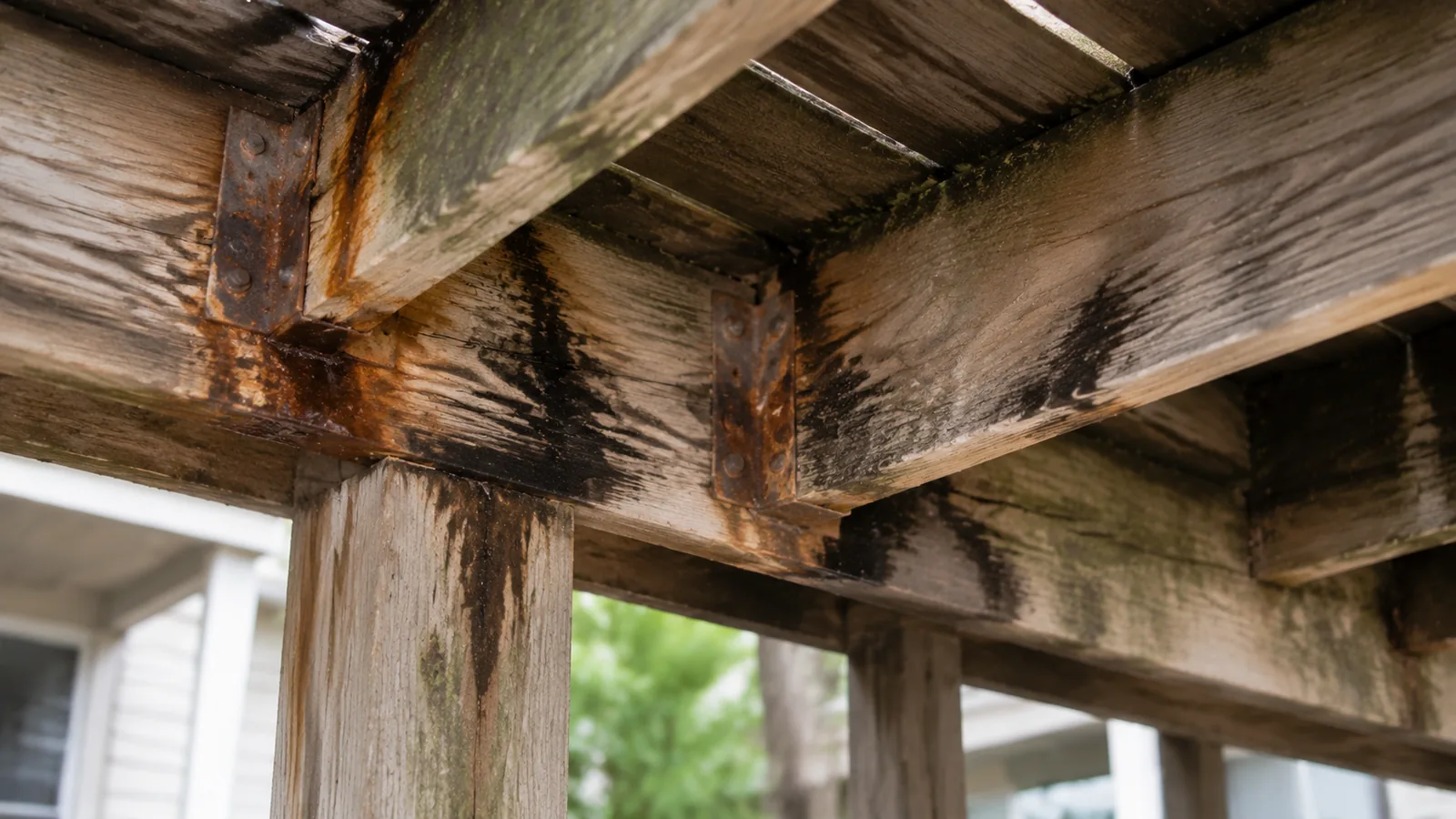
- Ledger connections, framing, concrete and corrosion, for a whole balcony that separated from the building.
A structural engineer should test the alternatives instead of assuming every collapse comes from deferred maintenance.
Records to request, and what they can show
- Plans and permits, for how the balcony was designed and built.
- Inspection reports, for what inspectors saw and when.
- Repair recommendations and invoices, for what was recommended, approved or put off.
- Prior complaints, for whether residents reported movement, softness, cracking, rust or water.
- Renovation photos, for what the framing looked like before it was covered.
A dated photo and a specific warning about a deteriorated connection say far more than a report that calls the balcony old.
Preserve debris and inspection opportunities
The broken components can be the most important evidence in the case, so they need a written protocol.
Protocol items, each with a hypothetical example
- Identification, such as a tag on each joist and bracket saying where it came from.
- Storage, such as a locked, dry room on the property for the pieces.
- Photographs, such as a shot of each piece before anyone moves it.
- Sampling and destructive testing, only after every side has notice and a chance to attend.
Residents shouldn't remove structural debris or put themselves in danger. If emergency repairs happen, ask for records of what was removed, what replaced it, and why.
If evidence goes missing, ask | Why |
|---|---|
Who controlled it | Only a party with control had a duty to keep it. |
When litigation became reasonably foreseeable | That's when the duty to preserve starts. |
What preservation steps were possible | The answer bears on fault. |
Whether the loss hurt the investigation | The remedy depends on prejudice. |
Missing evidence isn't an automatic win. Under Brookshire Brothers v. Aldridge, the trial judge decides spoliation and the remedy, which has to be proportionate, and a spoliation instruction is reserved for intentional loss or negligent loss that left the other side without a meaningful way to present its case [S19].
Investigate each participant separately
Every company you name needs its own facts showing what it did wrong and how that caused the collapse.
Participants, and when each may be responsible
- Owner, when it kept responsibility for structural maintenance or hid a defect it knew about [S26].
- Manager, when it received warnings or controlled access and repairs.
- Repair company, when it did defective work on the failed part.
- Design professional, when a negligent design caused the failure.
- Parent company or portfolio vendor, though not automatically, just because of a business relationship.
Completing a job doesn't give a contractor blanket immunity. Strakos v. Gehring rejected the accepted-work doctrine [S23], but a collapse doesn't make every past contractor responsible either.
Ordinary injury limitations are generally two years, with exceptions [S11].
Rule | What it says |
|---|---|
Design repose (§16.008) | 10 years from substantial completion for architects, engineers, interior designers, and landscape architects [S11]. |
Construction repose (§16.009) | 10 years from substantial completion for people who build or repair improvements; if injury happens in the last year, suit may be filed within two years of accrual (§16.009(d)); it doesn't protect a person in actual possession or control of the property [S11]. |
Certificate of merit (Ch. 150) | A claim against a licensed architect, engineer, land surveyor, or landscape architect needs a certificate of merit filed with the first pleading that asserts the claim against that professional, with a narrow exception when limitations is about to expire [S12]. |
Save completion dates and repair dates, and talk with a lawyer early, because repose can cut off a claim no matter how recent the injury is.
Frequently asked questions
Can several companies be liable for one collapse?
Yes, when the evidence supports separate contributions. Fault is allocated under Chapter 33, and the same damages can't be recovered twice from different defendants [S15].
Does fresh paint over rot prove concealment?
It's a lead, not proof. The facts still have to show what was visible, who did the work, what they knew, and how the rot caused the failure [S26].
Why talk with Aaron Herbert about a structural injury?
Aaron Herbert is Board Certified in Personal Injury Trial Law by the Texas Board of Legal Specialization [S1]. Ask The Law Firm of Aaron A. Herbert, P.C. about the engineering plan, preservation steps, and expert costs. No settlement or verdict is promised.
Tell us about your apartment injury
Bring photos, the lease, any notices about the balcony, and the names of repair companies you saw on site. Tell us about your apartment injury or call (214) 200-4878.
Related pages
- Texas apartment injury knowledge hub, with every apartment guide in one place.
- How a Texas apartment injury claim is built, on the claim and lawsuit process.
- Who is liable for an apartment injury in Texas, on owners, managers, contractors and designers.
- Negligent apartment construction and repair claims in Texas, on builders and repair vendors.
- Preserving evidence after a Texas apartment injury, on protocols for physical evidence.
- Texas apartment injury lawyer, the firm's statewide apartment page.
- Dallas premises liability lawyer and Fort Worth premises liability lawyer, the firm's property-injury pages.
Sources
- [S1] State Bar of Texas, Aaron Alan Herbert, Bar No. 24036761
- [S11] Civil Practice and Remedies Code Chapter 16
- [S12] Civil Practice and Remedies Code Chapter 150
- [S15] Civil Practice and Remedies Code Chapter 33
- [S19] Brookshire Bros., Ltd. v. Aldridge (Tex. 2014)
- [S23] Strakos v. Gehring (Tex. 1962)
- [S26] Johnson County Sheriff's Posse, Inc. v. Endsley (Tex. 1996)

ABOUT THE ATTORNEY
Aaron A. Herbert
Founding Attorney
Board Certified in Personal Injury Trial Law
Aaron founded The Law Firm of Aaron A. Herbert in 2010 to focus on developing each client's case and seeking its maximum value. For over a decade, he has represented people seriously injured in major accidents and industrial catastrophes, pursuing trial verdicts and settlements while working to reduce the stress of litigation.
Education
- Texas A&M University · B.S., Criminal Justice, 1999
- University of Oklahoma College of Law · J.D., 2002; graduated in the top of his class
Trial experience & approach
Aaron earned numerous jury verdicts at boutique personal injury litigation firms. According to his biography, he spent a year as the top-earning litigation attorney at a firm that frequently appeared in verdict searches as having one of the highest numbers of trial wins in Texas. At another Dallas personal injury firm, he moved from managing pre-litigation attorney to managing litigation attorney over seven years as the firm grew into one of Dallas's largest personal injury firms.
His biography describes a reputation as one of America's most aggressive trial lawyers, with noteworthy recoveries from judges and juries and substantial pretrial settlements. Most of those settlements included confidentiality agreements requested by the defense. Aaron has said the recoveries were justified by the injuries and losses involved, which no amount of money could make someone choose to experience.
His approach combines passion, preparation, persistence and courtroom imagination. He believes a well-supported, engaged and motivated team working cooperatively helps deliver strong representation, with the goal of achieving the best possible result for every client.
Dallas roots, military service & publication
Born and raised in Dallas, Aaron enlisted in the United States Marine Corps after high school and later received an Honorable Discharge. He completed his university and law degrees after his military service and became a lifelong Sooners football fan in law school.
Publication: “Litigating Dog Bite Cases,” Texas Dog Law Seminar, Dallas, 2009.
Professional affiliations & recognition
Professional affiliations and recognition listed in Aaron’s biography:
- State Bar of Texas
- American Bar Association
- Association of Trial Lawyers of America (now American Association for Justice)
- Texas Trial Lawyers Association
- Dallas Trial Lawyers Association
- Dallas Bar Association
- Tarrant County Bar Association
- Million Dollar Advocates Forum
- The National Trial Lawyers – Top 100 Trial Lawyers