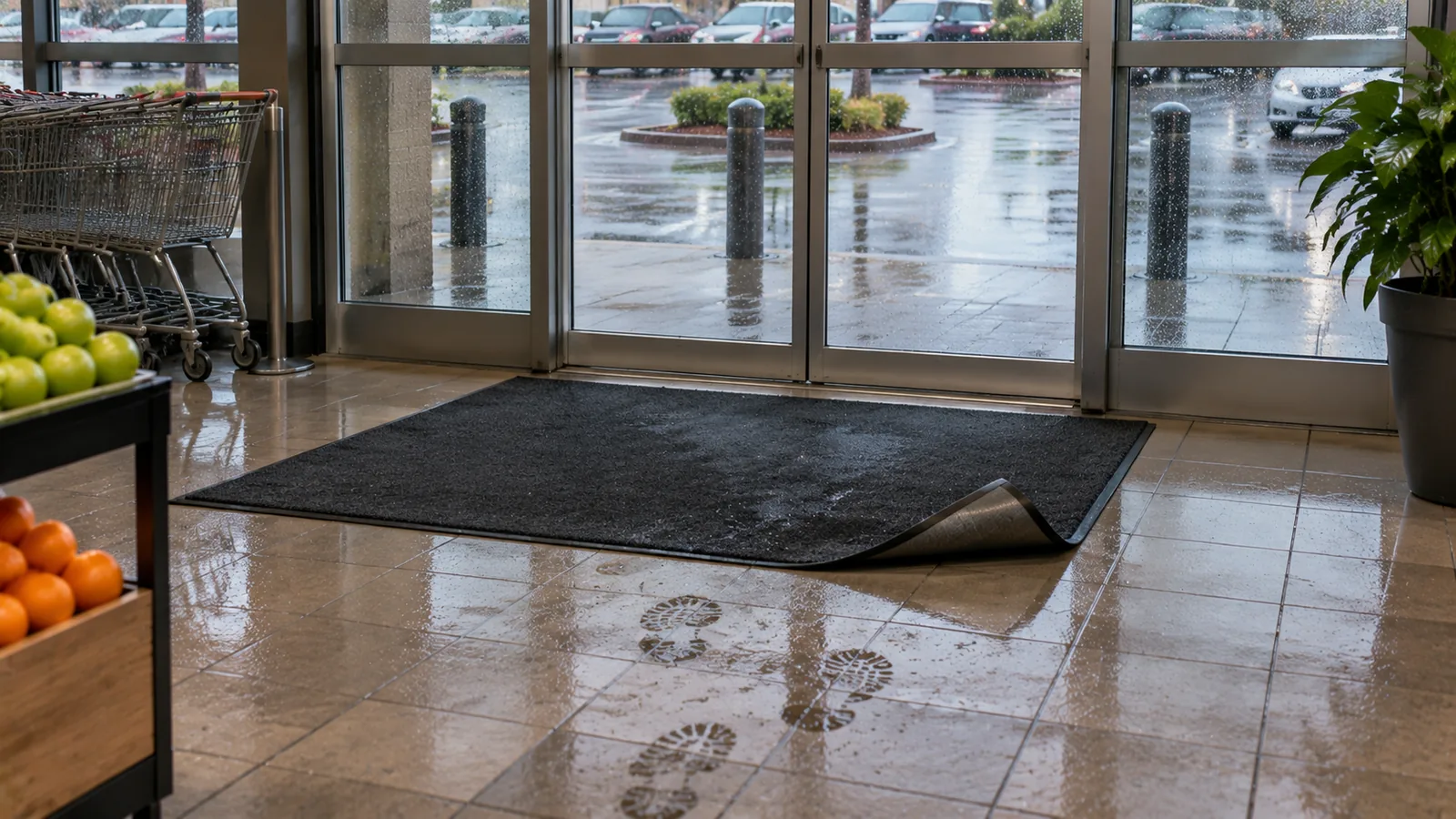
A curled mat corner at the H-E-B doors can support a Texas injury claim [S9]. Rain on the tile usually can't, at least not by itself. In April 2026 the Texas Supreme Court sided with H-E-B over a rainy-day puddle because nobody could say how long it had sat there [S6]. So start with the thing your foot hit, and when the store knew.
| What caught you | What you'll need to show |
|---|---|
| A mat that slid out from under you | Why it moved, and who placed and checked it |
| A curled or raised mat corner | How long the curl was there, and who saw it |
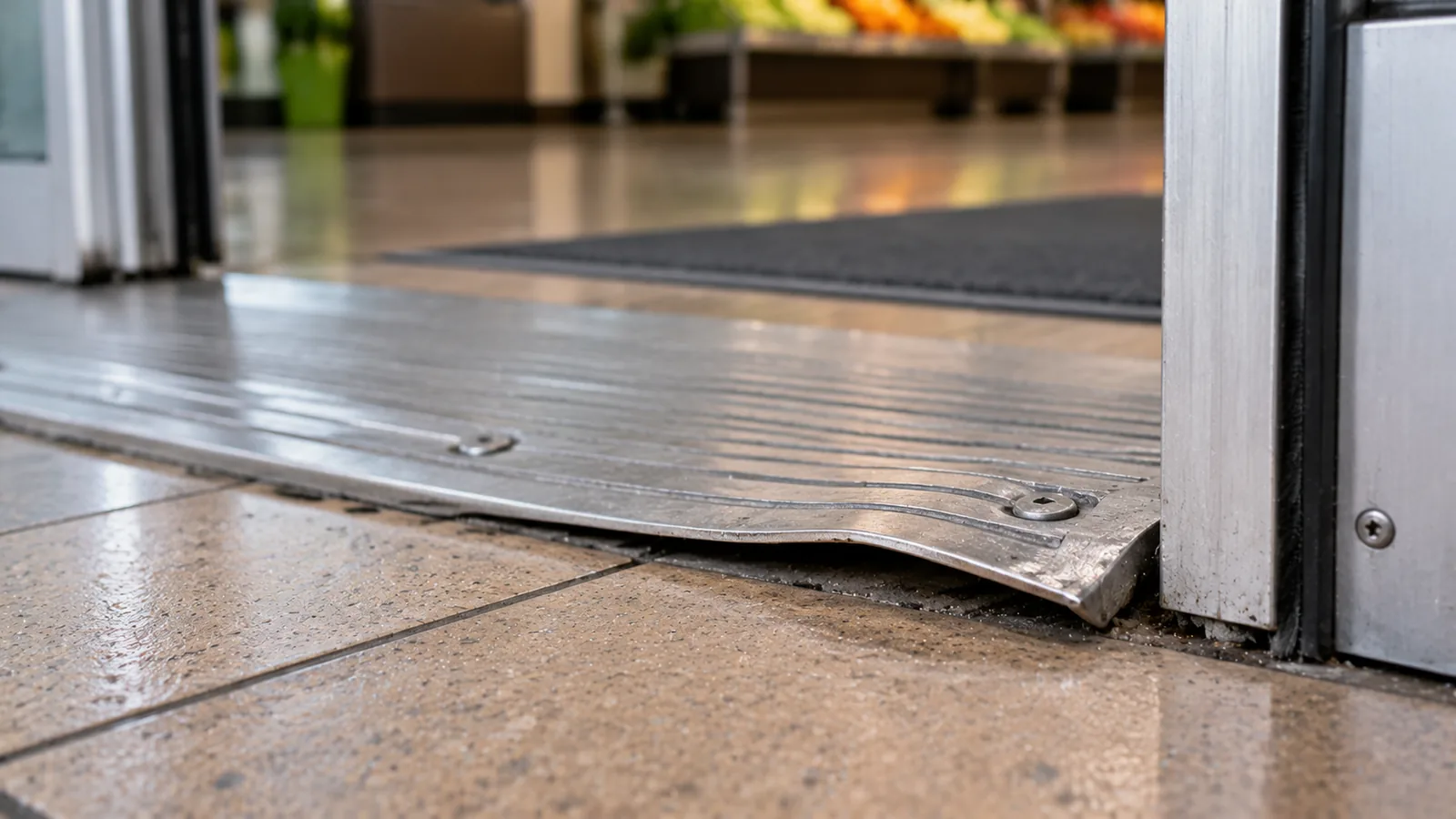
| A cracked or uneven threshold strip | Its condition, repair history, and who controlled it |
| Water on the tile between the doors | Where it came from and how long it sat [S6] |
| Something left in the walkway | Who put it there, and when |
Keetch v. Kroger Co. (Tex. 1992) lists what you'd prove against whoever controlled the entrance [S9]:
- Knowledge, actual or constructive, of the curl, the gap, or the water.
- An unreasonable risk of harm from that condition.
- No reasonable care to fix it or reduce the risk.
- Your fall and injuries caused by that failure.
To have a lawyer look at the entrance evidence, tell us about your H-E-B injury or call (214) 200-4878. Bring the store address, incident date, injury details, photos, and witness names.
What changes in the first five minutes?
Suppose it's 5:10 p.m. and raining hard. Your toe catches the curled corner of the mat between the two sets of automatic doors, and you land on wet tile. The scene starts changing before you're back on your feet:
| Time | What changes | What to note |
|---|---|---|
| 5:11 | A worker straightens the entry mat | Who moved it, and how witnesses say it looked before |
| 5:12 | Carts roll over what's left of the curl | A side photo of the corner, if it's safe |
| 5:15 | A wet-floor cone goes up | That it wasn't there when you fell |
| 5:18 | Someone mops the threshold | The time, and the time stamp on each photo |
Take a wide shot too, of the vestibule, both sets of doors, and any sign. Keep the shoes you wore, unwashed, and get witness names and numbers before people head out to the parking lot.
How did you actually go down?
The words you use later matter, so describe what you felt and nothing more.
| What you felt | How you might put it |
|---|---|
| A catch | "My toe caught the raised corner of the mat, and I fell forward." |
| A slide | "My heel slid on water on the tile between the two sets of doors." |
| A shift | "The mat slid out from under me when I stepped on it." |
| A drop | "My foot came down wrong where the threshold strip meets the floor." |
Not sure which one it was? Say so. Video and witnesses can fill that in, while a guess about mechanics can be used against you later. Also note whether you saw the curl or the water before you stepped, or only once you were down.
Who controlled the entrance?
Four companies can have a hand in one entry mat:
- H-E-B, as the store operator, on who inspected and adjusted the mats that day
- a landlord or shopping-center owner, on whether a lease gave it the sidewalk, doors or threshold
- a cleaning company, on who mopped the vestibule, when and with what
- a mat rental vendor, on who delivered, placed and swapped the mats, and when
Owning a mat doesn't prove anyone knew about a particular curl.
Why did the rain protocol fail in Peterson?
H-E-B had a heightened inspection protocol for rainy weather. In H-E-B, LP v. Peterson, a shopper slipped on a puddle in a toy aisle about two hours after the rain stopped. The store's earlier roof leaks were concentrated in its southern portion, not near the toys [S6].
In 2026 the Texas Supreme Court reinstated summary judgment for H-E-B. The rain plan, the weather, and problems elsewhere in the building didn't show how long that puddle had been there, and constructive notice needs some evidence of the particular condition's duration [S6]. Under Peterson and Reece, an employee standing nearby doesn't fill that gap either [S6, S8].
A report or an earlier sighting at the same spot can change things:
| Timing proof | What it may show |
|---|---|
| A shopper tells a cashier at 5:05 that the entry mat is soaked and curling | Actual notice of the same condition before a 5:25 fall |
| Video shows the mat bunched at 4:50 and nobody fixing it | How long the condition existed, once the camera clock is checked |
| An employee stood at the service desk near the door | Not enough without proof of duration [S8] |
Water that traveled from a cooler is covered in H-E-B refrigeration leaks and wet floors.
Was the wet-floor sign in the right place?
Judge a sign by when it went up, where it stood, which way it faced, and what it warned about. A sign just inside the doors may not have warned about a raised threshold or a mat that had slid. One that went out after you fell says nothing about the warning before. A sign across the vestibule raises distance and visibility, and one facing only the exit lane may not be visible to a shopper walking in. Photograph the sign with the hazard in the same frame when you can.
What if you saw the curl before you stepped on it?
The plaintiff in Austin v. Kroger Texas, L.P. (Tex. 2015) was a Kroger worker suing his own employer. The Court said a property owner generally owes no duty to warn of, or fix, a danger that's open and obvious or already known. Narrow exceptions exist, such as third-party crime and necessary use [S11].
Wanting to get into the store doesn't automatically make the route a necessary use. Tell your lawyer what other doors or paths were open, and say so if you noticed the curl first.
Fault is a different question from duty [S11, S16]. Under Chapter 33, a shopper found more than 50 percent responsible recovers nothing, and a lower share reduces the damages [S16]. H-E-B warning signs and shared fault goes deeper.
Does a building code help?
Maybe. Someone has to show which standard governs and whether the city adopted it for that building, since a modern model code doesn't automatically govern every existing Texas entrance. An expert who measures should explain why the rule applies and how the condition caused your injury, and should disclose every assumption and any later change to the entrance. A threshold that was repaired or replaced before testing may not match what you stepped on.
Medical and work records prove the injury, the care, and the missed shifts. They don't prove the threshold was bad, and a bad threshold doesn't prove every diagnosis. For grocery falls in general, see Texas grocery store falls.
Frequently asked questions
It was raining. Does that excuse the store?
The Peterson shopper fell about two hours after the rain stopped, and H-E-B still won [S6]. Weather sets the scene. You still need the condition, the store's notice of it, a failure to act, and an injury that follows from that.
What if the mat was flat when I came back?
Write both times down, say 5:10 for the fall and 6:00 for your return. Somebody probably fixed it in between. Witnesses and the store's own video show the 5:10 version, so ask in writing that the footage be kept.
Can I still recover if I was partly at fault?
Chapter 33 draws the line at 50 percent [S16]. Suppose a jury puts 20 percent on you: a $10,000 award drops to $8,000. At 51 percent, you'd get nothing.
Who else besides H-E-B could be responsible?
A landlord, a cleaning company, or a mat vendor, depending on the lease and who actually did the work.
Who can review an entrance fall?
Call The Law Firm of Aaron A. Herbert, P.C. with the time you fell, your mat photos, and the names of anyone who saw it. Aaron Herbert is Board Certified in Personal Injury Trial Law by the Texas Board of Legal Specialization [S1]. That isn't a guarantee or a ranking.
Tell us about your H-E-B injury
Bring the store address, incident date, injury details, photos, and witness names. Tell us about your H-E-B injury or call (214) 200-4878.
Related pages on H-E-B injuries
- Texas HEB injury knowledge hub: every guide in one place.
- How to file and litigate a Texas HEB injury claim: the claim and lawsuit process.
Sources
- [S1] State Bar of Texas, Aaron Alan Herbert, Bar No. 24036761. Board certification.
- [S6] H-E-B, LP v. Peterson, No. 24-0310 (Tex. Apr. 10, 2026).
- [S8] Wal-Mart Stores, Inc. v. Reece, 81 S.W.3d 812 (Tex. 2002).
- [S9] Keetch v. Kroger Co., 845 S.W.2d 262 (Tex. 1992).
- [S11] Austin v. Kroger Texas, L.P., 465 S.W.3d 193 (Tex. 2015).
- [S16] Tex. Civ. Prac. & Rem. Code ch. 33.

ABOUT THE ATTORNEY
Aaron A. Herbert
Founding Attorney
Board Certified in Personal Injury Trial Law
Aaron founded The Law Firm of Aaron A. Herbert in 2010 to focus on developing each client's case and seeking its maximum value. For over a decade, he has represented people seriously injured in major accidents and industrial catastrophes, pursuing trial verdicts and settlements while working to reduce the stress of litigation.
Education
- Texas A&M University · B.S., Criminal Justice, 1999
- University of Oklahoma College of Law · J.D., 2002; graduated in the top of his class
Trial experience & approach
Aaron earned numerous jury verdicts at boutique personal injury litigation firms. According to his biography, he spent a year as the top-earning litigation attorney at a firm that frequently appeared in verdict searches as having one of the highest numbers of trial wins in Texas. At another Dallas personal injury firm, he moved from managing pre-litigation attorney to managing litigation attorney over seven years as the firm grew into one of Dallas's largest personal injury firms.
His biography describes a reputation as one of America's most aggressive trial lawyers, with noteworthy recoveries from judges and juries and substantial pretrial settlements. Most of those settlements included confidentiality agreements requested by the defense. Aaron has said the recoveries were justified by the injuries and losses involved, which no amount of money could make someone choose to experience.
His approach combines passion, preparation, persistence and courtroom imagination. He believes a well-supported, engaged and motivated team working cooperatively helps deliver strong representation, with the goal of achieving the best possible result for every client.
Dallas roots, military service & publication
Born and raised in Dallas, Aaron enlisted in the United States Marine Corps after high school and later received an Honorable Discharge. He completed his university and law degrees after his military service and became a lifelong Sooners football fan in law school.
Publication: “Litigating Dog Bite Cases,” Texas Dog Law Seminar, Dallas, 2009.
Professional affiliations & recognition
Professional affiliations and recognition listed in Aaron’s biography:
- State Bar of Texas
- American Bar Association
- Association of Trial Lawyers of America (now American Association for Justice)
- Texas Trial Lawyers Association
- Dallas Trial Lawyers Association
- Dallas Bar Association
- Tarrant County Bar Association
- Million Dollar Advocates Forum
- The National Trial Lawyers – Top 100 Trial Lawyers