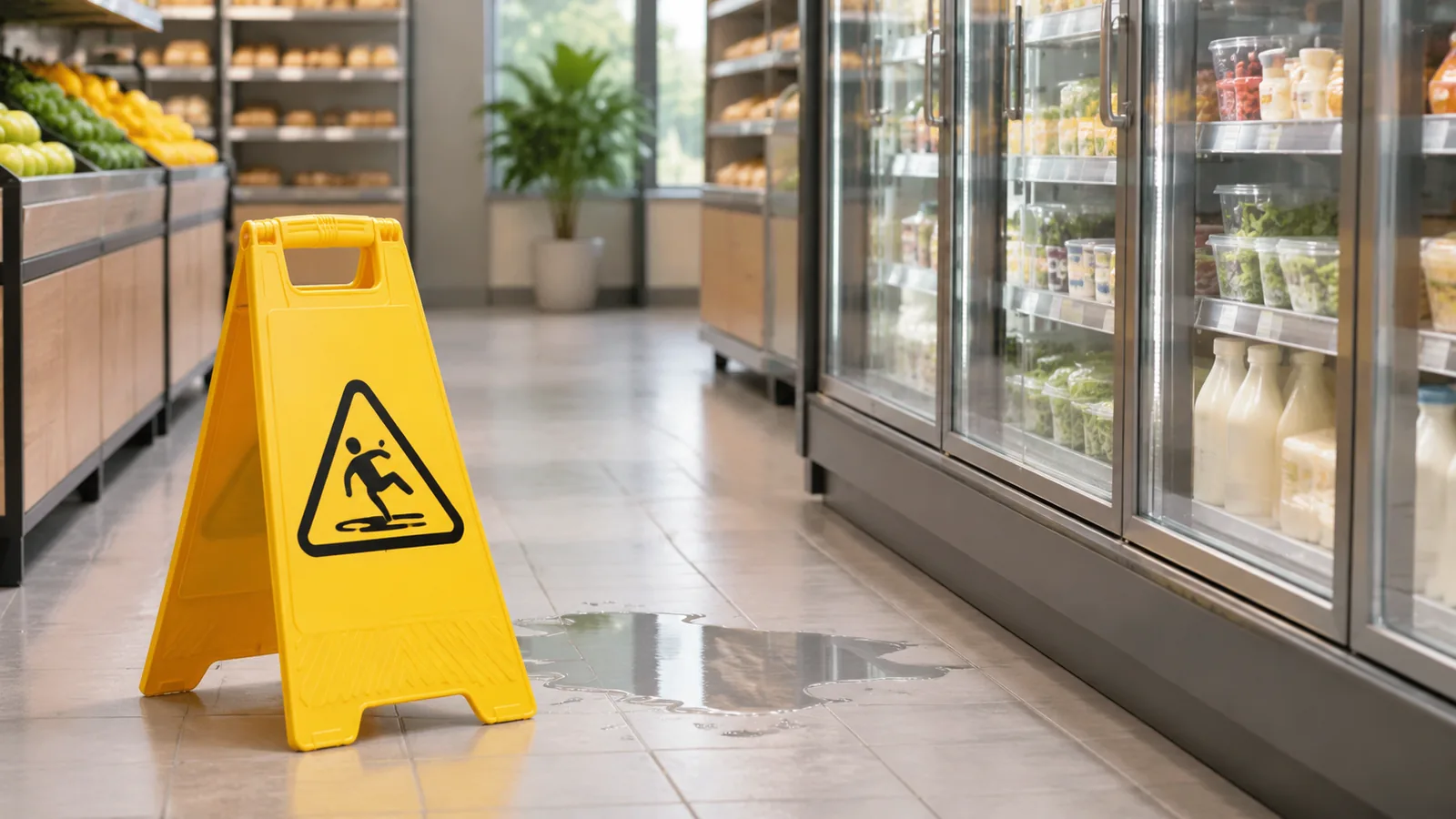
Texas grocery store injury resources
Texas HEB injury lawyer and claims guide
You may have a claim if a dangerous condition at a Texas H-E-B hurt you and the evidence shows the store knew or should have known about it, failed to use reasonable care, and caused your injury. A fall alone doesn't prove that, so get medical care first and then preserve the scene, the video, witness names, and records of what the store knew.

The Law Firm of Aaron A. Herbert, P.C., Dallas, Texas.
Texas Bar license #24036761. Board Certified in Personal Injury Trial Law by the Texas Board of Legal Specialization since 2008.
Type at least 2 characters. Use arrow keys to choose a result and Enter to open it.
| Question | Short answer |
|---|---|
| Does an injury at H-E-B mean H-E-B has to pay? | No. The evidence has to prove notice, an unreasonable risk, a lack of reasonable care, and causation [S9]. |
| Who else could be responsible? | A landlord, a cleaning or refrigeration contractor, a vendor, or a driver, depending on who controlled what. |
| How long do I have to sue? | Texas generally allows two years for a personal injury lawsuit, with exceptions [S14]. |
| What changed in 2026? | In H-E-B, LP v. Peterson, the Supreme Court of Texas required some evidence of how long a puddle had been on the floor [S6]. |
| Should I take a payment right away? | Get a clear explanation of what still needs investigation before you accept money or decide to sue. |
Tell us about your H-E-B injury or call (214) 200-4878. Bring the store address, the incident date, your injury details, any photos, and the names of witnesses, and don't worry if you haven't worked out the legal case yet.
| Credential | What it means for you |
|---|---|
| Aaron Herbert is Board Certified in Personal Injury Trial Law by the Texas Board of Legal Specialization | You can check it on his State Bar of Texas profile [S1]. |
| State Bar of Texas profile | Bar number 24036761, licensed November 6, 2002, and listed as eligible to practice [S1]. |
| What it doesn't mean | Certification isn't a guarantee or a ranking, and it doesn't predict how your case turns out. |
| What an evaluation covers | Your event, the proof you have, the responsible entities, and the steps that protect the claim. |
| Independence | The Law Firm of Aaron A. Herbert, P.C. is not affiliated with or endorsed by H-E-B. |
Start with these guides
Guides in this hub
Each guide takes one part of an H-E-B injury claim and answers it in more depth.
| Guide | What it answers |
|---|---|
| How to file and litigate a Texas HEB injury claim | The full process, from investigation and notice through summary judgment and trial. |
| The first 72 hours after an injury at HEB in Texas | What to do about care, reporting, witnesses, and evidence in the first three days. |
| Proving notice in a Texas HEB slip and fall claim | How actual and constructive notice are proved after Peterson. |
| Texas HEB produce and sampling display injury claims | Falls on produce, grapes, and spills near a sample stand. |
| HEB refrigeration leak and wet floor claims in Texas | Water from cases and coolers, and what ties a leak to a fall. |
| HEB entrance mat, threshold and rain related injury claims | Curled mats, floor transitions, and water tracked in on rainy days. |
| HEB falling merchandise, fixture and construction injury claims | Stacked goods, shelving, displays, and ceiling or construction failures. |
| Texas HEB parking lot fall and walkway injury claims | Potholes, wheel stops, drainage, and who controls the lot. |
| HEB curbside, cart and parking lot pedestrian injury claims | Curbside pickup spaces, cart movement, and vehicle traffic. |
| Preserving HEB surveillance and injury evidence in Texas | What to ask the store to keep, and what happens when video is lost. |
| HEB inspection records and corporate testimony in injury cases | Inspection logs, maintenance records, and testimony from store personnel. |
| HEB warning signs, known dangers and shared fault in Texas | Cones, open-and-obvious hazards, and how fault is divided. |
| Texas HEB injury settlement value and medical proof | What drives value and how medical expenses are proved. |
| HEB injury statistics, settlements and liability insurance limits | What public data does and doesn't show. |
| Texas HEB injury lawsuits, summary judgment and trial | Filing deadlines, Rule 166a, mediation, and trial. |
| Choosing a Texas HEB injury attorney | Questions to ask a lawyer before you hire one. |
Can you file a claim against HEB after a fall?
Yes, if the evidence supports it, but getting hurt at H-E-B doesn't automatically mean H-E-B must pay.
| What a customer usually has to prove | What that looks like (hypothetical) |
|---|---|
| The store actually knew, or should have known, about the condition | A shopper told a clerk about spilled yogurt by the dairy case ten minutes before the fall. |
| The condition posed an unreasonable risk of harm | A puddle in the walking lane by the frozen-food case on aisle 12. |
| The store didn't use reasonable care to reduce or eliminate the risk | No cone, no cleanup, and no one sent to the aisle. |
| The condition caused your injury | You slipped in that puddle and broke your wrist. |
These elements come from Keetch v. Kroger Co., and the Court applied the notice element again in Peterson [S6, S9]. Your status as a customer, who controlled the area, any warnings, and other facts also matter.
| Be precise about | Why it matters |
|---|---|
| The condition itself | A puddle is different from a defective refrigerator that might have produced it. |
| What the store knew | Knowing a cooler sometimes needs service doesn't necessarily show knowledge of water at the spot and time of your fall. |
| Which defect | Several cracks in a parking lot don't identify the one that tripped you. |
| Who created it | Evidence that the store created the condition bears on knowledge but doesn't prove knowledge as a matter of law, and the factfinder decides it [S9]. |
| Your own account | Separate what you saw yourself from an explanation someone gave you later. |
Ongoing employee conduct can support a different theory, negligent activity, but Texas limits it to injuries caused by or as a contemporaneous result of the activity itself [S9, S13].
| Event (hypothetical) | Likely theory |
|---|---|
| An employee pushes a stocking cart into you on aisle 7 | Negligent activity, because the activity itself hurt you. |
| You trip over a stocking cart left parked in the aisle an hour earlier | Premises condition, because United Scaffolding, Inc. v. Levine treats a condition created by an activity as a premises claim [S13]. |
| A floor condition relabeled as active negligence to avoid notice rules | A weak approach, so counsel should pick the theory the event actually supports. |
What should you do first after an injury at HEB?
Get away from any continuing danger and get the medical care your injury needs, calling 911 when it's needed.
| Step | What to do | Example (hypothetical) |
|---|---|---|
| Stay safe | Don't stand under an unstable fixture, step into a construction area, or walk into parking-lot traffic to get proof. | Wait for help beside the cart corral, not in the drive lane. |
| Photograph if safe | Shoot the condition up close and the wider aisle, doorway, display, or parking space that identifies it. | A close shot of water by the floral cooler, then a wide shot showing the aisle sign. |
| Tell a manager | Say what happened, where, and that you're hurt, and stick to facts instead of guesses about causes or fault percentages. | "I slipped on clear liquid by the floral cooler and hurt my knee." |
| Get the report | Ask for a copy of any incident report, or keep your own written report. | Write down the manager's name and the report number. |
| Read before signing | A form called routine can contain more than a factual account, especially if it mentions payment, medical reimbursement, or a release. | Take the form home to read instead of signing at the service desk. |
Then gather what may disappear, and don't guess about what you don't know.
| Keep | Why |
|---|---|
| Witness names and phone numbers | Someone may have seen the spill before you did. |
| Your receipt and purchase history | They place you in the store at a specific time. |
| Original photos and video | Originals are better evidence than screenshots or cropped copies. |
| Your clothing and shoes | Their condition may matter if footwear or the substance is disputed. |
| A short dated account | Write what you saw before and after the fall while your memory is fresh. |
| What you don't know | Not knowing who caused a spill or how long it sat there is a reason to investigate, not a reason to guess. |
Talk to a lawyer promptly about preservation, because cameras may record over footage, floors get cleaned, and damaged parts get replaced [S12].
| A focused preservation request asks for | Example (hypothetical) |
|---|---|
| Relevant footage | Cameras covering aisle 12 from 2:00 to 4:00 p.m., not just the minute you fell. |
| Reports and inspection records | The incident report and that day's floor inspection entries. |
| Maintenance history | Work orders on the freezer case in the month before the fall. |
| Contractor information | The company that serviced the case or cleaned the floor. |
| Your own messages and posts | Keep them too, because deleting material once a dispute is foreseeable can cause avoidable problems. |
If footage is lost anyway, Texas courts don't treat that as an automatic win.
| Brookshire Bros., Ltd. v. Aldridge | What it means for you |
|---|---|
| Who decides | The trial judge decides whether spoliation happened and picks a remedy that must be proportionate [S12]. |
| The facts | Grease that leaked from a container near the store's rotisserie-chicken Grab-N-Go was the alleged hazard, and the store kept only about eight minutes of video while the rest was recorded over. |
| The instruction | A spoliation instruction is reserved for intentional spoliation, or negligent loss that irreparably deprived the other side of any meaningful ability to present a claim or defense. |
| The takeaway | Missing video isn't an automatic win, so ask for preservation early. |
What does the Peterson decision mean for an HEB injury?
In H-E-B, LP v. Peterson, No. 24-0310 (Tex. Apr. 10, 2026), the Supreme Court of Texas reinstated summary judgment for H-E-B because the shopper had no evidence of how long the puddle had been on the floor [S6].
| Fact in Peterson | What the Court did with it |
|---|---|
| A customer slipped on a clear puddle in the toy aisle | The question was constructive notice of that puddle, and its characteristics didn't show how old it was. |
| Video showed no employee walked down that aisle in roughly the two hours before the fall | That still didn't show how long the puddle had been there. |
| The store had a heightened inspection protocol for rainy weather | The inspection evidence didn't supply the missing timing proof. |
| H-E-B knew of earlier roof leaks in other parts of the store | Leaks elsewhere didn't show how long this puddle existed. |
| Result | The Court reversed the court of appeals and reinstated summary judgment for H-E-B [S6]. |
Peterson follows the time-notice rule from Wal-Mart Stores, Inc. v. Reece, where an employee's proximity to a hazard wasn't enough by itself, though proximity and how conspicuous the hazard was can bear on whether it was there long enough [S8].
| Timeline question | Evidence that might answer it (hypothetical) |
|---|---|
| Did another customer see the spill earlier? | A shopper who passed the puddle at 1:40 p.m. and mentioned it at the deli counter. |
| Did someone notify an employee? | A page over the intercom or a text to the department lead. |
| Does video show when the water appeared? | Footage of a leaking jug in a cart rolling through at 1:25 p.m. |
| Was the spot the subject of a recent work request? | A ticket opened that morning for the same ceiling tile. |
| What's still uncertain? | Say so honestly, because each answer needs support. |
Peterson doesn't mean H-E-B can never be responsible for a wet-floor injury. Actual knowledge and other supported facts can change the analysis.
| Peterson doesn't | What still matters |
|---|---|
| End actual-knowledge claims | Proof that an employee knew about the spill. |
| End every wet-floor case | Direct or circumstantial evidence of how long the condition existed. |
| Require you to have watched the spill form | Witnesses, video, and records can supply the timeline. |
| Turn general maintenance criticism into notice proof | The evidence has to be tied to the specific condition [S6]. |
Grocery store hazards worth investigating
Produce, spilled liquids, ice, leaking equipment, freshly cleaned floors, and tracked-in water can all cause falls, but their presence doesn't prove negligence [S6, S8-S10].
| Hazard | What to pin down |
|---|---|
| Produce and spills | The exact item, where it was, how the store could have found it, and how long it had to act. |
| Ice near a drink area | Brookshire Grocery Co. v. Taylor held a soft-drink dispenser area wasn't unreasonably dangerous merely because ice sometimes fell, so the claim needs the condition that caused the fall [S10]. |
| Inspection evidence | It can help, but it has to connect to the condition instead of standing in for missing notice evidence. |
Entrance mats and floor transitions raise their own questions. Don't assume a later photo shows the mat where it was when you fell.
| Mat or threshold issue (hypothetical) | What to record |
|---|---|
| The entry mat by the automatic doors curled on a rainy afternoon | The point where your foot caught and the route you took. |
| A damaged or hidden threshold | Visibility and lighting at the time. |
| Earlier complaints | Any prior reports about the same mat or doorway. |
| A disputed mat condition | Preserve the actual mat or component through proper procedures. |
Falling merchandise and fixtures turn on stacking, shelving, installation, impact, and work activity.
| Ask | Example (hypothetical) |
|---|---|
| Was someone moving goods at that moment? | A pallet jack working the endcap display on aisle 9. |
| Did a display become unstable? | A stacked soda display that leaned after a restock. |
| Did a ceiling component come loose? | A light panel that fell near the bakery. |
| Was construction involved? | Get a qualified explanation of which component failed and why before blaming the work. |
Restrooms, customer service areas, carts, curbside routes, and outside walkways may need a look too, but a clear account of the one condition that hurt you beats a long list of possibilities.
| Related guide | What it covers |
|---|---|
| Texas grocery store falls | How the firm looks at grocery store fall claims across Texas. |
| Texas retail and grocery store injury lawyer | Store injuries at any Texas retailer or grocer, including the notice rules from Peterson. |
| Other grocery chains | Separate hubs cover Kroger slip and fall claims and Tom Thumb and Albertsons claims. |
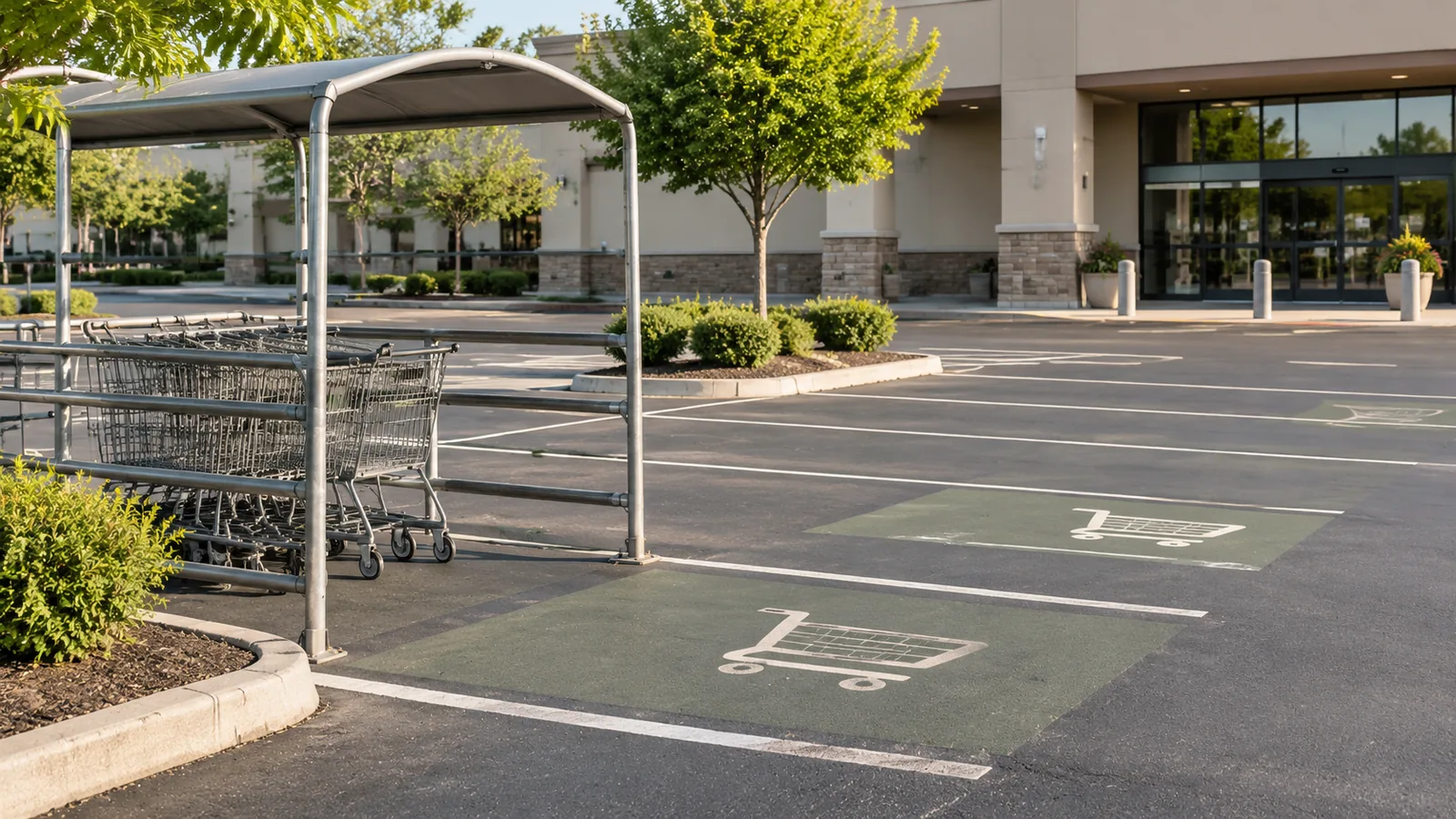
Parking lot and curbside injuries
A parking-area fall starts with one question, which is who owned and controlled that exact spot.
| Condition (hypothetical) | Who may control it |
|---|---|
| A pothole in the drive lane | The shopping center landlord, under the lease. |
| A broken wheel stop in a Curbside pickup space | The grocery operator or a maintenance contractor. |
| Standing water from a blocked drain | Whoever handles drainage under the lease and in practice. |
| A slick surface or blocked pedestrian route | Whoever maintains that walkway day to day. |
A landlord or contractor may owe different duties from the grocery operator, and the lease and actual maintenance practice help show who's responsible. Parking-lot and walkway claims are part of the firm's broader Dallas premises liability and Fort Worth premises liability work.
| If a vehicle hits you | Preserve |
|---|---|
| Driver | Name, plate, and insurance information. |
| Witnesses | Names and phone numbers of anyone who saw it. |
| Video | Lot cameras and any nearby dashcam footage. |
| Movement and visibility | Direction of travel, lighting, and where you were standing. |
| Property defect | A defect may have contributed, but an owner isn't liable just because a collision happened on its land. |
Any supported theory has to connect control, a legally relevant failure, and causation to the collision or injury.
| Curbside question | Why it matters |
|---|---|
| What was each person doing? | Loading, pushing carts, walking, and driving each raise different duties. |
| Who employed the person delivering groceries or driving? | Employment, contractor, and agency relationships need evidence, and they may not all be the same company. |
| What coverage applies? | Auto and commercial liability coverage serve different purposes and are investigated separately [S20, S21]. |
Who may be responsible besides HEB?
Depending on the facts, responsibility may fall on the store operator, property owner, shopping center manager, cleaning company, refrigeration vendor, construction contractor, merchandise vendor, equipment company, or a negligent driver.
| Possible party | What might connect it (hypothetical) |
|---|---|
| Property owner or center manager | Control of the parking lot and sidewalks. |
| Cleaning company | An overnight floor-care contract. |
| Refrigeration vendor | A service call on the dairy case two days earlier. |
| Merchandise vendor | A vendor rep who built the endcap display. |
| Driver | A car backing out of a Curbside space. |
| A caution | No company should be named just because it appears on a delivery record or carries insurance. |
Identify the correct legal entity for the store and the work involved, because the brand on the building isn't entity research.
| Entity research step | Why |
|---|---|
| Check the store address and lease records | Operators and owners can differ by location. |
| Read incident records and business information | They can name the entity handling the store and the claim. |
| Don't copy a name from another case | H-E-B, LP appears in Peterson, but that doesn't identify every proper defendant for every store, date, and operation [S6]. |
There's no standard number of defendants. Texas proportionate responsibility rules in Chapter 33 can divide fault among legally relevant participants [S16].
| Your share of responsibility (hypothetical) | Effect under Chapter 33 |
|---|---|
| More than 50 percent | You recover nothing [S16]. |
| 50 percent or less, such as 20 percent | Your damages are reduced by your percentage. |
| Settlements and joint liability | Separate rules apply to settlement credits and joint-liability thresholds. |
Do warning signs and your own knowledge affect the claim?
Yes, a cone or warning sign matters, but having one doesn't resolve every claim.
| Warning question | Example (hypothetical) |
|---|---|
| Where was it placed? | A cone at the end of aisle 4 while the spill sat mid-aisle. |
| When was it placed? | A sign set out after the fall isn't a warning before it. |
| Could you see it? | A sign hidden behind a stacked display. |
| Did it match the danger? | A sign far from the wet area is different from a barrier closing the aisle. |
| How do you prove it? | Photos and witness accounts taken before memories blur. |
In Austin v. Kroger Texas, L.P., an employee case, the Supreme Court of Texas held a property owner generally has no duty to warn of or make safe open-and-obvious or known hazards, with exceptions for third-party criminal activity and necessary use [S11].
| Tell your lawyer | Why |
|---|---|
| You saw the condition before you fell | Known-and-obvious-danger law can affect whether a duty existed, not only your percentage of fault. |
| You'd used that route earlier or got a warning | It bears on what you knew. |
| Why you used the route anyway | Necessary use needs careful analysis, and shopping convenience doesn't automatically establish it. |
| Other routes you could have taken | Explain the alternatives honestly. |
Expect the defense to look at distraction, footwear, physical conditions, route choice, and prior injuries, so be accurate about each.
| Difficult fact (hypothetical) | How to handle it |
|---|---|
| A prior knee problem | It doesn't automatically defeat a new injury or aggravation claim, but hiding it can hurt your credibility. |
| You were reading your phone | Say so, because a sound evaluation deals with helpful and difficult evidence before a demand or deposition. |
What decides settlement value in an HEB injury case?
There's no reliable H-E-B injury settlement price list, so value depends on the proof in your case.
| Value factor | What it turns on |
|---|---|
| Liability | How well notice, control, and causation are supported. |
| Injury and treatment | Medical causation, treatment, and future needs. |
| Work loss | Missed time and reduced earning capacity. |
| Pain and limits | Concrete effects on daily life. |
| Shared fault | Your percentage under Chapter 33. |
| Coverage and collection | What insurance and assets are actually available. |
A serious fracture with clear notice evidence is different from a disputed fall with an unknown cause, and neither can be valued from a generic online range.
| Proof | What to do |
|---|---|
| Medical records | Report symptoms and prior conditions accurately. |
| Missed work | Keep employment or business records. |
| Daily life | Describe concrete effects, like no longer lifting a grandchild, instead of legal labels. |
| Future care and earning capacity | These may need qualified opinions. |
| Medical expenses | Section 41.0105 limits recovery to amounts actually paid or incurred [S17]. |
| Expense affidavits | Under section 18.001, an uncontroverted affidavit can support that charges were reasonable and services necessary, but it isn't evidence of causation [S18]. |
What you take home after fees, expenses, medical balances, liens, and reimbursement claims is a different number from the gross settlement.
| Before you settle | Ask for |
|---|---|
| Fees | Written fee terms. |
| Deductions | A clear estimate of what comes out of the gross amount. |
| The release | An explanation of its effect on other defendants, property claims, and future treatment needs. |
What public data says about HEB stores and injuries
H-E-B's newsroom describes the company's stores in Texas and Mexico, but no public source gives a count of Texas H-E-B injuries [S2].
| Data point | What it can and can't show |
|---|---|
| H-E-B's newsroom store description | It includes Mexico and isn't a count of Texas stores on the date of any injury [S2]. |
| Commercial location datasets | They exist, but they aren't official counts and weren't independently audited for banners or completeness. |
| H-E-B's official store locator | Use it to verify an individual address and banner, not as an injury dataset [S4]. |
Research for this guide found no statewide H-E-B injury count, settlement average, or policy limit in the sources.
| Not established by public sources | Why |
|---|---|
| An annual total of Texas H-E-B customer accidents or injuries | No comprehensive public count was found. |
| An annual count of lawyer-negotiated settlements | No complete count was found. |
| An H-E-B-specific settlement mean or median | No representative figure exists in the sources. |
| Lawsuits and opinions as a census | A lawsuit isn't a paid claim, and a published appellate opinion isn't a census of either. |
| Employee injury statistics | They can't be relabeled as customer injury statistics. |
| Stores multiplied by a national accident rate | That estimate isn't supported by the data, and your location, date, witnesses, and maintenance history matter more. |
How does liability insurance work for an HEB claim?
Commercial general liability insurance can cover bodily injury and premises risks, and excess coverage may apply above the underlying limits [S20].
| What decides coverage | Why |
|---|---|
| The actual policies | Their terms control. |
| Insured entities and endorsements | They define who and what is covered. |
| Retentions and exclusions | They change when and whether a policy responds. |
| The incident date | Coverage is tied to the policy in effect. |
| A current H-E-B schedule | No current companywide customer liability schedule or per-store limit was verified in the reviewed sources. |
H.E. Butt Grocery Co. v. National Union Fire Insurance Co., a 1998 Fifth Circuit decision, describes a $1 million per-occurrence self-insured retention under a historical H-E-B policy involving 1994 events [S5].
| Point | What it means |
|---|---|
| A self-insured retention | It's the amount the insured bears before the policy responds under its terms, not the insurer's coverage limit [S5]. |
| The age of the case | It's old and factually different, so it doesn't show current coverage, a modern fall settlement average, or a cap on your damages. |
| Policy-limit talk | Don't accept an unsupported claim that every H-E-B customer claim is worth a policy limit, or that a large company pays every demand. |
| Your case | Ask how counsel will investigate coverage and collection as part of the whole case, since liability and damages still need proof. |
What are the filing deadlines and the path to court?
Texas generally gives you two years to file a personal injury lawsuit under section 16.003, subject to accrual rules and exceptions [S14].
| Deadline issue | What to know |
|---|---|
| Two-year limitations | Section 16.003 sets the general rule, with exceptions [S14]. |
| Construction and design claims | Sections 16.008 and 16.009 set a 10-year repose period for design professionals and builders of improvements [S14]. |
| Certificate of merit | Chapter 150 requires one with the first pleading against licensed architects, engineers, land surveyors, or landscape architects [S22]. |
| Claim numbers and negotiations | An incident report, claim number, or ongoing negotiation shouldn't be assumed to extend the deadline. |
| Defendants and service | Naming the right defendant and serving it diligently also matter. |
A lawsuit may involve discovery, inspections, depositions, qualified experts, summary judgment, mediation, trial, and post-judgment proceedings.
| Stage | What to know |
|---|---|
| Summary judgment | For motions filed on or after March 1, 2026, amended Rule 166a generally makes the response due 21 days after the motion is filed, unless the court grants leave or the parties agree [S15]. |
| Calendar | Current rules and court orders control the dates [S19]. |
| Preparation | Build the evidence well before a motion challenges what's missing. |
Frequently asked questions
Here are short answers to questions H-E-B shoppers often have after an injury.
| Question | Short answer |
|---|---|
| Can HEB be liable in more than one way? | Potentially. A case may involve an existing dangerous condition, contemporaneous employee activity, a supported undertaking, or another theory, but repeating negligence labels doesn't avoid the elements of a premises claim [S9, S13]. |
| What if another customer caused the spill? | The store may still face a claim if it knew or should have discovered that specific danger and failed to use reasonable care, but it isn't responsible the instant a customer spills something [S6, S8]. |
| Can I sue without video? | Possibly. Witnesses, photos, records, employee observations, and expert evidence can establish a claim, and missing footage doesn't automatically prove liability or entitle you to a favorable instruction [S12]. |
| Must I accept the claims representative's first offer? | No. An offer isn't a court's valuation, so check whether liability and medical needs are understood, what the release covers, and what your gross and net recovery would be. |
| How many parties should my lawsuit name? | Only those the facts and law support. Adding an owner, operator, contractor, or driver doesn't automatically add valid claims or money, and fault allocation and releases have to be coordinated [S16]. |
| Why consider Aaron Herbert? | He is Board Certified in Personal Injury Trial Law by the Texas Board of Legal Specialization, which you can verify [S1]. Ask how the firm would preserve evidence, investigate notice and control, evaluate experts, explain fees, and prepare for litigation, and know that representation and any recovery depend on the facts and an agreed engagement. |
Prepare for a useful case evaluation
A short, organized chronology helps more than a perfect folder.
| Bring or prepare | Why it helps |
|---|---|
| A short chronology | It covers the shopping trip, the injury, the report, medical care, and later contacts. |
| The store address and exact spot | Name the department or outside location, like the produce misters or the cart corral. |
| Original documents and photos | Keep the originals and make a separate copy for your notes. |
| Estimated times marked as estimates | An estimate shouldn't turn into a precise fact in later retelling. |
| A list of people and their roles | One person saw the fall, another saw the condition earlier, and a companion talked to management, and independent accounts help on notice and mechanism. |
| Separate witness accounts | Don't ask everyone to sign the same narrative. |
| Offers, authorizations, releases, recorded statements, and letters | Bring the actual wording instead of relying on a representative's description. |
| Health insurance, auto coverage for a parking collision, and reimbursement letters | They can affect coverage, records access, and your net result without deciding the negligence claim. |
| A question about each next step | Ask what it will resolve, such as control of a parking area, a notice witness, surrounding footage, or a qualified opinion, which gives a better basis for discussing costs and settlement timing than an early guess at value. |
| Whatever you have now | Seek advice even without every item, because a timely preservation discussion can matter more. |
Tell us about your H-E-B injury or call (214) 200-4878, and mention anything that may be lost or changed soon. Bring the store address, the incident date, your injury details, photos, and the names of witnesses.
Sources
| Source | What it supports |
|---|---|
| [S1] State Bar of Texas, Aaron Alan Herbert profile | Board certification, Bar number 24036761, the November 6, 2002 license, and eligibility. |
| [S2] H-E-B Newsroom, October 28, 2026 release | The company's own description of its stores in Texas and Mexico. |
| [S4] H-E-B official store locator | Verifying an individual store address and banner. |
| [S5] H.E. Butt Grocery Co. v. National Union Fire Ins. Co., 150 F.3d 526 (5th Cir. 1998) | The historical $1 million per-occurrence self-insured retention. |
| [S6] H-E-B, LP v. Peterson, No. 24-0310 (Tex. Apr. 10, 2026) | Constructive notice and proof of how long a puddle existed. |
| [S8] Wal-Mart Stores, Inc. v. Reece, 81 S.W.3d 812 (Tex. 2002) | The time-notice rule and employee proximity. |
| [S9] Keetch v. Kroger Co., 845 S.W.2d 262 (Tex. 1992) | Premises elements and the negligent-activity distinction. |
| [S10] Brookshire Grocery Co. v. Taylor, 222 S.W.3d 406 (Tex. 2006) | The soft-drink dispenser and ice decision. |
| [S11] Austin v. Kroger Texas, L.P., 465 S.W.3d 193 (Tex. 2015) | Known and obvious hazards and their exceptions. |
| [S12] Brookshire Bros., Ltd. v. Aldridge, 438 S.W.3d 9 (Tex. 2014) | Preservation, spoliation, and proportionate remedies. |
| [S13] United Scaffolding, Inc. v. Levine, 537 S.W.3d 463 (Tex. 2017) | Premises conditions versus negligent activity. |
| [S14] Texas Civil Practice and Remedies Code, Chapter 16 | Two-year limitations and construction and design repose. |
| [S15] Supreme Court of Texas Misc. Docket No. 26-9012 | Amended Rule 166a, effective March 1, 2026. |
| [S16] Texas Civil Practice and Remedies Code, Chapter 33 | Proportionate responsibility, settlements, and joint liability. |
| [S17] Texas Civil Practice and Remedies Code, Chapter 41 | Paid-or-incurred medical expenses under section 41.0105. |
| [S18] Texas Civil Practice and Remedies Code, section 18.001 | Medical expense affidavits. |
| [S19] Texas Rules of Civil Procedure, official compilation current October 1, 2026 | The current procedural rules. |
| [S20] Texas Department of Insurance, commercial general liability insurance | How commercial liability coverage works. |
| [S21] Texas Department of Insurance, automobile insurance guide | Auto coverage in parking-lot collisions. |
| [S22] Texas Civil Practice and Remedies Code, Chapter 150 | The certificate of merit for covered professional claims. |
ABOUT THE ATTORNEY
Aaron A. Herbert
Founding Attorney
Board Certified in Personal Injury Trial Law
Aaron founded The Law Firm of Aaron A. Herbert in 2010 to focus on developing each client's case and seeking its maximum value. For over a decade, he has represented people seriously injured in major accidents and industrial catastrophes, pursuing trial verdicts and settlements while working to reduce the stress of litigation.
Education
- Texas A&M University · B.S., Criminal Justice, 1999
- University of Oklahoma College of Law · J.D., 2002; graduated in the top of his class
Trial experience & approach
Aaron earned numerous jury verdicts at boutique personal injury litigation firms. According to his biography, he spent a year as the top-earning litigation attorney at a firm that frequently appeared in verdict searches as having one of the highest numbers of trial wins in Texas. At another Dallas personal injury firm, he moved from managing pre-litigation attorney to managing litigation attorney over seven years as the firm grew into one of Dallas's largest personal injury firms.
His biography describes a reputation as one of America's most aggressive trial lawyers, with noteworthy recoveries from judges and juries and substantial pretrial settlements. Most of those settlements included confidentiality agreements requested by the defense. Aaron has said the recoveries were justified by the injuries and losses involved, which no amount of money could make someone choose to experience.
His approach combines passion, preparation, persistence and courtroom imagination. He believes a well-supported, engaged and motivated team working cooperatively helps deliver strong representation, with the goal of achieving the best possible result for every client.
Dallas roots, military service & publication
Born and raised in Dallas, Aaron enlisted in the United States Marine Corps after high school and later received an Honorable Discharge. He completed his university and law degrees after his military service and became a lifelong Sooners football fan in law school.
Publication: “Litigating Dog Bite Cases,” Texas Dog Law Seminar, Dallas, 2009.
Professional affiliations & recognition
Professional affiliations and recognition listed in Aaron’s biography:
- State Bar of Texas
- American Bar Association
- Association of Trial Lawyers of America (now American Association for Justice)
- Texas Trial Lawyers Association
- Dallas Trial Lawyers Association
- Dallas Bar Association
- Tarrant County Bar Association
- Million Dollar Advocates Forum
- The National Trial Lawyers – Top 100 Trial Lawyers