
Lost footage can matter, but it does not prove the store was at fault, and it does not guarantee a jury instruction.
What is the short answer?
Yes, missing video can affect the case, but the judge decides what, if anything, to do about it. The court asks whether Costco had a duty to preserve the footage, which can begin once there was a substantial chance a claim would be filed, and whether that duty was breached. Remedies vary, a jury instruction is the rare one, and missing video does not by itself establish liability.
| Common belief | What Texas law says |
|---|---|
| Missing video means Costco loses. | It does not establish liability. |
| The jury will always hear about it. | An instruction is a remedy the judge may or may not give. |
| A letter to the store started the duty. | The duty may start earlier, when there was a substantial chance a claim would be filed. |
| Any short clip proves a cover-up. | A short export needs an explanation, not an assumption. |
Why does the video matter so much?
Because video can show time. In Brookshire Brothers, Ltd. v. Aldridge, 438 S.W.3d 9 (Tex. 2014), footage showed employees repeatedly passing a large grease spill in the five minutes before the shopper slipped. The Texas Supreme Court later pointed to that footage as some evidence of constructive knowledge.
Peterson, decided by the same court in April 2026, is the flip side. No camera showed when the puddle in that H-E-B toy aisle formed, and the shopper had "no idea" how long it had been there. She lost on summary judgment.
What does "missing" mean in your file?
Which of these happened to your video?
- No recording was made. Did this camera record the area at all?
- The camera faced elsewhere. Could its view have answered the disputed question?
- It was overwritten on a routine schedule. Did a duty to preserve exist by then?
- It was lost after the duty arose. What caused the loss?
Save the first copy and any system logs now. Then write down the date of the incident report, the date the preservation letter arrived, and the date of any export or deletion, with the name of the person who did it. Our guide on what evidence should be preserved after a Costco injury covers the first steps.

What does a worked example look like?
Here is a hypothetical example, not an actual case. The store's system keeps video for 30 days. On the day you fall, a manager watches the footage and exports 20 seconds of it. Your lawyer's letter asking for the full hour arrives on day 12. On day 30, the system quietly records over the original. Now the 20-second clip is all anyone has.
Don't assume the missing 59 minutes and 40 seconds were full of good news for you. Maybe they were. Maybe the camera was pointed at the bakery case. Find out why the manager picked those particular 20 seconds, whether he watched the rest first (and what he saw), and whether a second camera caught the same stretch of floor.
What happens in the lawsuit?
The person who runs the camera system gets deposed first. Bring the retention policy, the system settings and the export log, and make the witness walk through them. What was the overwrite schedule? Who chose the clip? Was anything else saved? Then the motion asks the judge for the least severe remedy that fixes the problem. See What Costco Surveillance Video Should a Lawyer Request and How to Litigate a Costco Injury Case in Texas.
Key point: Winning the fight over lost video doesn't win the fall case. You still have to prove the hazard, notice and timing.
How do Texas judges handle lost evidence?
Under Brookshire Brothers, the judge handles this, not the jury. Picture the manager who filled out an incident report at 2 p.m. and watched an ambulance pull up. By then, did the store know there was a substantial chance of a claim? That's duty. Did it do anything reasonable to keep the footage? That's breach. And if not, what fix matches the harm the loss caused? That's the remedy.
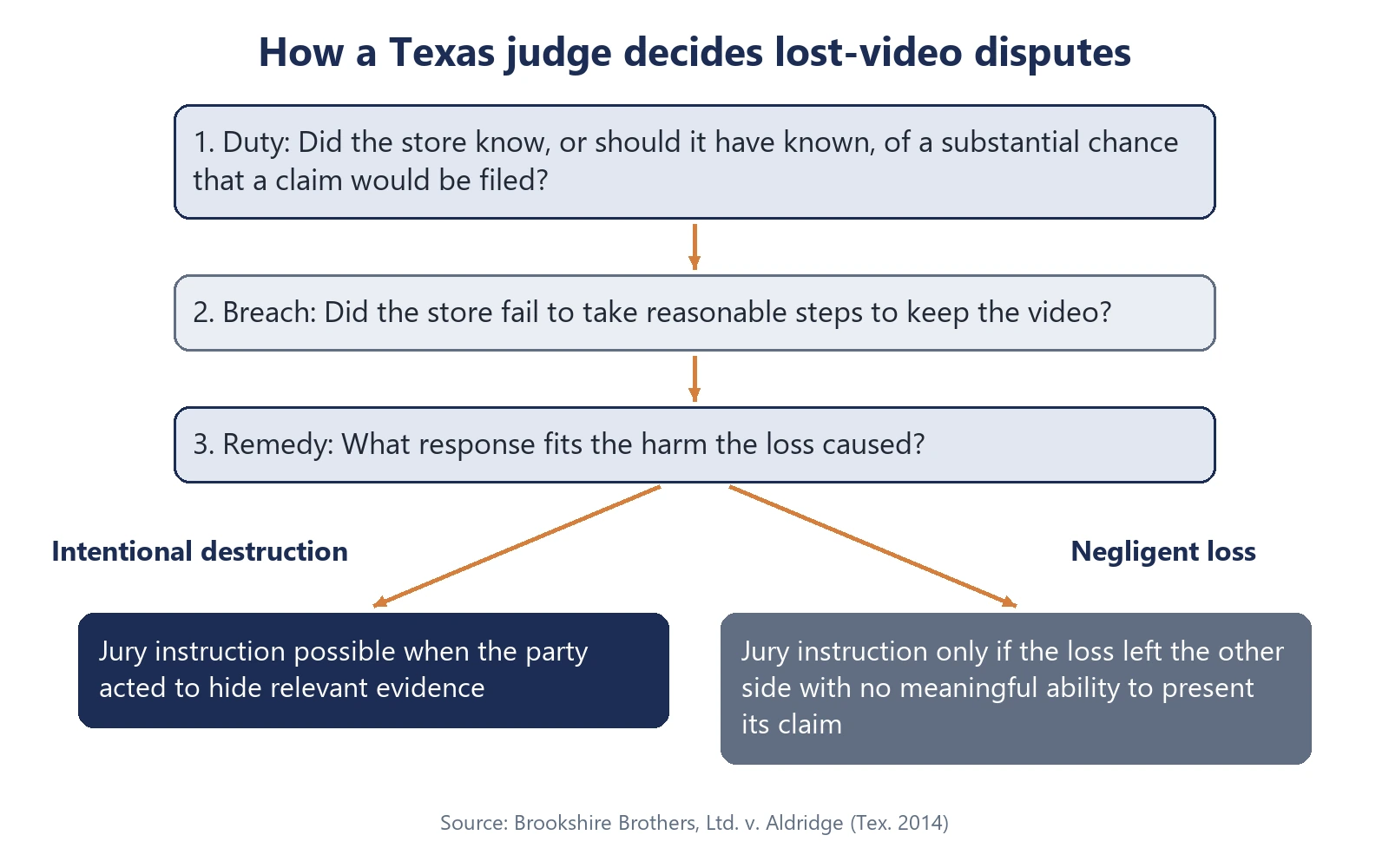
The limits on a jury instruction are strict:
| Type of loss | When an instruction may be given |
|---|---|
| Intentional destruction. | When the party acted to hide relevant evidence. |
| Negligent loss. | Only when it irreparably deprived the other side of any meaningful ability to present its claim. |
The court enforced those limits in Petroleum Solutions, Inc. v. Head (Tex. 2014). The trial judge there had given a spoliation instruction and struck the defendant's defenses. The Supreme Court held that both sanctions failed the Brookshire Brothers standard and sent the claims back for a new trial.
Frequently asked questions
Will the jury be told Costco lost the video?
Only if the judge picks an instruction as the remedy. That's the rare end of the scale.
My lawyer's letter went out on day 35. Is it too late?
For the footage, probably. For the argument, not necessarily, because the store's duty can start before any letter shows up.
Only 20 seconds were saved. Now what?
Find out who picked those 20 seconds, why, and whether that person watched the rest.
More Costco guides are on the Costco injury claims in Texas hub.
Sources
- Petroleum Solutions, Inc. v. Head, No. 11-0425 (Tex. 2014), applying Brookshire Brothers, Ltd. v. Aldridge, 438 S.W.3d 9 (Tex. 2014)
- H-E-B, LP v. Peterson, No. 24-0310 (Tex. Apr. 10, 2026)
This article is general information, not legal advice. Reading it does not make you our client, and every claim turns on its own facts and deadlines.

ABOUT THE ATTORNEY
Aaron A. Herbert
Founding Attorney
Board Certified in Personal Injury Trial Law
Aaron founded The Law Firm of Aaron A. Herbert in 2010 to focus on developing each client's case and seeking its maximum value. For over a decade, he has represented people seriously injured in major accidents and industrial catastrophes, pursuing trial verdicts and settlements while working to reduce the stress of litigation.
Education
- Texas A&M University · B.S., Criminal Justice, 1999
- University of Oklahoma College of Law · J.D., 2002; graduated in the top of his class
Trial experience & approach
Aaron earned numerous jury verdicts at boutique personal injury litigation firms. According to his biography, he spent a year as the top-earning litigation attorney at a firm that frequently appeared in verdict searches as having one of the highest numbers of trial wins in Texas. At another Dallas personal injury firm, he moved from managing pre-litigation attorney to managing litigation attorney over seven years as the firm grew into one of Dallas's largest personal injury firms.
His biography describes a reputation as one of America's most aggressive trial lawyers, with noteworthy recoveries from judges and juries and substantial pretrial settlements. Most of those settlements included confidentiality agreements requested by the defense. Aaron has said the recoveries were justified by the injuries and losses involved, which no amount of money could make someone choose to experience.
His approach combines passion, preparation, persistence and courtroom imagination. He believes a well-supported, engaged and motivated team working cooperatively helps deliver strong representation, with the goal of achieving the best possible result for every client.
Dallas roots, military service & publication
Born and raised in Dallas, Aaron enlisted in the United States Marine Corps after high school and later received an Honorable Discharge. He completed his university and law degrees after his military service and became a lifelong Sooners football fan in law school.
Publication: “Litigating Dog Bite Cases,” Texas Dog Law Seminar, Dallas, 2009.
Professional affiliations & recognition
Professional affiliations and recognition listed in Aaron’s biography:
- State Bar of Texas
- American Bar Association
- Association of Trial Lawyers of America (now American Association for Justice)
- Texas Trial Lawyers Association
- Dallas Trial Lawyers Association
- Dallas Bar Association
- Tarrant County Bar Association
- Million Dollar Advocates Forum
- The National Trial Lawyers – Top 100 Trial Lawyers