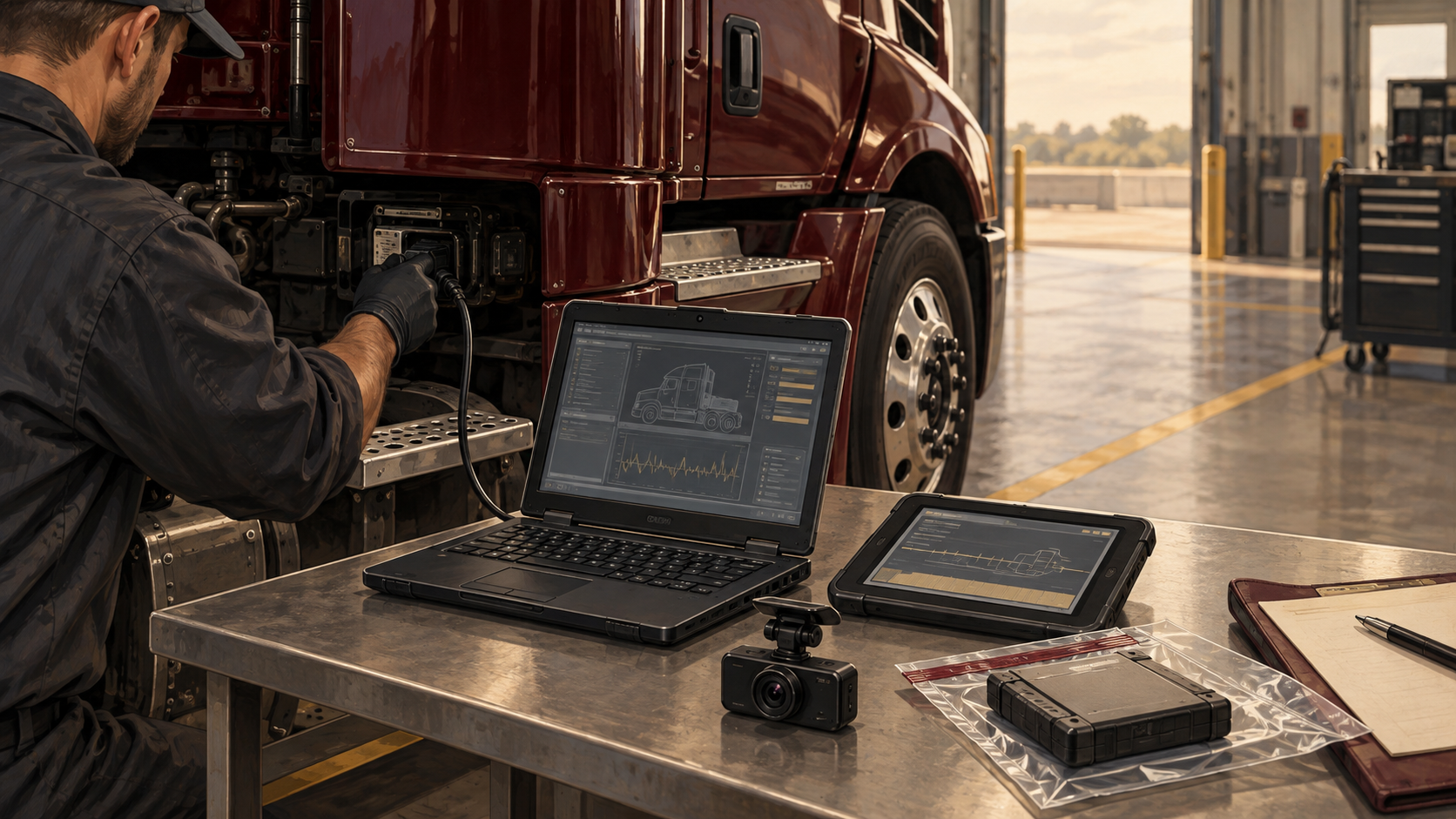
A request for truck-camera footage comes back with no video. Before accusing anyone of destroying evidence, counsel needs to find out whether the camera recorded the trip, where the recording went and who could retrieve it. A camera failure, an incomplete search and deletion after a duty to preserve arose present different facts. Texas courts need those facts before deciding whether spoliation occurred or choosing a remedy.
Identify the missing evidence precisely
Keep a search record for each source, including:
- The truck, camera and recording period requested.
- The employee who searched and the date of the search.
- The accounts or devices checked.
- Any request made to the vendor or to other people who might hold copies.
This is how counsel can distinguish an incomplete search from evidence that has disappeared. A carrier’s answer about its own folder may say nothing about what the vendor still holds.
Suppose the only item produced is an email with a still from the truck camera. Save the email and its attachment together. They may identify the camera, the employee who obtained the image and when that employee had it. The next step is to trace the full recording. Equipment instructions, retention settings and export records are useful here. Do not assume that the camera kept only that one frame, or that the employee saved everything it recorded.
Build the preservation chronology
The date of a preservation letter is only one entry in the chronology. The company may have learned of the injury earlier, and the recording may have disappeared before or after either event. Put the crash, injury notice, claim communications, preservation requests and loss in order. Identify the source for each date. Counsel can then assess when the duty arose against what the company knew at that time.
For each preservation step, record:
- Who handled the request.
- What that person copied or retained.
- When the work was done.
- Whether the result was a full export, a still image, the wrong date or something else.
Back each date with a document, such as the letter, the email or the system log. Check privilege before seeking communications that involve counsel. A dispute over a lost recording does not, by itself, entitle the requesting party to the carrier’s privileged legal correspondence.
Apply the Texas remedy framework
In Wackenhut Corp. v. Gutierrez, a bus recording was overwritten. Applying Brookshire Brothers, Ltd. v. Aldridge, the Texas Supreme Court held that the spoliation instruction should not have been given. Even assuming negligent spoliation, the remaining witness testimony, reports, photographs and medical records left the claimant able to present his case.
The judge decides whether spoliation occurred and what to do about it. Wackenhut explains the narrow grounds for a jury instruction: intent to conceal discoverable evidence, or negligent loss so severe that the opponent is irreparably deprived of any meaningful ability to present a claim or defense. Counsel seeking relief must establish the duty to preserve and its breach, explain the culpability and prejudice, and support the particular remedy requested. An instruction is not the automatic consequence of an overwritten file.

Look for alternative sources
A second camera may show the impact from another angle. Dispatch may still have a message that was deleted from the driver’s device. Look for recipients’ copies, vendor storage and backups as well as other devices. Compare what each surviving source actually contains with the information that is missing.
In Wackenhut, the court could point to testimony from the drivers and an eyewitness, police evidence, photographs and medical records. Compare the surviving proof in the actual truck case just as concretely. Identify the view, time period or other information each substitute supplies, and any gap it leaves. Where technical interpretation is necessary, use a qualified witness to explain it.
Prepare a focused hearing record
Bring these materials to the spoliation hearing.
| Hearing material | What it should show |
|---|---|
| Search history | The employee’s account of the download attempt, the steps taken, and any error message. |
| System behavior | Retention settings, audit logs, and the technician’s explanation of deletion. |
| Recovery attempts | What the employee or vendor actually tried, the result of each attempt, and the correspondence recording that work. |
| Possible equipment failure | The evidence for that explanation, even if it cuts against the requested relief. |
| Intentional deletion | Proof of that intent, if intent is alleged. |
The spoliation hearing does not give counsel free rein to discuss the missing file before the jury. Obtain and follow the court’s rulings about the remedy and any permitted trial presentation. In particular, do not tell jurors that the lost material must have been unfavorable merely because the other side no longer has it.
Evidence to preserve and request
Hypothetical: the carrier’s written policy keeps camera video for 30 days, but the unit in this truck was set to overwrite after 72 hours. The policy alone would not reveal that gap.
| Request | Purpose |
|---|---|
| Retention settings, deletion logs, and vendor records for the camera at issue | Show the settings the truck actually used. |
| Who controlled retention and when each setting was in effect | Tie the loss to a person and a period. |
| The litigation-hold acknowledgment and any copies recovered elsewhere | Show what was saved after notice. |
| Metadata or an audit trail in native or reasonably usable form | Help explain how and when the loss happened. |
| A witness familiar with the system | Explain the records and the period they cover. |
Name the crash and the vehicles in the preservation notice. Include the people, shipment, dates and systems involved so the recipient can locate the records. Acknowledgment of the notice is only a start: ask what was saved, by whom and when. Record anything the recipient says was already unavailable. Keep that correspondence and agree on an appropriate way to inspect or export the material.
Discovery and deposition strategy
Before noticing depositions, use interrogatories to identify the companies and people involved. Include the safety personnel, records custodians and vendors, along with the devices, accounts and repositories they used. Requests for production should reach both the records and the instructions needed to understand them. A request for admission should put a particular proposition to the recipient that it can fairly admit or deny. Choose witnesses according to the unanswered questions. The employee who tried to download a file can describe that attempt. The corporate designee must prepare to testify from the organization’s knowledge. For questions neither can answer about the system itself, consider testimony from the vendor or a forensic witness.
Arrange the deposition exhibits by date and work through them with the witness. Establish who or what created each record and which event it describes. Check the time standard before comparing timestamps. Ask whether the record could be edited, how an edit would appear and when routine retention would end. Follow through to the company’s response and whether anything is missing from its production. If a corporate representative cannot answer, ask what records they reviewed and whom they consulted; a gap in that witness’s preparation may differ from a lack of company information.
Common defense positions and focused responses
| Defense position | Focused response |
|---|---|
| The request is overbroad. | Tie each category to an identified issue, custodian, system, and reasonable period; offer staged production. |
| The record is unavailable. | Obtain retention settings, deletion history, preservation actions, vendor testimony, and substitute sources. |
| The rule does not apply. | Prove vehicle, driver, operation, and date-specific applicability; address exemptions and intrastate rules. |
| The fact did not cause the crash. | Use reconstruction, chronology, and expert testimony to connect the failure to perception, response, or vehicle performance. |
| The corporate evidence is inadmissible. | Identify a permitted purpose such as control, notice, system meaning, causation, authentication, or a later trial phase. |
Frequently asked questions
Why must this evidence be requested early?
Trucks return to service or go in for repairs, cameras record over old footage and vendors delete data when retention periods expire. A prompt request tells the people holding the records what to save.
Is a PDF or screenshot enough?
Sometimes, for a narrow question. It may omit metadata, fields, edits and relationships, so request native or reasonably usable data when those features matter.
Does a violation automatically establish liability?
No. Applicability, breach, causation, admissibility and damages remain separate questions.
Can more than one company control the evidence?
Yes. The carrier may access a platform while the vendor holds backend data; the tractor owner, driver or customer may hold separate copies.
How does HB 19 affect the issue?
Chapter 72 may affect trial sequence and admissibility. Identify the phase and permitted purpose for each category instead of assuming all corporate proof is excluded.
This article provides general information about Texas truck-accident litigation. It is not legal advice. The applicable law and available remedies depend on the facts of the case.

ABOUT THE ATTORNEY
Aaron A. Herbert
Founding Attorney
Board Certified in Personal Injury Trial Law
Aaron founded The Law Firm of Aaron A. Herbert in 2010 to focus on developing each client's case and seeking its maximum value. For over a decade, he has represented people seriously injured in major accidents and industrial catastrophes, pursuing trial verdicts and settlements while working to reduce the stress of litigation.
Education
- Texas A&M University · B.S., Criminal Justice, 1999
- University of Oklahoma College of Law · J.D., 2002; graduated in the top of his class
Trial experience & approach
Aaron earned numerous jury verdicts at boutique personal injury litigation firms. According to his biography, he spent a year as the top-earning litigation attorney at a firm that frequently appeared in verdict searches as having one of the highest numbers of trial wins in Texas. At another Dallas personal injury firm, he moved from managing pre-litigation attorney to managing litigation attorney over seven years as the firm grew into one of Dallas's largest personal injury firms.
His biography describes a reputation as one of America's most aggressive trial lawyers, with noteworthy recoveries from judges and juries and substantial pretrial settlements. Most of those settlements included confidentiality agreements requested by the defense. Aaron has said the recoveries were justified by the injuries and losses involved, which no amount of money could make someone choose to experience.
His approach combines passion, preparation, persistence and courtroom imagination. He believes a well-supported, engaged and motivated team working cooperatively helps deliver strong representation, with the goal of achieving the best possible result for every client.
Dallas roots, military service & publication
Born and raised in Dallas, Aaron enlisted in the United States Marine Corps after high school and later received an Honorable Discharge. He completed his university and law degrees after his military service and became a lifelong Sooners football fan in law school.
Publication: “Litigating Dog Bite Cases,” Texas Dog Law Seminar, Dallas, 2009.
Professional affiliations & recognition
Professional affiliations and recognition listed in Aaron’s biography:
- State Bar of Texas
- American Bar Association
- Association of Trial Lawyers of America (now American Association for Justice)
- Texas Trial Lawyers Association
- Dallas Trial Lawyers Association
- Dallas Bar Association
- Tarrant County Bar Association
- Million Dollar Advocates Forum
- The National Trial Lawyers – Top 100 Trial Lawyers