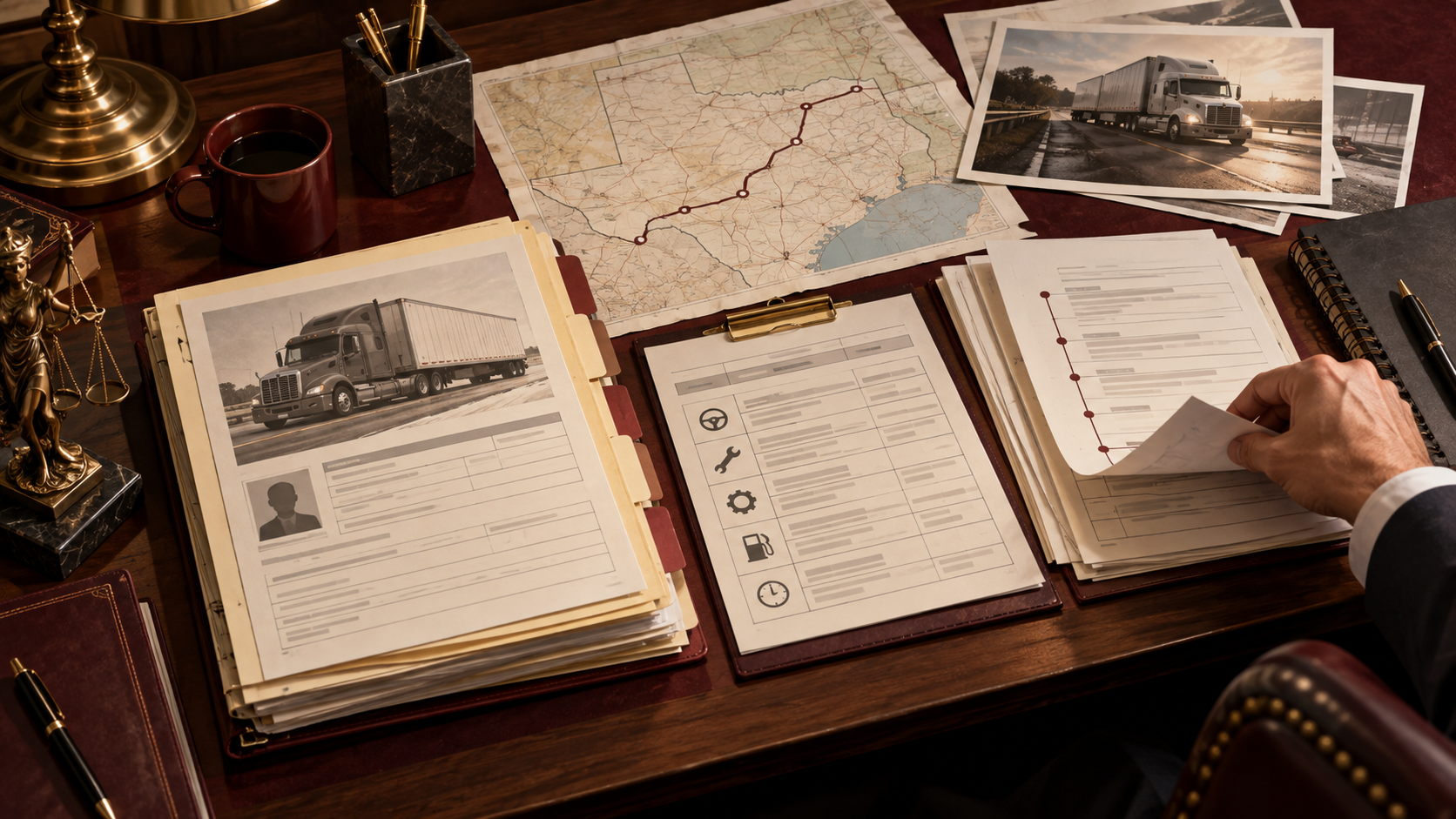
A broker, shipper and carrier may all be involved in the same trip. The records should show who did what. Start with the conduct you believe contributed to the crash, then identify the person or company responsible for that conduct. Arranging a shipment is not, by itself, proof that a business caused an injury.
Identify what each company handled
Put the transportation contract beside the rate confirmation, bill of lading, dispatch messages and loading records. The names may change from document to document. Ask who selected the carrier, who supplied the truck, who loaded the freight and who spoke with the driver. A company can take on more than one role; a label alone will not answer the question.
FMCSA describes the regulatory categories for motor carriers, brokers and freight forwarders. Those definitions help identify the kind of work involved. For this shipment, check the underlying records too. A broker’s name on a form does not show that it controlled the driver, and a contract heading does not establish what happened on the road.
What the Supreme Court’s broker ruling means
On May 14, 2026, the Supreme Court decided Montgomery v. Caribe Transport II, LLC, 608 U.S. 219 (2026). Shawn Montgomery was seriously injured when a truck hauling a load arranged by the broker C.H. Robinson struck his tractor-trailer. He claimed the broker negligently hired the carrier.
| Question | What the Court decided |
|---|---|
| Did the FAAAA preempt the negligent-hiring claim against the broker? | No. The Act’s motor-vehicle-safety exception saved the claim from preemption. |
| What happened to the lower-court ruling? | The Court reversed the Seventh Circuit’s judgment, which had upheld the preemption dismissal, and remanded the case. |
| Did the Court decide whether the broker was negligent? | No. The ruling only lets the claim go forward. |
The case can therefore proceed past that preemption defense. Winning the underlying negligence claim is a different matter. In a Texas case, counsel still has to identify a legal duty, show the conduct that allegedly breached it and prove the required causal connection and damages. Naming a broker in a lawsuit does not supply that proof.
Look at what was known when the carrier was chosen
Reconstruct the selection as it happened. Which version of the carrier scorecard was available that day? Who read the onboarding file or a message raising a safety concern? If the company made an exception to its usual process, find out who authorized it. Keep safety records and earlier communications with those materials. A post-crash report might document something the selector already knew, or it might contain entirely new information. The dates and sources help distinguish the two.
Do not treat a score as self-explanatory. Find out when it was measured, what it measures and what information went into it. Then test whether it bears on the risk alleged in this collision. A later crash, standing alone, cannot establish that the company should have selected a different carrier.
Separate a contract from an instruction
Read the dispatcher’s message in context, then question both the sender and the driver about it. A direction to take a certain road, meet a delivery time or change the load may raise a control issue. Find out whether the driver could refuse. Compare that testimony with the contract, including an independent-carrier clause. A routine request for the truck’s location may mean something quite different from an instruction the driver was required to obey.
Keep the discovery focused on the disputed request or undertaking. Whether it supports a claim depends on the facts and the governing legal standard, which counsel can assess.

Trace the loading decisions
Cargo work may involve several people. Identify the person who chose the load arrangement, the one who selected or applied restraints, and whoever supplied the weight information or sealed the trailer. Before relying on a witness’s account, establish what that person could actually inspect. Compare the account with photographs from the dock, video, diagrams and equipment records. After-impact damage may help an expert investigate the load, but it cannot alone establish how the freight was secured before departure.
The person who loaded the trailer may know nothing about how the carrier was selected. Interview and document those subjects separately. As the investigation develops, be prepared for the evidence to support one proposed claim while weakening another.
Make the document request answer a question
A useful request tells the recipient which shipment is at issue and what decision is being examined.
| Part of the request | What to ask for |
|---|---|
| Shipment and period | The load at issue and the dates of the trip. |
| Decision | The selection, instruction or loading decision in dispute. |
| Source material | The records used to make that decision. |
| Witnesses | The names of people who can explain those records. |
| Dispatch messages | The full conversation and attachments, since a screenshot of one sentence may leave out the reply that changes its meaning. |
Then build the chronology one entry at a time.
| Chronology field | What to record |
|---|---|
| Date | When the event happened or the record was made. |
| Source | The document or system that shows it. |
| Witness | The person who can explain the entry. |
| Issue | The duty or causation question the entry bears on. |
| Missing proof | What still has to be obtained. |
A contract establishes a relationship; proving breach and injury causation requires more.
What should a preservation request identify?
Take a hypothetical load booked on March 2 that crashed on March 5. A preservation letter for that trip should list both dates, the companies and driver, the tractor and trailer numbers and any known record systems. For carrier selection, ask for the onboarding file and the scorecard as it stood on March 2, before dispatch.
A safety-undertaking theory needs a clear account of the work the company took on, the person who performed it and the failure alleged within that work. Counsel must examine the claimed increase in risk or reliance. The Texas Supreme Court’s negligent-undertaking analysis focuses on affirmative conduct and the undertaking’s scope. The company’s participation in a shipment alone does not establish this duty.
| Source | Material and follow-up |
|---|---|
| Contract file | Transportation agreement, rate confirmation, bill of lading and amendments; witness able to explain their relationship. |
| Dispatch exchange | Full threads, attachments, revisions and mandatory instructions; material omitted from screenshots. |
| Carrier-vetting system | Platform, custodian and vendor; timestamps, relevant audit history, underlying data and explanation of score fields. |
| Collection history | Collector and collection date; unavailable sources; retention settings and deletion history for relevant gaps. |
Electronic records need their own request terms.
| Electronic request | Why it matters |
|---|---|
| Name the data and the format you want. | The recipient can then search the right system and produce usable files. |
| Ask for the change history when the dispute is about when a warning was added. | The scorecard’s current display may not show it. |
| Limit the period and scope to the pleaded issue. | A narrow request keeps the collection tied to the claim. |
| Check what the recipient preserved. | Open collection or inspection questions can then go into a suitable protocol. |
Which witnesses can explain the company’s decisions?
| Discovery tool | Use it to |
|---|---|
| Interrogatories | Identify the decision-makers, accounts, repositories and vendors. |
| Requests for production | Get the records behind the disputed decision. |
| Requests for admission | Address propositions the company can fairly admit or deny. |
| Corporate designee deposition | Separate personal knowledge from the organization’s knowledge and learn which records and people informed the preparation. |
| Platform or forensic witness | Explain how the system works when the company cannot. |
Walk the witness through the dates, including changes to a record and the time zone used by the system. If a warning appears, ask what the company did after receiving it. Also ask what has been left out of the production. When an employee says “I do not know,” clarify whether someone else or another set of records could supply the answer.
Texas Rules of Civil Procedure 192.3, 192.4, 196.4 and 199.2 govern the scope and limits of this work. Electronic requests should identify the information and desired format; reasonable availability, proper objections and retrieval burdens matter. Corporate-deposition topics should describe the subjects with reasonable particularity.
How can common objections be addressed?
| Defense position | Focused response |
|---|---|
| The request is overbroad | Identify the selection, instruction or loading decision, the custodian and a reasonable period. Consider staged production. |
| The record is unavailable | Examine retention settings, deletion history and preservation steps; ask the vendor about surviving records and identify substitute sources. |
| The regulation does not apply | Check the vehicle, operation, date and claimed role, including exemptions and intrastate requirements. Do not apply a motor-carrier duty merely because a company is a broker. |
| The conduct did not cause the crash | Connect the challenged decision to the collision mechanism through the chronology, reconstruction and qualified testimony. |
| The corporate evidence is inadmissible | Identify its specific purpose, such as control, notice or authentication, and assess the applicable trial phase and evidence rules. |
Two statutes can also shape the trial.
| Statute | Possible effect |
|---|---|
| Texas Civil Practice and Remedies Code Chapter 33 | Allocation of responsibility. |
| Chapter 72 | For claims within its scope, the trial sequence and specified employer-related proof. |
These questions require a claim-specific analysis; discovery relevance does not guarantee admission at trial.
Frequently asked questions
| Question | Short answer |
|---|---|
| Why request broker and shipper records early? | Some systems routinely overwrite dock video and dispatch history, and trucks return to service or go in for repairs. A prompt request gives counsel a chance to ask that the evidence be kept. |
| Is a screenshot of a carrier scorecard enough? | It may answer a narrow question. If the dispute is what the selector knew on a given date, the underlying fields, update history and time of access may matter. |
| Does a safety violation automatically make the broker liable? | No. Duty, breach, causation and damages still need proof. Montgomery lets the covered claim proceed; it does not decide negligence. |
| Can several companies hold different parts of the record? | Yes. The broker may hold the selection file, the carrier its dispatch records, the shipper the loading information and a vendor the backend data. |
| Does HB 19 exclude all broker or shipper evidence? | No blanket answer fits. Check whether Chapter 72 applies, which provision is involved and the purpose and trial phase for each item. |
Put this issue in the larger truck case
The Texas Truck Accident Litigation Knowledge Hub covers preservation, company records and causation. The advanced litigation guide places those subjects in the broader case strategy.
This article provides general information about Texas law, not advice about a particular case.

ABOUT THE ATTORNEY
Aaron A. Herbert
Founding Attorney
Board Certified in Personal Injury Trial Law
Aaron founded The Law Firm of Aaron A. Herbert in 2010 to focus on developing each client's case and seeking its maximum value. For over a decade, he has represented people seriously injured in major accidents and industrial catastrophes, pursuing trial verdicts and settlements while working to reduce the stress of litigation.
Education
- Texas A&M University · B.S., Criminal Justice, 1999
- University of Oklahoma College of Law · J.D., 2002; graduated in the top of his class
Trial experience & approach
Aaron earned numerous jury verdicts at boutique personal injury litigation firms. According to his biography, he spent a year as the top-earning litigation attorney at a firm that frequently appeared in verdict searches as having one of the highest numbers of trial wins in Texas. At another Dallas personal injury firm, he moved from managing pre-litigation attorney to managing litigation attorney over seven years as the firm grew into one of Dallas's largest personal injury firms.
His biography describes a reputation as one of America's most aggressive trial lawyers, with noteworthy recoveries from judges and juries and substantial pretrial settlements. Most of those settlements included confidentiality agreements requested by the defense. Aaron has said the recoveries were justified by the injuries and losses involved, which no amount of money could make someone choose to experience.
His approach combines passion, preparation, persistence and courtroom imagination. He believes a well-supported, engaged and motivated team working cooperatively helps deliver strong representation, with the goal of achieving the best possible result for every client.
Dallas roots, military service & publication
Born and raised in Dallas, Aaron enlisted in the United States Marine Corps after high school and later received an Honorable Discharge. He completed his university and law degrees after his military service and became a lifelong Sooners football fan in law school.
Publication: “Litigating Dog Bite Cases,” Texas Dog Law Seminar, Dallas, 2009.
Professional affiliations & recognition
Professional affiliations and recognition listed in Aaron’s biography:
- State Bar of Texas
- American Bar Association
- Association of Trial Lawyers of America (now American Association for Justice)
- Texas Trial Lawyers Association
- Dallas Trial Lawyers Association
- Dallas Bar Association
- Tarrant County Bar Association
- Million Dollar Advocates Forum
- The National Trial Lawyers – Top 100 Trial Lawyers