
Whether the employer carried workers' compensation is the first question, and the answer changes almost everything that follows.
Short answer
It depends on whether the employer had workers' comp. If it did, comp is usually the only remedy against it, though a surviving spouse and heirs of the body can seek exemplary damages when the employer's intentional act or gross negligence caused the death. If it didn't, your family can sue it for negligence. Either way, a claim against someone else, like an equipment maker or another contractor, can run alongside comp benefits.
Did the employer carry workers' compensation?
Start here, because the answer sorts every family into one of three paths.
| Employer status | What your family can pursue | Key law |
|---|---|---|
| Covered by workers' comp. | Death and burial benefits, and generally no negligence suit against the employer or its employees. | Labor Code § 408.001(a). |
| Covered, and the death came from an intentional act or gross negligence. | Comp benefits plus a claim for exemplary damages by the surviving spouse or heirs of the body. | Labor Code § 408.001(b). |
| Nonsubscriber with no comp coverage. | A negligence suit against the employer, with certain defenses taken away. | Labor Code § 406.033. |
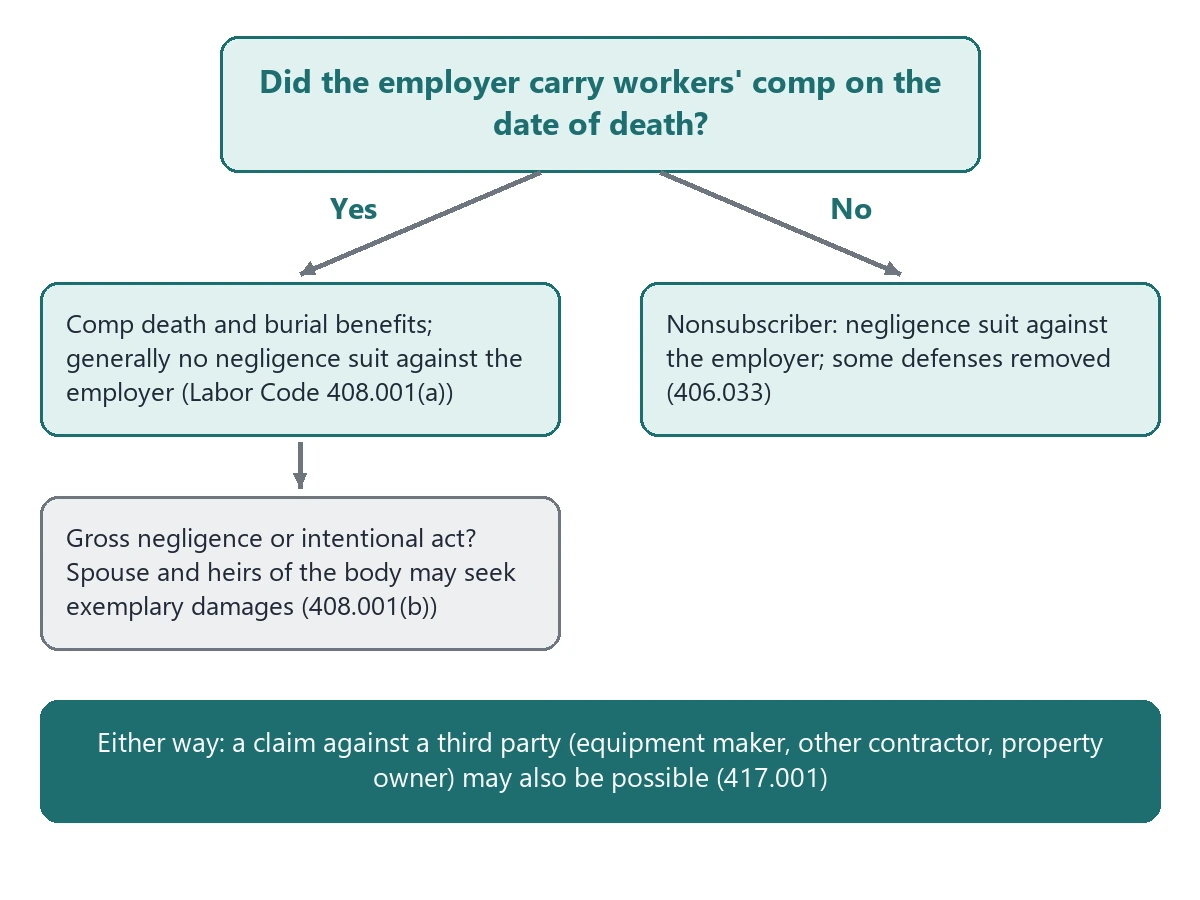
Coverage is checked as of the date of death. A staffing agency, a parent company, or a general contractor may have a coverage arrangement that a pay stub or a badge won't reveal. Ask for these records early:
- the comp carrier's name and the policy dates, which show whether the exclusive-remedy rule applies;
- staffing, subcontract, and site agreements, which show who employed the worker and who controlled the task;
- the employer's notice of non-coverage, if there is one, since nonsubscribers must notify the state under § 406.004.
How do the different family groups compare?
The three remedies don't go to the same people, which can surprise parents.
| Remedy | Who can receive it |
|---|---|
| Wrongful death damages under Civil Practice and Remedies Code § 71.004. | The surviving spouse, children, and parents. |
| Comp death benefits under Labor Code § 408.182. | Eligible spouse and children first, then certain dependents, then eligible parents in limited amounts. |
| Exemplary damages under § 408.001(b). | Only the surviving spouse and heirs of the body, so parents aren't included. |
Comp death benefits equal 75 percent of the employee's average weekly wage under § 408.181(b), subject to the statutory maximum. Burial benefits are capped at $10,000 under § 408.186. Our guide on who can file a Texas wrongful death claim covers the chapter 71 groups.
Take a 41-year-old warehouse lead who dies, leaving a wife, two children, and his mother:
- If his employer had comp coverage, benefits go to the wife and children, and only they could pursue the gross negligence claim.
- If his employer was a nonsubscriber, his wife, children, and mother can each bring a wrongful death claim against it.
What changes when the employer is a nonsubscriber?
Section 406.033 takes away some defenses but not all of them. A nonsubscriber can't argue that the worker was contributorily negligent, assumed the risk, or was hurt by a coworker's negligence. It can still defend on intoxication or an intentional self-injury under § 406.033(c). Your family still has to prove the employer was negligent under § 406.033(d). And a waiver the worker signed before the injury is void under § 406.033(e), so hiring paperwork can't give up the claim.
Austin v. Kroger Texas, L.P. adds three points to that:
- Losing the common-law defenses doesn't remove the employee's burden to prove a duty. The family still has to show the employer owed a duty for the hazard involved.
- No duty to warn about obvious or known hazards. An employer generally doesn't have to warn a worker about a premises hazard that's open and obvious or already known to the worker, with two narrow exceptions. A claim built only on a spill the worker saw may fail.
- Equipment is different. A claim that the employer didn't provide safe, necessary equipment doesn't need contemporaneous negligent activity, so missing tools, training, or gear can support a separate theory.
When can a family claim gross negligence?
Gross negligence under § 41.001(11) has two parts. Viewed from the employer's position at the time, the act or omission must have involved an extreme degree of risk. And the employer must have actually known about that risk and gone ahead with conscious indifference to worker safety. Your family has to prove it by clear and convincing evidence, and the jury has to be unanimous under § 41.003. Exemplary damages are capped by § 41.008(b) unless an exception in § 41.008(c) applies.
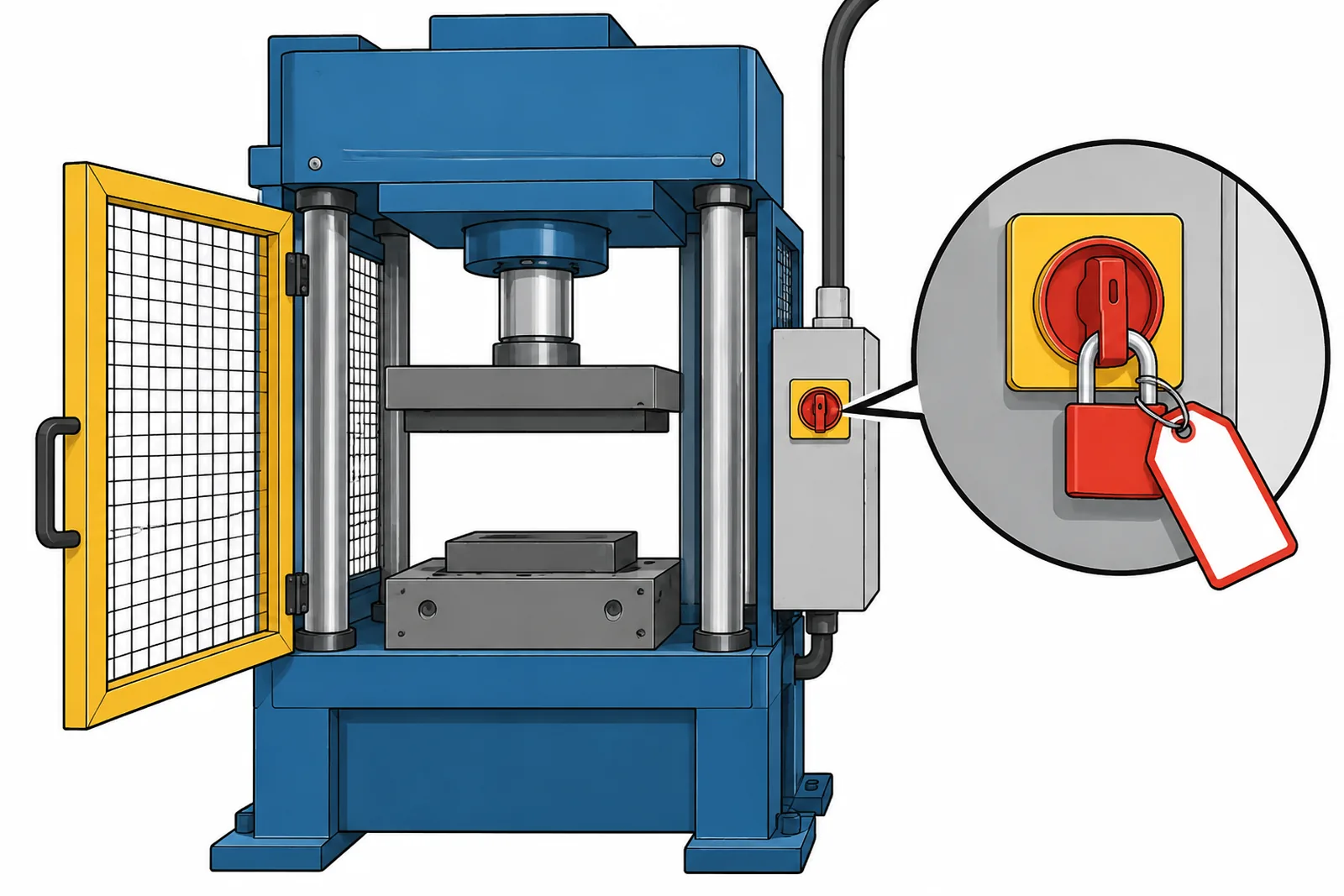
Picture a worker killed while clearing a jam on a press whose guard came off weeks earlier. Investigators would want answers to questions like these:
- Who took the guard off, and when?
- Who walked past the press while it ran without one?
- Did anyone order the line to keep running?
- Is there a text telling crews to skip the lockout step to meet a deadline?
An agency safety citation can point to those facts, but it isn't a civil finding of gross negligence. The separate article on gross negligence and exemplary damages in this hub, now in preparation, covers the standard in more depth.
Who else might be responsible?
Someone other than the employer may share the blame. Think of the equipment maker that sold a press without an interlock to stop it while the guard was open, or a crane operator from a different company who drops a load. A refinery owner may control the unit where a contractor's employee dies. A delivery truck from another company may back over a worker in a loading yard.
Chapter 417 of the Labor Code sets the money rules for that kind of claim:
- Section 417.001(a) lets your family take comp benefits and sue the third party at the same time.
- Under § 417.001(b), the comp carrier is subrogated. It's repaid from the recovery, less the reduction tied to the employer's percentage of responsibility.
- Section 417.002(a) sends the net recovery first to repay benefits the carrier paid, so your settlement figure isn't the amount you keep.
- Section 417.002(b) treats any excess as an advance against future benefits, so benefit checks may pause until it's used up.
Frequently asked questions
Can parents recover if the employer had comp coverage? Parents may qualify for some comp benefits in limited cases. They aren't in the group allowed to seek exemplary damages under § 408.001(b).
How long do we have to file? A wrongful death suit is generally due two years from the death under § 16.003. Comp claims and notices have their own deadlines.
The company called my husband an independent contractor. Does that end it? No. A label on a form doesn't settle employment or coverage. The contracts and who controlled his work do.
Will a third-party settlement cut off comp benefits? It can, because the excess is treated as an advance against future benefits. Ask for the numbers before agreeing.
More guides are in the Texas Wrongful Death Knowledge Hub, including how wrongful death proceeds are divided.
Legal sources
- Tex. Lab. Code § 408.001
- Tex. Lab. Code §§ 408.181, 408.182, 408.186
- Tex. Lab. Code § 406.033
- Tex. Lab. Code §§ 417.001, 417.002
- Tex. Civ. Prac. & Rem. Code §§ 41.001, 41.003, 41.008
- Austin v. Kroger Texas, L.P., 465 S.W.3d 193 (Tex. 2015)
This article is general information about Texas law, not legal advice about a particular case. Results depend on the facts, the evidence, the court and the law that applies. Reading it does not create an attorney-client relationship.
Families who need grief programs, funeral and survivor benefit help, or a needs assessment can use our Wrongful Death and Family Support Center.

ABOUT THE ATTORNEY
Aaron A. Herbert
Founding Attorney
Board Certified in Personal Injury Trial Law
Aaron founded The Law Firm of Aaron A. Herbert in 2010 to focus on developing each client's case and seeking its maximum value. For over a decade, he has represented people seriously injured in major accidents and industrial catastrophes, pursuing trial verdicts and settlements while working to reduce the stress of litigation.
Education
- Texas A&M University · B.S., Criminal Justice, 1999
- University of Oklahoma College of Law · J.D., 2002; graduated in the top of his class
Trial experience & approach
Aaron earned numerous jury verdicts at boutique personal injury litigation firms. According to his biography, he spent a year as the top-earning litigation attorney at a firm that frequently appeared in verdict searches as having one of the highest numbers of trial wins in Texas. At another Dallas personal injury firm, he moved from managing pre-litigation attorney to managing litigation attorney over seven years as the firm grew into one of Dallas's largest personal injury firms.
His biography describes a reputation as one of America's most aggressive trial lawyers, with noteworthy recoveries from judges and juries and substantial pretrial settlements. Most of those settlements included confidentiality agreements requested by the defense. Aaron has said the recoveries were justified by the injuries and losses involved, which no amount of money could make someone choose to experience.
His approach combines passion, preparation, persistence and courtroom imagination. He believes a well-supported, engaged and motivated team working cooperatively helps deliver strong representation, with the goal of achieving the best possible result for every client.
Dallas roots, military service & publication
Born and raised in Dallas, Aaron enlisted in the United States Marine Corps after high school and later received an Honorable Discharge. He completed his university and law degrees after his military service and became a lifelong Sooners football fan in law school.
Publication: “Litigating Dog Bite Cases,” Texas Dog Law Seminar, Dallas, 2009.
Professional affiliations & recognition
Professional affiliations and recognition listed in Aaron’s biography:
- State Bar of Texas
- American Bar Association
- Association of Trial Lawyers of America (now American Association for Justice)
- Texas Trial Lawyers Association
- Dallas Trial Lawyers Association
- Dallas Bar Association
- Tarrant County Bar Association
- Million Dollar Advocates Forum
- The National Trial Lawyers – Top 100 Trial Lawyers