
All 28 factors on one page, then five Texas Supreme Court cases that show how a few of them combine in a real claim.
Short answer: An average settlement can tell you what other people got. It can't tell you what your fault evidence, your paid bills, and the other side's coverage will support. So compare every offer with your own estimated net figure.
Which 28 factors move the value?
Here is the whole list in one place, in the order a claim usually meets them.
| Factor | Why it moves value |
|---|---|
| 1. Value is a range | Best case, likely deal, and trial downside differ |
| 2. A written worksheet | You get one page listing fault, bills, pay, pain, and liens |
| 3. Liability proof | A ticket helps; the dashcam file helps more |
| 4. Your share of fault | A 30 percent finding cuts 30 percent; 51 percent bars you |
| 5. Causation | The chart separates a new injury from an old one |
| 6. Paid or incurred bills | Recovery stops at what was paid |
| 7. Future care | Needs a reasonably probable medical opinion |
| 8. Lost earnings | Pay records and work restrictions prove it |
| 9. Pain and lost activities | Witnesses who saw the change |
| 10. Exemplary damages | Higher proof, unanimous jury, capped amount |
| 11. Collectibility | Limits and assets cap what's paid |
| 12. A Stowers demand | Can shift excess risk to the insurer |
| 13. Liens | Your health plan wants its money back |
| 14. Venue and jury pool | Dallas, Collin, and Kaufman jurors come from different places |
| 15. Credibility | The photo you mention first hurts less |
| 16. Treatment choices | Three missed weeks need a reason on paper |
| 17. Adjuster contacts | Statements and authorizations can be used |
| 18. The demand package | The surgeon's note attached for any surgery claimed |
| 19. A written range | Each offer logged with its date and net |
| 20. Mediation | A day of talks, proof in hand, no ruling |
| 21. Depositions | What you say under oath can be read at trial |
| 22. Targeted discovery | One subpoena to the right witness beats a thousand pages |
| 23. Consistent experts | Your doctor and your expert agree on the speed |
| 24. Pretrial motions | Losing the surgeon's testimony can zero out future care |
| 25. Trial risk | A verdict above the offer, below it, or zero |
| 26. The jury charge | One written question for each line of damages |
| 27. Settlement papers | Who's released, lien payoffs, a child's court approval |
| 28. Milestone updates | A dated estimate after the MRI, depositions, and mediation |
Werner, Haygood, Gunn, In re Farmers, Helena, and Gregory each turned on a few of these rows.
Can a driver be careless and still owe you nothing?
The pickup was going too fast for an icy interstate. It slid across a 42-foot median and into a Werner Enterprises 18-wheeler, and one person in the pickup died. The truck was under the speed limit, but the family persuaded a jury that it was also too fast for the ice. On June 27, 2025, in Werner Enterprises, Inc. v. Blake, No. 23-0493, the Texas Supreme Court rendered judgment for the trucking company. The pickup's crossing was the sole proximate cause, and showing the crash wouldn't have happened "but for" the truck's speed wasn't enough.
That is factors 3 and 5 working together. Fault and cause are separate questions, and a claim needs both.
Suppose you're stopped at a light on Central Expressway when a pickup hits you from behind. The other driver gets a ticket, and the car behind you has a dashcam. Weeks later the adjuster's letter puts 30 percent of the blame on you for braking hard. Under § 33.012(a) of the Civil Practice and Remedies Code, a 30 percent finding would cut your damages by 30 percent, and under § 33.001 anything above 50 percent would bar them. That 14-second dashcam clip is what answers the letter.
What to do now: Save the original video file and the names of everyone who stopped, before the phone that recorded it gets traded in.
Why isn't the hospital bill the number that counts?
Aaron Haygood's car hit a minivan pulling out of a grocery store lot, and he needed neck and shoulder surgery. His providers billed $110,069.12. Because he was on Medicare, they credited $82,329.69, leaving $27,739.43, but the jury awarded the full bill. In Haygood v. De Escabedo, 356 S.W.3d 390 (Tex. 2011), the Texas Supreme Court held that § 41.0105 limits recovery to amounts actually paid or incurred, and that only evidence of those amounts is admissible.
Future care follows a different rule. Shannon McCoy was 37 weeks pregnant when she suffered a placental abruption, and complications left her with brain damage and quadriplegia. In Gunn v. McCoy, No. 16-0125 (Tex. June 15, 2018), the court upheld the § 18.001 affidavits for her past bills and treated future medical costs as a question of reasonable probability.
Suppose an MRI, two injections, and six weeks of therapy at a Richardson clinic come to $38,000 in charges, and your health plan pays $14,500. Under Haygood, your past medical claim is that $14,500. The plan will probably ask for it back from the settlement. A surgeon's note predicting a third injection by next spring is what lets anyone put a price on future care.

What happens when the other driver can't pay?
Cassandra Longoria rear-ended Gary Gibson, and he sued her for $1 million. Her policy limit was $500,000. Gibson agreed to settle for $350,000, but her insurer put in only $250,000, so Longoria paid the other $100,000 herself. In In re Farmers Texas County Mutual Insurance Co., No. 19-0701 (Tex. 2021), the court held she had no Stowers claim, since nothing went past her limits, though her claim for breach of the duty to indemnify could go forward.
The Stowers duty itself has three conditions. Under American Physicians Insurance Exchange v. Garcia, 876 S.W.2d 842 (Tex. 1994), the claim must be within coverage, the demand within limits, and the terms ones a prudent insurer would accept.
Suppose the driver who hit you in March has a $50,000 policy, a leased truck, and no savings. His insurer can pay $50,000 and no more. The declarations page in your glove box shows $100,000 of underinsured motorist coverage. Section 1952.101 of the Insurance Code is why it's there, unless a named insured rejected it in writing.
What to do now: Find your declarations page tonight and look for the line that says uninsured/underinsured motorist.
Can a case end before it reaches a jury?
Two planes sprayed an herbicide over the Spade Ranch in Mitchell County in July 2015. Cotton farmers 1.8 to 25 miles away later blamed it for poor yields on more than 14,000 acres. A state inspector looked at the crops but ran no lab tests. On March 3, 2023, in Helena Chemical Co. v. Cox, No. 20-0881, the Texas Supreme Court reinstated summary judgment for the company, because the evidence raised no genuine fact issue on causation.
The farmers had expert opinions and the tools of discovery (factors 21 to 23). None of it closed the gap in their proof, and a pretrial motion ended the case (factor 24).
Suppose your surgeon's report assumes a 40-mile-an-hour impact, and your own reconstruction expert says 25. The defense will put those two numbers side by side at the expert's deposition. Fixed in month four, it's a correction. Found at trial, it becomes the defense's best exhibit.
Why can a big verdict disappear?
An 18-wheeler jackknifed on an icy highway near Amarillo. A jury awarded one driver's family about $16.8 million, mostly for noneconomic damages. In Gregory v. Chohan, 670 S.W.3d 546 (Tex. 2023), the Texas Supreme Court reversed and remanded for a new trial, holding that an award like that needs a rational connection to the evidence.
That's factors 25 and 26 in one case. A verdict can be cut or sent back, and every line of damages needs a witness or a document behind it.
Suppose you have a $60,000 offer on the table and a trial date eleven months out. A jury might award more, less, or nothing, and an appeal could add another year. The offer gets compared with a realistic net trial result after fees, costs, liens, and time, not with the best verdict you can imagine.
What should you do before you accept an offer?
Run through this list with your lawyer before you sign anything:
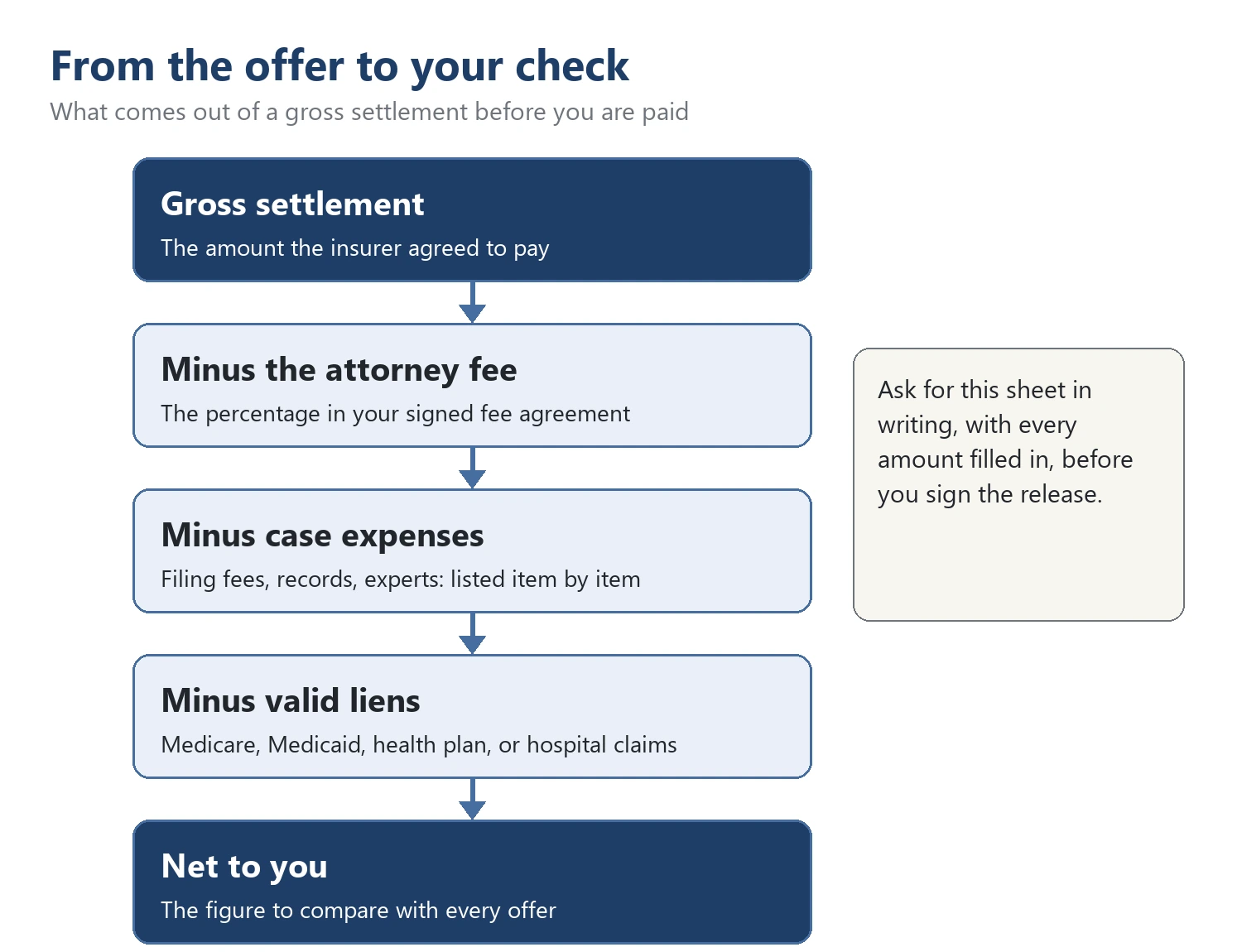
- I've seen the estimated net figure in writing.
- I know every policy that could pay, including my own.
- Each lien is listed with a final or negotiated amount.
- My doctor has put any future care in the chart.
- I've read the whole release, not a summary of it.
- I know roughly when the money will arrive.
- If a child is involved, the court-approval hearing is on the calendar.
Frequently asked questions
Are claims worth three times the medical bills? Aaron Haygood was billed $110,069.12, but only $27,739.43 was owed, and Haygood limits recovery to amounts paid or incurred. No Texas statute sets a multiplier.
Does filing suit always raise the value? In Helena, it didn't. The farmers had expert opinions and still lost on summary judgment in 2023.
Who decides whether to settle? You do. Rule 1.02 of the Texas Disciplinary Rules of Professional Conduct leaves the decision to accept an offer with the client.
How long do I have to file? Section 16.003 sets two years for most Texas injury suits, and some claims carry other deadlines.
What if a child was hurt? A child's settlement needs a judge's approval under Texas Rule of Civil Procedure 44, and that hearing has to be scheduled before any money is paid.
How long does payment take after a deal? Signatures, insurer processing, any court approval, and lien payoffs all come first. Ask what's still outstanding in your file.
Is there a simpler overview? Our companion article, How Much Is My Texas Injury Case Worth?, covers the basics in plain terms.
Start at the Texas Injury Claim Value and Litigation Knowledge Hub, or read about Texas life care plans, proving lost earnings, and how Texas injury claims are valued.
Texas statutes and cases cited in this article
- Werner Enterprises, Inc. v. Blake, No. 23-0493 (Tex. June 27, 2025)
- Haygood v. De Escabedo, 356 S.W.3d 390 (Tex. 2011)
- Gunn v. McCoy, No. 16-0125 (Tex. June 15, 2018)
- In re Farmers Tex. Cnty. Mut. Ins. Co., No. 19-0701 (Tex. 2021)
- Am. Physicians Ins. Exch. v. Garcia, 876 S.W.2d 842 (Tex. 1994)
- Helena Chemical Co. v. Cox, No. 20-0881 (Tex. Mar. 3, 2023)
- Gregory v. Chohan, 670 S.W.3d 546 (Tex. 2023)
- Tex. Civ. Prac. & Rem. Code §§ 33.001, 33.012, § 41.0105, §§ 41.003, 41.008, § 18.001, and § 16.003
- Tex. Ins. Code § 1952.101
- Tex. R. Civ. P. 44 and Tex. Disciplinary R. Prof'l Conduct 1.02
This article is general information about Texas law, not legal advice about a particular case. Results depend on the facts, the evidence, the court and the law that applies. Reading it does not create an attorney-client relationship.

ABOUT THE ATTORNEY
Aaron A. Herbert
Founding Attorney
Board Certified in Personal Injury Trial Law
Aaron founded The Law Firm of Aaron A. Herbert in 2010 to focus on developing each client's case and seeking its maximum value. For over a decade, he has represented people seriously injured in major accidents and industrial catastrophes, pursuing trial verdicts and settlements while working to reduce the stress of litigation.
Education
- Texas A&M University · B.S., Criminal Justice, 1999
- University of Oklahoma College of Law · J.D., 2002; graduated in the top of his class
Trial experience & approach
Aaron earned numerous jury verdicts at boutique personal injury litigation firms. According to his biography, he spent a year as the top-earning litigation attorney at a firm that frequently appeared in verdict searches as having one of the highest numbers of trial wins in Texas. At another Dallas personal injury firm, he moved from managing pre-litigation attorney to managing litigation attorney over seven years as the firm grew into one of Dallas's largest personal injury firms.
His biography describes a reputation as one of America's most aggressive trial lawyers, with noteworthy recoveries from judges and juries and substantial pretrial settlements. Most of those settlements included confidentiality agreements requested by the defense. Aaron has said the recoveries were justified by the injuries and losses involved, which no amount of money could make someone choose to experience.
His approach combines passion, preparation, persistence and courtroom imagination. He believes a well-supported, engaged and motivated team working cooperatively helps deliver strong representation, with the goal of achieving the best possible result for every client.
Dallas roots, military service & publication
Born and raised in Dallas, Aaron enlisted in the United States Marine Corps after high school and later received an Honorable Discharge. He completed his university and law degrees after his military service and became a lifelong Sooners football fan in law school.
Publication: “Litigating Dog Bite Cases,” Texas Dog Law Seminar, Dallas, 2009.
Professional affiliations & recognition
Professional affiliations and recognition listed in Aaron’s biography:
- State Bar of Texas
- American Bar Association
- Association of Trial Lawyers of America (now American Association for Justice)
- Texas Trial Lawyers Association
- Dallas Trial Lawyers Association
- Dallas Bar Association
- Tarrant County Bar Association
- Million Dollar Advocates Forum
- The National Trial Lawyers – Top 100 Trial Lawyers