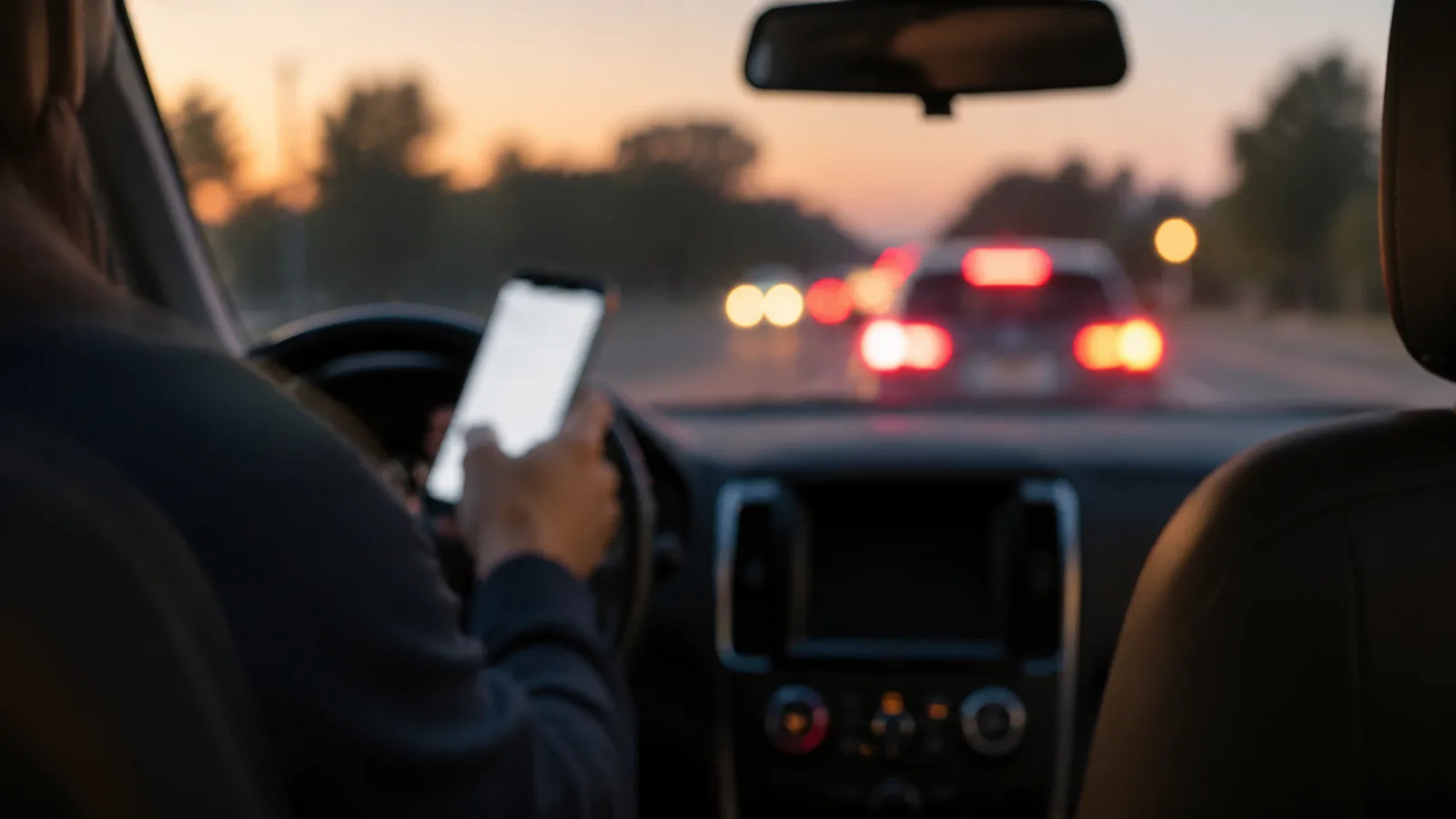
Texting or drinking behind the wheel can support a strong injury claim, but the evidence still has to tie that conduct to the moment of the crash.
Short answer
The other driver was texting, or drunk. That helps, but it doesn't win the case on its own. The proof has to land on the minute of the crash and tie to the collision.
Strong proof can also open the door to exemplary (punitive) damages. Those take clear and convincing evidence of gross negligence and a unanimous jury.
Each piece of evidence proves something, but rarely everything:
| Evidence | What it can show | What it can't show alone |
|---|---|---|
| Phone carrier records | Messages or data sessions at certain times | That the driver was looking at the screen at impact |
| Breath or blood test | Alcohol concentration when the sample was taken | The concentration at the exact time of the crash |
| Arrest or DWI charge | That police found probable cause | Civil fault, causation, or your damages |
| Bar tab or receipt | Where and when the driver was served | That the bar is legally responsible |
| Dashcam or traffic video | Lane drift, late braking, or no braking | Why the driver reacted late |
What does Texas law say about texting while driving?
Transportation Code § 545.4251 makes it an offense to use a handheld wireless device to read, write, or send an electronic message while operating a moving vehicle. The offense doesn't apply while the vehicle is stopped. Was the car moving when the message went out? Pin that down first.
Plenty of texting cases have no ticket at all. The man in the next lane, a store camera, or the carrier's log can prove what the driver was doing. Expect the driver to reach for the exceptions in the statute: hands-free use, GPS, an emergency call, music, some work dispatch.
The penalty is a fine. It becomes a Class A misdemeanor if the driver caused death or serious bodily injury.
Key point: Say no officer saw the phone and nobody wrote a ticket. Your claim can still rest on ordinary negligence, such as watching a screen instead of the road.
Texting isn't the only distraction. Other proof sources include:
- platform activity logs for scrolling video or social media, obtained in discovery
- call detail records with start and end times for a handheld call
- vehicle infotainment data for a driver adjusting a dashboard screen
Related topics are in the Texas Car Accident Knowledge Hub.
How do you prove the driver was distracted at the moment of the crash?
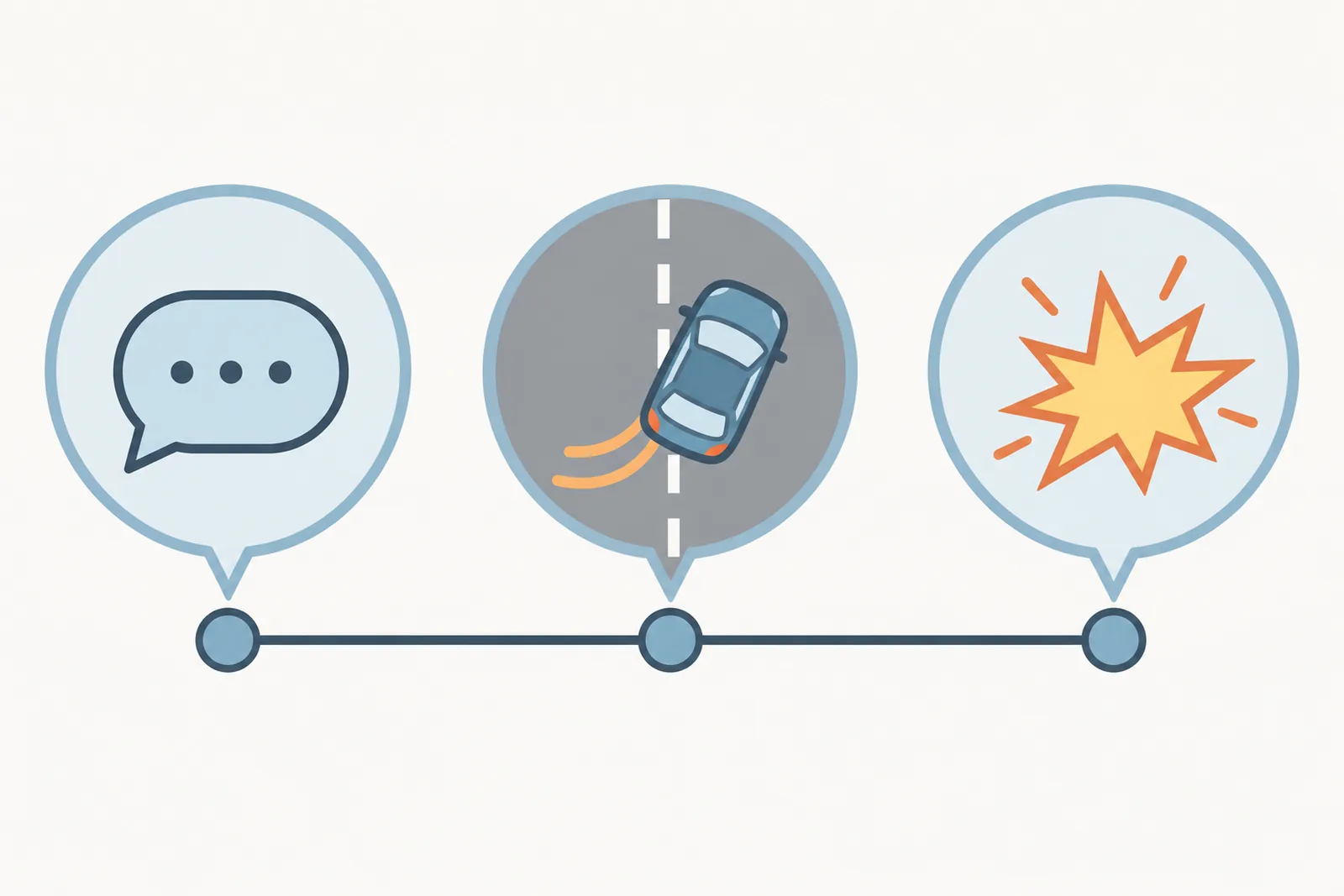
With a timeline, every source on one clock. Start with the crash report for the time, the place, and what the driver said. Ask the carrier for texts, data, and calls in a narrow window around the crash; you don't need the whole phone. The vehicle's event data shows speed and braking in the last seconds. Add camera footage from nearby businesses and traffic signals, and the witness who says "he was looking down."
Here's what a good one looks like on Belt Line Road:
- 5:12:03 p.m.: the carrier logs an outgoing text.
- 5:12:06 p.m.: a store camera shows the car drifting into the next lane.
- 5:12:08 p.m.: impact. The event data shows no braking.
One caution about clocks. A phone and a crash report don't always agree, so line them up before you rely on either. A text four seconds before impact is strong; four minutes before, much weaker. Delivery logs can also show when a message arrived rather than when it was read.
What if the driver says a passenger sent the text? Then you need to know who was holding the phone and whether any video shows the inside of the car.
You can learn more in how to prove a driver was distracted. Don't try to get into the other driver's phone or accounts yourself.
What to do now: Tonight, write down what you saw the driver doing. Save the original files from your dashcam and phone, not copies. Then list every business with a camera near the intersection.
What counts as drunk or drugged driving in Texas?
Penal Code Chapter 49 defines intoxication two ways, and either one can support a civil claim. The first is impairment: not having normal use of mental or physical faculties from alcohol, drugs, or another substance. No number is needed. Officer observations, field tests, and video can prove it.
The second is a number: an alcohol concentration of 0.08 or more. A blood draw three hours later is weaker proof than one taken at the scene.
Most DWIs are misdemeanors. Section 49.04 covers driving intoxicated in a public place, and it becomes Class A at 0.15. If the intoxication causes serious bodily injury, the charge turns into intoxication assault under § 49.07. If it causes a death, it's intoxication manslaughter under § 49.08. Both of those are felonies.
How does the criminal case affect your injury claim?
The criminal case and your civil claim run on separate tracks with different burdens of proof. Your claim doesn't have to wait for the prosecution. Here's how each outcome plays out:
| Criminal outcome | Effect in your civil case |
|---|---|
| Felony conviction after a trial or guilty plea | Under Rule of Evidence 803(22), it can be offered to prove facts essential to the judgment, if no appeal is pending. |
| No contest (nolo contendere) plea | Rule 803(22) doesn't cover the judgment. |
| Misdemeanor DWI conviction | Not covered by Rule 803(22). The underlying evidence is still used. |
| No charges filed | Your claim can still be proven with its own evidence. |
| Charge still pending | The two-year filing deadline under CPRC § 16.003 doesn't pause. |
The criminal file can hold useful records:
- bodycam and dashcam video of slurred speech, balance problems, and statements at the scene
- breath or blood test results, with the time of the sample
- field sobriety test notes
- the arrest report narrative, which may say where the driver had been drinking
Ask the investigating agency how to request the crash report, video, and test records. A pending prosecution can delay release. The Texas car accident claims guide covers the full claim process.
When can you seek exemplary damages against a drunk or distracted driver?
Exemplary damages punish. They don't compensate, and Chapter 41 sets a higher bar for them:
| Requirement | Statute | What it means |
|---|---|---|
| Gross negligence | CPRC § 41.001(11) | An extreme degree of risk that the driver actually knew about but ignored |
| Clear and convincing proof | CPRC § 41.003(a)-(b) | Ordinary negligence evidence isn't enough |
| Unanimous jury | CPRC § 41.003(d) | All jurors agree on liability and the amount |
| More than nominal damages | CPRC § 41.004 | No exemplary award on nominal damages alone |
| Per-defendant award | CPRC § 41.006 | Each defendant pays only the amount found against it |
Then there's the cap in § 41.008. Run the numbers on $300,000 in economic damages and $500,000 in noneconomic damages. Double the economic part: $600,000. Add the noneconomic part, which counts up to $750,000: $1.1 million. The statute takes that or $200,000, whichever is greater.
Is there a way around the cap? Under § 41.008(c), it doesn't apply to conduct described as intoxication assault (§ 49.07) or intoxication manslaughter (§ 49.08). Net worth discovery is allowed only by court order after a showing of substantial likelihood of success, under § 41.0115. Whether an insurance policy pays exemplary damages is a separate question.
Can a bar or restaurant be responsible for a drunk driving crash?
Sometimes. A sale alone isn't enough. Alco. Bev. Code § 2.02(b) requires three things:
- The server provided alcohol to the person. Tabs, receipts, and card statements help prove it.
- At the time, it was apparent that the person was obviously intoxicated to the point of being a clear danger to themselves and others. Who saw it? Bar video, staff, and other patrons can answer that.
- The intoxication was a proximate cause of your damages.
The Act is the exclusive remedy against providers for serving adults 18 or older. A separate rule covers adults who knowingly supply a minor under 18. See what happens after an alcohol-related crash.
Say a driver leaves a Deep Ellum bar at 1:40 a.m. after six drinks and hits you on I-30 at 2:05 a.m. The driver faces ordinary negligence and possibly gross negligence claims. A licensed bar or restaurant answers under Alco. Bev. Code §§ 2.02(b) and 2.03.
If the driver were 17 and an adult had served him at a party, § 2.02(c) could reach that adult, with exceptions for parents and guardians. And if the driver's limits are too low, your own UM/UIM coverage can help.
Frequently asked questions
The driver got a DWI. Does that mean I win?
It helps on fault. You'd still have to show what the crash did to your body and what that costs you.
Can I subpoena the driver's whole phone?
Rarely. A judge will usually allow a narrow slice, like texts and data from 5:10 to 5:15 p.m., not the whole device.
Is texting at a red light illegal in Texas?
The § 545.4251 offense doesn't apply while the vehicle is stopped. For your civil claim, ask whether the driver was still on the phone once the car started moving.
Does the punitive damages cap apply in a drunk driving case?
It can. It doesn't apply to conduct described as intoxication assault or intoxication manslaughter.
Sources
- Tex. Transp. Code § 545.4251
- Tex. Penal Code §§ 49.01, 49.04, 49.07, 49.08
- Tex. Civ. Prac. & Rem. Code Chapter 41
- Tex. Alco. Bev. Code §§ 2.02, 2.03
- Tex. Civ. Prac. & Rem. Code § 16.003
- Texas Rules of Evidence
This article provides general information about Texas law, not legal advice. Every case depends on its facts, evidence, insurance, deadlines and governing law. Past results do not guarantee a similar outcome.

ABOUT THE ATTORNEY
Aaron A. Herbert
Founding Attorney
Board Certified in Personal Injury Trial Law
Aaron founded The Law Firm of Aaron A. Herbert in 2010 to focus on developing each client's case and seeking its maximum value. For over a decade, he has represented people seriously injured in major accidents and industrial catastrophes, pursuing trial verdicts and settlements while working to reduce the stress of litigation.
Education
- Texas A&M University · B.S., Criminal Justice, 1999
- University of Oklahoma College of Law · J.D., 2002; graduated in the top of his class
Trial experience & approach
Aaron earned numerous jury verdicts at boutique personal injury litigation firms. According to his biography, he spent a year as the top-earning litigation attorney at a firm that frequently appeared in verdict searches as having one of the highest numbers of trial wins in Texas. At another Dallas personal injury firm, he moved from managing pre-litigation attorney to managing litigation attorney over seven years as the firm grew into one of Dallas's largest personal injury firms.
His biography describes a reputation as one of America's most aggressive trial lawyers, with noteworthy recoveries from judges and juries and substantial pretrial settlements. Most of those settlements included confidentiality agreements requested by the defense. Aaron has said the recoveries were justified by the injuries and losses involved, which no amount of money could make someone choose to experience.
His approach combines passion, preparation, persistence and courtroom imagination. He believes a well-supported, engaged and motivated team working cooperatively helps deliver strong representation, with the goal of achieving the best possible result for every client.
Dallas roots, military service & publication
Born and raised in Dallas, Aaron enlisted in the United States Marine Corps after high school and later received an Honorable Discharge. He completed his university and law degrees after his military service and became a lifelong Sooners football fan in law school.
Publication: “Litigating Dog Bite Cases,” Texas Dog Law Seminar, Dallas, 2009.
Professional affiliations & recognition
Professional affiliations and recognition listed in Aaron’s biography:
- State Bar of Texas
- American Bar Association
- Association of Trial Lawyers of America (now American Association for Justice)
- Texas Trial Lawyers Association
- Dallas Trial Lawyers Association
- Dallas Bar Association
- Tarrant County Bar Association
- Million Dollar Advocates Forum
- The National Trial Lawyers – Top 100 Trial Lawyers