
How Texas jury selection works in a serious injury trial, what lawyers may ask prospective jurors and where a jury consultant fits.
Short answer
Voir dire is the part of a Texas trial where the lawyers question the jury panel to find people who can't be fair in this particular case. In a catastrophic injury trial, it usually focuses on attitudes about lawsuits, invisible injuries, experts, and large future-care numbers. A jury consultant can help design those questions but can't promise a result.
Say a panel of 40 people files into a district courtroom on a Monday morning. By the afternoon, twelve of them will be your jury. Here's the order of the day:
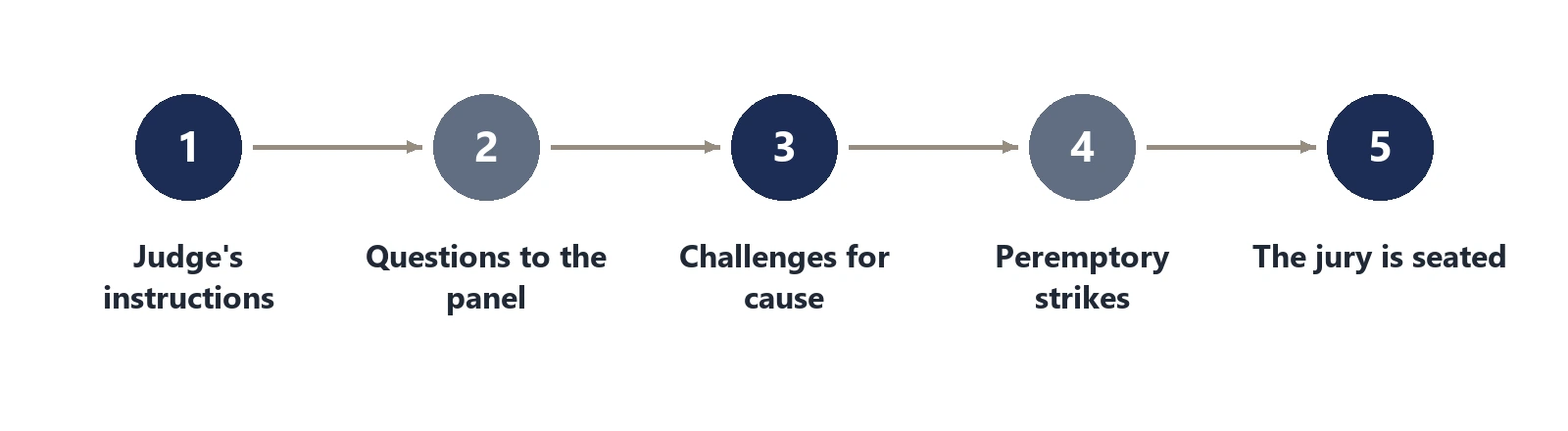
- Judge's instructions. The judge reads the Supreme Court's required instructions to the panel under TRCP 226a.
- Questions to the panel. Lawyers for each side ask about background, experiences, and attitudes, within limits the judge sets.
- Challenges for cause. A lawyer asks the judge to excuse a panel member who is legally disqualified or unfit to sit, and the judge rules on each one.
- Peremptory strikes. Each side crosses off a fixed number of names. No reason is required, but race and gender can't be the basis.
- The jury is seated. The clerk reads the first twelve names still left on the lists (TRCP 234, district court).
What rules control jury selection in a Texas civil case?
A handful of rules and statutes set the framework. Under TRCP 226a, the court must give the panel instructions prescribed by the Texas Supreme Court before questioning begins. Panel members are told the lawyers may ask about their background, experiences, and attitudes.
Gov't Code 62.105 lists who is disqualified in a particular case. That includes a person who is a witness, is interested in the case, is related to a party within the third degree, is biased for or against a party, or served as a juror in an earlier trial of the same facts. Bias toward or against your side is a legal ground to excuse someone.
The procedural rules fill in the rest:
- Under TRCP 228, a challenge for cause alleges a fact that disqualifies the person by law or makes the person unfit in the court's opinion. The judge can hear other evidence on the challenge, not only the panel member's answers.
- Under TRCP 230, a panel member may not be asked a question whose answer may show a disqualifying conviction or a pending theft or felony charge. Some background questions are off limits in open questioning.
- TRCP 233 gives each party six peremptory challenges in district court and three in county court. Two trucking companies on the same side? The judge may adjust the numbers to keep the sides even.
- Under TRCP 234, after strikes, the clerk calls the first twelve names remaining in district court and six in county court. The order of the panel matters to who is seated.
What may lawyers ask, and what crosses the line?
Hyundai Motor Co. v. Vasquez started with a low-speed crash. A passenger airbag deployed and broke the neck of four-year-old Amber Vasquez, who was riding unbelted in the front seat. At jury selection, her parents' lawyer wanted to ask whether panel members would decide against them because she wasn't wearing a seat belt, no matter what else the evidence showed. The trial judge refused, and the jury found no design defect. The Texas Supreme Court held that the refusal wasn't an abuse of discretion.
In that opinion, the court said the substance of a question, not its wording, decides whether it probes for prejudice or previews a probable verdict. The court also said that asking jurors what their verdict would be if certain facts were proved is improper. Here's how that line might apply to a few hypothetical questions:
| Hypothetical question | Likely category | Why |
|---|---|---|
| "Does anyone believe a person can't have a real brain injury if the CT scan looks normal?" | Probes for bias | It asks about a fixed belief, not this case's evidence |
| "If the evidence showed he wasn't wearing a seatbelt, would that end it for you?" | May be refused as a commitment | Vasquez involved a seatbelt question the trial court was allowed to refuse |
| "Would you award $20 million if we prove these facts?" | Improper commitment | It asks for a verdict on selected facts before any evidence |
| "Is there anyone who could not consider a large amount even if the evidence supported it?" | Probes for a fixed ceiling | It asks whether a belief would override the court's instructions |
The difference is whether the question asks about a belief or asks for a promise. A question like "Has anyone had a bad experience with a doctor who testifies in lawsuits?" also probes for bias, since it looks for an experience that might keep someone from weighing testimony fairly.
Which attitudes matter most in a catastrophic injury trial?
The questions should track what's actually disputed in your case. Say the injury is a brain injury with normal imaging. A follow-up such as "What would you want to hear from a neuropsychologist before deciding?" tests whether a panel member needs to see an injury to believe it.
Other disputes call for other follow-ups:
- With decades of future care, ask, "Could you follow the judge's instructions on future medical expenses if the proof supported them?" It tests whether any large number seems automatically excessive.
- With competing experts, ask, "How would you decide between two doctors who disagree?" It tests whether experts are all seen as hired guns.
- With a company defendant, ask, "Would you start out leaning toward either side before hearing anything?" It tests whether corporations are presumed careful or careless.
- With improvement after therapy, ask, "Can someone get better in some ways and still need lifelong help?" It tests whether progress means the injury wasn't serious.
Questions like these work best when they connect to the proof you'll actually offer, such as a Texas life-care plan or neuropsychological testing in a Texas brain injury claim.

Ordinary skepticism isn't bias. The follow-up question is what separates the two:
| What a panel member says | A fair follow-up |
|---|---|
| "I think some people sue too quickly." | "Could you still decide this case on the evidence and the judge's instructions?" |
| "Doctors who testify get paid to say things." | "Would you listen to both doctors before deciding who's right?" |
| "I don't trust big verdicts." | "Is there a number you couldn't award even if the proof supported it?" |
None of those first answers disqualifies anyone by itself. And don't guess from a retired engineer's job title. Ask about the belief.
How is a biased panel member removed?
There are two tools, and they work differently. A challenge for cause requires a lawyer to show a legal ground, such as bias or prejudice under Gov't Code 62.105, and the judge decides. There's no fixed number, but each one needs a supported ground.
A peremptory challenge lets a party strike a panel member without assigning a reason under TRCP 232, and TRCP 233 fixes the number. Two U.S. Supreme Court cases limit those strikes. Edmonson v. Leesville Concrete held that a private civil litigant may not use peremptory challenges to exclude jurors on account of race, which applies to both sides in a civil case. J.E.B. v. Alabama ex rel. T.B. held that the Equal Protection Clause bars gender-based peremptory challenges, so a consultant's profile can't justify a strike on that basis.
Hypothetical: Juror 22 says, "Anybody who sues over a car wreck is after a payday." That's a start. It isn't a record yet.
- Exact words go in the notes. "Anti-lawsuit" isn't good enough.
- Then comes the follow-up: "Would that belief keep you from following the judge's instructions on damages?" If she says "I'd try," that may not carry a challenge.
- Challenge Juror 22 on the record, by number, and state the ground: bias.
- Track the ruling and which strikes were used, in case the ruling is questioned on appeal.
What can a jury consultant do, and what can't they do?
Where does a consultant actually help? Mostly with clarity. A focus group or mock trial shows which evidence confuses people. It can't tell you what twelve real jurors will award.
A consultant can draft a juror questionnaire when the panel is large and the issues are sensitive, though the court decides whether a questionnaire is used and what it asks. A consultant can also watch answers in court while the lawyers are busy asking questions and taking notes. Final strike decisions stay with the trial lawyer and must be lawful.
Research has limits too. A consultant can review public information the court allows, but there's no contact with panel members, and research has to follow the court's directions. The TRCP 226a instructions tell panel members not to mingle or talk with the lawyers, parties, or witnesses, and they say the lawyers have to follow those instructions too. In practice:
- Reading public records the court allows is generally permitted, depending on the court's directions.
- Messaging, friending, or following a panel member online is off limits, because it's contact.
- Using an investigator to approach a panel member's family is off limits.
What to do now: Sit down with your lawyer a few weeks before trial and ask three questions.
- Which beliefs are most likely to hurt this case?
- Will we use a questionnaire or jury research, and what will it cost? Research costs are case expenses.
- How will the jury hear about my daily limitations?
For a fuller picture of how trial preparation fits the whole case, see the Texas catastrophic injury claims guide and the Texas Catastrophic Injury and Damages Hub.
Frequently asked questions
Will I have to answer questions during jury selection?
No, the panel members answer, not the parties. You may be in the courtroom during selection, so the panel may see you.
How many jurors decide a Texas civil case?
A district court jury has twelve, and a county court jury has six, as reflected in TRCP 234. The verdict rules are separate from jury selection.
Can my lawyer ask jurors whether they would award a specific amount?
Not as a promise. Vasquez says asking jurors what their verdict would be on previewed facts is improper. Your lawyer can still ask whether anyone has a fixed ceiling that would override the evidence and the judge's instructions.
Is a jury consultant worth the cost?
It depends on the size of the case and how contested the issues are. Ask what specific question the research will answer before approving the expense.
Can someone be removed just because they seem unfriendly?
A peremptory strike needs no reason, but it can't be based on race or gender. A challenge for cause needs a legal ground such as bias or prejudice.
Sources
- Texas Rules of Civil Procedure (court-posted PDF): Rules 226a and 227 to 234.
- Tex. Gov't Code §§ 62.102, 62.105: who may serve, and who is disqualified in a particular case.
- Hyundai Motor Co. v. Vasquez, 189 S.W.3d 743 (Tex. 2006): the seat-belt voir dire question.
- Edmonson v. Leesville Concrete Co., 500 U.S. 614 (1991): race-based strikes in civil cases.
- J.E.B. v. Alabama ex rel. T.B., 511 U.S. 127 (1994): gender-based strikes.
This article provides general information about Texas law, not legal advice. Every case depends on its facts, evidence, insurance, deadlines and governing law. Past results do not guarantee a similar outcome.

ABOUT THE ATTORNEY
Aaron A. Herbert
Founding Attorney
Board Certified in Personal Injury Trial Law
Aaron founded The Law Firm of Aaron A. Herbert in 2010 to focus on developing each client's case and seeking its maximum value. For over a decade, he has represented people seriously injured in major accidents and industrial catastrophes, pursuing trial verdicts and settlements while working to reduce the stress of litigation.
Education
- Texas A&M University · B.S., Criminal Justice, 1999
- University of Oklahoma College of Law · J.D., 2002; graduated in the top of his class
Trial experience & approach
Aaron earned numerous jury verdicts at boutique personal injury litigation firms. According to his biography, he spent a year as the top-earning litigation attorney at a firm that frequently appeared in verdict searches as having one of the highest numbers of trial wins in Texas. At another Dallas personal injury firm, he moved from managing pre-litigation attorney to managing litigation attorney over seven years as the firm grew into one of Dallas's largest personal injury firms.
His biography describes a reputation as one of America's most aggressive trial lawyers, with noteworthy recoveries from judges and juries and substantial pretrial settlements. Most of those settlements included confidentiality agreements requested by the defense. Aaron has said the recoveries were justified by the injuries and losses involved, which no amount of money could make someone choose to experience.
His approach combines passion, preparation, persistence and courtroom imagination. He believes a well-supported, engaged and motivated team working cooperatively helps deliver strong representation, with the goal of achieving the best possible result for every client.
Dallas roots, military service & publication
Born and raised in Dallas, Aaron enlisted in the United States Marine Corps after high school and later received an Honorable Discharge. He completed his university and law degrees after his military service and became a lifelong Sooners football fan in law school.
Publication: “Litigating Dog Bite Cases,” Texas Dog Law Seminar, Dallas, 2009.
Professional affiliations & recognition
Professional affiliations and recognition listed in Aaron’s biography:
- State Bar of Texas
- American Bar Association
- Association of Trial Lawyers of America (now American Association for Justice)
- Texas Trial Lawyers Association
- Dallas Trial Lawyers Association
- Dallas Bar Association
- Tarrant County Bar Association
- Million Dollar Advocates Forum
- The National Trial Lawyers – Top 100 Trial Lawyers