
Trial preparation and mediation serve one goal: money that actually reaches you and pays for the care and income your injury took away.
Short answer
Most of these cases settle. They settle higher when the file is ready for a jury, because that's how the adjuster prices them.
Then look past the headline number. Fees, expenses, liens, and the other side's policy limits all come out before you see a check. The Texas catastrophic injury claims guide covers the full claim.
What has to be proven before a catastrophic injury case goes to trial?
A severe injury doesn't create its own claim. The case still rests on duty, breach, proximate cause, and damages, or on the elements of a premises, product, or other specific claim.
Here's that checklist for a 34-year-old electrician with a C6 spinal cord injury:
| Element | Example proof | Gap to close before trial |
|---|---|---|
| Who was at fault | Crash report, dashcam clip, and the other driver's phone records | A witness who can authenticate the video |
| Causation | Emergency MRI from the day of the crash and the surgeon's opinion | Earlier neck complaints in old records |
| Past medical cost | Itemized bills and what was actually paid or owed | Billing that doesn't match the paid-or-incurred amounts |
| Future care | A life care plan tied to physician recommendations | Plan items no treating doctor has endorsed |
| Lost earning capacity | Pay stubs, union scale, and a vocational opinion | No economist yet for present value |
Expect three defense moves on fault. (Chapter 33 bars recovery above 50 percent and cuts your damages by any lower share.)
- "He was speeding too." Every percentage point the jury finds against you cuts the award.
- The defense designates a responsible third party, and another person's share goes to the jury. The motion is due 60 days before trial unless the court finds good cause.
- Are your medical bills too high? Recovery of medical expenses is limited to amounts actually paid or incurred.
Which pretrial rulings can shape the trial?
In a summary judgment motion, the defense may argue there's no evidence of an element such as causation. Your response attaches the actual testimony and records.
Say the defense calls your request for its driver's logs too broad. Narrow it to hours driven in the seven days before the crash.
Key point: A motion in limine doesn't finally exclude evidence.
It only says certain topics shouldn't come up without first approaching the bench. At trial, your lawyer still has to offer the evidence or object to keep the issue for appeal.
Ask your lawyer three things:
- Which of our experts could the defense try to strike under Rule 702, which requires a qualified expert whose specialized knowledge will help the jury?
- If that expert is excluded, is there a backup source for the same fact?
- Is the jury charge drafted yet? Under Rule 278, a party that wants a question submitted has to request it in writing in substantially correct wording.
What happens at mediation and what stays confidential?
A mediator is a neutral person with no power to decide your case. Nobody can make you sign. You can leave without a deal.
Can the defense use what I say at mediation?
Under CPRC § 154.073, communications in an ADR procedure are confidential and can't be used as evidence against a participant. Records made at mediation are confidential too, subject to the statute's exceptions.
Do records I show there become secret?
No. A record that's admissible on its own stays admissible.
What does Rule 408 add?
It bars using settlement offers or negotiation statements to prove or disprove the claim or its amount. For the damages side, see the Catastrophic Injury and Damages Hub.
Your homework starts about a week out:
- Write down two numbers. The high one counts every line of the life care plan. The low one assumes a jury puts 20 percent of the fault on you.
- List every lien: the health plan, Medicaid, Medicare, the hospital.
- List every policy that could pay, and its limit.
- Ask your lawyer what actually lands in your account at each likely offer.

How do insurance limits, liens and fees change what you actually receive?
Can a $3 million verdict turn into $30,000? It can, when the driver carries a $30,000 auto policy, no umbrella, and owns little more than a used truck. Most of that judgment may never be collected unless someone else pays. So ask early:
- What are the defendant's liability limits? Is there an excess or umbrella layer?
- Was the driver or worker acting for a company, so that an employer or business policy may pay?
- Did you reject UM/UIM in writing, or does your own auto policy apply?
- Could anyone actually collect a judgment above the limits from the defendant's personal assets?
Then subtract what others are owed from the gross amount. The take-home settlement guide walks through that math.
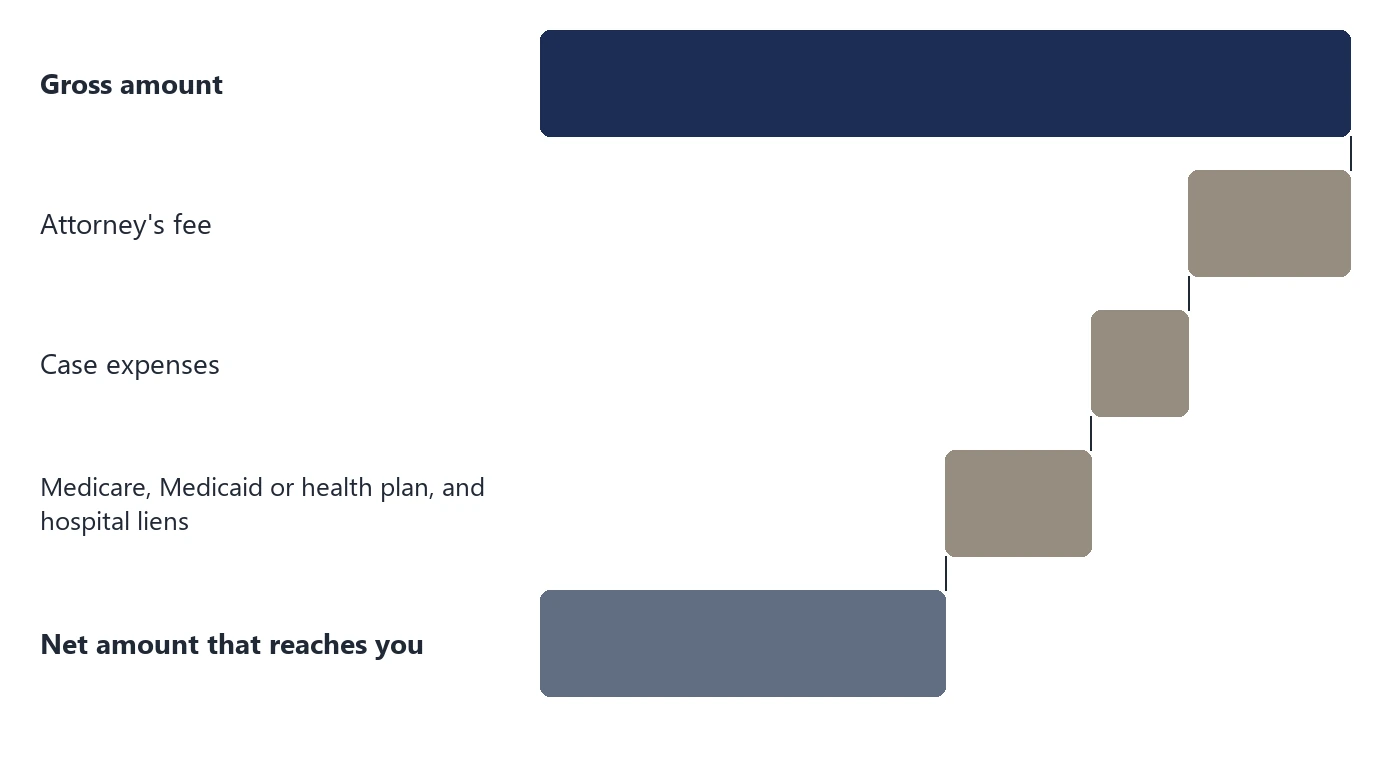
Match each deduction to a piece of paper:
| Deduction | Paperwork to get first |
|---|---|
| Attorney's fee | The percentage in your signed fee agreement |
| Case expenses | An itemized list of expert, deposition, and record costs |
| Medicare | A conditional payment amount, since Medicare is entitled to be repaid from a settlement, judgment, or award |
| Medicaid or a health plan | A written lien or reimbursement claim with itemized charges |
| Hospital lien | The claimed amount, checked line by line against the injury |
See a charge that has nothing to do with the crash? Dispute it through the payer's process before funds are released.
Who can approve a settlement for a child or an adult who can't decide?
A child's claim runs through a parent, and a parent can be on the other side of the money. Here's how that plays out when one crash hurts both:
- June 14: a pickup runs a light on I-30 in Grand Prairie. Maya, 12, and her mother are both hurt.
- July: the insurer confirms one $100,000 policy for both claims.
- September: it offers to split the policy. Each dollar to the mother is a dollar Maya doesn't get.
Her mother brings Maya's claim as next friend under TRCP 44. No compromise binds Maya until a judge approves it. And because the two are after the same money, TRCP 173 has the court appoint a guardian ad litem to look at the split from Maya's side alone.
Court approval also covers an adult without a guardian who can't manage the case. Capacity is assessed, not assumed. An adult with a brain injury who understands the choice makes it himself.
Long-term care needs may call for a trust, structured payments, or benefits advice:
| Situation | Planning question |
|---|---|
| A 9-year-old with a below-knee amputation | Who holds the money for prosthetic replacements until adulthood? |
| A 52-year-old on Medicaid after a brain injury | Will a lump sum affect eligibility for current benefits? |
| A 40-year-old with paraplegia and a working spouse | Do structured payments fit future care better than one lump sum? |
What deadlines matter before and after a verdict?
- Most Texas personal injury suits must be filed within two years of the injury under CPRC § 16.003.
- Health care and government claims add separate notice and expert-report rules. Under CPRC Chapter 74, expert reports and noneconomic damages caps apply only to health care claims.
- Under CPRC § 33.004, the motion to designate a responsible third party is due 60 days before trial. A late one needs good cause.
- TRCP 329b puts the motion for new trial within 30 days after the judgment is signed. It preserves certain complaints and affects appeal timing.
What to do now: Once the judgment is signed, ask your trial lawyer for the appeal calendar and a final payoff letter from each lienholder. Nobody gets paid before those letters arrive. If you need a trust or a structure, ask for the specialist's name too.
Frequently asked questions
Why prepare for trial if most cases settle?
The insurer prices a case on how it would look in front of a jury. Weak trial proof usually means a lower offer.
Can the defense use what I said at mediation against me?
Generally, no. Texas law makes mediation communications confidential, and Rule 408 limits use of settlement talks. Facts provable some other way can still come in.
Does a big verdict mean I get that amount?
It may not. Limits, collectability, fees, expenses, and liens all come out of the gross figure.
Who signs the settlement for my injured child?
You sign as next friend, but the court has to approve it. If your interest might conflict with your child's, a guardian ad litem may be appointed.
Will settling affect my Medicaid or SSI?
It can. It depends on how the money is received and held, so get benefits advice before you agree to the terms.
Sources
- Tex. Civ. Prac. & Rem. Code § 16.003
- Tex. Civ. Prac. & Rem. Code §§ 33.001, 33.004, 33.012
- Tex. Civ. Prac. & Rem. Code § 41.0105
- Tex. Civ. Prac. & Rem. Code Chapter 74
- Tex. Civ. Prac. & Rem. Code § 154.073
- Texas Rules of Civil Procedure
- Texas Rules of Evidence
- CMS beneficiary services
This article provides general information about Texas law, not legal advice. Every case depends on its facts, evidence, insurance, deadlines and governing law. Past results do not guarantee a similar outcome.

ABOUT THE ATTORNEY
Aaron A. Herbert
Founding Attorney
Board Certified in Personal Injury Trial Law
Aaron founded The Law Firm of Aaron A. Herbert in 2010 to focus on developing each client's case and seeking its maximum value. For over a decade, he has represented people seriously injured in major accidents and industrial catastrophes, pursuing trial verdicts and settlements while working to reduce the stress of litigation.
Education
- Texas A&M University · B.S., Criminal Justice, 1999
- University of Oklahoma College of Law · J.D., 2002; graduated in the top of his class
Trial experience & approach
Aaron earned numerous jury verdicts at boutique personal injury litigation firms. According to his biography, he spent a year as the top-earning litigation attorney at a firm that frequently appeared in verdict searches as having one of the highest numbers of trial wins in Texas. At another Dallas personal injury firm, he moved from managing pre-litigation attorney to managing litigation attorney over seven years as the firm grew into one of Dallas's largest personal injury firms.
His biography describes a reputation as one of America's most aggressive trial lawyers, with noteworthy recoveries from judges and juries and substantial pretrial settlements. Most of those settlements included confidentiality agreements requested by the defense. Aaron has said the recoveries were justified by the injuries and losses involved, which no amount of money could make someone choose to experience.
His approach combines passion, preparation, persistence and courtroom imagination. He believes a well-supported, engaged and motivated team working cooperatively helps deliver strong representation, with the goal of achieving the best possible result for every client.
Dallas roots, military service & publication
Born and raised in Dallas, Aaron enlisted in the United States Marine Corps after high school and later received an Honorable Discharge. He completed his university and law degrees after his military service and became a lifelong Sooners football fan in law school.
Publication: “Litigating Dog Bite Cases,” Texas Dog Law Seminar, Dallas, 2009.
Professional affiliations & recognition
Professional affiliations and recognition listed in Aaron’s biography:
- State Bar of Texas
- American Bar Association
- Association of Trial Lawyers of America (now American Association for Justice)
- Texas Trial Lawyers Association
- Dallas Trial Lawyers Association
- Dallas Bar Association
- Tarrant County Bar Association
- Million Dollar Advocates Forum
- The National Trial Lawyers – Top 100 Trial Lawyers