Experts link the crash or fall to the injury and the injury to a lifetime of costs, and Texas judges check each link before a jury hears it.
| An opinion usually survives when | It usually gets struck when |
|---|---|
| The wage matches the W-2s | The wage comes from nowhere |
| The care plan tracks the surgeon's orders | The plan adds care no doctor ordered |
| Other causes are ruled out in writing | An earlier injury is never mentioned |
There's a fourth way to lose, and Gharda USA v. Control Solutions shows it. A Pasadena warehouse burned on March 8, 2004, after workers left 32 drums of chlorpyrifos to melt overnight in a hot box. The plaintiffs' case ran through four experts, each leaning on another. In 2015, the Texas Supreme Court found at least two of those opinions unreliable, which took the other two down with them, and it reinstated a take-nothing judgment.
Which experts does a catastrophic injury case usually need?
Most cases line up like this:
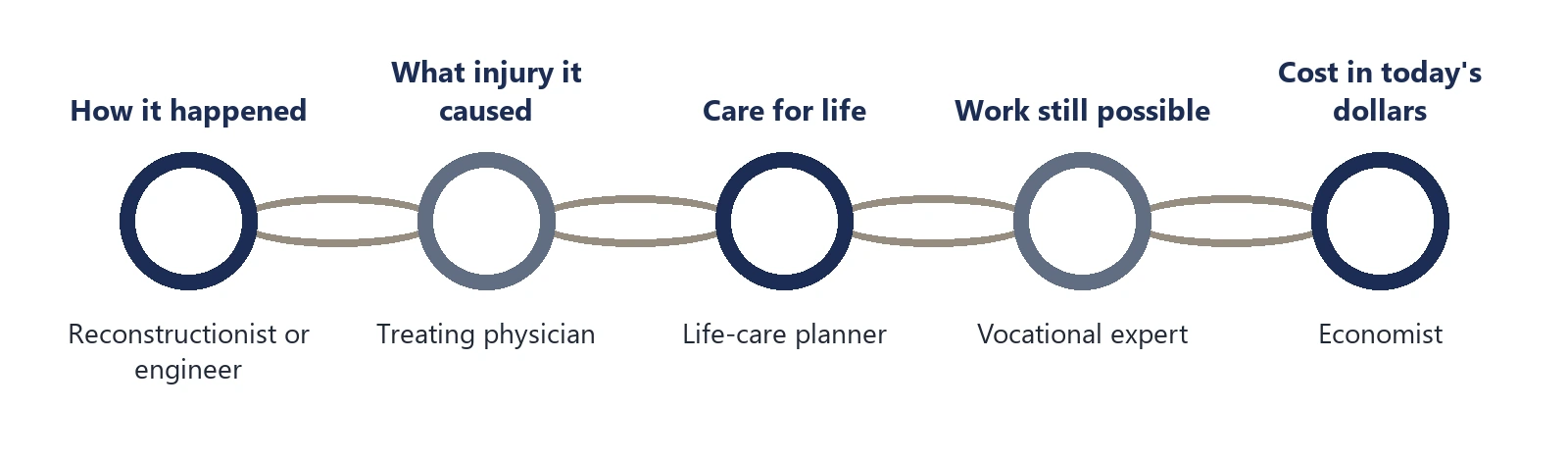
- How did the crash or fall happen? An accident reconstructionist or engineer.
- What injury did it cause? A treating physician or specialist.
- What care will you need for life? A life-care planner.
- What work can you still do? A vocational expert.
- What do those losses cost in today's dollars? An economist.
A surgeon may be the right person to say a spinal fusion will need revision. The surgeon usually isn't the right person to price thirty years of attendant care.

How do Texas courts test whether an expert is reliable?
Under Texas Rule of Evidence 702, a qualified expert may give an opinion that helps the jury. The judge decides whether that opinion is relevant and reliable before the jury hears it. The expert's training must fit the specific question.
Four Texas Supreme Court cases supply the questions:
| Case | The question |
|---|---|
| E.I. du Pont de Nemours & Co. v. Robinson, 923 S.W.2d 549 (Tex. 1995) | Six non-exclusive factors, such as testing, peer review, error rate, and general acceptance |
| Gammill v. Jack Williams Chevrolet, Inc., 972 S.W.2d 713 (Tex. 1998) | Is the analytical gap between data and opinion too great? |
| Gharda USA, Inc. v. Control Solutions, Inc., 464 S.W.3d 338 (Tex. 2015) | Does it rest on another expert's unreliable opinion? |
| Merrell Dow Pharmaceuticals, Inc. v. Havner, 953 S.W.2d 706 (Tex. 1997) | Was a plausible cause that could be negated excluded with reasonable certainty? |
The Robinson factors differ from case to case. Gammill's gap check applies to experience-based opinions too.
Under Gharda, an opinion built on another expert's unreliable opinion fails too. If the planner's opinion falls, the economist who priced the plan can fall with it.
Does Havner mean ruling out every cause a defendant can imagine? No.
What happened in Helena Chemical Co. v. Cox?
Cotton farmers in Mitchell County said an herbicide sprayed from two planes over the Spade Ranch in July 2015 drifted onto their fields. The fields sat anywhere from 1.8 to 25 miles from the spray sites. The farmers' experts never visited those fields or collected cotton samples. Many of the farmers had filed insurance claims blaming drought or other weather.
The Texas Supreme Court ruled against the farmers in 2023. Their proof never dealt with weather or other herbicides, two plausible alternative causes, and the court reinstated summary judgment for Helena.
Rule 705(c) attacks the same problem from the evidence side. An opinion without a sufficient basis in the underlying facts or data is inadmissible.
What must be disclosed about your experts, and when?
Under Rule 195.2, unless the court orders otherwise, a party seeking relief designates experts 90 days before discovery ends. Other parties designate 60 days before. Many courts set their own dates in a scheduling order, so check yours.
Count back from the close of discovery. If it closes June 30, the injured person's experts are due about April 1 and the defense experts about May 1. A life-care planner first named in mid-April is already late.
What does the other side get to see?
- Rule 195.5(a) disclosures include the subject, the general substance of opinions, and, for retained experts, the materials reviewed, résumé, prior testimony list, and fee.
- Lawyer-expert communications are protected under Rule 195.5(c), with three exceptions: compensation, facts or data the lawyer supplied, and assumptions the lawyer supplied.
- Draft reports and draft disclosures are protected under Rule 195.5(d).
- A new surgery or new restrictions? Rule 195.6 requires retained experts' opinions and their bases to be supplemented.
- Under Rule 193.6, evidence not timely disclosed may be excluded unless good cause or no unfair surprise or prejudice is shown.
At the reliability hearing, the other side may question the expert about the underlying facts outside the jury's presence under Rule 705(b). Bring these:
- the list of every record the expert relied on
- the calculations and the workbook behind them
- the alternative-cause analysis, in writing
How does the expert team stay consistent?
Every shared assumption needs one source:
| Assumption | Source | Common mismatch |
|---|---|---|
| Future surgeries | Treating physician | A surgery the physician never recommended |
| Attendant care | Physician and planner | 24-hour care in the plan, 8 hours from the physician |
| Work ability | Vocational expert | Total disability in the economist's math, part-time work in the vocational report |
| Earnings | Payroll and tax records | No after-tax step under Civ. Prac. & Rem. Code § 18.091 |
| Medical costs | Billing records | Past bills at list price, not the amount actually paid or incurred under § 41.0105 |
The experts should share facts, not a script. Each one has to reach the conclusion through their own professional judgment.
Related reading: the Texas catastrophic injury claims guide, Texas life care plans, How to prove lost earnings and earning capacity, and the catastrophic injury and damages hub.
Frequently asked questions
Can my treating doctor be my expert?
On the injury and your care, often yes. Nobody knows your fusion better than your surgeon. Pricing 30 years of care, measuring lost earning capacity, or rebuilding the crash is usually someone else's job.
Does a famous expert make my case stronger?
Not by itself. The Helena farmers had five causation experts. They still lost, because the proof didn't account for weather and other herbicides.
Will I meet the experts?
You'll meet some of them. Life-care planners and vocational experts often interview or test the injured person, and the defense may ask the court to order its own medical exam under Rule 204.1.
What if the defense expert disagrees with mine?
That's common. If both opinions are reliable, the jury decides which to believe.
Who pays when the defense deposes my expert?
Under Rule 195.7, the party taking the deposition pays the expert's reasonable fees for preparing, testifying, and reviewing the transcript.
Sources
- Texas Rules of Evidence
- Texas Rules of Civil Procedure
- Gharda USA, Inc. v. Control Solutions, Inc., 464 S.W.3d 338 (Tex. 2015)
- Helena Chemical Co. v. Cox, No. 20-0881 (Tex. Mar. 3, 2023)
- Tex. Civ. Prac. & Rem. Code § 18.091
- Tex. Civ. Prac. & Rem. Code § 41.0105
This article provides general information about Texas law, not legal advice. Every case depends on its facts, evidence, insurance, deadlines and governing law. Past results do not guarantee a similar outcome.

ABOUT THE ATTORNEY
Aaron A. Herbert
Founding Attorney
Board Certified in Personal Injury Trial Law
Aaron founded The Law Firm of Aaron A. Herbert in 2010 to focus on developing each client's case and seeking its maximum value. For over a decade, he has represented people seriously injured in major accidents and industrial catastrophes, pursuing trial verdicts and settlements while working to reduce the stress of litigation.
Education
- Texas A&M University · B.S., Criminal Justice, 1999
- University of Oklahoma College of Law · J.D., 2002; graduated in the top of his class
Trial experience & approach
Aaron earned numerous jury verdicts at boutique personal injury litigation firms. According to his biography, he spent a year as the top-earning litigation attorney at a firm that frequently appeared in verdict searches as having one of the highest numbers of trial wins in Texas. At another Dallas personal injury firm, he moved from managing pre-litigation attorney to managing litigation attorney over seven years as the firm grew into one of Dallas's largest personal injury firms.
His biography describes a reputation as one of America's most aggressive trial lawyers, with noteworthy recoveries from judges and juries and substantial pretrial settlements. Most of those settlements included confidentiality agreements requested by the defense. Aaron has said the recoveries were justified by the injuries and losses involved, which no amount of money could make someone choose to experience.
His approach combines passion, preparation, persistence and courtroom imagination. He believes a well-supported, engaged and motivated team working cooperatively helps deliver strong representation, with the goal of achieving the best possible result for every client.
Dallas roots, military service & publication
Born and raised in Dallas, Aaron enlisted in the United States Marine Corps after high school and later received an Honorable Discharge. He completed his university and law degrees after his military service and became a lifelong Sooners football fan in law school.
Publication: “Litigating Dog Bite Cases,” Texas Dog Law Seminar, Dallas, 2009.
Professional affiliations & recognition
Professional affiliations and recognition listed in Aaron’s biography:
- State Bar of Texas
- American Bar Association
- Association of Trial Lawyers of America (now American Association for Justice)
- Texas Trial Lawyers Association
- Dallas Trial Lawyers Association
- Dallas Bar Association
- Tarrant County Bar Association
- Million Dollar Advocates Forum
- The National Trial Lawyers – Top 100 Trial Lawyers