What happens when you, your doctors and the defense experts testify under oath before trial, and how those answers get used later.
Short answer
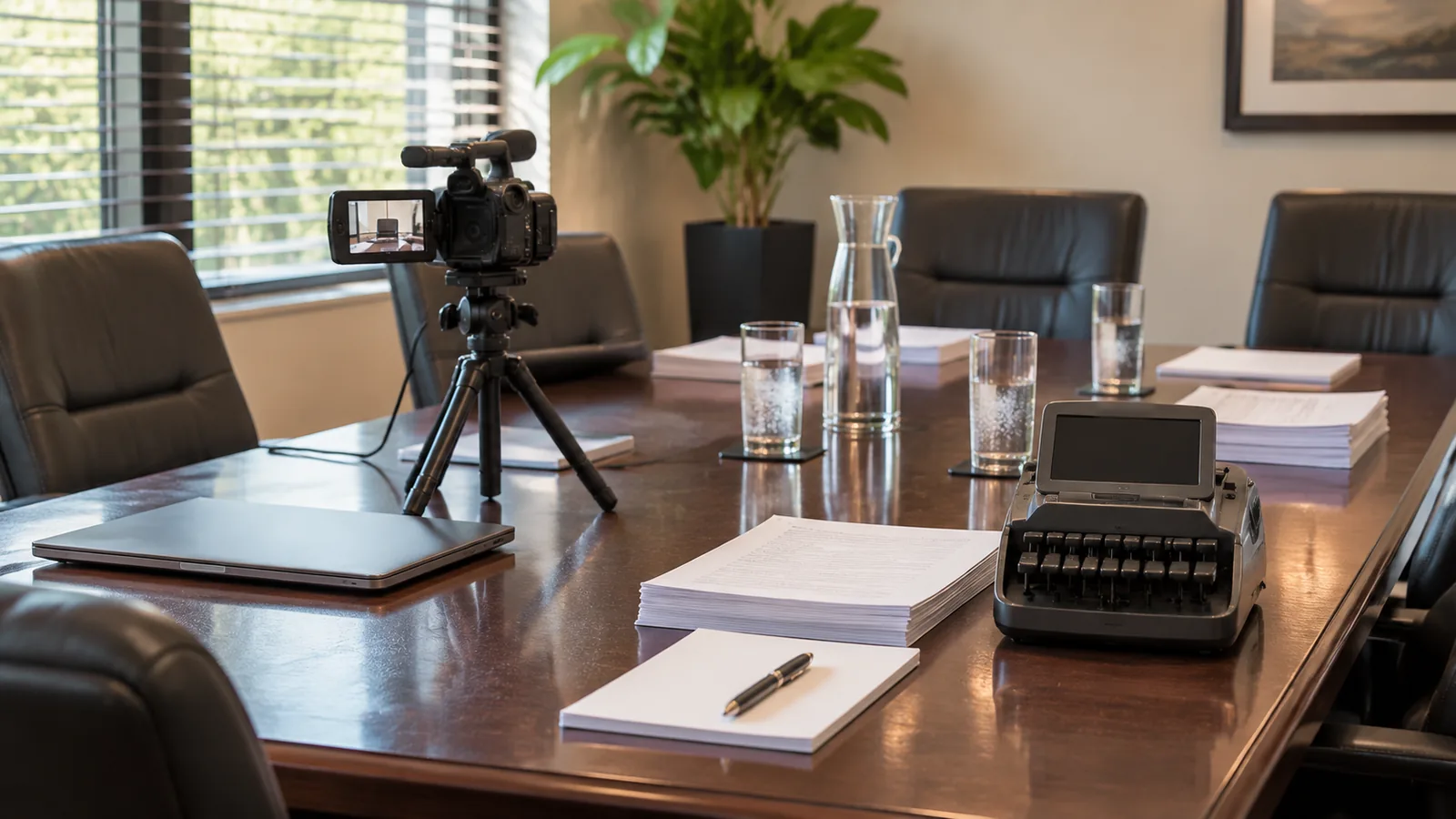
A deposition happens in a conference room, usually months before trial: a court reporter, a video camera, and a defense lawyer with a binder of your medical records. Everything you say there is sworn testimony.
In a Texas catastrophic injury case, it often decides what the jury later hears about how you were hurt, what you can still do, and what your future care will cost.
Who usually gets deposed?
- you, on how the event happened, your treatment, and daily life now
- a spouse, parent, or caregiver who helps you bathe and dress
- treating doctors and therapists
- retained experts on both sides
- the defendant or a company representative, on what the company knew and its policies
What rules control a Texas deposition?
Under Rule 199.5(b), every witness is placed under oath, and the parties may examine and cross-examine.
How long can it go? Rule 199.5(c) says no side may question an individual witness for more than six hours, not counting breaks.
Can you lean over and ask your lawyer what to say? No. Under Rule 199.5(d), private conferences during questioning are improper except to decide whether to assert a privilege. You can talk during agreed breaks.
Key point: Rule 199.5(e) limits objections to "Objection, leading" and "Objection, form." When you hear one, you still answer unless your lawyer tells you not to.
Rule 199.5(f) lists the only reasons a lawyer may instruct a witness not to answer: to preserve a privilege, to comply with a court order or the rules, to protect the witness from an abusive or misleading question, or to secure a ruling. An instruction not to answer has to be justified on request.
Rule 203.1(b) lets the witness list changes with reasons on a separate sheet. Wait more than 20 days, and the right to make changes can be waived. Read it the week it comes.
The deposition can also be video recorded if a party gives at least five days' notice under Rule 199.1(c):
| Format | What a jury later gets |
|---|---|
| Stenographic transcript only | Your words read aloud, without your tone or pauses |
| Video plus transcript | How you move, speak, and handle fatigue during the day |
| Remote deposition by video link | Allowed with reasonable written notice under Rule 199.1(b), which helps if travel is hard |
A paralegal reading your words in a flat voice won't show that you shifted in your chair every ten minutes by 3 p.m. Video can.
How should you prepare for your own deposition?
You don't memorize a script. You get the facts straight.
- Build your own timeline: injury date, hospital admission and discharge, each surgery, the first therapy visit.
- Reread your medical history. That chiropractor visit for the same shoulder in 2021 will come up, and forgetting it looks like hiding it.
- List what you can and can't do. Stairs? Lifting a grandchild? A full shift? Standing at the stove through dinner?
- Plan for your limitations: an interpreter, extra breaks, a better chair, a shorter session after a brain injury.
- Review what you posted and wrote. Texts and social media posts about the injury are discoverable, and you may be shown them.
Practice these out loud:
- "I don't remember."
- "Which part of the question do you want me to answer first?"
- "My grip is better, but I still can't button a shirt."
- "I need a break. Can we note that on the record?"
What do treating doctors get asked?
The defense will test the basis for each treating doctor's opinion:
| Topic | Example question | What a strong answer covers |
|---|---|---|
| Diagnosis | "What objective findings support the C6 injury you documented?" | Imaging dates, exam findings, and test results, not only the patient's report |
| Causation | "How did you rule out the 2019 back strain?" | The prior records reviewed and why the new injury differs |
| Future care | "How often will this patient need a urologist, and for how long?" | Frequency and duration |
| Preexisting conditions | "Would the patient have needed this surgery anyway?" | The history before and after the event |
| Limits of the opinion | "Did you calculate the cost of this care?" | Usually no; price belongs to other experts |
Under Texas Rule of Evidence 703, an expert may rely on facts or data that experts in the field would reasonably rely on, even if those facts aren't separately admissible. Rule 705(c) makes the opinion inadmissible when the underlying facts don't give it a sufficient basis.
An orthopedic surgeon offering an opinion on a bladder injury is the mismatch the defense looks for. Rule 702 admits expert testimony only from a qualified witness, and only when specialized knowledge helps the jury.
Under Rule 705(b), the other side in a civil case may question an expert about the underlying data outside the jury's hearing before the opinion is stated. When your expert's opinions or their basis change, Rule 195.6 requires your side to supplement the expert's deposition testimony or report.
How is a defense expert cross-examined?
Good cross-examination narrows the real disagreement. Calling the expert biased over and over doesn't. Say a 34-year-old electrician from Mesquite has a C6 spinal cord injury, and the defense hires its own life-care planner.
The questions might go like this:
| Issue | Question to the defense expert |
|---|---|
| Need | "Do you agree he needs a power wheelchair?" |
| Frequency | "How often should the chair be replaced, and what's your source?" |
| Price | "Which vendor prices did you use, and what year?" |
| Records reviewed | "Did you read the 2026 urology notes?" |
| Correcting one input | "If replacement is every five years instead of seven, how does your total change?" |
The defense planner agrees you need the wheelchair. That item is settled, and only price and replacement frequency are left to fight about. She never read the urology notes? That may explain the gap in her assumptions. The same one-item-at-a-time test works on most line items in a Texas life-care plan.
"You're paid by the defense, aren't you?" asked four times in an hour starts to sound like a lawyer with nothing else. Cover fees and prior testimony once, then move to method.
How can deposition answers be used at trial?
Under Rule 203.6(b), all or part of a deposition may be used for any purpose in the same proceeding. Your own answers may be read or played to the jury.
- Rule 801(e)(3): a deposition statement from the same civil proceeding isn't hearsay, and the witness doesn't have to be unavailable.
- Rule 801(e)(2): a party's own statement offered against it isn't hearsay. A company representative's answers can be used against the company.
- Rule 613(a): before using a prior inconsistent statement, the examiner must tell the witness what was said, when and where it was said, and to whom. The witness then gets a chance to explain or deny it.
- Rule 107: if one side uses part of a deposition, the other side may introduce other parts needed to understand it.
Say the defense plays a 12-second clip of you saying "I can walk." Under Rule 107, your lawyer can play the next 30 seconds, where you add "about half a block, with a cane."
What deadlines and fault rules sit behind all of this?
Two years. That's the usual limit for filing a Texas personal injury suit under Civ. Prac. & Rem. Code § 16.003, counted from when the cause of action accrues. Depositions usually come only after suit is filed.
The fault questions at your deposition have a reason. Above 50 percent responsibility, section 33.001 bars recovery. Below that, section 33.012(a) reduces damages by your percentage. One answer about speed, a phone, or an ignored warning can move that number.
More reading: the Texas catastrophic injury claims guide, the Texas Catastrophic Injury and Damages Hub, Texas brain injury claims and proof of lasting cognitive harm, and Texas spinal cord injury claims and lifetime care damages.
Frequently asked questions
Can I bring notes into my deposition?
Ask your lawyer first. Under Rule 612, the other side can inspect a writing you use to refresh your memory while testifying.
What if I give a wrong date by mistake?
Correct it on the record as soon as you notice. You can also list the change with a reason on the errata sheet under Rule 203.1(b).
Can my lawyer stop the deposition if it gets abusive?
Rules 199.5(f) and (g) let your lawyer instruct you not to answer an abusive question and suspend the deposition to get a ruling from the court. Rule 199.5(h) requires a good faith basis for either step.
Who pays the defense expert for deposition time?
The defense does. Under Rule 195.7, the party that retained the expert pays the expert's reasonable fees for preparing for and giving the deposition.
Sources
- Texas Rules of Civil Procedure (court-posted PDF)
- Texas Rules of Evidence (effective July 2, 2026)
- Tex. Civ. Prac. & Rem. Code § 16.003
- Tex. Civ. Prac. & Rem. Code §§ 33.001, 33.012
This article provides general information about Texas law, not legal advice. Every case depends on its facts, evidence, insurance, deadlines and governing law. Past results do not guarantee a similar outcome.

ABOUT THE ATTORNEY
Aaron A. Herbert
Founding Attorney
Board Certified in Personal Injury Trial Law
Aaron founded The Law Firm of Aaron A. Herbert in 2010 to focus on developing each client's case and seeking its maximum value. For over a decade, he has represented people seriously injured in major accidents and industrial catastrophes, pursuing trial verdicts and settlements while working to reduce the stress of litigation.
Education
- Texas A&M University · B.S., Criminal Justice, 1999
- University of Oklahoma College of Law · J.D., 2002; graduated in the top of his class
Trial experience & approach
Aaron earned numerous jury verdicts at boutique personal injury litigation firms. According to his biography, he spent a year as the top-earning litigation attorney at a firm that frequently appeared in verdict searches as having one of the highest numbers of trial wins in Texas. At another Dallas personal injury firm, he moved from managing pre-litigation attorney to managing litigation attorney over seven years as the firm grew into one of Dallas's largest personal injury firms.
His biography describes a reputation as one of America's most aggressive trial lawyers, with noteworthy recoveries from judges and juries and substantial pretrial settlements. Most of those settlements included confidentiality agreements requested by the defense. Aaron has said the recoveries were justified by the injuries and losses involved, which no amount of money could make someone choose to experience.
His approach combines passion, preparation, persistence and courtroom imagination. He believes a well-supported, engaged and motivated team working cooperatively helps deliver strong representation, with the goal of achieving the best possible result for every client.
Dallas roots, military service & publication
Born and raised in Dallas, Aaron enlisted in the United States Marine Corps after high school and later received an Honorable Discharge. He completed his university and law degrees after his military service and became a lifelong Sooners football fan in law school.
Publication: “Litigating Dog Bite Cases,” Texas Dog Law Seminar, Dallas, 2009.
Professional affiliations & recognition
Professional affiliations and recognition listed in Aaron’s biography:
- State Bar of Texas
- American Bar Association
- Association of Trial Lawyers of America (now American Association for Justice)
- Texas Trial Lawyers Association
- Dallas Trial Lawyers Association
- Dallas Bar Association
- Tarrant County Bar Association
- Million Dollar Advocates Forum
- The National Trial Lawyers – Top 100 Trial Lawyers