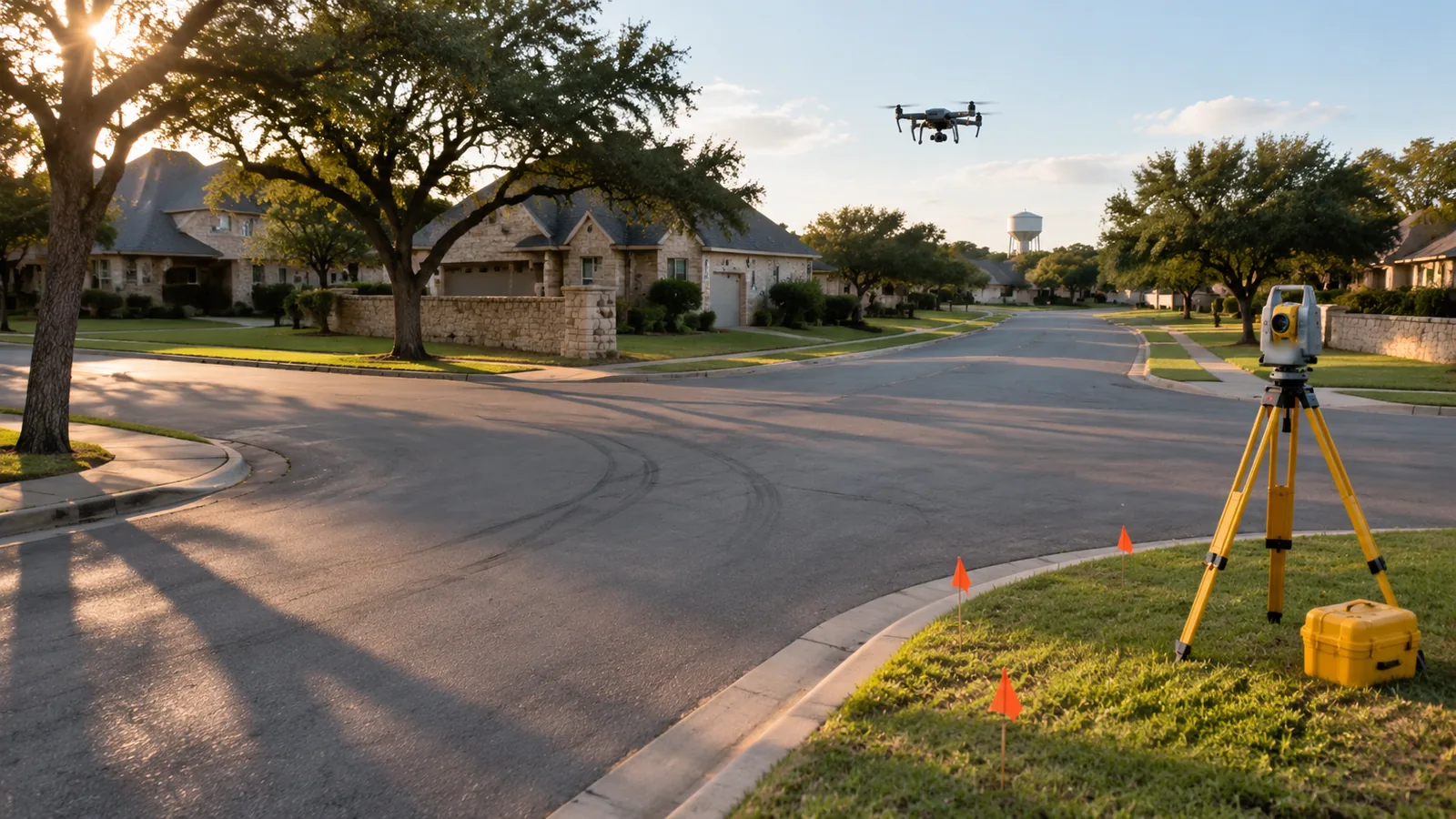
How scene measurements, vehicle data and drone mapping can explain a serious crash, and the Texas and FAA rules that decide whether that work holds up.
Short answer
A reconstruction can show where the cars were, how fast they were moving and what each driver could see. It can't decide who's at fault. That's the jury's job, and the work only reaches the jury if a judge finds the data lawful and the method reliable.
| What reconstruction can show | What it can't show by itself |
|---|---|
| Distances, grades, sight lines, and rest positions | Who is legally at fault |
| Speed or braking ranges backed by vehicle data and road marks | Lighting, traffic, or hedges on the crash date if the survey came months later |
| Whether a driver could have seen a hazard from a set point | That a polished animation is accurate |
| Which sequence of events best fits the physical evidence | What your injuries are worth |
What evidence should be saved first?
One hard rain can wash out tire marks. Work through these in the first week:
- Photograph tire marks, gouges, and debris, with a tape measure or coin in the frame.
- Mail the owner and the insurer a hold letter for the event data recorder, the "black box," before anyone repairs, salvages, or crushes the car.
- Ask the gas station or traffic office for its camera video in writing. Keep a copy of your letter.
- Request the 911 audio and dispatch log by date, time, and cross street before the agency's retention period runs out.
- When you order the crash report, ask whether officers measured the scene or flew a drone.
Who can pull the black box data? Transportation Code § 547.615 answers that. A person other than the owner needs a court order, the owner's consent, or one of a few narrow safety purposes.
What to do now: If the other car sits at a salvage yard, call the insurer and the yard the same day and ask them to hold it. Then get the owner's consent or a court order before anyone plugs in.
How does a drone survey help, and which FAA rules apply?
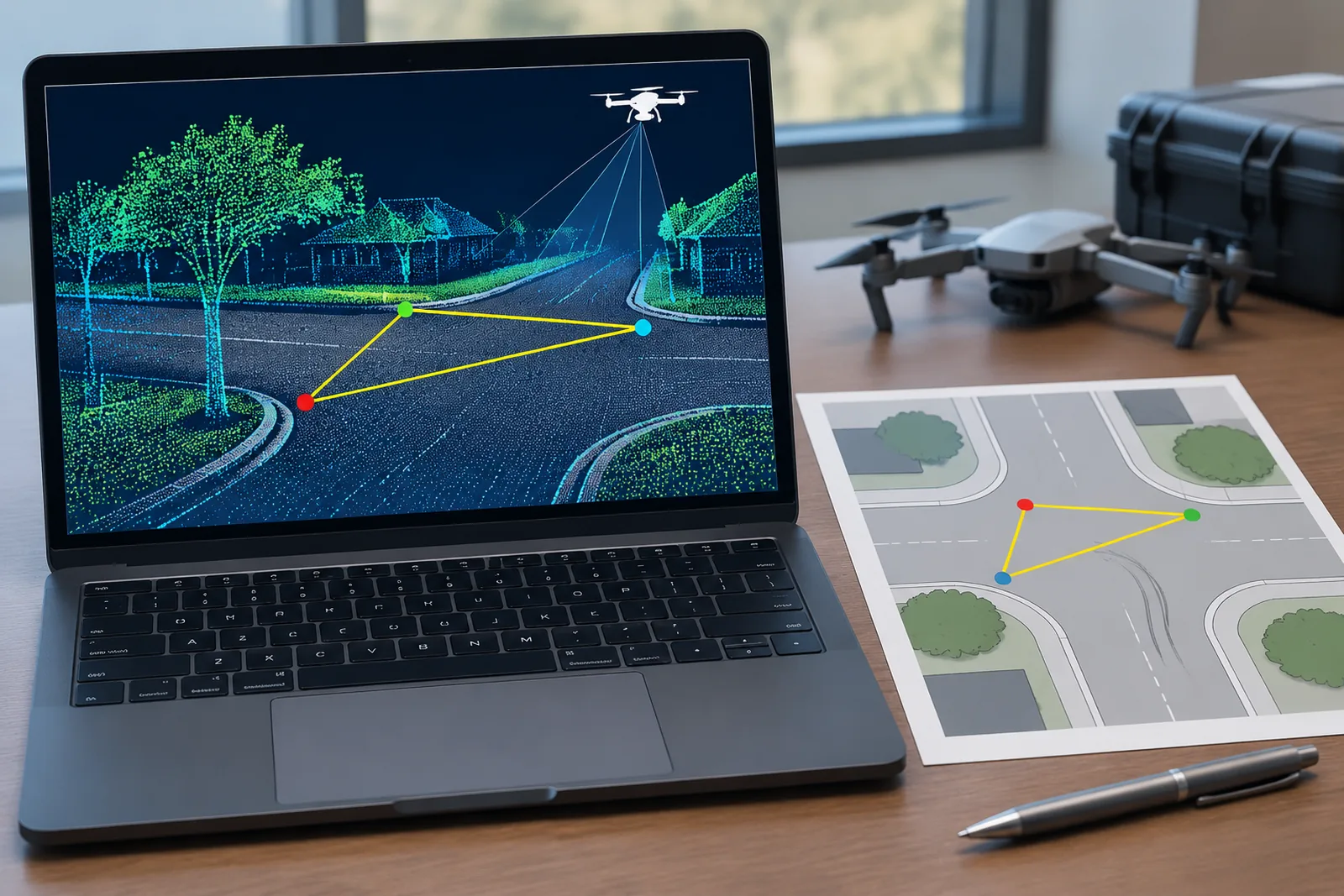
A licensed surveyor can map an empty intersection early on a Sunday. The drone flies a grid and shoots hundreds of overlapping photos. Software stitches them into a scaled map, and the expert measures skid marks and curb lines off it weeks later.
The federal rules sit in 14 C.F.R. Part 107. Before you rely on the map, ask the operator:
- Can I see your remote pilot certificate with a small UAS rating? (§ 107.12)
- Did someone keep the drone in sight the whole flight? (§ 107.31)
- Does the flight log stay at or under 400 feet, or near a structure? (§ 107.51(b))
- We're close to Love Field or DFW. Did you get air traffic control authorization for that Class B, C, or D airspace? (§ 107.41)
- Did the drone pass over anyone, and if so, which exception applied? (§ 107.39)
FAA approval doesn't settle the Texas side. Government Code chapter 423 has its own image rules:
- Shooting a public road? Section 423.002(a)(15) makes it lawful to capture an image of public real property or a person on it, and roadway scenes often fit.
- A parking lot, store, or private yard needs the consent of the owner or lawful occupant under section 423.002(a)(6).
- Licensed surveyors and engineers may capture images in their practice if no individual is identifiable, under sections 423.002(a)(19) and (20).
Section 423.003 makes it a Class C misdemeanor to use a drone to capture an image of a person or private property with intent to conduct surveillance.
Under section 423.005, images captured in violation of section 423.003, and images incidental to lawful capture, generally can't be used as evidence in a civil action. What about the shots of the neighbor's backyard? Ask the operator before anyone flies.
What does the reconstructionist actually test?
The black box says 47 mph. The skid marks say 60. Somebody has to explain that gap, and a good expert checks every input against a second one:
| Input | Checked against | What goes wrong |
|---|---|---|
| Speed | Event data, crush depth, skid length | The three don't land in one range |
| Road friction | A drag sled run on that pavement | A textbook number; one dry run on a damp night |
| Time stamps | One reference clock | A store camera running four minutes fast |
| Sight lines | Dated street photos | Hedges the city trimmed eight months later |
| Impact and rest points | Scene marks, police diagram | Positions guessed off a photo |
How does a judge decide whether the reconstruction comes in?
Under Texas Rule of Evidence 702, a witness qualified by knowledge, skill, experience, training, or education may give an opinion that helps the jury. A fire investigator isn't automatically qualified to reconstruct a highway crash.
Rule 705(c) makes an opinion inadmissible if the underlying facts or data don't give it a sufficient basis.
In E.I. du Pont de Nemours & Co. v. Robinson, 923 S.W.2d 549 (Tex. 1995), the court said judges may weigh factors such as testing, error rate, peer review, and general acceptance. Gammill v. Jack Williams Chevrolet, Inc., 972 S.W.2d 713 (Tex. 1998), held that an opinion fails if there is too great an analytical gap between the data and the conclusion.
What happened when four experts leaned on each other?
Gharda USA, Inc. v. Control Solutions, Inc. started with a warehouse fire in Pasadena, Texas. On March 8, 2004, workers loaded 32 drums of chlorpyrifos into an industrial oven called a hot box to melt overnight. Around 5:15 the next morning, a manager heard a boom, and the fire consumed nearly everything inside.
The plaintiffs' fire investigators pointed to burn patterns leading away from the hot box. Their case rested on a series of four experts whose opinions depended on one another. In 2015, the Texas Supreme Court held that at least two of those opinions were unreliable, and the other two were built on them. It reinstated the trial court's take-nothing judgment.
Under Rule 901(a), the party offering an item must show it is what they claim it is. The pilot or surveyor may need to explain how the map was made.
Rule 403 allows a court to exclude relevant evidence if its value is substantially outweighed by unfair prejudice or the risk of misleading the jury. Animations that look like real footage often draw this objection.
Key point: An animation illustrates an expert's opinion. It isn't a recording of the crash, and it should say so on screen.
Each exhibit has its own limit:
| Exhibit | What it is | Its limit |
|---|---|---|
| Scaled scene diagram | A drawing from surveyed points | It has to match the measured data |
| 3D model from drone photos | A measurable model | It shows conditions on the survey date |
| Animation | The expert's opinion in motion | It must match the expert's numbers and be labeled |
| Physics simulation | Software output from chosen inputs | The inputs must be disclosed so the other side can test them |
How does reconstruction fit with fault and deadlines?
A range of 52 to 61 mph in a 40 zone sounds like it ends the case. It doesn't. Under Civ. Prac. & Rem. Code § 33.003, the jury decides who caused the harm and gives each person a percentage.
Go over 50 percent and you recover nothing, under sections 33.001 and 33.012. Anything less cuts the award by your share. Want to blame someone who isn't in the suit? Section 33.004 generally needs a motion for leave by the 60th day before trial.
The expert's file is discoverable too. Rule 195.5(a)(4)(A) of the Texas Rules of Civil Procedure covers the models and data a retained expert receives or prepares. Testing that could destroy or materially alter a part needs court approval first, under Rule 196.5. And the clock keeps running: the usual filing deadline is two years, under section 16.003. Related guides: the Texas catastrophic injury claims guide, the catastrophic injury and damages hub, What is an expert witness in a car accident case, and Texas spinal cord injury claims.
Frequently asked questions
Can I fly my own drone over the crash scene?
Part 107 generally applies to a flight for your case, and it requires an FAA remote pilot certificate. Dated phone photos taken safely from the roadside often help more.
Does the police report settle how the crash happened?
It's one piece of evidence. A reconstructionist tests the officer's diagram and opinions against the physical marks and data.
What if the other car has already been repaired?
Ask for the repair invoices and whether the data module was replaced. Photos taken before the repair still matter.
Can the other side use my car's data against me?
It can, if it's lawfully obtained and relevant.
Sources
- Tex. Transp. Code § 547.615
- Tex. Gov't Code ch. 423
- 14 C.F.R. Part 107
- Texas Rules of Evidence
- Texas Rules of Civil Procedure
- Gharda USA, Inc. v. Control Solutions, Inc., 464 S.W.3d 338 (Tex. 2015)
- Tex. Civ. Prac. & Rem. Code ch. 33
- Tex. Civ. Prac. & Rem. Code § 16.003
This article provides general information about Texas law, not legal advice. Every case depends on its facts, evidence, insurance, deadlines and governing law. Past results do not guarantee a similar outcome.

ABOUT THE ATTORNEY
Aaron A. Herbert
Founding Attorney
Board Certified in Personal Injury Trial Law
Aaron founded The Law Firm of Aaron A. Herbert in 2010 to focus on developing each client's case and seeking its maximum value. For over a decade, he has represented people seriously injured in major accidents and industrial catastrophes, pursuing trial verdicts and settlements while working to reduce the stress of litigation.
Education
- Texas A&M University · B.S., Criminal Justice, 1999
- University of Oklahoma College of Law · J.D., 2002; graduated in the top of his class
Trial experience & approach
Aaron earned numerous jury verdicts at boutique personal injury litigation firms. According to his biography, he spent a year as the top-earning litigation attorney at a firm that frequently appeared in verdict searches as having one of the highest numbers of trial wins in Texas. At another Dallas personal injury firm, he moved from managing pre-litigation attorney to managing litigation attorney over seven years as the firm grew into one of Dallas's largest personal injury firms.
His biography describes a reputation as one of America's most aggressive trial lawyers, with noteworthy recoveries from judges and juries and substantial pretrial settlements. Most of those settlements included confidentiality agreements requested by the defense. Aaron has said the recoveries were justified by the injuries and losses involved, which no amount of money could make someone choose to experience.
His approach combines passion, preparation, persistence and courtroom imagination. He believes a well-supported, engaged and motivated team working cooperatively helps deliver strong representation, with the goal of achieving the best possible result for every client.
Dallas roots, military service & publication
Born and raised in Dallas, Aaron enlisted in the United States Marine Corps after high school and later received an Honorable Discharge. He completed his university and law degrees after his military service and became a lifelong Sooners football fan in law school.
Publication: “Litigating Dog Bite Cases,” Texas Dog Law Seminar, Dallas, 2009.
Professional affiliations & recognition
Professional affiliations and recognition listed in Aaron’s biography:
- State Bar of Texas
- American Bar Association
- Association of Trial Lawyers of America (now American Association for Justice)
- Texas Trial Lawyers Association
- Dallas Trial Lawyers Association
- Dallas Bar Association
- Tarrant County Bar Association
- Million Dollar Advocates Forum
- The National Trial Lawyers – Top 100 Trial Lawyers