
A puddle on a toy-aisle floor. No proof of how long it had been there. In H-E-B, LP v. Peterson (Tex. Apr. 10, 2026), that gap decided the case: the grocer's no-evidence motion was granted.
Eight months into a lawsuit over spilled lard by the meat counter at a La Michoacana Meat Market, the store files a no-evidence motion: no proof it knew about the spill. The response has to point to admissible evidence tied to that exact motion.
Saying the injury deserves a jury won't do it, so the real work starts back in the investigation.
A ruling can:
- end the whole case, as when there's no evidence the store knew about water by the produce scale
- drop one defendant, such as a property owner when the tenant ran the sales floor
- cut one claim, such as a negligent-activity theory while the premises claim goes on
- settle a defense, such as an affirmative defense resolved before trial
This article is about the La Michoacana Meat Market grocery chain, not the ice cream shops (paleterías) or independent businesses that also use the "La Michoacana" name. The sign may not name the defendant.
In a 2018 Houston appeal, the defendant was LMMM Houston #41, Ltd., d/b/a La Michoacana Meat Market #41.
Read this with the actual motion, the record and the court's orders. Nothing here says any La Michoacana location broke a duty. Hurt at a La Michoacana store? Tell us about your La Michoacana injury or call (214) 200-4878. Contacting the firm does not create an attorney-client relationship.
Which version of Rule 166a applies?
Effective date: March 1, 2026. That's when the rewrite of Texas Rule of Civil Procedure 166a took effect (Supreme Court Misc. Docket No. 26-9012), and it covers only motions filed on or after that day.
Same law: apart from deadlines it isn't meant to change the law. The burdens and the notice cases still apply. In Peterson, the Supreme Court of Texas noted the 2026 amendments didn't apply to that earlier motion.
New labels: Rule 166a(c) now covers clerk and court duties, and Rule 166a(i) is the ruling deadline. An old "166a(i) motion" citation is wrong.
| Motion | The movant must | The respondent must |
|---|---|---|
| Traditional (166a(a)(1), (b)(2)(C), (h)(2)) | State specific grounds and prove no genuine fact issue | Show the proof falls short or raise a material fact dispute |
| No-evidence (166a(a)(2), (b)(2)(D), (h)(3)) | File after adequate discovery time and name the elements | Raise a genuine fact issue on each challenged element, or lose the motion |
| Combined | Carry the required titles and keep grounds identifiable | Answer each ground and each element separately |
The deadlines, counted from the filing date
Count from the motion's actual filing date, not the day it reached your lawyer's desk.
- The response is due 21 days after filing, unless there is leave or agreement (d)(1).
- Evidence not yet available calls for an affidavit or declaration saying why (d)(3).
- The movant's reply has a 7-day deadline and can't raise new grounds (e).
- The hearing or submission can't come within 35 days; it is generally within 60, up to 90 in listed situations (g)(1).
- The written ruling comes within 90 days of hearing or submission (i).
Check local rules, standing orders and the scheduling order too. Dallas and other counties issued their own orders after the rewrite. Then pin down the motion itself.
Here, the operating company filed, not the landlord. It went after the premises claim and left negligent activity alone. It said there was no proof of knowledge or proximate cause. It attached two things, a manager's declaration and the meat department's floor-check log, and asked the court to throw out every claim against it.
Which elements will the store attack?
Each element of an invitee's premises claim needs its own proof. Knowledge usually turns on how long the condition existed at that spot. Some conditions have been held not unreasonably dangerous as a matter of law.
A store isn't an insurer of its customers. The medical records have to tie the fall to the injury and the bills. And duty turns on who you were (an invitee, here), the claim, and this defendant's tie to the building.
Spilled lard, a falling display and a collision with an employee's cart raise different questions. Negligent activity asks whether the activity itself caused the injury at the time; control asks whether this defendant ran the area. Proving store notice in a La Michoacana slip and fall claim covers notice.
One line per element, with a page cite
| Element | Evidence and where it sits |
|---|---|
| Notice | A shopper who saw the liquid earlier, deposition pp. 42-47, with the basis for her timing |
| Condition | Photos of the puddle by the dairy case, Exhibit 6, frames 2-4, with the photographer's testimony |
| Control | The lease and management agreement, Exhibit 11, §§4 and 9, with a business-records declaration |
| Causation | The orthopedic surgeon's report, Exhibit 14, p. 3, through the disclosed expert |
The judge gets a page number, not a box of paper. Citing a whole 180-page deposition can hide the fact that nothing in it covers timing. And if the store attacks causation or control instead of notice, the response answers that.
One strong element won't carry another.
A crystal-clear video of the fall says nothing about who ran the floor.
A shattered wrist doesn't show the store knew.
Two years of maintenance records don't put water in front of the dairy case at 4:10 that afternoon.
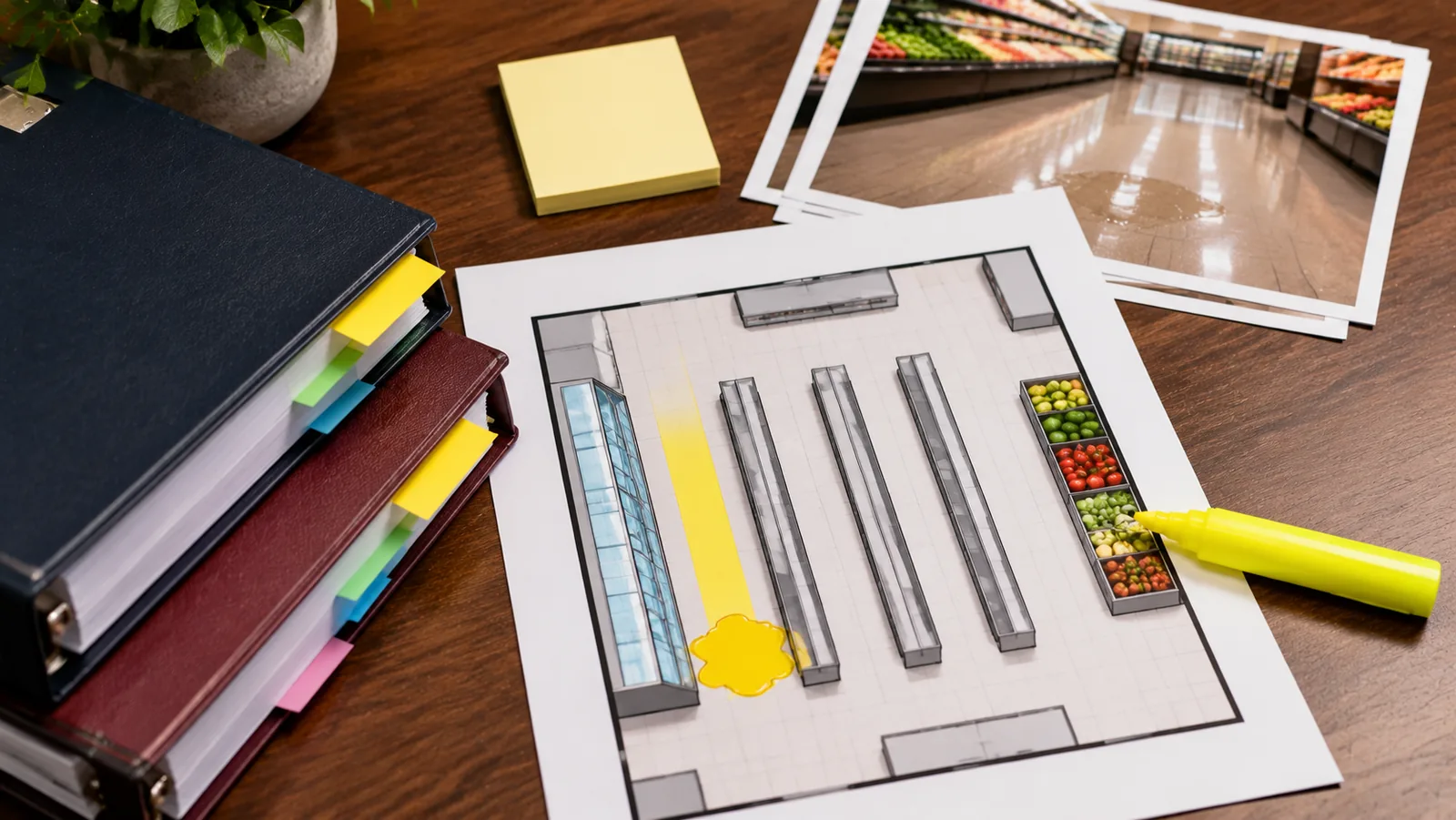
What should discovery have gathered?
"The store should have known" isn't evidence. In the lard-spill case, three records do most of the work.
- The produce-aisle camera from the hour before the fall, for when the lard hit the floor.
- That afternoon's floor-check log, for who walked the aisle and when.
- The meat-counter schedule, for who was standing ten feet away.
Employee and corporate-representative depositions fill in the rest. So do inspection and maintenance records for that spot, admissible prior complaints, photos showing the spill's size and color, and the medical causation opinions. Written discovery in a La Michoacana injury lawsuit covers how to ask for them.
How long was the spill there?
Often the hardest question is whether the store had a fair chance to find the hazard. Footage of the spill 25 minutes before the fall helps. So do a stocker walking past twice in ten minutes, a sweep log blank from 2:00 to 4:00 p.m., a customer's warning to the meat counter, cart tracks through the liquid, or a service ticket that morning for the same leaking case. A leak somewhere else isn't notice of this puddle.
| Case | What the Supreme Court of Texas held |
|---|---|
| H-E-B v. Peterson (2026) | A respondent to a no-evidence motion needs some evidence of how long the condition existed at that place; leaks elsewhere, puddle size and general inspection evidence didn't fill the gap |
| Wal-Mart v. Reece (2002) | An employee's proximity to a hazard, without more, isn't enough |
| Wal-Mart v. Gonzalez (1998) | Meager circumstantial evidence of how long a substance sat doesn't prove notice |
| Brookshire Bros. v. Aldridge (2014) | A spoliation case: the trial court decides whether video was improperly lost and the remedy |
Missing footage isn't an automatic win. And the two kinds of notice need different proof.
Constructive notice?
A when. When the lard hit the floor, how anyone knows, and how long it sat in that one spot.
Actual notice?
A who. The employee's name, what she saw or heard, and the time.
"Someone must have known" is neither.
Attachments that aren't evidence yet
Some attachments look like proof and aren't.
| Filed as | Why it falls short |
|---|---|
| A brief paragraph saying what a witness will say | Argument, not evidence |
| A screenshot of a text nobody authenticates | Just a picture |
| A summary of a store record | It can drop the "approximately" that mattered |
| A document with no sponsoring witness | Not competent on its own |
Each one needs a witness or declaration behind it.
Affidavits and declarations must rest on personal knowledge, state facts rather than conclusions, and meet Rule 166a(j). "I saw the puddle when I picked up tortillas at aisle 7, about 15 minutes before I heard the fall" can be tested.
"It was there a while" can't. A form defect isn't grounds for reversal unless an objection pointed it out and amendment was refused (166a(j)(4)).
Preparing her means learning what she remembers and why. If she said "for a while," her affidavit can't say "25 minutes." What fixes the time for her? Maybe she'd just hung up with her sister, or had the tortillas in her cart.
Aisles 6 and 7 have the same endcap display, so show her photos, and let her pick. A rushed affidavit full of conclusions can do more harm than a deposition that fits the issue.
Answering a no-evidence motion, step by step
- Quote the element exactly as the motion states it.
- Note what the movant says is missing.
- Cite the record by exhibit, page and line.
- Confirm it's admissible or can be presented in admissible form.
- Explain why it raises a genuine issue of material fact; courts describe the showing as more than a scintilla of probative evidence.
- Apply or distinguish Peterson, Reece and Gonzalez.
- Ask the court to deny the motion on the right grounds.
Answering a traditional motion
With a traditional motion, the store carries the burden. It has to show there's no genuine fact issue at all. That means its own exhibits get read hard, line by line. In the lard-spill case, the manager's declaration had four lines worth pushing on.
| The store's paper says | The gap to press |
|---|---|
| "Floors are inspected hourly." | That's the policy. Who actually walked that floor between 2:00 and 4:00 p.m.? |
| "Aisle checked 3:00 p.m." | The meat counter runs the whole aisle. Which end did someone look at? |
| "No one reported a spill." | Did the manager ask every stocker working that shift? |
| "Floor tested slip-resistant." | When was the test, and was the tile dry? Lard is a different surface. |
A binder full of policies doesn't tell you what happened at 3:40 on a Saturday.
Still missing evidence at the deadline?
In the lard-spill case, it was the lane 3 video. Her lawyer had asked the store to keep it in week one and asked for a copy in month two. Two more letters went out in months three and four, and nothing came back.
So with the response due, she filed a declaration under Rule 166a(d)(3). It listed those dates and said what the footage should show, which was when the lard hit the floor. It also noted the manager's deposition was set for the next month.
A late response, under Rule 166a(d)(1), needs leave of court or the other side's agreement. Her letters didn't buy any time by themselves.
Objections to the store's evidence
Paragraph 6 of the manager's declaration said, "A stocker told me the aisle was dry at 3:45." Which stocker? He never said. Her lawyer filed a written hearsay objection to that paragraph a week before the hearing.
Exhibit C was a printout with no one to vouch for it, so she objected. Paragraph 9 described things the manager couldn't have seen from his office. The defense expert's opinion had nothing reliable under it. And the store's excerpt from page 61 of a deposition stopped one sentence short of the part that mattered.
Then she asked the judge to rule on each one, because some objections are lost without a ruling. Rule 166a and the controlling cases say which.
A notice motion, worked through
This time the store's motion says there's no evidence it knew about water on the floor. The shopper has three things.
| Evidence | What it can show | Its limit |
|---|---|---|
| Photos taken after the fall | Water was there when they were taken | Not how long it was there |
| A repair invoice from another department | Equipment elsewhere needed service | Not notice of this condition |
| A witness who saw water in the aisle 12 minutes earlier | A 12-minute interval, if reliable | She has to identify the same spot and condition |
Only the witness gets at time. So the response is built on her: where she stood, what she saw, and how she knows it was 12 minutes earlier. If some footage seems to cut the other way, the response deals with it. Take her away, with no video and nothing but water at the moment of the fall, and the notice problem gets serious.
Every inference needs a fact under it
| Inference | Fact that supports it | Not enough |
|---|---|---|
| The employee knew | A shopper told her at 3:20 | Her name on the schedule |
| The store controlled the aisle | Section 9 of the lease assigns floor upkeep | The sign out front |
| The "aisle checked" entry has limits | Evidence showing what it couldn't cover | Calling it fake |
The deadline, the hearing, the order
By the deadline, the file needs:
- every cited exhibit attached, readable and labeled
- service complete
- the proposed order on file
- objection rulings in the record
At the hearing there's no live testimony (166a(g)(4)). Your lawyer points to the best evidence on each element by record cite, and brings nothing that wasn't filed.
What the signed order means
| Ruling | Next question |
|---|---|
| Granted in full | Finality and appeal |
| Granted in part | Which claims and parties remain, and how that changes the charge and the negotiation |
| Denied | Trial; a denial isn't a finding that the evidence is enough to win |
A denial doesn't mean the evidence is enough to win at trial. Appeal timing is covered in post-trial motions and appeals in a La Michoacana injury case, and the whole lawsuit in the La Michoacana injury case and trial preparation guide.
Frequently asked questions
Can the judge decide my case without hearing me testify live?
The judge rules on paper. Rule 166a(g)(4) doesn't allow oral testimony at the hearing, so your side of it comes in by deposition, affidavit, or declaration.
Does a denial mean I will win at trial?
A denial usually just sends the disputed issues to trial, where burdens, rulings on evidence and credibility still decide things.
Should my response include every document in the file?
Only what answers the grounds the store raised, with exact exhibit cites. Dumping everything in can bury your best proof.
Can I appeal immediately if the motion is granted?
It depends on the signed order, which claims and parties are left, and the governing law. Some rulings only end part of a case.
Who can review my case?
The Law Firm of Aaron A. Herbert, P.C. can review the store location, the date, and the evidence you have.
Tell us about your La Michoacana injury
Bring the store address, the incident date, and any photos, receipts, or witness names. Tell us about your La Michoacana injury or call (214) 200-4878. Aaron Herbert is Board Certified in Personal Injury Trial Law by the Texas Board of Legal Specialization. The office is The Law Firm of Aaron A. Herbert, P.C., 8330 Lyndon B. Johnson Freeway, Suite 700, Dallas, Texas 75243. No result is guaranteed, and contacting the firm does not create an attorney-client relationship.
Related pages on La Michoacana injuries
More in this series: Texas La Michoacana supermarket injury knowledge hub, La Michoacana injury case and trial preparation guide, Proving store notice in a La Michoacana slip and fall claim, Written discovery in a La Michoacana injury lawsuit, and Post-trial motions and appeals in a La Michoacana injury case.
Sources and legal authorities
- Rules and statutes: Supreme Court of Texas, Misc. Docket No. 26-9012; Texas Rules of Civil Procedure (as amended October 1, 2026); Texas Rules of Evidence 602, 701-705, 801-806 and 901 (amendments effective July 2, 2026).
- Cases: H-E-B, LP v. Peterson, No. 24-0310 (Tex. Apr. 10, 2026); Wal-Mart Stores, Inc. v. Reece, 81 S.W.3d 812 (Tex. 2002); Wal-Mart Stores, Inc. v. Gonzalez, 968 S.W.2d 934 (Tex. 1998); Brookshire Bros., Ltd. v. Aldridge, 438 S.W.3d 9 (Tex. 2014); Keetch v. Kroger Co., 845 S.W.2d 262 (Tex. 1992).
- Texas Judicial Branch, rules and standards.
Legal sources checked November 2, 2026.

ABOUT THE ATTORNEY
Aaron A. Herbert
Founding Attorney
Board Certified in Personal Injury Trial Law
Aaron founded The Law Firm of Aaron A. Herbert in 2010 to focus on developing each client's case and seeking its maximum value. For over a decade, he has represented people seriously injured in major accidents and industrial catastrophes, pursuing trial verdicts and settlements while working to reduce the stress of litigation.
Education
- Texas A&M University · B.S., Criminal Justice, 1999
- University of Oklahoma College of Law · J.D., 2002; graduated in the top of his class
Trial experience & approach
Aaron earned numerous jury verdicts at boutique personal injury litigation firms. According to his biography, he spent a year as the top-earning litigation attorney at a firm that frequently appeared in verdict searches as having one of the highest numbers of trial wins in Texas. At another Dallas personal injury firm, he moved from managing pre-litigation attorney to managing litigation attorney over seven years as the firm grew into one of Dallas's largest personal injury firms.
His biography describes a reputation as one of America's most aggressive trial lawyers, with noteworthy recoveries from judges and juries and substantial pretrial settlements. Most of those settlements included confidentiality agreements requested by the defense. Aaron has said the recoveries were justified by the injuries and losses involved, which no amount of money could make someone choose to experience.
His approach combines passion, preparation, persistence and courtroom imagination. He believes a well-supported, engaged and motivated team working cooperatively helps deliver strong representation, with the goal of achieving the best possible result for every client.
Dallas roots, military service & publication
Born and raised in Dallas, Aaron enlisted in the United States Marine Corps after high school and later received an Honorable Discharge. He completed his university and law degrees after his military service and became a lifelong Sooners football fan in law school.
Publication: “Litigating Dog Bite Cases,” Texas Dog Law Seminar, Dallas, 2009.
Professional affiliations & recognition
Professional affiliations and recognition listed in Aaron’s biography:
- State Bar of Texas
- American Bar Association
- Association of Trial Lawyers of America (now American Association for Justice)
- Texas Trial Lawyers Association
- Dallas Trial Lawyers Association
- Dallas Bar Association
- Tarrant County Bar Association
- Million Dollar Advocates Forum
- The National Trial Lawyers – Top 100 Trial Lawyers