
Quick answer
Look for evidence connecting Walmart to the spill before the fall. An employee's observation or a customer's report may establish actual knowledge. If that evidence is missing, constructive notice generally requires proof that the spill was present long enough for Walmart to discover it. Video, witnesses and store records can supply parts of that proof. A fall inside the store is not enough on its own. Even evidence that an employee created the condition supports an inference of knowledge rather than automatically deciding that issue.
“The store should have known” is a conclusion. A claim needs the facts underneath it.
A photograph can show water. An incident report can show that someone fell. But notice asks an earlier question: what did the store know, or have a reasonable opportunity to discover, before the injury? Start there when sorting the available evidence. The Texas Walmart knowledge hub explains how notice fits with dangerousness, reasonable care and causation.
If someone at Walmart already knew
Suppose a customer says she told an employee about the spill before you fell. The next conversation should be with that customer. What exactly did she say? Where was she standing? Can she identify the employee? How does she know her report came before the accident?
A description may identify an employee even without a name. Receipts, messages and footage may help place the conversation in time. Without audio, the recording will not establish what was said.
Employee testimony, a radio message or a record of a cleanup request may also help, if such evidence exists. Keep the focus on this condition at this location. General knowledge that customers sometimes spill things is different.
If nobody admits seeing it
Constructive notice does not depend on an admission. It asks whether the condition had existed long enough for Walmart to have a reasonable opportunity to discover it.
That makes time a necessary part of the inquiry. A nearby employee is not a substitute for temporal evidence. In Wal-Mart Stores, Inc. v. Spates, 186 S.W.3d 566 (Tex. 2006), the Supreme Court considered an employee's proximity to a clear plastic ring on the floor and found the evidence of constructive knowledge insufficient. The employee's presence did not establish a reasonable opportunity to discover the hazard under the circumstances.
Start with the earliest sighting of the spill that evidence supports. If liquid is already present when a recording begins, ask for earlier footage or find a witness who passed that spot before the camera clip starts.
What if a Walmart employee caused the spill?
Evidence of creation deserves close attention. For example, footage of an employee dropping a container may answer questions that a photograph taken after the fall cannot. But identify what the evidence actually shows. An employee passing a shelf is not footage of that employee causing a leak.
Keetch v. Kroger Co., 845 S.W.2d 262 (Tex. 1992), allows an inference of knowledge from creation of the condition. When knowledge is disputed, creation does not establish it as a matter of law. Counsel should also distinguish an unsafe premises condition from a negligent activity occurring at the time of injury.
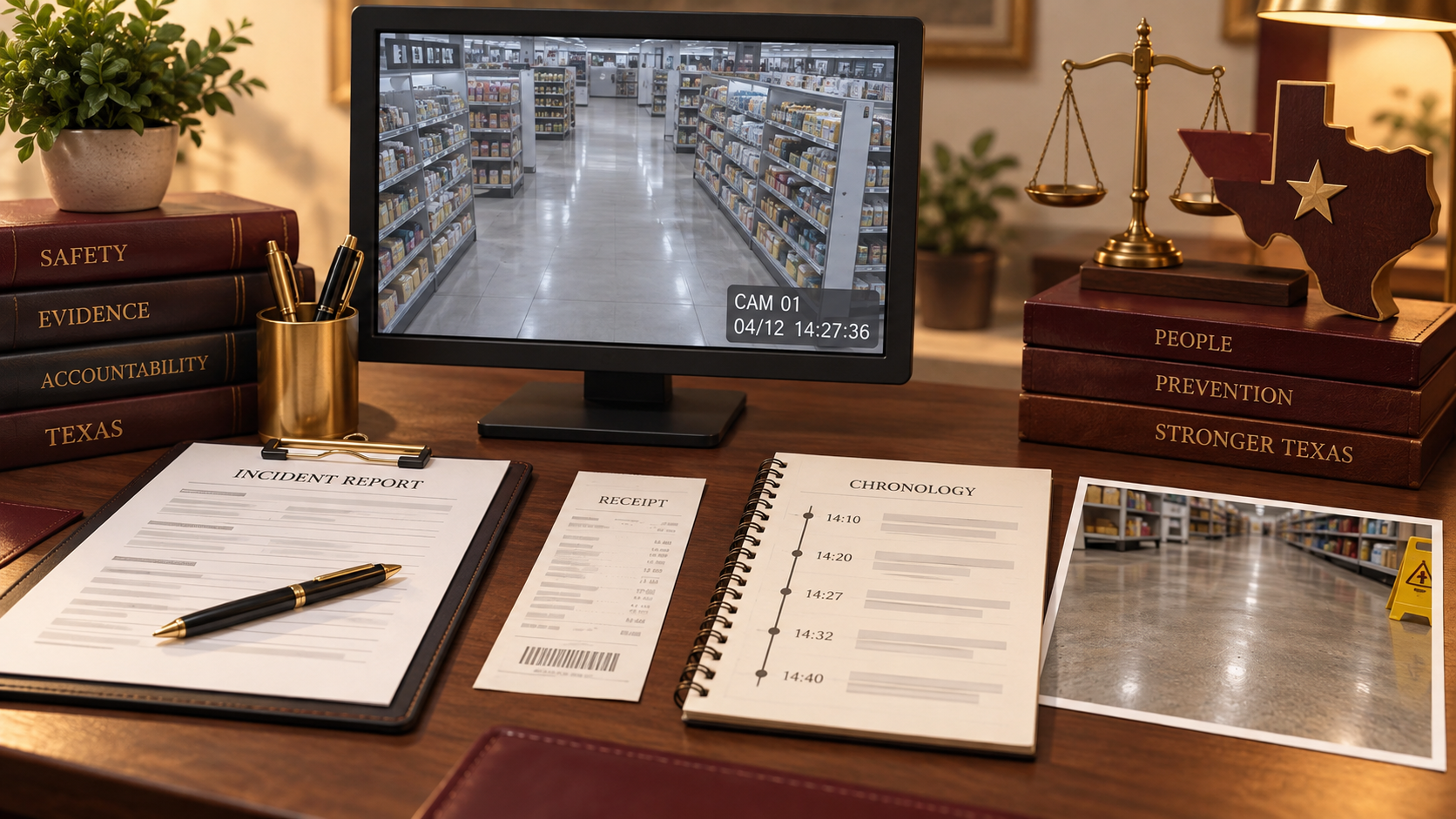
Put the accounts next to the records
A useful case file lets a reviewer distinguish an observation from an interpretation. “Employee walks past the end of aisle at 1:04 on Camera 6” is an observation. “Employee must have seen the spill” is an inference that needs support about sight lines, attention and the condition's appearance.
The same care applies to inspection records. A completed entry may be relevant, but it needs an explanation of who made it, what area was covered and what its time means. Compare it with the video before accepting either account as complete.
Save the original files and witness accounts. Flag a conflicting timestamp for review instead of editing the witness’s recollection to make it fit.
What proving notice still leaves to decide
A store that knows of a hazard must be evaluated on its response as well. Was there an adequate warning? What opportunity existed to make the area reasonably safe? Did the condition cause the injury? Notice does not answer all of those questions.
A cone can be relevant on both sides of the analysis: it may suggest awareness of a condition, and it may support a warning defense. Its timing and purpose matter. For an initial consultation, bring the evidence you have and identify what you do not yet know. That is more useful than forcing every fact into one theory at the outset.
For the broader litigation process, read How to Litigate a Walmart Injury Case in Texas.
Discuss a Texas Walmart injury claim
Contact The Law Firm of Aaron A. Herbert, P.C., at (214) 200-4878 or request a consultation. Free consultation. No fees or expenses unless you recover.
This is general information about Texas law, not advice for a particular case. Reading it does not create an attorney-client relationship. Deadlines, available evidence and the applicable legal duties depend on the facts.

ABOUT THE ATTORNEY
Aaron A. Herbert
Founding Attorney
Board Certified in Personal Injury Trial Law
Aaron founded The Law Firm of Aaron A. Herbert in 2010 to focus on developing each client's case and seeking its maximum value. For over a decade, he has represented people seriously injured in major accidents and industrial catastrophes, pursuing trial verdicts and settlements while working to reduce the stress of litigation.
Education
- Texas A&M University · B.S., Criminal Justice, 1999
- University of Oklahoma College of Law · J.D., 2002; graduated in the top of his class
Trial experience & approach
Aaron earned numerous jury verdicts at boutique personal injury litigation firms. According to his biography, he spent a year as the top-earning litigation attorney at a firm that frequently appeared in verdict searches as having one of the highest numbers of trial wins in Texas. At another Dallas personal injury firm, he moved from managing pre-litigation attorney to managing litigation attorney over seven years as the firm grew into one of Dallas's largest personal injury firms.
His biography describes a reputation as one of America's most aggressive trial lawyers, with noteworthy recoveries from judges and juries and substantial pretrial settlements. Most of those settlements included confidentiality agreements requested by the defense. Aaron has said the recoveries were justified by the injuries and losses involved, which no amount of money could make someone choose to experience.
His approach combines passion, preparation, persistence and courtroom imagination. He believes a well-supported, engaged and motivated team working cooperatively helps deliver strong representation, with the goal of achieving the best possible result for every client.
Dallas roots, military service & publication
Born and raised in Dallas, Aaron enlisted in the United States Marine Corps after high school and later received an Honorable Discharge. He completed his university and law degrees after his military service and became a lifelong Sooners football fan in law school.
Publication: “Litigating Dog Bite Cases,” Texas Dog Law Seminar, Dallas, 2009.
Professional affiliations & recognition
Professional affiliations and recognition listed in Aaron’s biography:
- State Bar of Texas
- American Bar Association
- Association of Trial Lawyers of America (now American Association for Justice)
- Texas Trial Lawyers Association
- Dallas Trial Lawyers Association
- Dallas Bar Association
- Tarrant County Bar Association
- Million Dollar Advocates Forum
- The National Trial Lawyers – Top 100 Trial Lawyers