When a company is on the other side, its own records and the people it designates to speak for it often explain how a life-changing injury happened.
Short answer
When a business is a defendant in a Texas catastrophic injury case, discovery lets your lawyer obtain its records and question the company itself under oath. Texas Rule of Civil Procedure 199.2(b)(1) requires the company to name one or more people to testify about matters known or reasonably available to it, on topics described with reasonable particularity.
Corporate discovery can show what the company's written rules required on the date you were hurt, whether inspections, repairs, or training actually happened, who knew about a hazard and when, and how the company investigated the incident. It has limits, though. On its own, it can't prove these things:
- Breaking a company rule isn't the same as breaking the law.
- Company records won't establish your medical needs or future care costs.
- The records don't prove the company is the only party at fault.
- Discovery doesn't guarantee a result or settlement amount.
What records does a company usually keep?
Most businesses create records as part of daily operations, and those records often outlast anyone's memory. Common categories include these:
- Written policies, such as a safety manual, loading procedure, or driver handbook, show what the company expected employees to do.
- Revision history, meaning dated versions of the same manual, shows whether the rule in effect that day matches the current one.
- Training files, such as sign-in sheets, test scores, and course outlines, show whether the worker involved was trained on the task.
- Inspection records and work orders, such as daily equipment checks and repair tickets, show whether the company followed its own schedule.
- Incident reports, such as a supervisor's report or root-cause review, show what the company learned right after the event.
- Prior complaints from customers or employees about the same hazard show whether the company had warning before your injury.
A manual tells you what should have happened. Inspection logs, repair tickets, and the people who filled them out tell you what did happen.

Say a pallet rack collapses at a warehouse and crushes a delivery driver's legs. In that hypothetical, your lawyer might request these records:
- Rack inspection logs for 12 months and the repair ticket history, to show whether known damage was reported and left in place.
- The rack load-limit policy and the version in effect that day, to show what weight the company itself treated as safe.
- Training records for the forklift operator, to show whether the operator was taught to report rack strikes.
- Prior incident reports involving that aisle, to show notice before the collapse.
How does a corporate representative deposition work?
You don't get to pick the witness. Your lawyer's notice names the company and lists topics. Rule 199.2(b)(1) says those topics must be described with reasonable particularity. The company then designates one or more people to answer for it.
Hypothetical: the warehouse sends its regional safety manager. She's never stood in the aisle where the rack fell. Is that a dead end? No. A designee testifies to matters known or reasonably available to the organization. Did she read the inspection logs? Did she call the shift supervisor? Under that standard, "I don't personally know" doesn't end the inquiry.
Three more rules affect the deposition itself:
- Documents. Under Rule 199.2(b)(5), a notice to a party may ask the witness to bring documents, governed by Rules 193 and 196. The rack inspection binder can sit on the table while she answers.
- Video. Under Rule 199.1(c), a deposition may be video recorded with at least five days' notice. Jurors can then watch her answer instead of hearing a transcript read aloud.
- Time. Under Rule 199.5(c), no side may examine or cross-examine an individual witness for more than six hours. Ask about the topics that matter most first.
A company deposition doesn't replace the people who were there. Your lawyer may also depose the supervisor, the driver, or the technician who did the work.
The wording of each topic matters. Here's how vague topics compare with better ones in the rack-collapse hypothetical:
| Topic as written | Better version |
|---|---|
| "All safety practices of the company." | Rack inspection procedures at the named warehouse from January 2025 through the incident date |
| "Everything about the accident." | The company's investigation of the incident, including who took part and what was reviewed |
| "All records." | The records created by the inspection procedure and where they are stored |
| "Why the company is not at fault." | The facts the company relies on to say the rack was inspected |
The vague versions are too broad to prepare for, mix facts with legal conclusions, or ask for an argument instead of facts.
How are emails, data and video requested?
Electronic records need their own specific request in Texas. Under Rule 196.4, the request must specifically ask for electronic data and say what form it should be produced in. Ask for native files with metadata where the dates matter.
What if the data sits on an old server? Rule 196.4 also requires the company to produce data reasonably available in its ordinary course of business, or object. Say last year's camera footage survives only on backup tapes that a vendor would have to restore. That's the kind of extraordinary step that can lead to a cost dispute.
Key point: A vendor's server can still count. Rule 192.3(b) reaches documents and data compilations in the company's possession, custody, or control.
Narrow requests last longer, too. Rule 192.4 lets a court limit discovery that's duplicative or whose burden outweighs its likely benefit. Ask for the aisle 14 camera from 6 a.m. to noon on the day of the collapse. Don't ask for every camera in the building.
Under Rule 192.6, a person may ask the court for a protective order. Trade secrets and personal data may then be produced under limits instead of withheld. These electronic sources come up often:
| Electronic source | What to ask for |
|---|---|
| Fleet telematics, such as GPS speed and hard-braking alerts | Data for the trip and the days before it |
| Maintenance software with work-order timestamps | The audit trail showing edits |
| Email and messaging, such as a supervisor's note about a broken guardrail | Messages from named people over a set date range |
| Loading-dock and other camera systems | The original export and the retention setting |
Narrow, dated requests like these are easier to enforce and harder to call burdensome.
What happens when the company holds records back?
Texas rules give both sides a way to raise and test objections, privilege claims, and missing answers. The process usually runs in this order:
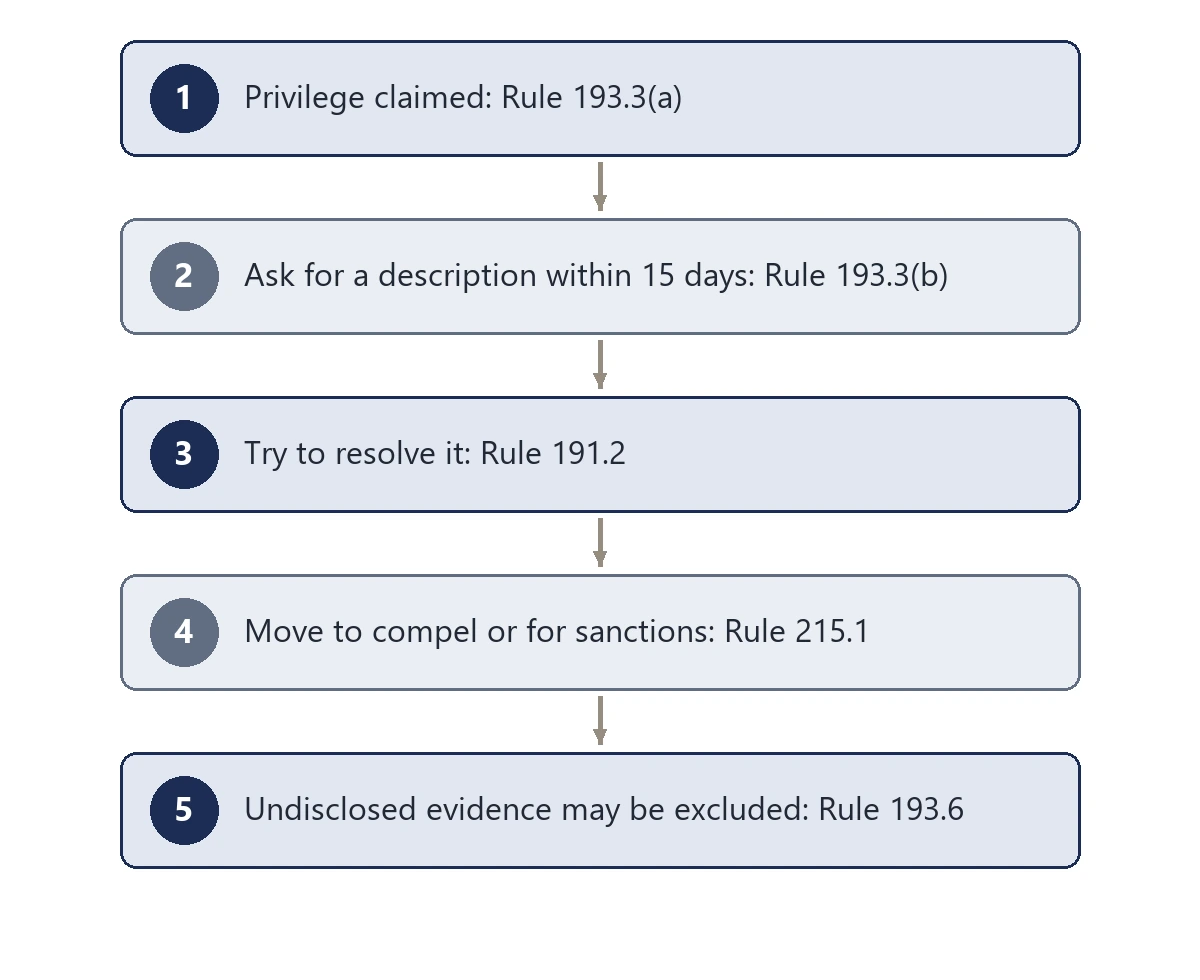
- If the company says records are privileged, Rule 193.3(a) requires it to state that material was withheld, the request it relates to, and the privilege claimed.
- On written request, Rule 193.3(b) gives the company 15 days to describe the withheld items and the privilege for each. Under Rule 193.3(c), a lawyer communication about this lawsuit may be withheld without that log.
- If the two sides can't agree, Rule 191.2 requires a discovery motion to certify that a reasonable effort to resolve the dispute failed.
- If answers are still missing, Rule 215.1 lets a party ask the court for an order compelling discovery or for sanctions.
- If a party never disclosed a document or witness, Rule 193.6 says that evidence may be excluded at trial unless the court finds good cause or no unfair surprise.
Getting records is half the job. They also have to come into evidence at trial. Under Texas Rule of Evidence 901(a), testimony or other evidence must support a finding that the record is what it claims to be.
Rule 803(6) lets you use a business record despite the hearsay rule if it was made at or near the time and kept in the regular course of business. Rule 902(10) lets you prove that by affidavit, as long as you serve the record and affidavit on every party at least 14 days before trial. Under Rule 1006, a chart summarizing thousands of entries is allowed if the originals are made available to the other side.
How does company proof connect to fault and damages?
Back to the rack collapse. The logs show a bent upright reported in March. Nobody fixed it. Then the defense points to the painted no-entry zone the driver crossed that morning. Here's how Texas splits fault:
- Your share. Under Civ. Prac. & Rem. Code §§ 33.001 and 33.012, a share of fault over 50 percent bars recovery, and a lower share reduces it. At 20 percent, the driver's damages drop by 20 percent.
- A contractor. If the company blames a contractor, section 33.004 generally requires a motion to designate a responsible third party 60 days before trial.
- Company rules. A company rule can be evidence of what was reasonable under Texas negligence law, but it doesn't create a legal duty by itself.
- Filing deadline. Under section 16.003, most injury suits must be filed within two years.
What to do now: As records come in, flag the ones that change the damages picture.
- A hazard reported weeks earlier: are gross negligence and exemplary damages worth pursuing?
- An untrained worker: does the employer, a staffing agency, or both share responsibility?
- A contractor's repair: which insurance policies may respond?
Damages proof runs on a separate track. See the Texas catastrophic injury claims guide, the catastrophic injury and damages hub, and how Texas life care plans prove lifetime needs.
Frequently asked questions
Will I have to sit through the company's deposition?
Parties may usually attend, but you don't have to. Your lawyer can tell you whether being there would help.
Can the company send someone who knows nothing?
It must prepare its designee on matters known or reasonably available to the company. If the witness is unprepared, your lawyer can build a record and ask the court for relief.
Can I get the company's internal emails?
Yes, if they're relevant, not privileged, and requested properly, usually by named people and date range. Sensitive material may come with a protective order.
What if the manual was changed after my injury?
Ask for the version in effect on that date and the revision history. The current manual alone may not reflect the rule that applied to you.
Do I have to give the company my records too?
Yes. Discovery runs both ways, and the company will request your medical and work records.
Sources
- Texas Rules of Civil Procedure: Rules 191.2, 192.3, 192.4, 192.6, 193.3, 193.6, 196.4, 199.1, 199.2, 199.5, and 215.1.
- Texas Rules of Evidence: Rules 803(6), 901, 902(10), and 1006.
- Tex. Civ. Prac. & Rem. Code ch. 33: proportionate responsibility and responsible third parties.
- Tex. Civ. Prac. & Rem. Code § 16.003: the two-year limitations period for personal injury.
This article provides general information about Texas law, not legal advice. Every case depends on its facts, evidence, insurance, deadlines and governing law. Past results do not guarantee a similar outcome.

ABOUT THE ATTORNEY
Aaron A. Herbert
Founding Attorney
Board Certified in Personal Injury Trial Law
Aaron founded The Law Firm of Aaron A. Herbert in 2010 to focus on developing each client's case and seeking its maximum value. For over a decade, he has represented people seriously injured in major accidents and industrial catastrophes, pursuing trial verdicts and settlements while working to reduce the stress of litigation.
Education
- Texas A&M University · B.S., Criminal Justice, 1999
- University of Oklahoma College of Law · J.D., 2002; graduated in the top of his class
Trial experience & approach
Aaron earned numerous jury verdicts at boutique personal injury litigation firms. According to his biography, he spent a year as the top-earning litigation attorney at a firm that frequently appeared in verdict searches as having one of the highest numbers of trial wins in Texas. At another Dallas personal injury firm, he moved from managing pre-litigation attorney to managing litigation attorney over seven years as the firm grew into one of Dallas's largest personal injury firms.
His biography describes a reputation as one of America's most aggressive trial lawyers, with noteworthy recoveries from judges and juries and substantial pretrial settlements. Most of those settlements included confidentiality agreements requested by the defense. Aaron has said the recoveries were justified by the injuries and losses involved, which no amount of money could make someone choose to experience.
His approach combines passion, preparation, persistence and courtroom imagination. He believes a well-supported, engaged and motivated team working cooperatively helps deliver strong representation, with the goal of achieving the best possible result for every client.
Dallas roots, military service & publication
Born and raised in Dallas, Aaron enlisted in the United States Marine Corps after high school and later received an Honorable Discharge. He completed his university and law degrees after his military service and became a lifelong Sooners football fan in law school.
Publication: “Litigating Dog Bite Cases,” Texas Dog Law Seminar, Dallas, 2009.
Professional affiliations & recognition
Professional affiliations and recognition listed in Aaron’s biography:
- State Bar of Texas
- American Bar Association
- Association of Trial Lawyers of America (now American Association for Justice)
- Texas Trial Lawyers Association
- Dallas Trial Lawyers Association
- Dallas Bar Association
- Tarrant County Bar Association
- Million Dollar Advocates Forum
- The National Trial Lawyers – Top 100 Trial Lawyers