
How vocational experts and economists show what a catastrophic injury took from your ability to earn, and how the defense tries to shrink that number.
What are you actually claiming?
Before the crash, Luis wired buildings for $38 an hour. After it, he can price jobs from a desk for less. The space between those two numbers, carried out to the end of his working life, is lost earning capacity.
Four people usually build that number:
| Question | Who answers it | Typical proof |
|---|---|---|
| What can your body or brain no longer do? | Treating physicians | Written restrictions, a functional capacity evaluation |
| What did your old job really require? | Your employer and coworkers | Job descriptions, schedules, your own testimony |
| What work is left, and where? | A vocational rehabilitation expert | Local openings that fit the restrictions |
| What is the difference worth? | An economist | Tax-adjusted, present-value figures |
Luis, a hypothetical: 34, a commercial electrician, 12 years on ladders. April, Garland: a delivery van runs a red light. A C6 neck fracture. His surgeon's verdict on ladders: done.
New to this? Start with lost wages vs loss of earning capacity first, then how to prove lost earnings and earning capacity.
Which Texas rules cut the number down?
Four of them, in this order:
| Rule | What it does | Luis at $900,000 future loss |
|---|---|---|
| CPRC § 18.091(a) | Lost earnings and earning capacity come in as a net loss after federal income tax | The economist's figure is after tax |
| CPRC § 18.091(b) | The court tells the jury whether the recovery is subject to federal or state income tax | The charge says so |
| CPRC § 41.001(10) | Future loss of earnings is loss after judgment, counting income, wages, and earning capacity | Pre-trial months are a separate past loss |
| CPRC §§ 33.012, 33.001 | Your share of fault comes off; over 50 percent bars recovery | 20 percent leaves $720,000; 51 percent leaves nothing |
Who may give these opinions? Texas Rule of Evidence 702 allows a qualified expert when specialized knowledge helps the jury. So ask a vocational expert one thing before you hire: have you worked with electricians, or nurses, or whatever the trade is?
Don't wait on the report: Section 16.003, two years from accrual for most injury suits. Vocational work can take months of it.
How does the vocational expert get from "can't work" to real jobs?
Nobody hires for "can't work." Employers hire for "no ladders, no lifting over 10 pounds." The expert starts there.
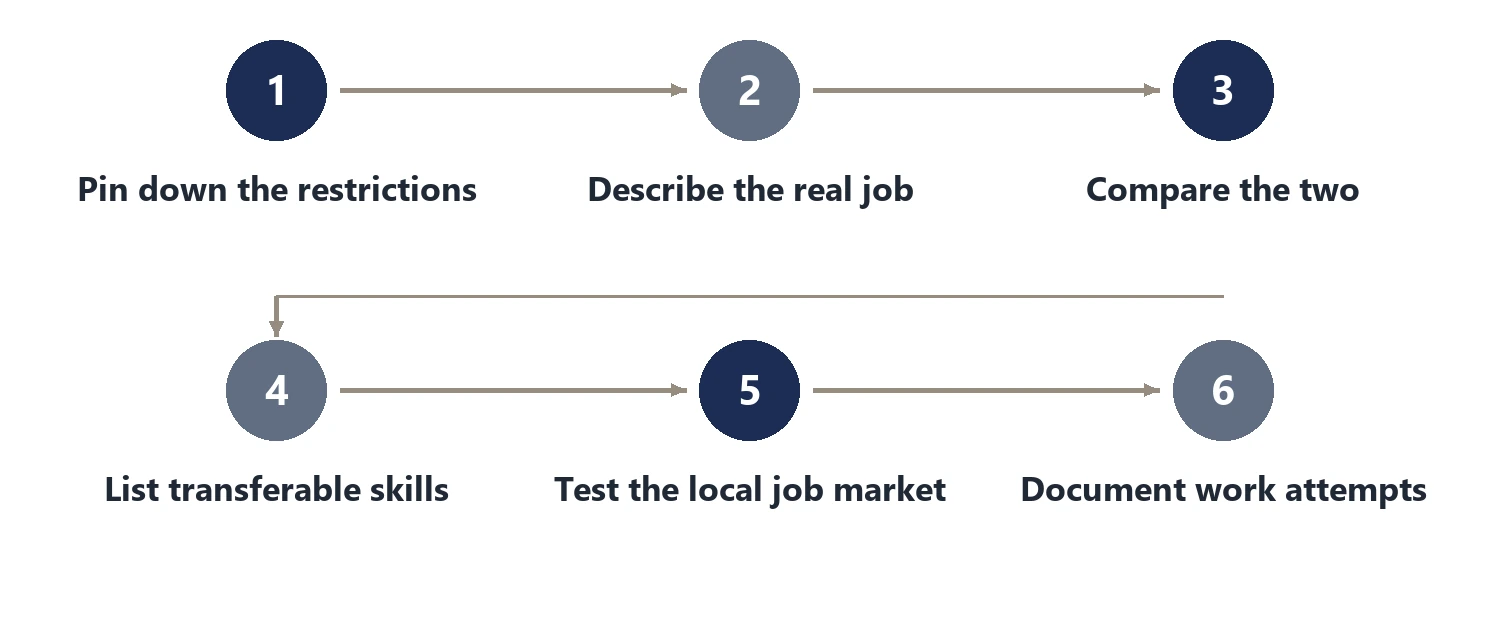
| Step | In Luis's file |
|---|---|
| Restrictions | No ladders. Nothing over 10 pounds. (Surgeon's note.) |
| The job as done | Bending conduit and pulling wire on site, not reading plans |
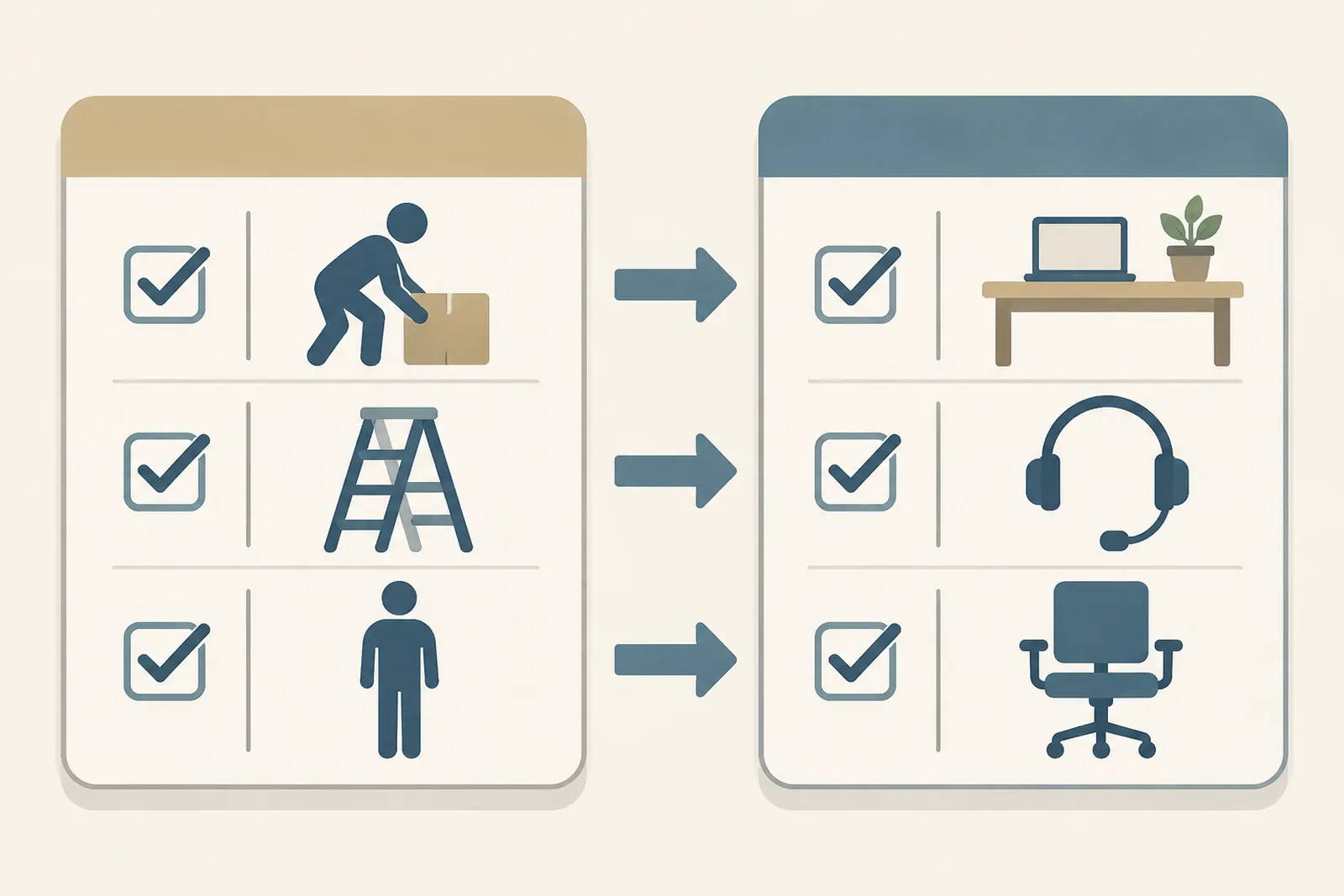
| Duty by duty | Ladder, overhead, and lifting work all fail the note |
| Skills that carry over | Journeyman license, crew supervision, estimating software |
| Local market | Openings within an hour of Garland and their pay against $38 |
| Work attempts | Light duty June to August, and why it ended |
Bring these to the first meeting:
- doctor's notes with any lifting, standing, or hours limit
- a job description, or a coworker who did the same work
- licenses, certificates, training records
- three years of pay stubs and W-2s
- dates of any return-to-work try, and why it stopped
What work is still open?
Usually something. Usually for less money.
Luis moves to estimating or dispatch. A 45-year-old nurse with a brain injury might handle part-time clerical work from written task lists; her 12-hour medication shifts are gone. A roofer with a crushed foot bids jobs from the ground. A 28-year-old warehouse lead who loses a leg below the knee may run inventory from a chair after prosthetic training. He has close to 40 working years ahead, and every one of them is in the math.
What do you say when the defense says "he can be a cashier"?
It comes up at Luis's deposition. The defense vocational expert reads a job list, and cashier is on top.
Luis's lawyer asks how long he can stand at a register. The expert concedes his restrictions don't allow a full shift. Next question: what does it pay?
The line changes from case to case. She went back to work. He can retrain. There are hundreds of listings. The same three questions answer all of them:
- How far away is the job?
- What does it pay?
- Can a new supervisor take the accommodations away?
Don't overreach in the other direction. "Never earn another dollar" collapses the moment the jury sees you can do some work.
Why doesn't a busy business mean no loss?
Ray's roofing company kept billing after his fall. The defense loves that. The missing piece: who did the work. A crew lead Ray hired, paid out of Ray's profit. Texas looks at profit, not gross receipts.
Net, the three years before the fall: $61,000. $74,000. $58,000. All three go in. Only the $74,000 year? The defense calls it cherry-picking, fairly.
Four sets of paper:
- tax returns and schedules: the net figures
- profit-and-loss statements, bank records: real expenses, year by year
- the crew lead's payroll: the new cost, counted once (not lost income and labor both)
- bids Ray turned down: jobs he couldn't do
What should you ask about the economist's report?
Every assumption belongs on the page:
| Input | Your question |
|---|---|
| Earnings baseline | Which years, and why those? |
| Residual earnings | Does it match the vocational expert's jobs and pay? |
| Work-life expectancy | Does it fit your age, schooling, and trade? |
| Fringe benefits | Are health insurance and retirement counted once? |
| Federal income tax | What rates and filing status went into the § 18.091 step? |
| Growth and discount rates | Does each one cite a source and a period? |
A rate without a source is the defense economist's first deposition question.
What if you never had a paycheck?
Ana was 15 and on the honor roll when a crash left her with a brain injury. No job, no W-2. Her claim rests on report cards, test scores, what her teachers saw, and how far her parents went in school. "She wanted to be a doctor," with nothing behind it, adds little.
Other people without pay stubs have their own paper:
| Who | What proves capacity |
|---|---|
| College student | Transcripts and internship offers in his field |
| Parent at home | Hours of cooking, driving, and child care, claimed once, since household services are a separate loss from wages |
| Welder laid off in March, hurt in May | Certifications, ten years of W-2s, the applications he'd sent |
Two idle months don't make the welder's capacity zero.
Ana has a second problem: two clocks. Section 16.001 generally pauses her own two-year period until she turns 18. Her parents' claim for the medical bills they pay while she's a minor may already be running.
What to do now: Ask your lawyer for both dates in writing.
For the full picture, see the Texas catastrophic injury claims guide or the Texas Catastrophic Injury and Damages Hub.
Frequently asked questions
Can I claim lost earning capacity if I'm back at work?
Going from 36 hours a week to 24 still counts. So does losing the path to foreman. The jury weighs the return to work with everything else.
I tried light duty and had to quit. Does that hurt my claim?
Not if a doctor explains why you stopped; that can even help. Save four things: the start date, the duties, your last day, and the note.
Do I need both a vocational expert and an economist?
Most catastrophic injury cases use both. The vocational expert says which jobs you can still hold. The economist says what the gap is worth.
Why does Texas reduce the number for income taxes?
Because § 18.091 says lost earnings come in as a net loss after federal income tax. The judge also tells jurors whether the award itself is taxable.
Will a defense vocational expert examine me?
The defense may ask for a vocational interview. The parties usually negotiate the terms, or the court sets them. Talk to your lawyer before agreeing to any test or interview.
What if my business income dropped for other reasons too?
Say your biggest customer left the state that same year. The economist has to separate that loss from the injury, and you should raise it before the defense does.
Sources
- Tex. Civ. Prac. & Rem. Code § 18.091
- Tex. Civ. Prac. & Rem. Code § 41.001
- Tex. Civ. Prac. & Rem. Code §§ 33.001, 33.012
- Tex. Civ. Prac. & Rem. Code §§ 16.001, 16.003
- Texas Rules of Evidence (effective July 2, 2026)
This article provides general information about Texas law, not legal advice. Every case depends on its facts, evidence, insurance, deadlines and governing law. Past results do not guarantee a similar outcome.

ABOUT THE ATTORNEY
Aaron A. Herbert
Founding Attorney
Board Certified in Personal Injury Trial Law
Aaron founded The Law Firm of Aaron A. Herbert in 2010 to focus on developing each client's case and seeking its maximum value. For over a decade, he has represented people seriously injured in major accidents and industrial catastrophes, pursuing trial verdicts and settlements while working to reduce the stress of litigation.
Education
- Texas A&M University · B.S., Criminal Justice, 1999
- University of Oklahoma College of Law · J.D., 2002; graduated in the top of his class
Trial experience & approach
Aaron earned numerous jury verdicts at boutique personal injury litigation firms. According to his biography, he spent a year as the top-earning litigation attorney at a firm that frequently appeared in verdict searches as having one of the highest numbers of trial wins in Texas. At another Dallas personal injury firm, he moved from managing pre-litigation attorney to managing litigation attorney over seven years as the firm grew into one of Dallas's largest personal injury firms.
His biography describes a reputation as one of America's most aggressive trial lawyers, with noteworthy recoveries from judges and juries and substantial pretrial settlements. Most of those settlements included confidentiality agreements requested by the defense. Aaron has said the recoveries were justified by the injuries and losses involved, which no amount of money could make someone choose to experience.
His approach combines passion, preparation, persistence and courtroom imagination. He believes a well-supported, engaged and motivated team working cooperatively helps deliver strong representation, with the goal of achieving the best possible result for every client.
Dallas roots, military service & publication
Born and raised in Dallas, Aaron enlisted in the United States Marine Corps after high school and later received an Honorable Discharge. He completed his university and law degrees after his military service and became a lifelong Sooners football fan in law school.
Publication: “Litigating Dog Bite Cases,” Texas Dog Law Seminar, Dallas, 2009.
Professional affiliations & recognition
Professional affiliations and recognition listed in Aaron’s biography:
- State Bar of Texas
- American Bar Association
- Association of Trial Lawyers of America (now American Association for Justice)
- Texas Trial Lawyers Association
- Dallas Trial Lawyers Association
- Dallas Bar Association
- Tarrant County Bar Association
- Million Dollar Advocates Forum
- The National Trial Lawyers – Top 100 Trial Lawyers