Trial preparation starts with the questions the jury will answer. It also has to protect your family, your children, and the record for appeal.
What will the jury actually be asked?
Hypothetical: a family sues a trucking company and its driver after a 61-year-old grandfather dies on Interstate 20. The charge may ask about each defendant's negligence, the percentage of fault for each, and damages for the widow, each child, and the estate separately.
| Damages question | Who it's for | Who usually proves it |
|---|---|---|
| Lost support and household services. | Spouse and children. | An economist plus family testimony. |
| Mental anguish and loss of companionship. | Each spouse, child, and parent. | Each family member describing their own relationship. |
| Pain before death and funeral costs. | The estate, through the survival claim. | Medical records, a physician, and receipts. |
Short answer: A wrongful death trial is built backward from the jury charge, the written questions the jury must answer about fault, causation, and each person's damages. Every answer needs admissible proof, and every objection has to be made on time and on the record so a good verdict can survive appeal. Your family should know what you'll be asked, how children are protected, and why a verdict isn't the same as money in hand.
In the grandfather's case, the charge rules work out like this:
- Rule 277 has the court submit broad-form questions whenever feasible, so the jury may get one negligence question per defendant, plus the instructions and definitions it needs.
- If the jury finds fault on both sides, it gives each one a percentage and still answers damages without cutting them for the grandfather's share.
- Rule 278 only allows questions raised by both the written pleadings and the evidence, so the family's lawyer needs both for every theory.
- If a question gets left out, it isn't reversible error unless the complaining side handed it up in writing, in substantially correct wording.
Keep the damages separate rather than one family total. Our guide to wrongful death and survival claims explains why.
How do experts get ready?
Suppose the trucking company says the grandfather had a heart attack before the crash. The family's medical expert has to answer that. Under Tex. R. Evid. 702, the expert needs the knowledge, skill, experience, training, or education for that specific opinion. E.I. du Pont de Nemours & Co. v. Robinson and Gammill v. Jack Williams Chevrolet add that the opinion has to rest on a sound method, not just credentials and a subjective belief. Helena Chemical Co. v. Cox (Tex. 2023) applied those standards.
Good preparation looks like this:
- the expert sees the unfavorable documents too, before the deposition;
- a medical expert deals with other possible causes of death instead of ignoring them;
- if a significant alternative cause was missed, the lawyer gets the missing material and supplements the report on time.
An emotional story won't carry a gap in causation.
How do lawyers prepare a grieving family to testify?
Good preparation walks you through the courtroom, the oath, and likely cross-examination, and it lets each person describe their own loss. Expect your lawyer to go over questions like these:
- Where will I sit, and who asks me questions first?
- What do I say if I don't remember a date? ("I don't know" and "I'm not sure" are fine answers.)
- Which records can I look at beforehand to check dates?
- What will the other side's lawyer probably ask me?
Nobody should script your tears, have relatives repeat matching phrases, or push you to sound sure about records you haven't seen. You also shouldn't have to retell the crash over and over, or describe another relative's private grief for them.
Say the grandfather also left a 15-year-old son. His lawyer should ask whether the boy has to testify at all, or whether a coach or a record can prove the point. Under Tex. R. Civ. P. 44, his mother, as next friend, can settle or agree to a judgment for him only with court approval. If her interest appears adverse to his, Rule 173.2 requires a guardian ad litem. The jury divides wrongful death damages among the spouse, children, and parents in the shares it finds under Tex. Civ. Prac. & Rem. Code § 71.010. And the family's lawyer can ask the court to limit exposure of private medical or family records.
What arguments about money are allowed?
In Gregory v. Chohan, 670 S.W.3d 546 (Tex. 2023), an 18-wheeler jackknifed on an icy highway near Amarillo and a jury awarded one driver's family about $16.8 million. Only six justices took part in the appeal. The lead opinion required a rational connection, grounded in the evidence, between the injury and the noneconomic award. So the amount a family asks for should tie to testimony about the actual relationship and loss. The opinion criticized "unsubstantiated anchoring," like comparing a life to a fighter jet or a famous painting, and that kind of comparison invites reversal.
Justice Bland joined the anchoring part but not the parts on ratios and applying the test, so how binding each part is remains a question for your trial lawyer. The court also held that a responsible third party was wrongly left off the charge, and that error alone required a new trial. A defendant may move to designate a responsible third party under § 33.004, and the jury then assigns that person a share of fault.
How do objections protect a verdict on appeal?
A verdict can be lost on appeal if the record doesn't show a proper objection. These rules decide that.
| Rule | What has to happen |
|---|---|
| Charge objections (Tex. R. Civ. P. 272). | Objections are made in writing or on the record before the charge is read to the jury, or they're waived. |
| Specific grounds (Rule 274). | The objection must point out distinctly what's wrong and why. |
| Evidence admitted over objection (Tex. R. Evid. 103). | The party must object on time and state the specific ground. |
| Evidence excluded (Rule 103). | The party must make an offer of proof, which the court must allow before reading the charge. |
| Appeal (Tex. R. App. P. 33.1). | The record must show a timely, specific complaint and a ruling, or an objection to the court's refusal to rule. |
Key point: A pretrial ruling on a motion in limine usually doesn't preserve anything. Your lawyer still has to object when the evidence comes in.
What happens after the verdict?
The number on the verdict form can still change before anyone is paid.
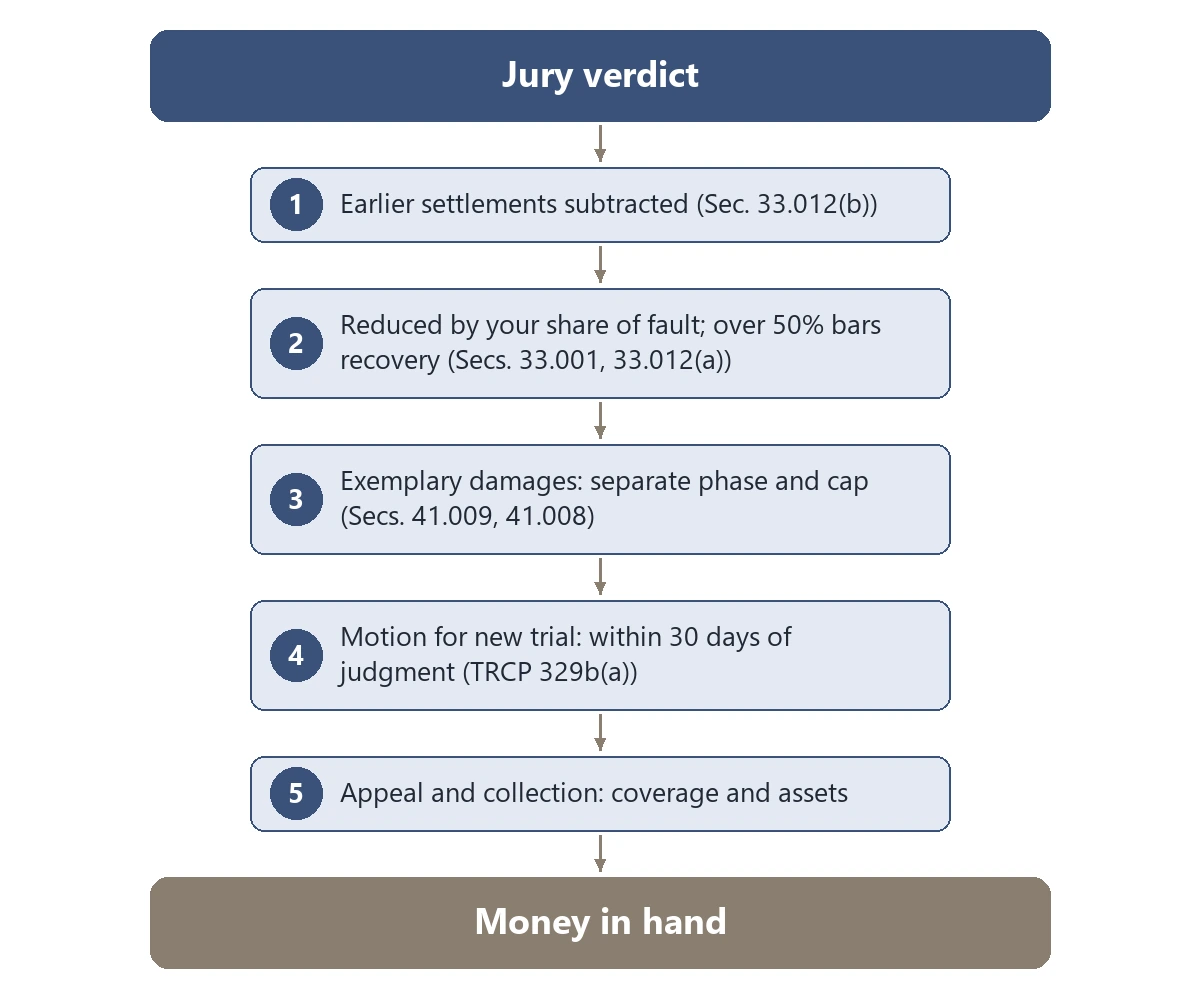
- Earlier settlements reduce the recovery by their dollar amount under § 33.012(b).
- The award is reduced by the claimant's share of fault, and a share over 50% bars recovery under §§ 33.001 and 33.012(a).
- A separate phase may decide exemplary damages under § 41.009, and the cap in § 41.008 may limit them.
- A motion for new trial must be filed within 30 days after the judgment is signed under Tex. R. Civ. P. 329b(a).
- Payment can wait for appeal, and collection depends on coverage and assets.
A child's share still needs the court's approval and a plan for holding the money. See how wrongful death proceeds are divided in Texas.
Frequently asked questions
Does my whole family have to testify? Not always. Each person claiming mental anguish or lost companionship needs someone to prove that loss, and that someone is often the person themselves.
Will the jurors hear about the cap on exemplary damages? No. Section 41.008(e) keeps it from them, and the judge applies the cap after the verdict.
Does a trial-ready case settle more often? No one can promise that. A prepared case does let you compare an offer with the proof you'd actually present.
Texas statutes and cases cited in this article
- Tex. R. Civ. P. 44, 173, 272, 274, 277, 278, 329b; Tex. R. Evid. 103, 702; Tex. R. App. P. 33.1
- Gregory v. Chohan, No. 21-0017 (Tex. 2023) and Helena Chem. Co. v. Cox, No. 20-0881 (Tex. 2023)
- Tex. Civ. Prac. & Rem. Code ch. 33, §§ 41.008, 41.009, and § 71.010
This article is general information about Texas law, not legal advice about a particular case. Results depend on the facts, the evidence, the court and the law that applies. Reading it does not create an attorney-client relationship.
Families who need grief programs, funeral and survivor benefit help, or a needs assessment can use our Wrongful Death and Family Support Center.

ABOUT THE ATTORNEY
Aaron A. Herbert
Founding Attorney
Board Certified in Personal Injury Trial Law
Aaron founded The Law Firm of Aaron A. Herbert in 2010 to focus on developing each client's case and seeking its maximum value. For over a decade, he has represented people seriously injured in major accidents and industrial catastrophes, pursuing trial verdicts and settlements while working to reduce the stress of litigation.
Education
- Texas A&M University · B.S., Criminal Justice, 1999
- University of Oklahoma College of Law · J.D., 2002; graduated in the top of his class
Trial experience & approach
Aaron earned numerous jury verdicts at boutique personal injury litigation firms. According to his biography, he spent a year as the top-earning litigation attorney at a firm that frequently appeared in verdict searches as having one of the highest numbers of trial wins in Texas. At another Dallas personal injury firm, he moved from managing pre-litigation attorney to managing litigation attorney over seven years as the firm grew into one of Dallas's largest personal injury firms.
His biography describes a reputation as one of America's most aggressive trial lawyers, with noteworthy recoveries from judges and juries and substantial pretrial settlements. Most of those settlements included confidentiality agreements requested by the defense. Aaron has said the recoveries were justified by the injuries and losses involved, which no amount of money could make someone choose to experience.
His approach combines passion, preparation, persistence and courtroom imagination. He believes a well-supported, engaged and motivated team working cooperatively helps deliver strong representation, with the goal of achieving the best possible result for every client.
Dallas roots, military service & publication
Born and raised in Dallas, Aaron enlisted in the United States Marine Corps after high school and later received an Honorable Discharge. He completed his university and law degrees after his military service and became a lifelong Sooners football fan in law school.
Publication: “Litigating Dog Bite Cases,” Texas Dog Law Seminar, Dallas, 2009.
Professional affiliations & recognition
Professional affiliations and recognition listed in Aaron’s biography:
- State Bar of Texas
- American Bar Association
- Association of Trial Lawyers of America (now American Association for Justice)
- Texas Trial Lawyers Association
- Dallas Trial Lawyers Association
- Dallas Bar Association
- Tarrant County Bar Association
- Million Dollar Advocates Forum
- The National Trial Lawyers – Top 100 Trial Lawyers