
An accurate attachment can still be overstated in a demand. Consider this hypothetical treatment note:
| Hypothetical treatment note | Limit to preserve in the demand |
|---|---|
| Surgery may be considered if conservative care fails. | Keep the condition in the calculation. This is a possibility, not a recommendation to proceed with surgery or a settled future expense. |
The demand might quote the note accurately but go too far when calculating future care. Check the rest of the package for the same mismatch between the record and what the letter claims.
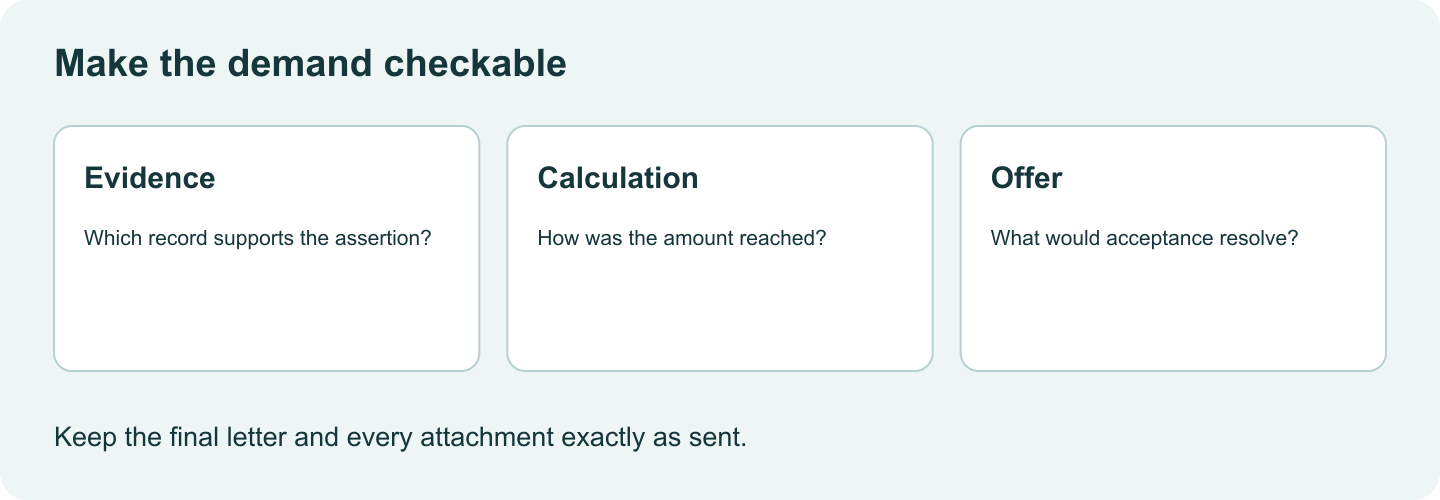
Can the reader check the demand?
Use the first few paragraphs to tell the recipient what happened, what conduct is alleged, how the person was injured, and what resolution you seek. Explain the insured’s alleged responsibility through the evidence. Identify the facts the parties agree on and give your position on the disputed points.
The reader should be able to move from an important assertion to its supporting document, witness, recording, or opinion. An inference needs to be identified as an inference; a disputed conclusion should not read as an established fact. Check every assertion against the underlying record before asking the insurer to accept the calculation. The attachment’s accuracy cannot cure an overstatement in the letter.
The Texas injury claim value and litigation hub lays out the broader framework, and our guide to how Texas injury claims are valued and litigated goes deeper. A demand also depends on the coverage behind it, which we cover in policy limits, coverage and settlement mechanics.
Build the index alongside the letter
| Index item | What to include or check |
|---|---|
| Every exhibit | Prepare the index as you draft the letter. Use the same exhibit file name in both. Give each entry a one-line description and identify the issue the exhibit addresses. |
| Video | Timestamp of the relevant passage. |
| Testimony | Page and line numbers. |
| Treatment record | Treatment date and page. |
| Wage calculation | The payroll source placed beside the calculation. |
| Copies and legibility | Remove duplicate copies and replace records that are too hard to read. |
| Optional grouping | If it helps the reader, group entries by responsibility, medical causation, past expenses, future care, income loss, and settlement terms. |
Show how each damages figure was reached
| Claim | What the calculation needs | Qualification to keep visible |
|---|---|---|
| Past medical expenses | Provide an itemized statement or ledger. List original charges, contractual adjustments, payments, claimed balances, write-offs, and disputed entries separately. A stack of bills leaves the total unexplained. Each amount claimed needs its bills, wage records, or other calculation material. | When the ledger gives a different figure, do not describe the full billed amount as paid. Mark entries still under review so their inclusion is clear. See how to prove past medical expenses in Texas. |
| Future care | Show the medical basis, treatment frequency and duration, cost-estimate source, and assumptions. Keep a clinician’s recommendation distinct from a procedure mentioned as a possibility. | For conditional care, keep the condition in the calculation. A possible procedure is not a recommendation to proceed or a settled future expense; the surgery example at the start shows why this distinction matters. |
| Income loss | Set the amount claimed beside the missed-work dates, missed shifts, and payroll records. | Resolve any overlap with earnings included in another damages category before adding the income loss to the total. |

Address the point most likely to be disputed
A recipient looking at a treatment gap or a disputed charge needs more than a pile of attachments. Address the strongest known defense point in the letter itself, whether it concerns notice, responsibility, causation, treatment or a charge. Explain your position and the evidence for it. Follow the disputed assertion through the index to the exhibit. If that chain does not support the assertion, correct it or explain the gap.
If the present record cannot answer that point, name the missing record or testimony and say whether you have requested it. Keep the present limitation clear. New evidence may justify another review.
After checking the evidence references, redact private identifiers the insurer does not need. Use a secure delivery method suited to the sensitive material.
Put the offer and release terms in one place
| Offer term | What the recipient needs to know |
|---|---|
| People and claims | Name the claimant and the insureds. Specify the claims covered by the release and every person it releases. |
| Amount | State the amount sought for this defined settlement opportunity. |
| Acceptance | Explain how to accept and when a response is due. Set out payment terms, required signatures and lien handling, along with the effect of acceptance. |
| Policy information | Check the terms against the policy information actually available. Identify unconfirmed coverage and assumed limits as uncertain. |
| Offer and release together | Read the offer beside the release. Identify what the recipient must do to accept and what acceptance would settle. Supporting exhibits will not resolve an ambiguity in either answer. |
Before the letter says that liens, reimbursement or settlement authority are resolved, discuss them with the client. Work out who can sign, and make sure every necessary claimant and released party is included. This is a check against confusion about the terms. It cannot guarantee a settlement or determine the insurer’s duty.
Check whether a policy-limits demand meets the legal requirements
An opening proposal is different from a demand to settle within policy limits, whatever its heading says. A specific limits proposal may have legal consequences. Coverage, the offered terms, the insured’s potential exposure, and the full circumstances determine that assessment.
In Seger v. Yorkshire Insurance Co., the Supreme Court of Texas identifies three requirements for a Stowers claim:
- The claim falls within coverage.
- The settlement demand is within policy limits.
- An ordinary prudent insurer would accept the demand in light of the likelihood and degree of the insured’s potential excess exposure.
That assessment depends on the facts. A “Stowers” heading does not establish that these requirements are met.
Check the outgoing files
- Review the version about to leave the office, not only the working folder.
- Check names, dates, and arithmetic.
- Read every page for legibility.
- Check exhibit order, links, and release language.
- Confirm that every intended attachment is included in the transmission.
Save the final letter and every exhibit exactly as sent, with the delivery method, recipient, date, time, confirmation, and any response. A later reviewer needs to establish what was received and when. The working folder may contain files that never accompanied the letter.
Keep both versions when making a correction. Retain the original package, including the letter, evidence and offer, alongside the separate corrected version and a record of the changes. A replacement on its own may not show what the insurer originally had to consider or distinguish it from material received later.
Use the response to inform the client’s decision
Ask why the insurer reached its position. For rejected treatment, identify the excluded bills and the reasons. Answer requests for missing records, and assess any coverage dispute separately from valuation. The response gives the client more to consider than the offer’s dollar amount.
New evidence may change the inputs to the defensible settlement valuation model. Update the model when it does, keep the evidence supporting the change, and explain to the client how it affects liability or damages.
Before the client accepts, review:
- The release.
- Deductions from the payment and expenses still ahead.
- The option of continuing the case.
- The gross offer compared with what the client would receive.
Discuss an injury claim
Contact The Law Firm of Aaron A. Herbert, P.C., at (214) 200-4878 or request a consultation. For collision cases, see the firm’s Dallas car accident practice. Free consultation. No fees or expenses unless you recover.
This is general information about Texas injury claims, not advice about a particular demand, policy or case. Reading it does not create an attorney-client relationship. Evidence, coverage, settlement terms and available recovery depend on the facts and applicable law.

ABOUT THE ATTORNEY
Aaron A. Herbert
Founding Attorney
Board Certified in Personal Injury Trial Law
Aaron founded The Law Firm of Aaron A. Herbert in 2010 to focus on developing each client's case and seeking its maximum value. For over a decade, he has represented people seriously injured in major accidents and industrial catastrophes, pursuing trial verdicts and settlements while working to reduce the stress of litigation.
Education
- Texas A&M University · B.S., Criminal Justice, 1999
- University of Oklahoma College of Law · J.D., 2002; graduated in the top of his class
Trial experience & approach
Aaron earned numerous jury verdicts at boutique personal injury litigation firms. According to his biography, he spent a year as the top-earning litigation attorney at a firm that frequently appeared in verdict searches as having one of the highest numbers of trial wins in Texas. At another Dallas personal injury firm, he moved from managing pre-litigation attorney to managing litigation attorney over seven years as the firm grew into one of Dallas's largest personal injury firms.
His biography describes a reputation as one of America's most aggressive trial lawyers, with noteworthy recoveries from judges and juries and substantial pretrial settlements. Most of those settlements included confidentiality agreements requested by the defense. Aaron has said the recoveries were justified by the injuries and losses involved, which no amount of money could make someone choose to experience.
His approach combines passion, preparation, persistence and courtroom imagination. He believes a well-supported, engaged and motivated team working cooperatively helps deliver strong representation, with the goal of achieving the best possible result for every client.
Dallas roots, military service & publication
Born and raised in Dallas, Aaron enlisted in the United States Marine Corps after high school and later received an Honorable Discharge. He completed his university and law degrees after his military service and became a lifelong Sooners football fan in law school.
Publication: “Litigating Dog Bite Cases,” Texas Dog Law Seminar, Dallas, 2009.
Professional affiliations & recognition
Professional affiliations and recognition listed in Aaron’s biography:
- State Bar of Texas
- American Bar Association
- Association of Trial Lawyers of America (now American Association for Justice)
- Texas Trial Lawyers Association
- Dallas Trial Lawyers Association
- Dallas Bar Association
- Tarrant County Bar Association
- Million Dollar Advocates Forum
- The National Trial Lawyers – Top 100 Trial Lawyers