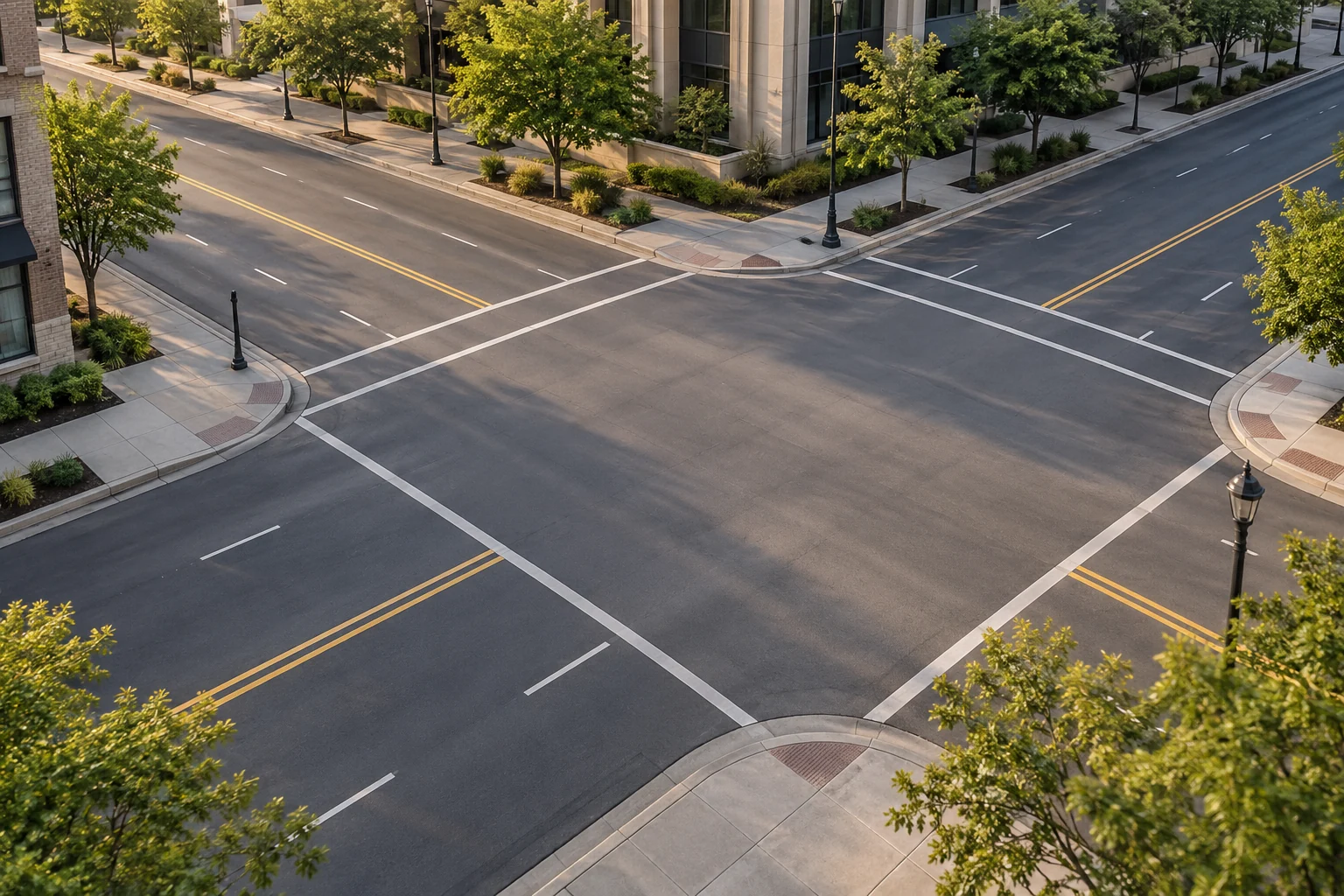
Cover image: AI-generated illustrative streetscape; this is not a specific intersection or a reconstruction of a crash.
A driver turning across a motorcycle’s path may say the rider was never visible. To assess that explanation, investigators need to place both vehicles in the moments before the turn. The signal, speed and route of travel matter. So does the rider’s opportunity to avoid the collision. A failure to yield may be part of the case, but responsibility cannot be settled from the driver’s explanation alone.
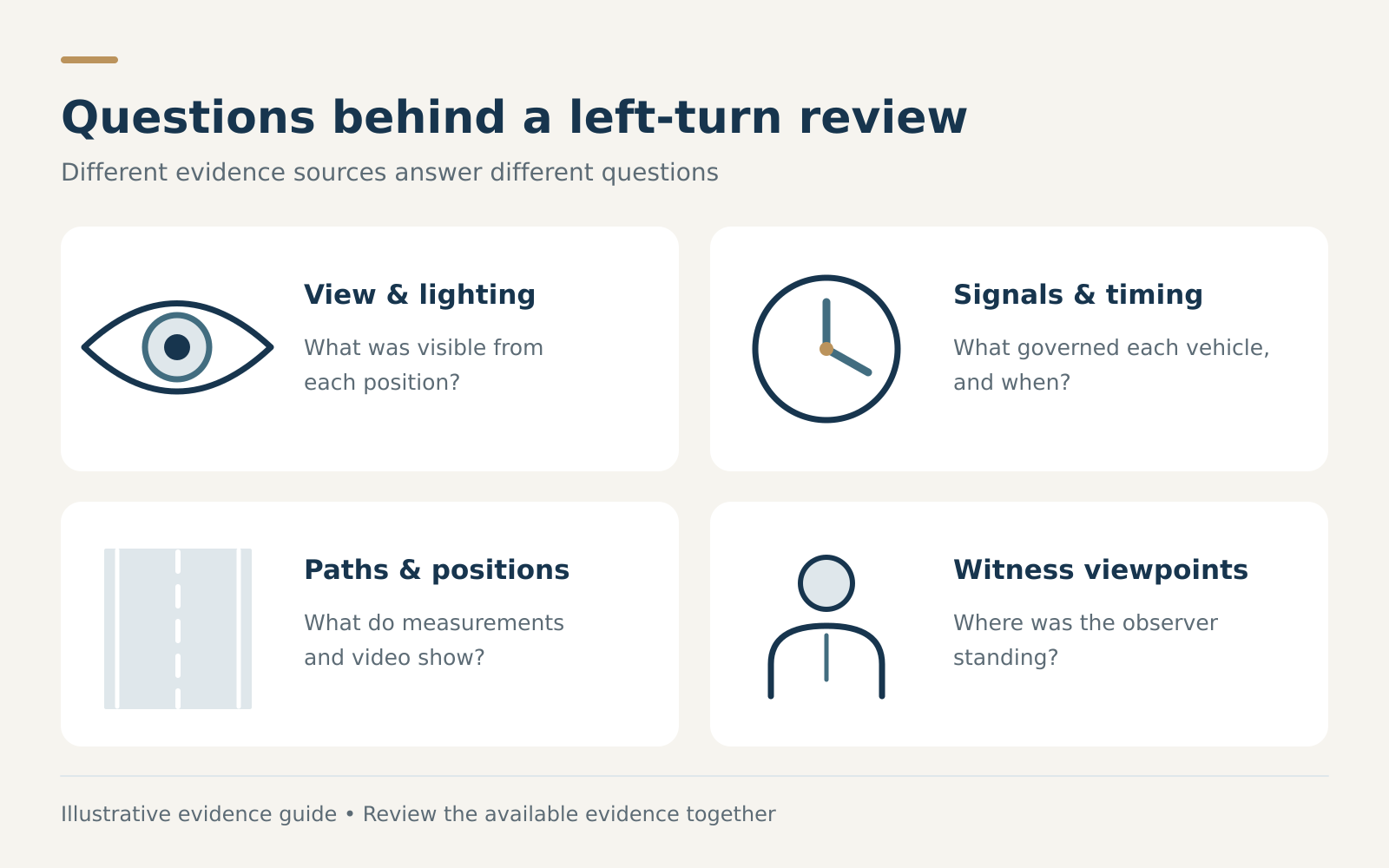
Several sources may help place the vehicles. Police scene records, the damage and the impact location provide one set of clues; original approach video may supply the timing. Compare those with witness positions and any available signal timing records. Check where each image was taken before treating it as the driver’s view. The driver was seated at road level, not at an overhead camera’s position, and the light at noon differs from the light at night. If the dispute calls for an expert, counsel can obtain measurements of the lanes, obstructions and turn paths.
If the defense says the motorcycle came out of nowhere or was speeding, look for the basis of that claim. A violent impact or a rider’s landing point is not, on its own, a reliable speed calculation. A reconstructionist may use measured positions, video frames and reaction-time analysis to test a range of speeds. The question is whether the crash would still have occurred under other assumptions supported by the evidence, including a slower or faster approach.
Preserve the camera file in its original form. When identifying witnesses, distinguish those who saw the vehicles approaching from people who only saw the aftermath. Ask a family member to record each witness’s location while it is fresh. That information can fill gaps in a police diagram and help test sightlines. Counsel can then ask the driver to describe the sequence: where the vehicle stopped or slowed, what was visible, what obstructed the view and what triggered braking.
For more on reconstruction, see the motorcycle claims and litigation guide. The common-causes article covers other collision patterns. A Dallas rider seeking a case review can use the motorcycle service page. Counsel must identify the rule that applies to the actual maneuver and signal; Texas Transportation Code Chapter 545 contains the relevant conduct provisions.
Does the turning driver always lose? No automatic rule decides every fact pattern. Signals, rider conduct, visibility and physical evidence must be evaluated together.
Find related rider questions in the Texas Motorcycle Accident Knowledge Hub.
Aaron A. Herbert
Founding Attorney

Aaron A. Herbert is a Texas attorney, Board Certified in Personal Injury Trial Law by the Texas Board of Legal Specialization.
For over a decade he has shown an unwavering commitment to clients who were seriously injured by major accidents and industrial catastrophes. During that time he has earned the reputation as one of America’s most aggressive trial lawyers by achieving noteworthy recoveries from judges and juries, as well as substantial settlements prior to trial, the majority of which contained negotiated confidentiality agreements at the request of the defense. When asked about these cases, Mr. Herbert has said that each case not only justified the recovery level, but that no one would trade places with any one of these victims in return for any amount of money, once they know the facts and severity of the injuries and tragedy involved. According to Mr. Herbert, “there can be no substitute for passion, preparation and persistence in the practice of law”. He is known not only for this tenacious preparation, but also for his imagination in the courtroom. He is passionate and persistent in seeking to obtain the maximum case value for each individual client at trial or through settlement, while reducing the stress of litigation on his clients. Born and raised in Dallas, Texas, Mr. Herbert enlisted in the United States Marine Corps after high school and later received an Honorable Discharge. After the Marines, he obtained a Bachelor of Science in Criminal Justice from Texas A&M University, then a Juris Doctorate from the University of Oklahoma College of Law. There he graduated in the top of his class and became an eternal Sooners Football fan. Aaron has worked as a zealous advocate for injured clients at several boutique personal injury litigation firms where he amassed numerous jury verdicts. After spending a year as the top earning litigation attorney at a firm that frequently tops verdict search as one with the highest number of trial wins in Texas, Aaron accepted a position as a the managing pre-litigation attorney at another Dallas personal injury firm. Over the next seven years he transitioned to the managing litigation attorney, and that firm grew to one of the largest personal injury firms in Dallas. In 2010 he formed the Law Firm of Aaron A. Herbert, to get back to a focus on developing each individual case and maximizing case value for each client. Mr. Herbert practices law with the belief that a well taken care of, highly engaged and motivated team of employees working in a cooperative team environment will result in superior representation and great results for the firm clients. He believes in always setting a goal of achieving the best possible results for each and every client.
Education
Texas A&M University (B.S. Criminal Justice, 1999)
University of Oklahoma College of Law (J.D., 2002)
Professional Associations
Licensed to practice in Texas (2002)
Board Certified in Personal Injury Trial Law – Texas Board of Legal Specialization (2008)
Member
State Bar of Texas
American Bar Association
American Trial Lawyer Association
Texas Trial Lawyers Association
Dallas Trial Lawyers Association
Dallas County Bar Association
Tarrant County Bar Association
Million Dollar Advocates Forum
Nation Trial Lawyers – Top 100 Trial Lawyers
Publications
Litigating Dog Bite Cases, Texas Dog Law Seminar, Dallas 2009