
Illustration only. A case file ties the scene evidence and medical records to the legal questions. It doesn't show a real case or result.
What does a Tom Thumb or Albertsons injury case need?
Slipped, tripped, or went down at a Tom Thumb or an Albertsons in Texas? A claim needs:
- a legal theory your facts actually support
- the right companies as defendants
- evidence tying the store's condition or conduct to your injury
- a lawsuit filed on time in the proper court
A broken hip doesn't excuse anyone from proving fault. A flat "no" from the store doesn't erase a claim good evidence backs up. Save what could be gone by next week, then measure the case against the elements a judge and jury will apply.
In a grocery fall, the things that go missing first are usually ordinary:
- the camera footage of the aisle
- the sweep log for that afternoon
- the name of the stocker who came over with the mop
- the shoes you had on, if they get thrown out
- the jar or package you were carrying, with its label
Examples marked "hypothetical" are made up. They are not client results or accusations against any Tom Thumb or Albertsons store.
Aaron Herbert's board certification, covered in section 32, is a qualification to weigh, not a forecast about any lawsuit. S1
Contents
- Six questions that decide whether a case can go forward
- Take care of the person and keep the account honest
- Pin down the actual hazard and how the fall happened
- Premises condition or ongoing activity?
- Establish control and name the right defendants
- What the store knew about the floor where you fell
- How long the hazard sat there
- Six minutes of video from a Kingwood Randalls
- When video or other evidence goes missing
- Why the scene may need to be inspected
- A made-up fall and its file
- Small numbers can decide a case
- The two-year deadline and serving the right company
- Where the case is filed and whether it moves to federal court
- Plead what happened, then plan discovery in order
- The records your lawyer will ask for
- Depositions of store workers, the company, and you
- Getting exhibits admitted is its own project
- Match each expert to one question
- When an old injury meets a new fall
- What each kind of damages needs
- Shared fault and open and obvious conditions
- Get ready for summary judgment before the motion lands
- What your lawyer's settlement sheet should show you
- What your lawyer is doing at mediation, and why
- What jury selection is for
- The trial story has to fit the jury's questions
- How your lawyer questions witnesses
- Jury instructions, the verdict form, and protecting the record
- Closing argument and the damages request
- Net recovery and reimbursement obligations
- How to evaluate Aaron Herbert for your case
- A sample work plan for your case
- Research controls for Tom Thumb or Albertsons information
- Common questions after a fall in a store
- Pick the next article by what's missing from your file
- Before trial, someone should argue the store's side
- What to bring to your consultation
- What three published Tom Thumb and Randalls cases teach
- Water by a refrigerated case: find the source and the timing
- Grape displays and the limits of the Corbin case
- Build a grocery evidence map before you depose the manager
- Turn the record into a compensation presentation that holds up
- Mohammadi demands precision about the danger and the knowledge
- Getting a question to the jury takes a request and the proof behind it
- Use Johnson to investigate shopping-center boundaries
- An auditable dashboard for a grocery fall case
1. Six questions that decide whether a case can go forward
- What exactly did you slip on or trip over: a grape, spilled soap, a curled mat?
- Who controlled that spot the day you fell, and who left the hazard there?
- What shows the store knew, or should have known, under the rule that applies?
- What could the store reasonably have done first, such as setting out a cone?
- How does the way you fell connect to the injuries you're claiming?
- Which court procedures and deadlines govern?
A blank answer marks where the investigation goes next.
Fault, the size of the injury, and whether money can be collected are separate questions. Your lawyer needs all three answered before recommending an expensive lawsuit:
- A huge grocery chain can still face a claim with no evidence behind it.
- A spill that's easy to prove can still come with a sprained wrist and modest damages.
- Skipping physical therapy you couldn't afford doesn't prove you weren't hurt.
Your lawyer will ask for:
- the register receipt, with the store's address (a made-up 3:41 p.m. at register 4)
- your phone's call log (a made-up 3:52 p.m. call to your spouse; neither time pins down the minute you fell in produce)
- photos and video with time stamps
- any incident report number
- names of people who heard your first account
- drafts, texts and messages about the fall, including a first version you later corrected
- dated notes on shifts you worked, cut short or missed after the fall
2. Take care of the person and keep the account honest
Get the care your symptoms call for and follow the doctor's advice. What a claim might be worth shouldn't decide whether you see a doctor.
If it's safe, the person with you can take pictures. They shouldn't stand in the mop's path, pick up glass from a broken pickle jar, or block other shoppers with a cart. A second fall helps nobody.
That night, write down what you remember, and keep what happened before the fall apart from what you noticed afterward. Here's how that looks for a hypothetical fall in produce:
What you write (hypothetical) | What it tells your lawyer |
|---|---|
"I saw a produce tie beside my shoe after I fell." | Where the tie was lying once you were down |
"I saw my shoe catch the produce tie." | That your shoe touched it, which the first sentence never says |
"The cashier from lane 6 came over after I was on the floor." | The cashier didn't see the fall itself |
"A shopper by the bananas said, 'That's been there all day.'" | The witness's exact words, with no guess about what "all day" meant |
3. Pin down the actual hazard and how the fall happened
Each kind of hazard sends the investigation in a different direction:
Hazard (hypothetical) | What your lawyer will look for |
|---|---|
Clear liquid on the tile in front of the dairy case | When it appeared, the sweep log, and its source, such as a cracked milk jug |
A twist tie or price tag on the produce floor | Photos of where it lay and which bin it came from |
An entrance mat with a curled corner | How high the corner stood, photos, and how the mat sat when you walked in |
Albertsons, LLC v. Mohammadi, 689 S.W.3d 313 (Tex. 2024) (per curiam), involved a slip beside a cart of returned or damaged items at a Randalls, where an inconclusive video seemed to show an employee placing a wet plastic bag in it. The relevant danger was the wet floor, and knowing that cart products were leaking did not prove the store actually knew of the wet floor. S15
Before the details fade, get these down:
- which shoe slid or caught
- your movement, such as a turn or a step onto a mat
- a close photo and a wide photo of the same spot, since a wide shot can hide clear liquid
- what changed later, such as the mop pass or a new mat
No expert should rebuild a fall from a diagnosis alone, and a hazard near the fall may not be what caused it.
4. Premises condition or ongoing activity?
- Keetch v. Kroger Co., 845 S.W.2d 262 (Tex. 1992): the injury must be caused by the activity itself or as its contemporaneous result.
- United Scaffolding, Inc. v. Levine, 537 S.W.3d 463 (Tex. 2017): a contemporaneous, negligent activity gets ordinary negligence principles. S23
In Keetch, plants on a desk in the floral department were sprayed with "Green Glo" leaf shine sometime before 7:00 p.m. The fall came around 7:30. No spraying was going on by then, so there was no negligent-activity claim, and the judgment for Kroger was affirmed. S22
The same rack can land on either side of that line:
Hypothetical | What happened | Which theory it points toward |
|---|---|---|
Rack left in the aisle | An employee finishes stocking cereal and leaves a rack base jutting into the aisle. Twenty minutes later, a shopper trips over it. | A premises condition, because the rack was simply sitting there |
Rack being moved | An employee rolls the same rack down the aisle and pushes it into a shopper. | A negligent activity, because the injury came from what the employee was doing right then |
Your lawyer has to pick the theory that fits before pleading ordinary negligence, premises liability, or both in the alternative. A label in the petition can't get around the proof the facts demand. So you may hear the same questions more than once:
- who was pushing the rack, and whether it had stopped
- how many seconds passed before you hit it
- whether the danger existed apart from the employee's work
5. Establish control and name the right defendants
Johnson v. Tom Thumb Stores, Inc., 771 S.W.2d 582 (Tex. App.—Dallas 1989, writ denied), involved a dew-slick glass light fixture set into the sidewalk about 10 feet from a Tom Thumb entrance. The plaintiff broke a hip. A stipulated lease gave the landlord control of the common areas. The court affirmed a directed verdict for Tom Thumb, the tenant, and reversed and remanded the claim against the landlord for a new trial. S16
Control can change within a few steps of the front door:
- the entrance mat inside the doors
- the sidewalk and a parking lot shared with other tenants
- a leased counter inside the store
- the restroom
Each can have its own maintenance arrangement. Owning the land isn't always controlling the condition, and leases, service contracts, and who did the work can matter more. The question is who had the duty or took part in the conduct, not who has the biggest name.
Who gets named depends on the proof:
- the store operator, named from business and court records, since an incident report may say only "Tom Thumb" or "Albertsons"
- a landlord or contractor, only when the facts and the law support it
- not a local defendant added just to defeat federal jurisdiction, which invites an improper-joinder fight
Preservation letters have to reach whoever actually holds the records, and the registered agent may not run the cameras:
Record | Who might hold it |
|---|---|
Parking lot and outside camera footage | The landlord or shopping center owner |
Inside aisle recordings | The store operator |
Floor-cleaning work orders | An outside cleaning company, in its own system |
Legal notice, notice to the people who handle each record, and written confirmation get tracked separately. A letter to one company doesn't protect everybody's records.
A friendly call from an adjuster replaces neither service nor a limitations analysis. Misnomer and misidentification are treated differently, so the right company should be verified and served before the deadline rather than fixed afterward.
6. What the store knew about the floor where you fell
Albertsons, LLC v. Mohammadi, 689 S.W.3d 313 (Tex. 2024) (per curiam), began at a Houston Randalls:
- the claimant worked at a Wells Fargo branch inside the store and slipped next to a cart of returned and damaged items
- an inconclusive video seemed to show an employee placing a wet plastic bag in the cart
- the jury answered "No" on constructive knowledge and never reached actual knowledge
- the Texas Supreme Court held that knowing the cart's products leaked didn't prove the store actually knew the floor was wet, and it reinstated the take-nothing judgment. S15
In Keetch v. Kroger Co., plants on a desk in the floral department were sprayed with "Green Glo" leaf shine sometime before 7:00 p.m., and the shopper fell nearby around 7:30. The jury found a slippery spot but not that Kroger knew or should have known. With no activity ongoing, there was no negligent-activity claim, and judgment for Kroger was affirmed. S22
A noon complaint about water by the front doors doesn't necessarily prove the store knew about water in the self-checkout lane at 3 p.m. (a made-up example). Your lawyer looks for:
- the employee who heard the complaint and how they described the spot
- the original text, radio log, or supervisor reply, with its time
- the work order or store map showing which aisle the complaint named
- the sweep log, and whether the water was still there later
If you hear an employee say "we told somebody about that earlier," write down who said it, their job, the exact words, and when. The remark isn't automatically a company admission and needs its own evidentiary foundation.
7. How long the hazard sat there
In Wal-Mart Stores, Inc. v. Reece, an off-duty employee was 5 to 8 feet from a pizza-sized puddle of clear liquid at a Wal-Mart snack bar. Being nearby wasn't enough without proof of how long the puddle had been there, so the verdict was reversed and rendered. Wal-Mart Stores, Inc. v. Spates applied the same rule. S2
In Spates, the plaintiff's toe and sandal caught in an empty plastic six-pack ring in a Lake Jackson Wal-Mart soft-drink aisle. An employee 3 to 5 feet away was working the shelves, with the ring behind the employee for 30 to 45 seconds. The Court found no constructive notice and reinstated summary judgment for Wal-Mart. No set number of minutes decides these cases. S2
8. Six minutes of video from a Kingwood Randalls
Clark v. Randalls Food came from a Kingwood Randalls in March 2005:
- detergent was leaking from another customer's basket near the pharmacy counter
- the store kept video from 2:59 to 3:05 p.m., and the fall came at about 3:00:45, which leaves under two minutes of lead-up
- the court found a duty to preserve and a breach, but no prejudice, and affirmed summary judgment for Randalls. S19
The 60 to 90 day tape retention procedure described in Clark is history, not current policy, and the case came before Brookshire Bros. v. Aldridge. No retention period has been verified for Tom Thumb or Albertsons stores, so nobody should promise you 30, 60, or 90 days.
That's why your lawyer sends the preservation letter fast and asks the store for:
- the original video files, where reasonably available, and any software needed to play them
- the camera numbers and on-screen times
- the store's export report, with the name of whoever ran it
- hash values or another integrity check on every copy
- a set window for each camera, instead of a whole day from all of them
A gap in the footage isn't proof of deletion. Ask:
- whether a camera setting, an export limit, or a blocked view explains it
- who searched, if the store says the recording doesn't exist, and where the backups are
9. When video or other evidence goes missing
On Sept. 2, 2004, a customer slipped near a display table in a Brookshire Brothers grocery store. The store's report blamed grease that had leaked from a container by the "Grab-N-Go" rotisserie chicken case, about 15 feet away. The store kept about eight minutes of video, and a 30-day loop overwrote the rest before a request came almost a year later.
In Brookshire Bros., Ltd. v. Aldridge, 438 S.W.3d 9 (Tex. 2014), the jury got a "may consider" spoliation instruction and awarded $1,063,664.99. The Texas Supreme Court held 6-3 that the instruction was an abuse of discretion and remanded for a new trial. S5
Showing that helpful evidence is gone isn't enough. The Court's rules:
- The trial judge, not the jury, decides spoliation.
- An instruction needs intentional spoliation, or a negligent loss that irreparably deprives a party of any meaningful ability to present a claim or defense.
- Remedies must be proportionate, and a sanctions fight stays away from the jury unless the court allows it. S5
For a made-up fall in aisle 7, the record might show:
- what existed: the aisle 7 camera recorded that day
- who was told: the manager the same day, then the operator's claims address by letter on day 4
- when the duty began: the day the store knew or reasonably should have known there was a substantial chance of a claim
- the gap: the 20 minutes before the fall, which could show how long the spill sat there
A preservation letter can't take the recorder out of the store, and before suit the store's cooperation is voluntary. A Rule 202 petition for a presuit deposition needs notice and court findings. S6
Keep the original photo files on your phone, the shoes you wore, your texts and social media posts, and any fitness-tracker data. Deleting anything selectively can hurt your case, and a protective order can handle privacy worries.
10. Why the scene may need to be inspected
In H.E. Butt Grocery Co. v. Resendez, the grape displays had a sampling bowl recessed 5 inches, three-inch railings, a non-skid floor, mats, and warning cones, and the Texas Supreme Court reversed the verdict and rendered judgment. S4
A curled mat or a stocking cart calls for measurements from a qualified expert:
- how high the edge or object stood
- how far it stuck into the walking path
- how it contrasted with the floor
- the approach and the walking room left
For a slip, a friction reading on clean, dry tile may say little about tile wet with spilled soap, so the expert first asks whether any test fits.
Your lawyer finds the code provision that covered:
- that property and that spot in the store
- the period when that part was built
- that type of condition
A model code isn't necessarily local law. An accessibility standard can inform the question without creating a private damages claim or proving negligence per se.
The other side gets notice and a chance to watch any test that will change a sample or surface.
11. A made-up fall and its file
Everything below is invented and isn't about any real Tom Thumb or Albertsons store. At about 4:10 p.m., a shopper slips on a clear spill and breaks a wrist.
So far the file has:
- a wrist X-ray taken that evening
- a photo of a puddle about two feet wide, taken on a companion's phone
- a stocker who remembers walking the aisle "sometime that afternoon"
- one minute of camera footage, 4:09 to 4:10 p.m.
- the store's street address on the receipt
What still has to be checked:
- the company that ran the store on the date of the fall, and the crew or contractor that cleaned the floors
- how the foot moved, the layout around the display, and any other explanation for the fall
- the original photo file, where and when it was taken, and what changed after the fall
- the actual inspection time, route, line of sight, and any log entry
- earlier footage, and whether that camera could see the floor
- the treating doctor's view of the fracture, and any earlier wrist trouble
Two changes to the made-up facts:
- The full footage shows a customer dropping a bottle of olive oil at 4:09:40 p.m., 20 seconds before the fall. In Spates, 30 to 45 seconds with an employee a few feet away wasn't enough, so constructive notice looks weak, and the case would need actual knowledge or another recognized theory.
- The liquid is plainly visible on an earlier frame at 3:48 p.m., 22 minutes before the fall. That raises questions of visibility and the chance to find it, without settling liability.
12. Small numbers can decide a case
In Wal-Mart Stores, Inc. v. Spates, a six-pack ring had been on the floor behind an employee for 30 to 45 seconds, and the Texas Supreme Court said that wasn't enough to show the store should have found it. S2 In H-E-B, LP v. Peterson (Tex. Apr. 10, 2026), roof leaks recorded elsewhere in the store, none above the toy aisle, didn't show how long a clear puddle in the toy aisle had been there, so summary judgment for H-E-B was reinstated. S21
A made-up ER visit after a fall by the deli counter puts these lines on the damages worksheet:
- the billed charge, say $4,800
- the amount actually paid or incurred, say $1,150 from your health plan, which Section 41.0105 generally makes the limit S8
- any charge the store blames on an old back injury
- missed shifts, and future care a doctor supports
A Section 18.001 affidavit can support that charges were reasonable and necessary, but it isn't evidence of causation. S9
Tripling the bills isn't a Tom Thumb or Albertsons settlement value, and this guide has no verified, representative set of their Texas settlements. Scenarios with stated assumptions are compared by your net after costs and reimbursement claims. S8 S9
13. The two-year deadline and serving the right company
Three early events can look like progress.
None of these starts a lawsuit or necessarily extends the deadline:
- the incident report the store manager filled out
- a preservation letter asking the store to keep video
- calls and early offers from the adjuster
Your lawyer's calendar should show:
- the Section 16.003(a) deadline, which requires suit "not later than two years after the day the cause of action accrues" S3
- for a made-up fall on March 3, 2026, a filing date that generally falls on March 3, 2028, a Friday S3
- any Section 16.001 pause for a child's own claim, with a parent's related claim and court approval handled separately S3
- the accrual date, since symptoms that appear months later don't automatically restart the clock S3
- the earliest possible deadline and the legal basis for any exception relied on
- the next day county offices are open, if the last day lands on a weekend or holiday under Section 16.072 S3
- the exact company to be served
- each service attempt, its return, and the next follow-up date
- proof the right company was served, since a letter marked "sent" proves nothing and a court may ask whether service was diligent
- the date the store confirmed a video hold, apart from the date the preservation letter arrived
14. Where the case is filed and whether it moves to federal court
Section 15.002(a)(1) of the Civil Practice and Remedies Code lets suit go in the county where all or a substantial part of the events or omissions occurred. S14
For a made-up fall at a Collin County Tom Thumb, a shopper's home in Dallas County doesn't automatically control. Your lawyer also checks jurisdiction, the parties, the amount in dispute, and who controlled the store. S14
A state filing doesn't guarantee the case stays there. A grocery company may remove it to federal court when federal jurisdiction exists and the removal requirements in Title 28 of the U.S. Code (Sections 1332, 1441, and 1446) are met. S10
Don't assume a business entity is a citizen only of the states where it runs stores. A plaintiff also shouldn't add a defendant it has no real claim against just to block removal.
After removal, state deadlines don't carry over. Federal pleading, discovery, and motion rules apply even though Texas premises law still sets the liability standard, so the scheduling order, local rules, and any motion with a response date come first. Remand on procedural grounds and on jurisdictional grounds runs on separate deadlines. S10
15. Plead what happened, then plan discovery in order
Take a made-up slip on blue laundry soap at self-checkout lane 3 of a Garland store, at 6:40 p.m. on a Tuesday. The petition states:
- the store, the date, and the exact spot
- how the fall happened
- each company's role, such as tenant, landlord, or cleaning contractor
- the duty each company owed you, and the damages sought
Under Rule 194.2, initial disclosures are generally due within 30 days after the first answer or general appearance, without a request. In an injury case, they include medical records and bills. S6
First requests in that soap case go to:
- the camera footage of lane 3
- earlier reports of soap or other spills at the self-checkout lanes
- aisle checks for the half hour before 6:40 p.m.
- the lease and maintenance contracts, ahead of any damages deposition, when control of an outside area is disputed
In Johnson v. Tom Thumb Stores, Inc., a plaintiff broke a hip at a dew-slick glass light fixture set into a shopping-center sidewalk about 10 feet from the Tom Thumb entrance. The stipulated lease gave the landlord control of common areas, so the Dallas court of appeals affirmed a directed verdict for Tom Thumb and sent the claim against the landlord back for a new trial. S16
"No records found" calls for a focused follow-up before any talk of a cover-up, because the search may have used the wrong:
- dates, such as the day after the fall
- system, such as the camera server
- custodian, such as the day manager
- company, such as the landlord's property manager
16. The records your lawyer will ask for
In a made-up leak at freezer door 3, your lawyer might ask for:
- the incident report and its photos
- video from the cameras covering that aisle
- the sweep log for that afternoon
- work orders for the freezer case
- texts or radio messages about the water
- reports of earlier water at that same freezer case, a similar incident with the same location, mechanism, and cause
- any attachment a produced page mentions but the set omits, such as the one cited on a page stamped Bates 000214 in a made-up production
Your lawyer may also ask how each record is stored, because a printout can drop the timing data. A database export may need someone to explain its fields. When the company sends a witness to testify for it, Rule 199.2(b)(1) requires the notice to describe the topics with reasonable particularity. S6
17. Depositions of store workers, the company, and you
In a made-up dairy-case fall, the register 4 cashier may remember who shouted about the spill but not how the cameras store files.
What the company knows comes through Rule 199.2(b)(1). The notice describes the matters "with reasonable particularity," and the company must designate someone to testify about what is known or reasonably available to it. S6
Federal Rule 30(b)(6) is a related but separate notice that adds a duty to confer in good faith about the topics. S11
Topics for that made-up case might include:
- the aisle 14 sweep from 2:00 to 2:30 p.m. and how it was marked done
- camera retention settings, and any export or search after the report
- repairs to the front-door light fixture and wet-floor signs, under the lease and maintenance contract
With a timestamped sweep log in front of the witness, your lawyer asks how an entry was made, what a column means, and what the log doesn't show.
For your own deposition, you and your lawyer review the incident report and any recorded adjuster call beforehand. In the room:
- listen to the whole question, and ask to hear a long one again
- say "I'm not sure" when that's true
- keep what you remember apart from what you've figured out since
- don't accept a premise you disagree with
18. Getting exhibits admitted is its own project
A photo in your lawyer's file isn't evidence yet. Each exhibit raises three questions:
- Who can show it's genuine: a witness, a certification, or another foundation?
- Why is it being offered?
- Is there a hearsay problem, and what's the answer to it?
A business-record foundation may get an incident report in, but it doesn't carry every sentence inside it. The clerk's note about water by the dairy case, a customer's quoted words, and a supervisor's later opinion on fault can be three separate problems. S7
Grocery exhibit | What usually has to be shown |
|---|---|
Your phone photo of the puddle by the freezer case | The person who took it, or someone who can say it fairly shows what was there |
A clip from the produce camera | The system or another proper way to authenticate it, how it was exported, and any changes |
A floor diagram of the checkout lanes | Whether it's only a teaching aid or a reconstruction offered as proof |
Zoomed, cropped, or slowed video | The untouched export, plus a note of each edit |
A mop-bucket photo taken after cleanup | Shows the cleanup, not carelessness before the fall |
The store's liability insurance policy | Generally not a way to prove fault |
Before trial, your lawyer keeps a foundation chart with one row per exhibit:
- where the exhibit came from
- who will sponsor it
- the objections the store is likely to raise
- a timely objection on the record, because a complaint not raised at trial is generally lost on appeal
- an offer of proof for any exhibit the judge keeps out, so the ruling can be reviewed
19. Match each expert to one question
Each dispute needs its own expert:
- Was the tile in front of the dairy case slick under a milk spill? A floor-safety specialist.
- Did a curled mat edge or a ramp slope create a trip point? An engineer.
- Did the fall break your wrist, or wake up an old injury? A physician.
- Can you go back to a warehouse job? A vocational expert.
Your lawyer asks each candidate what data the opinion needs and whether it can actually be gotten.
A floor-friction number alone won't carry an opinion. The expert has to tie each of these to your fall:
- the test method and the equipment
- the calibration record
- the floor surface
- the liquid on it
- the footwear assumptions
- the test date, since a dry floor six months later says little about a spilled-milk afternoon
- the conclusions that still stand if conditions can't be recreated
A physician keeps diagnosis, causation, prognosis, and treatment apart, starting from the baseline records, unhelpful ones included.
Texas Rule of Evidence 702 governs experts in state court and Federal Rule of Evidence 702 in federal court. S7 S11
No expert should be asked to announce that Tom Thumb or Albertsons was negligent or had notice. Experts explain the technical facts, the judge supplies the law, and the jury decides the disputed facts.
20. When an old injury meets a new fall
If you had back trouble before, a qualified provider decides whether the later diagnosis is a new injury, an aggravation, a temporary flare, or progression that would have happened regardless. Pain that starts after a fall shows timing, not cause.
Gaps in treatment need a paper explanation, like these:
- the dated letter in which insurance denied the MRI
- the orthopedic office's six-week wait for an opening
- the move to Waco by the friend who drove you to physical therapy
Steady treatment doesn't tie every charge to the fall.
Once treatment starts:
- follow the medical advice
- don't ask for procedures to raise the claim's value
- don't hide it when you get better
The medical and damages article goes deeper into records, future care, and net recovery.
21. What each kind of damages needs
What each category rests on, with made-up figures:
- medical bills: the amount actually paid or incurred under Section 41.0105, such as $1,150 paid on a $4,800 charge S8
- reasonableness of those bills: a Section 18.001 affidavit, which isn't evidence of causation and runs on its own deadlines, like any counteraffidavit S9
- lost earnings for a taco truck owner who missed 23 days: sales reports with expenses taken out, plus the $900 paid to a fill-in cook, not 23 days times gross sales
- future care: a life-care plan that matches each wrist brace or therapy block to a doctor's recommendation
- lost earning capacity: a vocational expert's list of restrictions and the jobs still open
- future dollar figures: an economist pricing only a scenario the doctors support
Past losses stay apart from projected future ones.
Pain, anguish, and lost enjoyment come through best as concrete experience, within the governing legal standards. Your lawyer may ask:
- How do you sleep now?
- Can you push a cart through the store, or manage alone at home?
- What happened to Sunday dinner with the family?
A grandparent who can't lift a grandchild out of a car seat tells jurors more than a category label. Your lawyer watches for overlap between categories. The arbitrary multiplier, the demand based on the company's wealth, and any formula cut loose from the record all stay out.
22. Shared fault and open and obvious conditions
Expect the store to say you weren't watching, wore the wrong shoes, or were looking at your phone. Each of those claims needs proof:
- A phone in your hand isn't proof you were reading it.
- A photo of your sandals taken a month later may not show how they looked that day.
Chapter 33 of the Civil Practice and Remedies Code governs shared fault:
- The jury assigns each party a percentage of responsibility (Section 33.003). S12
- A claimant found more than 50 percent responsible generally recovers nothing (Section 33.001). S12
- A recovering claimant's award drops by the claimant's own percentage (Section 33.012). S12
In a made-up example, $200,000 in damages with 20 percent of the responsibility on the shopper leaves $160,000, before other adjustments, fees, expenses, and reimbursement issues. At 51 percent, the claimant would generally recover nothing. That's arithmetic, not a prediction for any Tom Thumb or Albertsons case.
Austin v. Kroger Texas, L.P. was an employee's claim against Kroger, but the Court applied the general rule for invitees: a landowner generally owes no duty to warn of or protect against obvious or known dangers, with two exceptions, criminal activity and necessary use. Whether either fits a shopper's facts takes care. S13
Once the doctrine is settled, the record is built on:
- the route you took
- what you could see and what you knew
- the other paths open to you
- what the store could reasonably expect
Suppose, hypothetically, you saw a pallet jack parked across aisle 6 and stepped around it into a spill. Your lawyer will ask why you took that route and what else was open. An honest account can admit what you did and still dispute how much fault it deserves. A flat denial the video contradicts won't hold up.
23. Get ready for summary judgment before the motion lands
The no-evidence ground, available "after adequate time for discovery," now sits in Rule 166a(b)(3)(B). S17
Through discovery, your lawyer tracks each element of the claim:
- the witness or document that supports it
- whether that proof can come in as admissible evidence
- what's still uncertain
"Let the jury decide" doesn't replace evidence that raises a genuine fact dispute.
Texas rewrote Rule 166a in 2026. The amended rule applies only to summary judgment motions filed on or after March 1, 2026, so the filing date gets checked first. S17
Under the amended rule | What the text says |
|---|---|
Response | Due within 21 days after the motion is filed, except on leave of court or agreement of the parties |
Reply | Due within 7 days after the response is filed, except on leave of court or agreement of the parties |
Hearing or submission | Can't be set within 35 days after filing; generally set within 60 days, or within 90 days if the court's docket requires it, on a showing of good cause, or if the movant agrees |
More time for discovery | The rule addresses requests when essential evidence isn't available yet |
The leave-or-agreement language goes with the response and reply deadlines. It doesn't change the 35, 60, and 90-day setting rules. Under the amended rule, the old habit of responding seven days before the hearing no longer applies. Your lawyer confirms the new rule applies, checks transition provisions, and reads the orders in your case. S6
What a response might cite in a made-up dairy-case fall:
- against a notice attack, the 2:00 p.m. sweep-log initials and camera 14's footage from 2:18 to 2:26 p.m.
- against a traditional motion, the proof for each element in turn
- if discovery isn't finished, the missing native export from the dairy camera and the custodian's testimony, and why they bear on the earlier 20-minute window
Federal Rule of Civil Procedure 56 follows a different framework in federal court. S11
24. What your lawyer's settlement sheet should show you
A written risk model for an offer lists:
- the damages the evidence supports, such as hospital bills and lost shifts
- how strong the proof of the store's knowledge is
- weak spots, such as a short video export or a gap in the sweep log
- the cost of more litigation and the wait for a trial date
- the amounts that come out of an offer: the fee under your agreement, filing fees and transcript costs, an unpaid hospital balance, and any lien or health-plan reimbursement claim, negotiated and verified
- what matters most to you, such as clearing a hospital balance
Limits on a sheet like that:
- a made-up win percentage times a damages figure is not an objective case value, and a range needs its assumptions stated
- an estimate without a validated method and suitable data is not a statistical prediction, and published verdicts plus confidential settlements are not a complete or representative Tom Thumb or Albertsons dataset
- in a made-up dairy-aisle fall, supported damages of $100,000 to $180,000 come with stated assumptions: the store disputes notice, saying no one saw the spilled milk first, and trial would cost about $15,000 more
- a net figure is an estimate until those obligations are resolved
The decision to settle is yours, and a verdict can be undone. In Brookshire Bros. v. Aldridge, a jury awarded $1,063,664.99 after a "may consider" instruction about overwritten store video, and the Texas Supreme Court held the instruction an abuse of discretion and ordered a new trial. S5
25. What your lawyer is doing at mediation, and why
Johnson v. Tom Thumb Stores, Inc. turned on who controlled a sidewalk. A dew-slick glass light fixture was set into the sidewalk about 10 feet from the entrance, and the lease gave the landlord control of common areas. The directed verdict for Tom Thumb, the tenant, was affirmed, and the claim against the landlord went back for a new trial. S16
The mediation brief opens with the most disputed point, the way control decided Johnson. Ask ahead who can say yes to a number for the store.
The headline number isn't the whole deal. Before anyone signs, have each written term explained in plain words:
- the scope of the release
- payment timing
- which parties are covered
- liens
- confidentiality
- any minor's claim or court-approval issue
26. What jury selection is for
Jury selection, called voir dire, looks for bias that would keep someone from judging the case fairly. Your lawyer checks three things before using a question:
- the law on commitment questions
- local practice
- the judge's procedures
No juror is asked to promise a liability finding or a damages number on chosen facts.
Subjects your lawyer may raise with the panel:
- personal responsibility
- large companies as defendants
- injury lawsuits
- pain an X-ray can't show
- old back problems
- the difference between an accident and legal responsibility
Your lawyer asks "What concerns would you have about deciding an injury claim against a grocery store?" rather than asking the whole panel to agree that safety matters.
A juror who says no shopper should ever recover for a fall, whatever the proof, may be struck for cause on the record.
"Could you weigh medical evidence that a fall made an old knee problem worse?" is a fair question. Reading the whole fact pattern and asking who'd award money isn't.
The trial article's issue-based question bank is for attorneys to adapt, and the court may not allow every question.
27. The trial story has to fit the jury's questions
For each question the jury will answer, your lawyer lines up:
- the proof, such as a sweep log for notice and treatment records for damages
- the witness who supplies it, never asked to answer a legal question that belongs to the jury
- an order for medical, technical, and everyday witnesses that makes the story easy to follow
- the floor expert stays off the subject of your pain, and your spouse doesn't give engineering opinions
In opening statement, your lawyer:
- builds the theme on one preventable failure the record shows, such as "the report reached the manager before the fall, and the aisle stayed open" (made up), not a broad line like "every fall is preventable"
- previews only admissible evidence and admits real uncertainty
- never argues anything the court excluded
- walks jurors through the store layout, the timeline, and the decision they'll face
- shows the source and limits of every demonstrative, such as a diagram of the produce section (hypothetical)
- gets a ruling before calling an animation a reconstruction, with its assumptions labeled
Your own preparation covers:
- travel, breaks, and any accommodations you need
- how exhibits will look on the courtroom screen
- how testifying works
28. How your lawyer questions witnesses
On direct examination, your lawyer builds each witness's foundation first:
- A customer who saw the fall: where they stood, what they could see, what happened.
- Your treating orthopedist covers history, findings, diagnosis, causation, and prognosis as separate steps.
- A retained expert gives qualifications for this issue, then the method, then the conclusions. A ten-minute recital of credentials that never reaches the reasoning helps nobody.
On cross-examination, an assistant manager who says the aisle was checked may hear, "Show me the sheet with the time and the route" (a made-up example).
With any expert, cross tests the assumptions, the data the expert picked, the methods, and the alternatives. It shouldn't suggest that every paid expert is dishonest. The question is whether the reasoning fits the evidence and the conclusion, and your lawyer holds your own experts to that standard before trial.
Weak spots your lawyer prepares for:
- an early approximate time, with where the estimate came from and why it was corrected
- a witness who missed the moment of the fall but saw the floor right afterward
29. Jury instructions, the verdict form, and protecting the record
Physical impairment, pain and mental anguish, and disfigurement can each get their own answer in the charge. A neighbor's testimony that you gave up a backyard tomato garden (made up) goes with physical impairment, so the jury doesn't pay twice for one loss.
Wording fights over the charge happen before the judge reads it to the jury. Rule 274 makes your lawyer point out distinctly what's wrong and why, Rule 278 generally requires a written request for a missing question or instruction, and the complaint needs a ruling. Typical problems: S6
- a question the form left out
- an instruction that misstates the law
- a question the evidence can't support
- a defective verdict form
- language copied from another retailer's case that drops a controlling distinction
A charge error can undo a verdict. In Brookshire Bros. v. Aldridge, a $1,063,664.99 award was set aside over a "may consider" spoliation instruction and related evidence about overwritten store video, and the Texas Supreme Court ordered a new trial. S5
30. Closing argument and the damages request
A made-up dairy-case closing might say, "Camera 14 shows the liquid at 2:18. The fall is at 2:26. That's at least eight minutes," and never "half an hour." The damages request then covers:
- past medical bills, only the amounts actually paid or incurred under Section 41.0105 S8
- a knee surgery next year, at the price in the surgeon's written plan (hypothetical)
- lost earnings, such as six missed warehouse shifts at a documented hourly rate (hypothetical)
- each noneconomic category in the charge, such as physical pain, explained from the evidence because arithmetic can't measure it
After the verdict, your lawyer reads the actual answers before explaining them. These can change the judgment:
- fault allocation: more than 50% assigned to you bars recovery under Section 33.001, and a smaller share reduces it under Section 33.012 S12
- offsets and other statutory limits
- interest and court costs
Your lawyer also preserves the posttrial motions and their deadlines. The amount read in court isn't necessarily what gets collected, or when, and your lawyer should explain that gap.
31. Net recovery and reimbursement obligations
Before accepting an offer, ask for a written estimate of what you'd keep. It starts with the gross settlement and subtracts:
- the fee under your actual written agreement
- reimbursable case expenses, such as court filing costs or a deposition transcript
- unpaid medical balances
- any reimbursement claim from a government program, your health plan, or another payer
A bill isn't automatically a lien, and a plan's asserted amount isn't always enforceable at face value.
Made-up example | Dollars |
|---|---|
Settlement offer | $120,000 |
Fee assumed here | $40,000 |
Filing fees and a transcript | $8,000 |
Resolved reimbursement obligations | $12,000 |
What's left in this illustration | $60,000 |
Change any assumption and the bottom line changes. Your actual contract and the obligations as finally resolved control. This example doesn't state Aaron Herbert's fee percentage or promise any net result.
Future care belongs in the decision even when no provider is paid from the settlement. Questions worth raising with your lawyer:
- How will ongoing physical therapy, or a knee surgery a doctor says you may need later, get paid?
- Could the settlement affect your health insurance or your eligibility for public benefits?
- Does a child's claim or a structured payment call for specialized advice?
The answer should fit your household, not a generic distribution worksheet.
The final accounting should list each deduction and the authority for it, plus any money held back while an issue is unresolved. You should get a real chance to ask questions before anything is distributed, through the proper procedures. Expenses and reimbursement shouldn't first come up on distribution day.
32. How to evaluate Aaron Herbert for your case
Aaron Herbert practices with the Law Firm of Aaron A. Herbert, P.C. His State Bar of Texas profile shows:
- a Texas law license
- Board Certified in Personal Injury Trial Law by the Texas Board of Legal Specialization S1
This guide doesn't credit Aaron Herbert with wins or confidential settlements against Tom Thumb or Albertsons, or with any special relationship with the retailer.
Start by asking how the firm would handle the weakest part of your facts:
- If the self-checkout video is gone, what other timing evidence would you look for?
- If I fell on the sidewalk outside the entrance, how would you find out who controlled that spot? In Johnson v. Tom Thumb Stores, the lease gave the shopping-center landlord control of the common areas. S16
- If I saw a doctor for the same knee two years ago, how would you sort out what the fall changed?
A useful answer describes a method and admits its limits. "A big grocery chain will pay because I'm aggressive" isn't an explanation.
Also ask the firm:
- who questions the store manager at deposition, and who works with the experts
- who makes the call on a settlement offer
- how big developments reach you, and who answers when you have a concern
Board certification can be a sound reason to put Aaron Herbert on your list, especially when the case may turn on trial skill. You'd still hire any lawyer for their qualifications, judgment, communication, and plan for your facts. You can request a case evaluation on the firm website. Send what you have, such as photos and the register receipt, and note what's still missing, like the store's video.
33. A sample work plan for your case
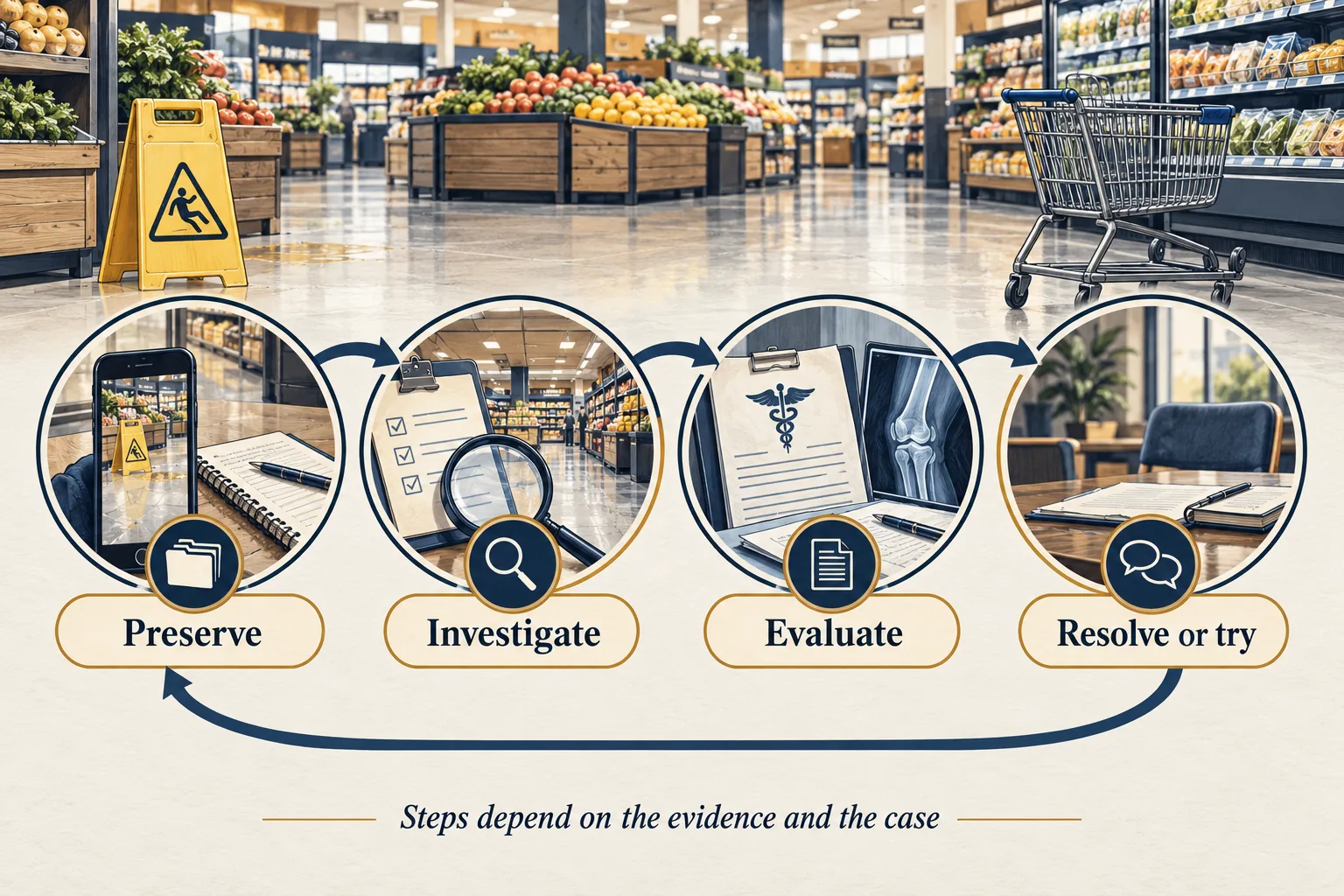
The first meeting in this made-up plan covers what could disappear first:
- the aisle video, which the store may record over
- a witness who's moving to Lubbock
- the filing date: a fall on March 3, 2026 generally means suing by March 3, 2028, though exceptions can change that S3
The investigation asks:
- What do the sweep log and the refrigeration work orders show?
- Can an expert actually answer the technical question with the data available?
Before any big expense, or a filing that rests on an untested assumption, your lawyer goes over the evidence with you.
Discovery and expert dates come from the court's scheduling order, not from this plan.
34. Research controls for Tom Thumb or Albertsons information
Albertsons, LLC v. Mohammadi came from a Houston Randalls and Johnson names Tom Thumb Stores, Inc., so a search for either company name misses the other case. S15 S16
So this guide gives no yearly count of Texas customer-fall suits against Tom Thumb or Albertsons. An honest count would need:
- documented search coverage and every operating-entity name
- state and federal dockets, with each removed case counted once
- customer falls sorted from employee claims and unrelated suits
- a list of unclassified cases and any counties left out
A search engine's hit count isn't a lawsuit statistic.
Each kind of record reaches only so far:
- A published opinion describes the record in one lawsuit.
- A retailer policy describes an intended process, once you know which version applied at which store on which date.
- A service ticket for freezer door 3 may cover one case in one building. In H-E-B, LP v. Peterson, records of roof leaks elsewhere in the store, none above the toy aisle, didn't show how long the puddle in the toy aisle had been there. S21
Insurance and other financial evidence raise their own relevance and admissibility questions. S7
Clark v. Randalls Food affirmed summary judgment after finding a preservation breach but no showing that the lost video hurt the case, and its 60-to-90-day retention procedure predates Brookshire Bros. S19
35. Common questions after a fall in a store
I didn't see what made me fall. Is that a problem?
Tell your lawyer you didn't see it, and skip the guessing. The cause may still turn up in:
- your phone photos of the floor
- the produce aisle camera
A grape or twist tie by your shoe may not show your foot touched it.
The manager wouldn't give me a copy of the report. Now what?
You have no automatic right to internal store records on the spot, and a refusal doesn't prove fault. Write down the manager's name, job title, and the time. Your lawyer can ask politely first, then use discovery after suit.
I finished my shopping after I fell. Does that hurt my claim?
It can come up, but your medical records and full timeline show how badly you were hurt. Tell your lawyer why you finished, and never hide a video of you walking afterward.
There was a wet-floor sign. Is my case over?
Not automatically. Your lawyer will want to know:
- where the sign stood and whether you could see it
- what it said
- whether it went up before you walked in or only after you fell
- whether it was meant for the spill you stepped in
In H.E. Butt Grocery Co. v. Resendez, cones counted along with mats, railings, and a non-skid floor in setting those grape displays apart from the bare linoleum in Corbin. S4 The duty that applies and the evidence decide your case, not a cone somewhere in the store.
The fall made an old back injury worse. Can I recover for that?
You may. After a careful medical review, a supported aggravation can be part of your recoverable damages. Unrelated problems you already had get separated where the evidence allows. Give your doctors the full history, such as a lumbar MRI from three years ago or a chiropractor's notes (hypothetical), and let them judge what changed. Hiding it does more damage than explaining it.
The adjuster made an offer in the first month. Should I take it?
No rule says to grab an early offer or to refuse one, and it might be fair or might not. Before deciding, get a handle on:
- the liability risk, such as whether store video survived
- your medical outlook after the orthopedic follow-up
- what the release would make you give up
- what you'd net after the fee, expenses, and reimbursement
Ask your lawyer what's still missing and how it could change the answer, especially if nobody knows yet what future care you'll need.
36. Pick the next article by what's missing from your file
Each companion article covers one piece of the legal work and what it means for you. Find the gap in your file:
- Your notes on the fall aren't written yet: The first 72 hours.
- You don't know whether the camera over the dairy case recorded you: Video preservation.
- The store says nobody knew about the water by freezer door 3: Notice and inspections.
- You caught your foot on a curled entrance mat or a stocking cart: Trip-hazard analysis.
- You aren't sure whom to sue or how to file: Defendants and filing.
- You need the sweep log or a manager's testimony: Discovery and depositions.
- An old back injury or a large hospital bill is part of the picture: Medical causation and damages.
- The store has asked the judge to end the case: Defenses and summary judgment.
- Someone has to explain a refrigeration drain or a floor test: Expert selection.
- Mediation or a trial date is on the calendar: Voir dire and trial.
The knowledge hub lists every article in one place.
Depending on what turns up, your lawyer may send a demand, file a lawsuit, narrow the fight to one disputed point, or advise you not to go forward. If you're considering Aaron Herbert, the next step is an evaluation of your own facts. Bring:
- the records you already have
- a note of what's missing, such as the video or the incident report
- your questions about how the firm would fill those gaps
You can request a case evaluation through the firm's website.
37. Before trial, someone should argue the store's side
Late in a case, someone on your lawyer's team may argue the store's side. One made-up test:
- The defense calls your knee pain degenerative. Is there a real medical alternative in the chart, or only a claim that everything over 50 is age-related?
You're better off when your lawyer can explain both positions to you straight.
Your lawyer may also keep a source ledger listing, for each point the case leans on:
- the exact page of testimony or the exhibit number
- the inference it supports
- any evidence pointing the other way
- the foundation needed to get it admitted
A technical floor inspection might run several thousand dollars, so your lawyer will weigh it against a cheaper source.
38. What to bring to your consultation
If you talk with the Law Firm of Aaron A. Herbert, P.C., mention first:
- the date of your fall, which generally starts the two-year clock under Section 16.003(a) S3
- a surgery on the calendar
- a recorded statement you gave the store's insurer
- a medical authorization or release you signed after the fall
Sort the rest by subject:
Folder | What goes in it |
|---|---|
Scene | Photos of the spill and the aisle, plus original video files |
Store and insurer | Store letters and the adjuster's emails |
Medical bills | Bills only, kept apart from doctors' notes and MRI reports |
Also bring:
- pay stubs and the work schedule for the weeks you missed
- a dated list of the fall, each doctor visit, and each adjuster letter
No consultation promises a recovery or a settlement amount.
39. What three published Tom Thumb and Randalls cases teach
Johnson v. Tom Thumb Stores, Inc., 771 S.W.2d 582 (Tex. App.—Dallas 1989, writ denied), involved a dew-slick glass light fixture set into the sidewalk about 10 feet from a Tom Thumb entrance. The plaintiff broke a hip, and a stipulated lease gave the landlord control of the common areas. The court affirmed the directed verdict for Tom Thumb, the tenant, and reversed and remanded the claim against the landlord for a new trial. That doesn't clear every tenant of every fall near an entrance, so your lawyer will check the exact spot, the lease, any work the tenant took on, and what each party did. S16
Decision | What your lawyer will investigate | What it doesn't establish |
|---|---|---|
Albertsons, LLC v. Mohammadi, 689 S.W.3d 313 (Tex. 2024) (per curiam) | Who knew about the wet floor, not just the leaking products in the cart | Approval of every conditional jury question S15 |
Johnson v. Tom Thumb Stores, Inc. | Who controlled the exact strip of sidewalk outside the entrance | Immunity for every tenant or every entrance condition S16 |
Clark v. Randalls Food, 317 S.W.3d 351 (Tex. App.—Houston [1st Dist.] 2010, pet. denied) | How much video was saved, and whether losing the rest caused prejudice | A current company video-retention policy, since its 60-to-90-day procedure is history and predates Brookshire Bros. v. Aldridge S5 S19 |
None of the three is an Aaron Herbert result. Each turned on a narrow question of proof, which is why a diagnosis alone won't carry a case, whatever the size of the retailer or the injury.
40. Water by a refrigerated case: find the source and the timing
Take a made-up fall in water at the third door of a frozen-pizza case. The spot alone doesn't say where the water came from. It could be:
- a customer's spilled iced tea
- condensation from the door
- a clogged drain line
- a defrost cycle
- some other source
Your lawyer will ask how that exact unit was running that day. A service call the following week may find a mechanical problem without showing when water reached the floor or who knew.
Records worth preserving, if they exist:
- the unit's asset tag or case number
- work orders and maintenance requests for that unit
- photos of the floor and the base of the case
- sensor or alarm records the system actually keeps
- any temperature log, which can date a defrost cycle but doesn't measure a puddle
Repair history helps only if it matches this fall:
- a request for the same unit that mentions floor water, not only a warm case
- a repair finished before the fall, or a problem that came back
41. Grape displays and the limits of the Corbin case
Corbin v. Safeway Stores, Inc., 648 S.W.2d 292 (Tex. 1983), involved a grape in front of an open, slanted, self-service bin over green linoleum, with evidence that no mat was down although Safeway's policy called for walk-off mats and Safeway knew the display carried an unusually high risk. The Texas Supreme Court reversed a directed verdict and remanded for a new trial, not a liability finding. S4
Later cases limit Corbin:
- Albertsons, LLC v. Mohammadi, 689 S.W.3d 313 (Tex. 2024): the Texas Supreme Court called Corbin an "exceptional case," usable, if at all, only where a store had a policy or practice it knew routinely created an unreasonable risk. A fall near produce still needs proof of notice. See also Brookshire Grocery Co. v. Taylor, 222 S.W.3d 406 (Tex. 2006).
- Compare H.E. Butt Grocery Co. v. Resendez, 988 S.W.2d 218 (Tex. 1999) (per curiam): two grape displays with bagged grapes, a sampling bowl recessed 5 inches, three-inch railings, a non-skid floor, mats, and warning cones set it apart from Corbin's slanted bin with no mat, and the verdict was reversed and rendered.
An attorney should review any Corbin theory against these cases before it appears in a pleading. S4 S15
Photos and notes worth getting:
- the bin's slope and how easily grapes roll over the front lip
- loose clusters or sealed bags
- the floor surface, and whether a mat lay in front of the bin
- any railing, cone, or warning sign
- whether the bin juts into the main walking path
- who set up or changed the display, and what anyone saw before the fall
A photo of last summer's watermelon display proves little about this bin. A stocker's comment that "grapes fall all the time" needs a foundation and may not show knowledge of an unusually risky arrangement.
Two made-up examples: a customer falls beside bagged grapes after a bag is torn open, or grapes keep rolling out of a sloped open bin lacking its required mat.
Neither describes a Tom Thumb or Albertsons practice, and neither set of records should be assumed to exist before discovery. If both a spill theory and a display theory are pleaded, a motion attacking either one needs a real answer with evidence, not a conclusory response. Expect your lawyer to name what has to be proved beyond a grape on the floor and to drop any allegation the investigation disproves.
42. Build a grocery evidence map before you depose the manager
In a hypothetical dairy-case fall, the sweep log sits with store management, the dairy case work orders with maintenance or an outside refrigeration vendor, the sidewalk repair records with the landlord, and the video exports and camera clock settings with technology staff.
A closing shift lead who worked that day can describe what that person saw. The same witness usually can't explain how the video system or the work-order software works.
When the company has to send a witness, Rule 199.2(b)(1) requires the notice to describe each topic "with reasonable particularity," such as the lane 4 cameras. S6
For a made-up fall at self-checkout lane 4, your lawyer may ask for:
- register transaction records that narrow the time of the fall
- the station number and the employee assigned to watch it
- the cameras that covered that lane
- a narrow, redacted export of other shoppers' data, under a protective order where needed
Your lawyer also keeps a contradiction list. In a made-up example:
- the cleaning log shows a 3:30 p.m. inspection
- video shows an employee walking past while an endcap blocked the view of the floor
- the work-order system shows a task opened, then closed out later
An innocent explanation is possible, so your lawyer gets the system's definitions of "inspected" and "closed" before calling any record falsified.
43. Turn the record into a compensation presentation that holds up
Four documents sit behind a settlement number in a made-up dairy case puddle claim:
- an element map with a source named beside each element
- a medical chronology from the ER visit forward, with the 2023 back records in a separate column
- an expense ledger showing the $2,300 paid, not the $9,600 billed, under Tex. Civ. Prac. & Rem. Code §41.0105 S8
- a net recovery worksheet: a gross scenario minus the contract fee, case costs, and the health plan's reimbursement claim
If you talk with the Law Firm of Aaron A. Herbert, P.C., ask:
- how the dairy case condition would be investigated
- how the store's notice defense would be answered
- who handles preservation, client calls, expert decisions, and trial work
Representation and referral terms come from the actual agreement, not from an educational article.
44. Mohammadi demands precision about the danger and the knowledge
Albertsons, LLC v. Mohammadi, 689 S.W.3d 313 (Tex. 2024) (per curiam), assumed without deciding that the claimant, who worked at the bank inside a Houston Randalls, was an invitee. It is not a finding about any Tom Thumb store. S15
Video and testimony were unclear on important points, and an inconclusive video seemed to show an employee placing a wet plastic bag in the cart. The Court focused on the wet floor: proof that products in the cart were leaking did not show the store actually knew about the puddle. An employee may have had reason to check on a risk without the record showing awareness of the specific puddle that caused the fall. Constructive knowledge is a separate question, and on that one the jury had answered "No." S15
In a hypothetical milk leak, your lawyer would prove four facts separately, each from its own source:
- the product's condition: a receipt or label identifying the leaking jug
- liquid on the floor, and where, before the fall: a customer who noticed the wet floor by register 5 before anyone went down
- what an employee knew: a radio log or text about the leak that a witness can authenticate
- time to respond: radio and camera timestamps for that same spot
When your lawyer talks with the employee who handled the damaged goods, expect questions like these:
- Where was the cart parked?
- What could be seen underneath it?
- Was there a trail of drips?
- What happened next?
A damaged-goods policy points to records and employees, but it does not show actual knowledge of the specific puddle. Your lawyer sorts each item from the milk leak file into three piles:
- proven fact: a timestamped radio call about the leak
- inference: an employee passing the cart minutes before the fall
- lead: a second camera angle to request
A lead is not proven corporate knowledge.
45. Getting a question to the jury takes a request and the proof behind it
In Mohammadi, the charge made the actual-knowledge question depend on the constructive-knowledge answer. The jury answered "No" on constructive knowledge and never reached the other question. The Supreme Court assumed the charge was wrong, held the error harmless because the record had no evidence of actual knowledge, and reinstated a take-nothing judgment. S15
The charge is the list of questions the judge gives the jury. Before trial, your lawyer works out:
- each knowledge theory the evidence supports, such as actual knowledge of a leak at freezer door 3 (hypothetical)
- the evidence that justifies submitting each theory
- any proposed conditioning instruction that could keep the jury from ever reaching a theory
- the applicable Texas procedure and current pattern instructions, fitted to the issues actually pleaded and tried
- timely, specific requests and objections, and the judge's rulings needed to preserve the issue S6 S7
A pattern instruction is a tool, not a substitute for judgment.
If the judge keeps out evidence about knowledge, your lawyer makes an offer of proof through the proper procedure. It covers:
- what the evidence was, such as a stocker's radio call about the leak in a made-up case
- why it was offered
- how admitting it could have changed the jury's findings, beyond the fact that it helped
A complaint about the charge can't supply evidence that never made it into the record. Submission, admissibility, and harm get weighed together, though each has its own requirements.
46. Use Johnson to investigate shopping-center boundaries
Johnson v. Tom Thumb Stores, Inc., 771 S.W.2d 582 (Tex. App.—Dallas 1989, writ denied), involved a dew-slick glass light fixture set into the sidewalk about 10 feet from the Tom Thumb entrance. The plaintiff broke a hip. The stipulated lease gave the landlord control of the common areas. The court affirmed a directed verdict for Tom Thumb, the tenant, and reversed and remanded the claim against the landlord for a new trial. S16
The case points your lawyer to three things:
- the lease language
- who actually controlled the spot
- exactly where the fall happened compared with the leased space
A different entrance, a different job someone took on, or a different source of danger can change the analysis. Your lawyer should read the whole opinion instead of quoting one tenant-friendly line.
After a fall outside the front doors, expect your lawyer to preserve a site plan marking:
- the store threshold and the walkway
- the fixture and the parking lane
- every camera
Then come the people and papers:
- repair tickets and complaint emails for the glass fixture
- the cone-setter's name, whether a porter or a contractor's crew member
- a confidentiality agreement, if the landlord asks for one
- the appraisal district listing, which gives the lot's owner and says nothing about upkeep
- the ownership and maintenance contracts in force on the fall date
In a hypothetical fall on the way to curbside pickup, a person walking to the front doors and a customer waved over to pickup space 4 may stand in different legal positions. Your lawyer documents:
- the directions an employee gave
- painted routes and work on site that day
- whether a delivery driver was shopping for another company's customers or working as a contractor
47. An auditable dashboard for a grocery fall case
This guide has no verified yearly Texas fall rate or settlement average, so a dashboard counts evidence. Six of eight identified sources in hand is 75 percent complete by count, not 75 percent likely to win.
In Wal-Mart Stores, Inc. v. Spates, a six-pack ring had been on the floor behind an employee for 30 to 45 seconds, and the Texas Supreme Court said that wasn't enough to show the store should have found it. S2
Checks before a made-up entry goes up:
- camera 7 runs two minutes slow, so its 2:49 p.m. frame is really 2:51
- a witness's "around 3" goes in as a window, 2:50 to 3:10
- an inspection logged for 2:30 p.m. was typed in at 4:10 p.m.
- a stretch with no inspection doesn't by itself prove the spill sat there the whole time
- a puddle first seen at 2:41 p.m. says nothing about when the spill started
- a verified response at 2:52 p.m. doesn't by itself prove the delay was unreasonable
Sources
S1 Aaron Alan Herbert, State Bar of Texas attorney profile (Board Certified, Personal Injury Trial Law, Texas Board of Legal Specialization). Read source.
S2 Wal-Mart Stores, Inc. v. Reece, 81 S.W.3d 812 (Tex. 2002); Wal-Mart Stores, Inc. v. Spates, 186 S.W.3d 566 (Tex. 2006). Read source.
S3 Tex. Civ. Prac. & Rem. Code §§ 16.001, 16.003, 16.072 (limitations; disability; weekend and holiday extension). Read source.
S4 Corbin v. Safeway Stores, Inc., 648 S.W.2d 292 (Tex. 1983); compare H.E. Butt Grocery Co. v. Resendez, 988 S.W.2d 218 (Tex. 1999) (per curiam), and Albertsons, LLC v. Mohammadi, 689 S.W.3d 313 (Tex. 2024); Brookshire Grocery Co. v. Taylor, 222 S.W.3d 406 (Tex. 2006). Read source.
S5 Brookshire Bros., Ltd. v. Aldridge, 438 S.W.3d 9 (Tex. 2014). Read source.
S6 Texas Rules of Civil Procedure. Read source.
S7 Texas Rules of Evidence, amendments effective July 2, 2026. Read source.
S8 Tex. Civ. Prac. & Rem. Code § 41.0105 (medical expenses actually paid or incurred). Read source.
S9 Tex. Civ. Prac. & Rem. Code §§ 18.001-18.002 (medical expense affidavits). Read source.
S10 28 U.S.C. §§ 1332, 1441, 1446, 1447 (diversity jurisdiction and removal). Read source.
S11 Federal Rules of Civil Procedure and Federal Rules of Evidence. Read source.
S12 Tex. Civ. Prac. & Rem. Code §§ 33.001, 33.003, 33.012 (proportionate responsibility). Read source.
S13 Austin v. Kroger Texas, L.P., 465 S.W.3d 193 (Tex. 2015). Read source.
S14 Tex. Civ. Prac. & Rem. Code ch. 15, including § 15.002 (venue). Read source.
S15 Albertsons, LLC v. Mohammadi, 689 S.W.3d 313 (Tex. 2024) (per curiam). Read source.
S16 Johnson v. Tom Thumb Stores, Inc., 771 S.W.2d 582 (Tex. App.—Dallas 1989, writ denied). Read source.
S17 Supreme Court of Texas, Misc. Docket No. 26-9012 (amendments to Texas Rule of Civil Procedure 166a). Read source.
S19 Clark v. Randalls Food, 317 S.W.3d 351 (Tex. App.—Houston [1st Dist.] 2010, pet. denied). Read source.
S21 H-E-B, LP v. Peterson, No. 24-0310 (Tex. Apr. 10, 2026). Read source.
S22 Keetch v. Kroger Co., 845 S.W.2d 262 (Tex. 1992). Read source.
S23 United Scaffolding, Inc. v. Levine, 537 S.W.3d 463 (Tex. 2017). Read source.